What if your financial reporting wasn’t just a record of the past, but a real-time data engine built to fuel your next funding round? For many founders, managing the accounting for SaaS startups Singapore feels like a constant battle against IFRS 15 revenue recognition and the manual headache of syncing Stripe data with Xero. We know the anxiety that comes with ACRA and IRAS compliance, especially when you’re trying to scale a digital service in a market projected to hit USD 1.4 billion this year.
We agree that you shouldn’t have to choose between building your product and keeping your books clean. It’s frustrating when manual data entry eats up your time or when tax deadlines feel like a looming threat rather than a routine process. This guide will show you how to master revenue recognition, automate your finance stack, and stay fully compliant with 2026 regulations, including the 40% Corporate Income Tax rebate. We’ll walk you through a logical progression from fixing your data flow to achieving a strategic, investor-ready financial setup that supports your long-term growth.
Key Takeaways
- Discover why cash-basis accounting falls short for subscription models and how to apply the IFRS 15 five-step model for accurate revenue recognition.
- Build a high-efficiency finance stack by automating the data flow between payment gateways like Stripe and your Xero ledger to simplify accounting for SaaS startups Singapore.
- Navigate ACRA and IRAS compliance with confidence by understanding the specific filing timelines and tax incentives designed for the tech sector.
- Unlock the strategic value of your books by learning how to calculate investor-ready metrics like MRR directly from your financial records.
- Learn when to scale your operations by moving from basic bookkeeping to a collaborative partnership that provides strategic CFO-level insights.
Mastering SaaS Revenue Recognition under Singapore Standards
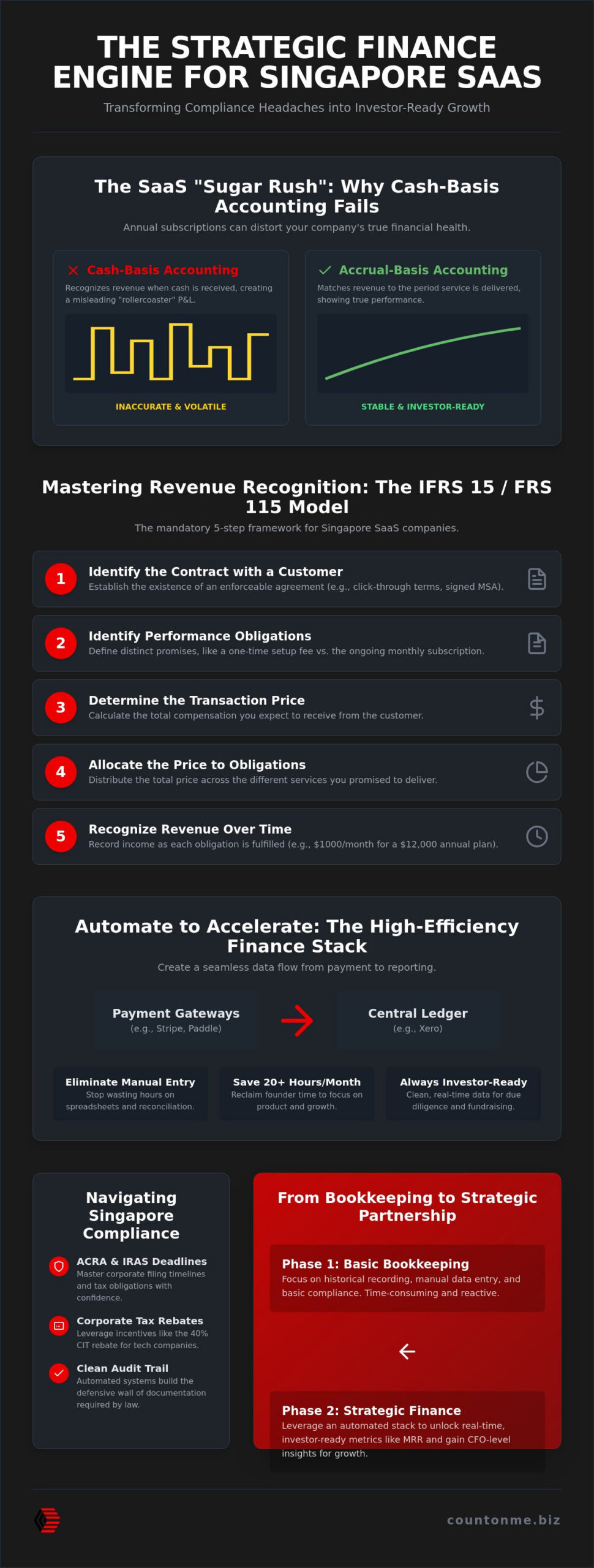
Many founders see a large annual subscription payment hit their bank account and celebrate. It’s a great feeling, but from an accounting perspective, that money isn’t yours to claim yet. Using cash-basis accounting often leads to a distorted view of your company’s health. You might look incredibly profitable in January when annual renewals come in, only to look like you’re bleeding cash in February. For proper accounting for SaaS startups Singapore, we move away from “cash in hand” to accrual-based reporting.
SaaS revenue recognition is the process of matching income to the period service is delivered. This ensures your Profit and Loss statement reflects the actual work you’re doing for customers each month. To get this right, you need to follow SaaS revenue recognition principles defined by IFRS 15. In Singapore, this is known as FRS 115; it’s the standard IRAS expects you to follow as you scale. This involves balancing deferred revenue, which is money received for services not yet provided, against accrued revenue, which is service provided but not yet billed.
The Five-Step Model for Singapore SaaS
To stay compliant, you must apply a structured approach to every dollar that enters your business. First, identify the contract with your customer, whether it’s a digital click-through or a signed enterprise agreement. Next, you must identify specific performance obligations. For example, a one-time setup fee might be recognized immediately, while a monthly subscription is recognized over time. We then determine the transaction price and allocate it across those obligations. This level of detail is what makes accounting for SaaS startups Singapore different from traditional retail. It transforms your books from a simple list of transactions into a strategic map of your earned value.
Common Pitfalls in Revenue Timing
The most frequent trap is the “sugar rush” of annual upfront payments. If you recognize a $12,000 annual payment all in month one, your growth metrics will look fantastic for thirty days and then vanish. This creates a rollercoaster P&L that scares off investors. Instead, that $12,000 belongs on your balance sheet as a liability (deferred revenue) and should be moved to income at $1,000 per month. You also need a clear system for handling refunds, credits, and chargebacks. If a customer cancels mid-year, your system must automatically adjust the remaining deferred revenue to ensure your books remain clean for future fundraising rounds. These are among the most common startup accounting mistakes Singapore founders make when managing subscription revenue without professional guidance. We help you build these workflows so your financial data stays accurate without manual intervention.
Building Your Digital Finance Stack: Automating SaaS Workflows
Scaling a subscription business means managing thousands of micro-transactions that would overwhelm a traditional bookkeeper. If you’re still manually entering invoices from Stripe or trying to reconcile Paddle payouts in a spreadsheet, you’re losing hours that should be spent on product-market fit. Modernizing your approach to accounting for SaaS startups Singapore begins with moving away from manual data entry and toward a fully integrated digital engine. It’s about creating a system where data flows seamlessly from your payment gateway to your ledger without human intervention.
Xero has become the gold standard for Singapore tech companies because of its open API and robust ecosystem. It acts as the central hub for your entire financial operation, allowing you to plug in specialized tools as your needs evolve. To understand the full scope of these tools, our complete guide to cloud accounting services in Singapore (2026) explores how specific integrations can save you up to twenty hours of admin work every month. This foundation ensures that your books are always “investor-ready” rather than a mess you have to clean up right before a Series A pitch.
Automation also ensures you stay on the right side of local regulations. As your transaction volume grows, maintaining a clean audit trail becomes a legal necessity. This is particularly relevant when you consider the record-keeping requirements outlined in the IRAS guide to corporate income tax. By automating your expense management, you aren’t just saving time; you’re building a defensive wall of documentation that makes annual tax filings a non-event. We believe that the best accounting for SaaS startups Singapore is the kind that happens in the background while you focus on growth.
The Stripe-to-Xero Integration Guide
Connecting Stripe or Paddle to Xero is the most impactful move you can make. The key is mapping your sales tax correctly; with Singapore’s GST rate at 9% in 2026, errors in global tax calculation can lead to significant compliance risks. You can use specialized connectors or middleware like Zapier to sync every subscription renewal as an individual invoice. This automates the bank reconciliation process, matching the net deposit in your bank account with the gross sales and processing fees automatically. It’s a level of precision that manual entry simply can’t match.
Choosing the Right SaaS-Friendly Tools
When building your operational stack, it is helpful to look at how successful platforms in specific niches manage their workflows. For instance, if you are developing a solution for the hospitality sector, you can check out CCM Pedidos to see how they handle the complexities of restaurant orders and delivery management.
Beyond software for payroll and reconciliation, founders can leverage specialized vendors to support their operational growth. For example, The CEO Creative offers a way to build business credit through net-30 accounts for office essentials and custom branding materials.
Your stack should extend beyond just sales. For remote or hybrid teams, payroll automation tools that sync directly with your ledger are essential for managing CPF contributions and monthly salaries. We also recommend digital receipt capture tools to eliminate paper clutter and ensure every business expense is accounted for in real-time. This setup feeds into real-time dashboards, giving you instant visibility into your burn rate and runway. If you’re looking to build this kind of high-performance setup, our Startups Package is designed to get your digital finance stack running from day one.
Navigating ACRA and IRAS Compliance for Tech Founders
Compliance in Singapore is designed to be business-friendly, but for a fast-moving SaaS, it’s easy to miss the details. While your automated stack handles the daily data, you still need to meet specific statutory milestones. For instance, your Estimated Chargeable Income (ECI) must be filed within three months of your financial year end. Missing these windows can lead to unnecessary penalties that drain your runway. This level of strategic planning is central to effective accounting for SaaS startups Singapore, ensuring you stay focused on product development rather than paperwork.
Tax planning is where your financial setup shifts from a cost center to a value driver. For the Year of Assessment 2026, eligible companies can access a 40% Corporate Income Tax rebate, capped at S$30,000. Additionally, the Start-Up Tax Exemption (SUTE) scheme remains a powerful tool for early-stage growth. It offers a 75% exemption on your first S$100,000 of chargeable income, providing a significant cash flow boost during those critical first three years. When we manage accounting for SaaS startups Singapore, we prioritize these exemptions to keep more capital inside your business.
If your taxable turnover exceeds S$1 million in a 12-month period, GST registration becomes mandatory. For SaaS founders, this includes managing the “reverse charge” on imported digital services. If you’re paying for global tools like AWS or HubSpot, you may need to account for GST on these expenses even if the vendor doesn’t charge it directly. Under the 2026 mandate, any new GST-registered business must use InvoiceNow-ready software, making your choice of a digital-first partner even more vital for seamless reporting. Overlooking these GST obligations is one of the most costly startup accounting mistakes Singapore tech founders make during their growth phase.
ACRA and the Corporate Secretary Role
Maintaining statutory registers isn’t just a legal chore; it’s about keeping your cap table clean for future investors. We help you manage these digital-first requirements, from filing annual returns seven months after your financial year end to documenting board resolutions. While private companies can often dispense with holding physical Annual General Meetings (AGMs), you still need a structured process to ensure your ACRA filings accurately reflect your share structure and directorships. This transparency is exactly what venture capitalists look for during due diligence.
Maximizing R&D Tax Incentives
Software development is often the biggest expense for a startup, and much of it may qualify for R&D tax incentives. Identifying qualifying activities, such as developing new algorithms or improving technical architecture, can lead to substantial tax savings. You need to document these tech costs meticulously to satisfy IRAS requirements. By working with a professional partner to categorize these expenses correctly, you can reclaim thousands in early-stage capital that would otherwise be lost to taxes, effectively extending your burn rate without giving up more equity.
Tracking SaaS Metrics: Beyond the Standard P&L
Standard statutory accounts are designed to satisfy ACRA and IRAS, but they rarely give you the full picture of your unit economics. While a traditional Profit and Loss statement tells you how much money you spent, it doesn’t tell you how efficiently you’re growing. For investors looking at accounting for SaaS startups Singapore, the value lies in your ability to translate ledger data into actionable metrics. If you can’t prove your Monthly Recurring Revenue (MRR) or your Customer Acquisition Cost (CAC) with hard data, you’ll struggle during due diligence.
Your ledger is the single source of truth for these numbers. By using the accrual-based revenue recognition we discussed earlier, your MRR becomes a direct reflection of your earned income rather than just cash collection. We help you bridge the gap between “accounting” and “analytics” by tagging transactions at the source. This allows you to see the true Lifetime Value (LTV) of your customers by matching their subscription history against the support and server costs required to keep them. With SaaS funding in Singapore reaching $258 million by April 2026, the competition for capital is high; having these metrics ready is your best advantage.
Translating Bookkeeping into SaaS Intel
To get a clear view of your gross margin, you must strictly separate Cost of Goods Sold (COGS) from Operating Expenses (OpEx). For a SaaS startup, COGS includes hosting fees, third-party software integrated into your product, and direct customer success costs. Everything else, like marketing and general admin, belongs in OpEx. This distinction is vital for tracking your “Burn Rate” correctly. We create reports that show you exactly how many months of runway you have left based on your current net burn, giving you the clarity needed to time your next raise perfectly.
Investor-Ready Financial Reporting
When you’re preparing for a Seed or Series A round, your books need to be beyond reproach. Investors expect IFRS-compliant statements that show a clean historical record without “messy” founder-led accounting shortcuts. This often requires a historical data clean-up to fix past errors in revenue timing or expense categorization. Many founders find that using on-demand CFO Singapore services provides the strategic layer needed to interpret these metrics for VCs. If you’re ready to turn your bookkeeping into a growth engine, our On-demand CFO Services can help you navigate the complexities of investor reporting.
Scaling Your SaaS with Strategic Accounting Support
There comes a point in every founder’s journey where spreadsheets and DIY fixes no longer cut it. You might find yourself spending five hours a week chasing receipts or feeling a knot in your stomach when an IRAS letter arrives. Making the switch to professional accounting for SaaS startups Singapore isn’t just about offloading admin work; it’s about reclaiming your time to focus on product-market fit. When your financial data is handled by experts, your books transform from a compliance chore into a strategic asset that helps you make faster, more confident decisions.
We believe that your finance function should be a competitive advantage. While a basic bookkeeper might just record what happened last month, a specialized partner looks ahead. By using our Startups Package, you get a system built for the specific nuances of the subscription economy. This includes handling the high volume of micro-transactions we discussed in the automation section and ensuring your revenue recognition is always investor-ready. It’s about building a foundation that can support a 10x growth spurt without breaking.
As you scale toward a Series A or beyond, the complexity of your financial needs will evolve. This is where financial advisory for startups Singapore provides high-level strategy without the overhead of a full-time executive hire. We help you interpret the metrics from the previous section, like CAC and LTV, to determine exactly when to hit the gas on your marketing spend. Having a seasoned pro in your corner gives you the quiet confidence to navigate board meetings and due diligence with ease.
The Count On Me Approach for SaaS
Our methodology is rooted in being a digital innovator. We don’t just provide a service; we build a collaborative partnership. We use a tech-forward approach centered on Xero to ensure your data is always real-time and accessible. Because we have over 20 years of experience, we know how to bridge the gap between rigid statutory requirements and the fluid nature of tech startups. We value human relationships over mere transactions, positioning ourselves as an ally who is as invested in your success as you are.
Your Next Steps to Financial Clarity
Getting your finances in order doesn’t have to be a painful process. Start by assessing the health of your current stack. Are you still manually reconciling payments? Is your revenue recognition a guessing game? We invite you to set up a consultation to explore a customized package that fits your current stage of growth. Moving to a professional partnership offers a sense of relief and stability, knowing that your compliance is airtight and your growth strategy is backed by clean data. If you’re ready to move from basic bookkeeping to strategic growth, our Cloud Accounting & Bookkeeping team is here to lead the way.
Turning Your Financial Engine Into a Growth Driver
You’ve built a product that users love; now it’s time to build a financial foundation that investors will respect. We’ve walked through the essentials of mastering IFRS 15 revenue recognition and automating your Stripe-to-Xero workflows to eliminate manual errors. The goal isn’t just to stay compliant with ACRA and IRAS, but to transform your ledger into a real-time data engine that fuels your decision-making. When you have total clarity over your MRR and burn rate, you can lead your team with a sense of relief and stability.
Navigating the specific nuances of accounting for SaaS startups Singapore is a collaborative journey, not a solo mission. With over 20 years of professional expertise and a team of Xero-certified cloud accounting experts, we’re here to provide the tailored support that Singapore tech founders need to thrive. We bridge the gap between basic bookkeeping and high-level strategy, ensuring your books are always ready for that next big funding round. It’s about more than just numbers; it’s about building a partnership that values your success as much as you do.
Ready to scale? Explore our Startup Accounting Packages today.
Your vision deserves a financial setup that can keep pace with your innovation. We’re excited to see what you build next.
Frequently Asked Questions
Does my SaaS startup need to be GST registered in Singapore?
GST registration is mandatory if your taxable turnover exceeds S$1 million over a 12-month period. You can also choose to register voluntarily if it benefits your business, such as reclaiming GST on your input costs. Keep in mind that for 2026, the GST rate is 9% and all new registrants must use InvoiceNow-ready software. This helps you stay compliant with IRAS digital standards while streamlining your reporting.
How is SaaS revenue recognized under IFRS 15?
SaaS revenue is recognized through a five-step model that matches income to the period when your performance obligations are met. Instead of recording a full annual payment upfront, you must allocate the transaction price and recognize it over the duration of the service contract. This ensures your financial statements provide a transparent view of your actual earned revenue rather than just your cash flow fluctuations during high renewal months.
What is the best accounting software for SaaS companies in Singapore?
Xero is widely considered the best foundation for accounting for SaaS startups Singapore due to its robust API and ecosystem of integrations. It allows you to connect directly with payment gateways like Stripe and automated expense tools. This setup creates a seamless data flow that reduces manual entry. It makes it much easier to maintain clean, investor-ready books as your subscription volume scales across global markets.
Can I claim R&D tax incentives for software development in Singapore?
You can claim R&D tax incentives if your software development involves resolving technical uncertainties or creating innovative new algorithms. Qualifying activities often include building proprietary technical architecture rather than just routine coding or bug fixing. By meticulously documenting your tech costs, you can potentially reclaim significant capital through tax savings. This effectively extends your runway without needing additional equity funding or sacrificing more of your company.
What are the ACRA filing deadlines for a new startup?
Most private companies must file their annual return with ACRA within seven months after their Financial Year End (FYE). You are also required to file your Estimated Chargeable Income (ECI) with IRAS within three months of your FYE. Staying on top of these milestones is essential for maintaining your company’s good standing. It helps you avoid late filing penalties that can distract you from your core mission of growing the business.
How do I handle multi-currency transactions in my SaaS accounting?
Handling multi-currency transactions is best managed through cloud accounting tools that offer real-time exchange rate syncing. When you bill global customers in USD or EUR, your system should automatically calculate the equivalent in SGD based on the transaction date. This prevents foreign exchange gains or losses from becoming a hidden mess in your ledger. It ensures your reporting remains accurate across all markets while providing a clear picture of your global revenue.
Why should a SaaS founder hire a fractional CFO?
Hiring a fractional CFO allows you to access high-level financial strategy and investor-readiness support without the cost of a full-time executive. A fractional partner helps you interpret complex metrics like LTV and CAC while ensuring your accounting for SaaS startups Singapore remains robust. They act as a strategic mentor. This helps you navigate fundraising rounds and board meetings with the quiet confidence of a seasoned professional who understands your journey.
What is the Startup Tax Exemption (SUTE) scheme?
The SUTE scheme provides a 75% tax exemption on your first S$100,000 of chargeable income and a 50% exemption on the next S$100,000 for your first three consecutive years. This is a powerful incentive designed to help new companies reinvest their profits back into scaling. To qualify, your company must be incorporated in Singapore and have no more than 20 shareholders. It is a critical tool for preserving early-stage capital.