
What if the hours you spend manually matching GrabFood receipts to your POS are actually costing you more than the delivery commissions themselves? We know the feeling. Between managing the 9% GST rate and handling high staff turnover, keeping your head above water in Singapore’s competitive dining scene is a constant juggle. It’s exhausting to watch thin margins get squeezed by rising food costs while you’re stuck behind a spreadsheet instead of being on the floor with your team.
We’re here to help you move past the paperwork. This guide is designed to help you master bookkeeping for F&B Singapore, transforming your back office from a source of stress into a strategic tool for growth. We’ll walk you through automating your sales reconciliation, tracking food costs in real-time, and staying ahead of 2026 IRAS and ACRA requirements. You’ll gain the visibility you need to protect your margins and the peace of mind that comes with knowing your compliance is handled. Let’s look at how digital workflows can give you back your time and your confidence.
Key Takeaways
- Learn how to automate the complex process of reconciling daily POS sales with delivery platform payouts and digital payment gateways.
- Navigate 2026 compliance requirements with ease, from managing the 9% GST rate to calculating accurate CPF contributions for your entire team.
- Gain a competitive edge by mastering prime cost analysis, giving you real-time visibility into how food and labor costs impact your bottom line.
- Discover how expert bookkeeping for F&B Singapore can replace manual data entry with automated workflows that free you up to focus on your customers.
- Identify your exact daily breakeven point to make informed, confident decisions about staffing, menu pricing, and business expansion.
Why F&B Bookkeeping in Singapore is a Different Beast in 2026
In the world of business, F&B is a unique animal. Unlike a consultancy that sends out two invoices a month, your restaurant or cafe manages hundreds of micro-transactions every single day. We define standard methods of bookkeeping as the baseline; however, for a Singaporean eatery in 2026, the real work lies in managing high-volume, low-value transactions across several different channels. You have walk-ins, GrabFood orders, and perhaps a catering wing all feeding into one bank account.
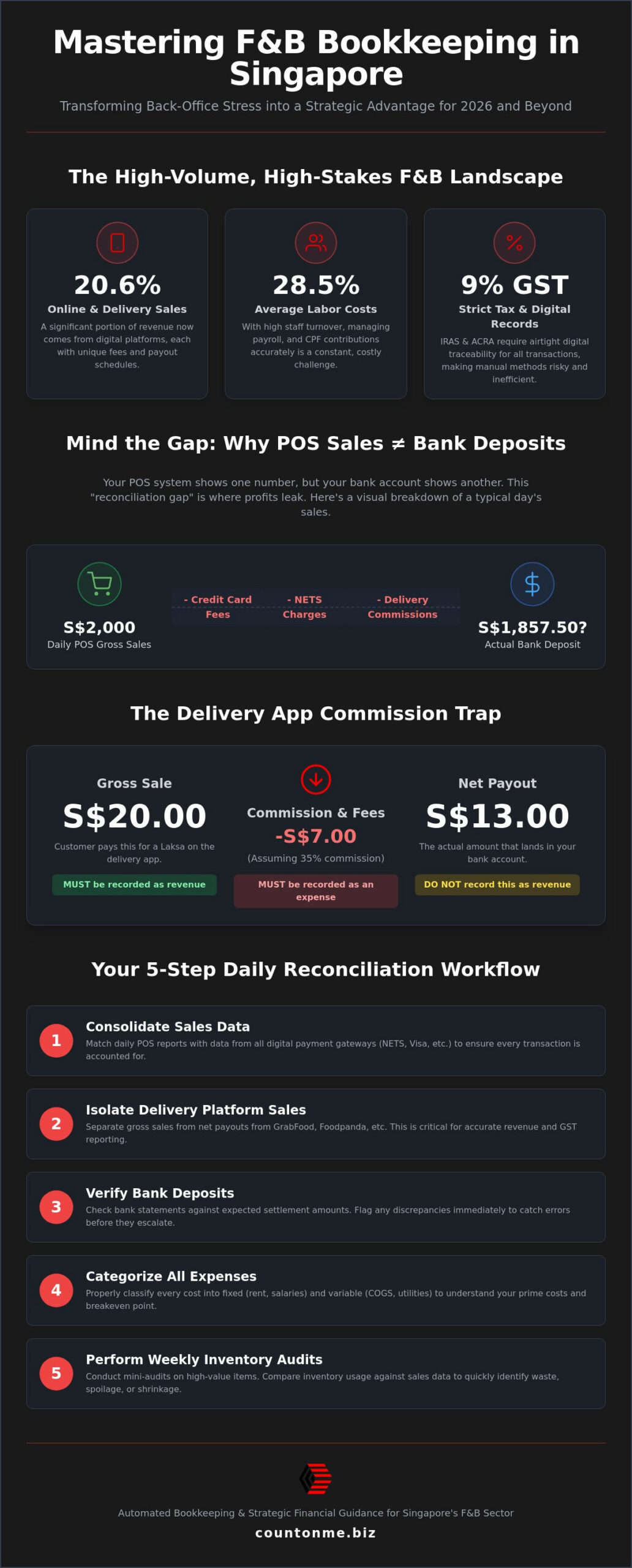
Singapore’s dining culture has shifted permanently. We’ve moved toward a cashless, delivery-first environment where online sales now constitute 20.6% of the total F&B turnover. With 90% of fast-food outlets using kiosks and 35% of restaurants adopting QR-code ordering, your financial data is coming from every direction at once. If you’re still waiting until the end of the year to hand over a shoebox of receipts to an accountant, you’re flying blind. In a high-cost environment where labor takes up an average of 28.5% of operating costs, that delay is often the reason why many local restaurants fail. Effective bookkeeping for F&B Singapore requires a proactive, digital-first mindset.
The High-Volume Transaction Challenge
Have you ever noticed that your POS report says you made S$2,000, but your bank statement shows a different figure? That’s the reconciliation gap. Between merchant fees for NETS and credit cards and the varying commission structures of delivery platforms, your actual cash on hand rarely matches your gross sales. To help mitigate these costs, some owners look into models like credit card processing with surcharge program to recover transaction fees, a strategy that is becoming more common globally. Tracking these tiny discrepancies is essential for your survival. Daily reconciliation is the only way to catch leakage or payment errors before they turn into major losses.
Regulatory Evolution: ACRA and IRAS in 2026
Compliance isn’t what it used to be. IRAS and ACRA now require much higher levels of digital traceability for every transaction. With the GST rate at 9% and a registration threshold of S$1 million, your records need to be airtight. You can’t just show a total; you must prove where every cent came from. This is why we advocate for Cloud Accounting & Bookkeeping. It ensures you’re always audit-ready and allows for real-time visibility that traditional paper-based systems simply can’t provide. Modern bookkeeping for F&B Singapore is about using these digital tools to build a transparent, stress-free financial foundation.
Mastering the Daily Sales and Delivery Reconciliation Workflow
Closing the day shouldn’t feel like a detective mission. We’ve all been there, staring at a POS report that doesn’t quite match the numbers in the bank account. The reality of modern bookkeeping for F&B Singapore is that cash is no longer king. Instead, you’re managing a digital stream of NETS, credit cards, and delivery app payouts. To keep your finances healthy, you need a methodical workflow that catches errors before they become expensive habits.
- Step 1: Consolidate your daily POS data with reports from your digital payment gateways. This ensures every swiped card is accounted for.
- Step 2: Isolate delivery platform gross sales from the net payouts. You need to see the “real” revenue before the delivery apps take their cut.
- Step 3: Verify your bank deposits against these “expected” settlement amounts. Banks and gateways sometimes have different settlement cycles; don’t let a missing S$50 slip through the cracks.
- Step 4: Categorize every expense into fixed costs, like rent, and variable costs, such as your Cost of Goods Sold (COGS).
- Step 5: Perform weekly “mini-audits” of your high-value inventory. Comparing what you sold to what is actually left in the chiller is the fastest way to spot shrinkage or waste.
The Delivery App Headache: Grab, Foodpanda, and Deliveroo
When you sell a S$20 laksa through a delivery app, you don’t actually see S$20. Between commissions that typically range from 25% to 35% and various promotion offsets, your net payout is significantly lower. A common mistake is reporting the net payout as your total revenue, which completely distorts your margins. You must record the gross sale and then account for the commission as a marketing or distribution expense. This keeps your revenue figures accurate for GST reporting. If you’re unsure how to handle taxes on these service fees, the Official IRAS GST guide for F&B provides clarity on how to treat commissions and service charges.
Inventory Management and COGS Tracking
Your bookkeeping should tell you more than just what’s in the bank; it should tell you if your menu is actually profitable. Since Singapore imports over 90% of its food, you’re vulnerable to global price spikes. Tracking your COGS ratio every month allows you to see if a specific ingredient is eating your profits. If your food costs are creeping up while your sales stay flat, it’s time to re-evaluate your suppliers or your pricing. We often use our On-demand CFO Services to help owners interpret these ratios, turning raw data into a strategy for menu engineering that protects your bottom line. It’s about moving from reactive recording to proactive management.
Singapore Compliance: GST, CPF, and Staff Payroll for F&B
Running a kitchen is hard enough without worrying if your payroll calculations are keeping you on the right side of the law. In 2026, the regulatory environment for bookkeeping for F&B Singapore has become more digitized and precise. Between the 9% GST rate and the updated CPF ceilings, there’s very little room for manual error. We’ve seen how the stress of an unexpected IRAS audit or a CPF late-payment penalty can take the joy out of the business. These risks are entirely manageable with the right systems in place.
If your annual taxable turnover exceeds S$1 million, GST registration is mandatory. For many growing cafes, this is a major milestone, but it also adds a layer of complexity to your daily bookkeeping for F&B Singapore. You aren’t just collecting 9% on every coffee; you’re also managing input tax credits on your supplies. A common headache for F&B owners is distinguishing between business entertainment and staff meals when claiming input tax. Getting this wrong can trigger red flags, which is why we emphasize clear documentation for every transaction from day one. Before committing to a DIY accounting app, it’s worth understanding the cloud accounting service vs software Singapore debate, as the right choice can significantly reduce your compliance risk and manual workload. If you’re also evaluating the overall cost of financial support for your business, our guide to affordable accounting services Singapore SMEs and startups can rely on breaks down how to get compliant, strategic support without overpaying.
Your team is likely a mix of full-timers, students, and part-time workers. Each group has different CPF contribution obligations for employers that you must calculate accurately every month. As of 1 January 2026, the Ordinary Wage ceiling has reached S$8,000, meaning your contributions for senior staff may have increased. Don’t forget the Foreign Worker Levy (FWL) either. It’s a significant monthly cash flow item that needs to be accrued for correctly so you aren’t hit with a surprise bill at the end of the month.
Automated Payroll for High-Turnover Teams
High staff turnover is a reality in Singapore’s F&B sector. While platforms like Shiftify help streamline the onboarding and training process for new hires, manually calculating pro-rated salaries, overtime pay for rest days, and CPF for a rotating roster is a recipe for disaster. Integrating your time-tracking software with our Payroll Management Solutions ensures that your team is paid correctly and on time, every time. Failing to make CPF contributions by the 14th of the following month can lead to interest charges and potential fines, so automation isn’t just a convenience, it’s a safeguard for your business license.
GST Filing for Restaurants
Modern POS systems in 2026 are built to handle the nuances of F&B tax, but they still need to talk to your accounting software. Cloud-based tools can automate your quarterly GST F5 filings by pulling data directly from your sales and expenses. This reduces the risk of human error and ensures that your input tax claims, like those for imported ingredients, are fully optimized. It’s about having a system that works as hard as your front-of-house team to keep the business moving forward.
Strategic Financial Insights: Moving Beyond the Ledger
Recording your sales and paying your staff is just the baseline. If you want to thrive in Singapore’s competitive culinary landscape, you need to use your financial data as a compass. Many owners feel like they’re working harder than ever, yet the bank balance doesn’t seem to reflect the effort. This usually happens because the focus is on the “what” of the past rather than the “how” of the future. By evolving your approach to bookkeeping for F&B Singapore, you can unlock insights that tell you exactly where your money is going and how to keep more of it.
One of the most critical metrics we track is your Prime Cost. This is the sum of your Cost of Goods Sold (COGS) and your labor costs. In Singapore, where labor accounts for an average of 28.5% of operating expenses, keeping your Prime Cost under 60% is often the difference between a profitable month and a loss. When you have this data at your fingertips, you can perform a daily breakeven analysis. You’ll know exactly how many covers you need per shift just to stay in the green, allowing you to make real-time decisions about staffing levels or promotional “happy hour” pushes.
We also look at menu engineering to identify your “Stars” and your “Dogs.” Stars are the dishes that are both highly popular and highly profitable. Dogs, on the other hand, are low-margin items that don’t sell well. Using your bookkeeping data to spot these trends helps you refine your offerings, ensuring every inch of your menu is working for your bottom line.
Leveraging Cloud Data for Margin Optimization
The days of waiting for a monthly report are over. We’ve moved into an era where integrated cloud ecosystems allow for “proactive” management. By using Cloud Accounting & Bookkeeping, your POS data flows directly into your ledger, giving you a real-time dashboard of your performance. Ditching manual spreadsheets for these automated workflows means you catch margin dips the week they happen, not three months later when it’s too late to course-correct.
The Fractional CFO Advantage for F&B
As you grow from a single cafe to multiple outlets, the complexity of your finances scales too. This is often when owners transition to our On-demand CFO Services. A fractional CFO doesn’t just look at the books; they help you negotiate better terms with suppliers by showing them your volume data. They also ensure your financial statements are “investor-ready” for when you want to pitch for expansion funding or secure a bank loan for a new central kitchen. If you’re ready to stop guessing and start growing based on hard data, reach out to us to discuss our On-demand CFO Services today.
Choosing the Right Partner: Why Count On Me for F&B
Your business is built on passion, flavor, and community. We believe your financial support should be built on the same foundations. At Count On Me, we don’t just act as another external vendor you hear from once a quarter. Instead, we position ourselves as your internal finance department. We’re here to share the load, offering the quiet confidence you need to manage the daily chaos of a busy kitchen. Effective bookkeeping for F&B Singapore is about more than just balancing numbers; it’s about building a partnership that values your success as much as you do.
We’re digital innovators at heart. We specialize in creating seamless ecosystems between your POS system and cloud platforms like Xero or QuickBooks. This tech-forward approach eliminates the manual data entry that often leads to errors in sales reconciliation or inventory tracking. By automating the repetitive tasks, we give you back the time to focus on what matters: your food and your customers. Our pricing is designed to be as transparent as our communication. We offer scalable solutions, so you only pay for the specific support your business needs as it grows from a single stall to a nationwide brand.
The Startups Package for New F&B Concepts
Launching a new cafe or restaurant is a whirlwind of licensing, renovation, and menu tasting. It’s easy for administrative tasks to fall through the cracks. Our Startups Package is designed to catch those details for you. We help you set up your chart of accounts correctly from Day 1, ensuring your GST and CPF tracking is compliant before you even serve your first customer. Beyond the ledger, we handle your incorporation and corporate secretary requirements, reducing the heavy administrative burden on first-time founders so you can focus on your launch.
Ready to Scale? Let’s Talk
When you’re ready to open your second or third outlet, the complexity of your financial reporting changes. You need consolidated views to understand which locations are performing and where your margins are thinning. We provide the high-level bookkeeping for F&B Singapore necessary for multi-outlet expansion, including specialized Tax Compliance & Advice to navigate the 2026 landscape. We’re here to provide the stability you need to grow with peace of mind. If you’re tired of the spreadsheet shuffle and ready for a more collaborative approach, book a consultation with our F&B specialists today. Let’s build something great together.
Ready to Turn Your Back Office into a Growth Engine?
Managing a restaurant in Singapore is a feat of endurance and passion. We’ve explored how modernizing your back office does more than just satisfy a regulator. It gives you the real-time clarity needed to protect your margins and the automated workflows to handle complex delivery reconciliations without the late-night stress. By mastering your prime costs and staying ahead of 2026 GST and CPF requirements, you’re building a business that’s resilient and ready for the next outlet.
Effective bookkeeping for F&B Singapore doesn’t have to be a solitary struggle. At Count On Me, we bring over 20 years of industry experience and a specialized F&B tech-stack integration to your team. As Xero Certified Advisors, we’re here to bridge the gap between high-level expertise and friendly, personalized support. We’re invested in your success as much as you are.
If you’re ready to ditch the manual spreadsheets for real-time visibility, we’re here to guide you. Get a customized F&B bookkeeping quote from Count On Me and let’s start a conversation about your future. You focus on the food; we’ll handle the stability. Let’s grow together.
Frequently Asked Questions
Do I need a specialized accountant for a small cafe in Singapore?
Yes, having a partner who understands the unique rhythm of the hospitality industry is a major advantage. F&B businesses deal with high-volume, low-value transactions and specific inventory challenges that generalist accountants might overlook. Specialized bookkeeping for F&B Singapore ensures your accounts are set up to track delivery commissions and food wastage accurately from day one, giving you a much clearer picture of your actual margins.
How do I handle GrabFood and Foodpanda commissions in my books?
You should always record the gross sales amount as your revenue and then list the commission as a separate distribution or marketing expense. Avoid the common mistake of only recording the net payout you receive in your bank account. Recording the full transaction ensures your GST reporting is compliant and allows you to see exactly how much these platforms are costing your business each month.
Is it better to use Xero or QuickBooks for a restaurant business?
Both platforms are excellent, but we often recommend Xero for Singaporean eateries due to its extensive ecosystem of F&B-specific integrations. It connects seamlessly with popular local POS systems and inventory tools, allowing for automated data flow. The best choice ultimately depends on your existing tech stack and which interface feels more comfortable for your team to use for daily tasks.
How often should I reconcile my F&B bank accounts?
Daily reconciliation is the best practice for any food business. Because you’re managing multiple payment modes like NETS, credit cards, and various delivery apps, errors can bury themselves quickly. Checking your settlements daily allows you to spot missing payments or terminal errors immediately, rather than trying to solve a month-old mystery during your end-of-period closing.
What are the common ACRA filing mistakes for F&B SMEs?
The most frequent errors include missing the annual return deadlines and failing to update changes in corporate secretarial details, such as new directors or address changes. Many SMEs also struggle with inaccurate financial statements because their internal records don’t match their bank balances. Keeping your books “audit-ready” throughout the year makes the ACRA filing process a simple, stress-free formality rather than a last-minute rush.
Can I manage my own F&B bookkeeping using just my POS system?
Your POS is a powerful tool for tracking sales, but it isn’t a substitute for a full accounting system. While a POS tells you what you sold, it doesn’t track your supplier debts, bank balances, or CPF obligations. You need a dedicated cloud accounting platform to integrate your sales data with your expenses to understand if your business is actually making a profit.
How does the 2026 GST rate impact my menu pricing?
With the GST rate at 9%, you must ensure your displayed prices are inclusive of tax according to IRAS regulations. This higher rate puts additional pressure on your margins, so it’s a good time to review your menu engineering. Many owners use this transition to slighty adjust prices or find ingredient efficiencies to ensure their take-home profit doesn’t shrink as tax obligations rise.
What staff-related costs should I include in my Labor Cost calculations?
To get an accurate figure, you must include gross salaries, employer CPF contributions, and the Foreign Worker Levy (FWL). Don’t forget to account for staff insurance, medical reimbursements, and any recruitment costs. Accurate bookkeeping for F&B Singapore requires looking at these “fully loaded” costs to calculate your true prime cost, which is essential for making smart decisions about your operating hours and staffing levels.