
What if the most expensive member of your team isn’t a person, but the manual data entry error that triggers an ACRA filing delay or an IRAS audit? It’s a question many business owners in the Lion City are asking as they move toward 2026. You likely started your business to innovate and serve customers, not to get buried under complex CPF regulations or spend your weekends squinting at spreadsheets to find your actual cash flow. We understand that the pressure to stay compliant while managing costs is a heavy lift, especially when traditional finance departments feel out of reach for a growing company.
This article explores how digital finance transformation Singapore is helping SMEs automate their most tedious tasks and unlock the real-time insights needed to scale efficiently. You’ll discover how to leverage cloud-based automation to eliminate human error and gain a clear view of your financial health. We’ll walk through the strategic shifts coming in 2026, showing you how to build a modern, tech-forward finance function that supports your vision without the high overhead of a full-time department.
Key Takeaways
- Understand why integrating technology into your accounting and payroll is becoming a survival requirement for Singapore businesses heading into 2026.
- Learn how digital finance transformation Singapore leverages AI to handle routine tasks like bank reconciliation, freeing you to focus on strategic growth.
- Follow a practical five-step roadmap that starts with a deep-dive audit to identify and fix the specific bottlenecks slowing your business down.
- Discover why combining modern software with professional governance reduces overhead and provides better stability than a traditional in-house finance team.
What is Digital Finance Transformation in the Singapore SME Context?
For a typical Singapore SME, digital finance transformation isn’t about buying the same complex software suites used by multi-national corporations. It’s about the practical integration of technology to automate your accounting, tax, and payroll workflows. We see it as a journey from just keeping records to using those records to make better business decisions. By 2026, digital finance transformation Singapore will be a core requirement as the government pushes for a fully digital economy.
Achieving this level of integration often requires a holistic view of your operations, which is why many businesses partner with growth-focused consultancies like contentfactory.biz to oversee their digital transformation journey.
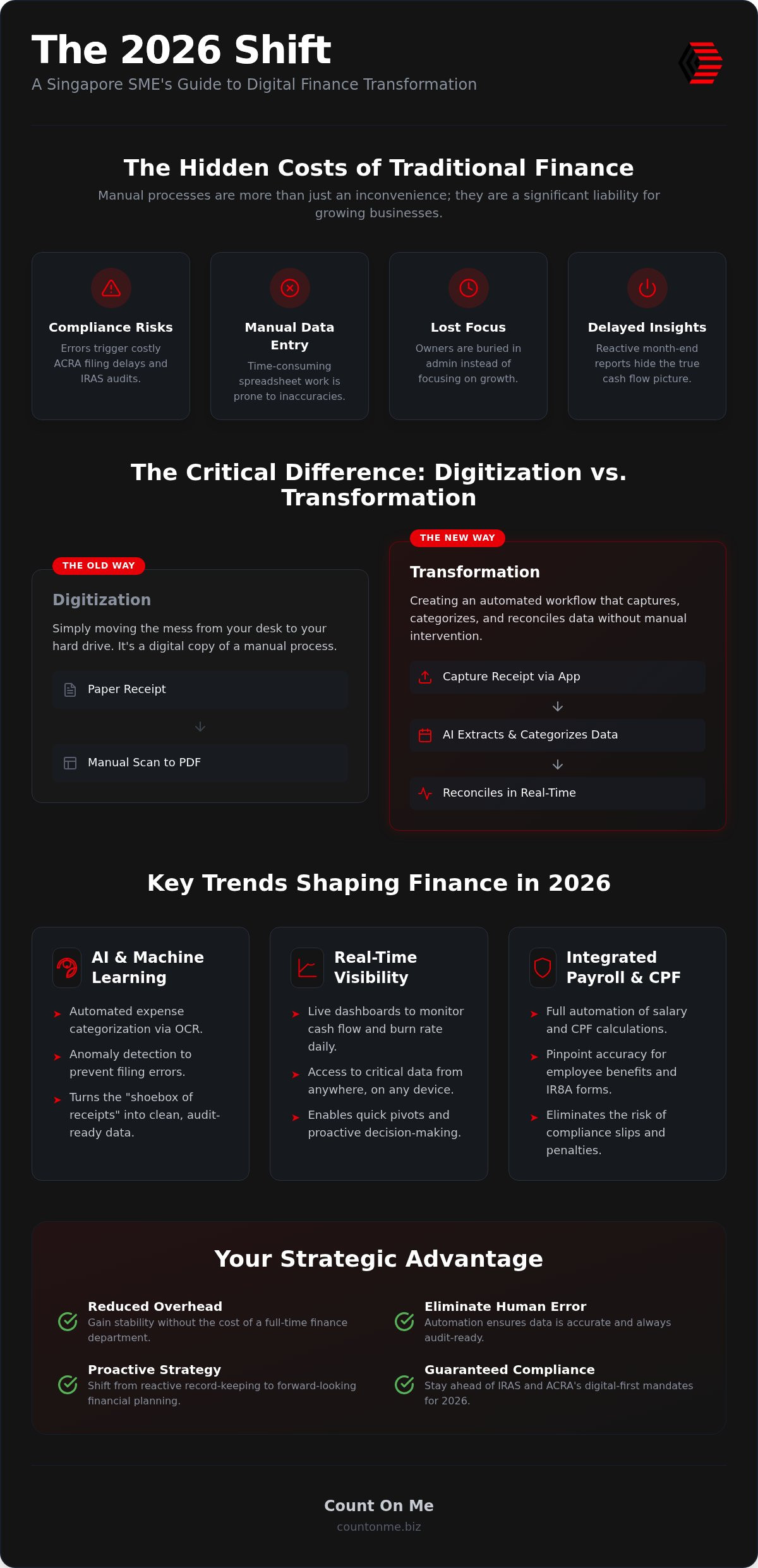
There’s a big difference between digitization and true transformation. Digitization is simply scanning a paper receipt into a PDF; it’s just moving the mess from your desk to your hard drive. Transformation is setting up an automated workflow where that receipt is captured, categorized, and reconciled against your bank statement without you lifting a finger. Digital finance transformation is the shift from reactive record-keeping to proactive financial strategy.
Moving Beyond Traditional Bookkeeping
We’ve all been there, staring at a spreadsheet on a Friday night, trying to figure out why the numbers don’t add up. Manual bookkeeping is slow and leaves too much room for human error, which can lead to major headaches during ACRA or IRAS submissions. When you switch to cloud accounting services Singapore, you create a foundation of accuracy. You stop worrying about lost receipts and start looking at real-time data that tells you exactly where your cash is going.
The Regulatory Push: ACRA and IRAS Digital Mandates
Singapore’s Smart Nation initiatives aren’t just for tech giants. They’re designed to make our entire business ecosystem more efficient. IRAS and ACRA are rapidly moving toward digital-first filing requirements. If you’re still relying on manual processes, you’re at a much higher risk for late filing penalties or compliance gaps. 2026 is a tipping point because these digital mandates will become the standard, making manual systems a liability rather than just an inconvenience. Embracing a digital finance transformation Singapore strategy ensures you stay on the right side of regulations while keeping your overhead low.
Key Trends Shaping Finance Transformation in 2026
The landscape of digital finance transformation Singapore is shifting from simple cloud storage to intelligent, interconnected systems. In 2026, the most successful SMEs won’t just be “on the cloud.” They’ll be using integrated ecosystems where accounting, payroll, and tax compliance talk to each other in real time. This move away from siloed software reduces the friction that usually slows down business owners. It’s about building a finance function that feels like a supportive engine rather than a heavy anchor.
AI and Machine Learning in Everyday Accounting
AI is no longer a futuristic concept for large corporations; it’s a daily tool for the modern Singaporean entrepreneur. Optical Character Recognition (OCR) has turned the “shoebox of receipts” into a relic of the past. Modern tools now automatically categorize expenses and detect anomalies in your ledger before they become filing errors. We help our clients automate accounting Singapore by implementing these smart tools, ensuring your data is clean and audit-ready without the manual grind.
The Rise of Real-Time Financial Visibility
Waiting for a month-end report to see if you’re profitable is like driving a car while only looking at the rearview mirror. By 2026, real-time visibility is the standard. Digital dashboards now allow you to monitor your cash flow and burn rates daily. This immediate access to data means you can pivot quickly, whether that’s doubling down on a profitable product line or cutting unnecessary costs before they impact your bottom line. Cloud-based platforms ensure you have this clarity anywhere, whether you’re in the office or at a meeting across town.
Integrated Payroll and CPF Automation
Payroll is often the most stressful part of the month for small teams. The trend for 2026 is full automation of salary disbursements and CPF contribution calculations. Integrated systems now ensure that employee benefits and IR8A forms are handled with pinpoint accuracy. This level of digital finance transformation Singapore removes the risk of compliance slips that lead to penalties. If you’re ready to stop manual calculations, our Payroll Management Solutions can help you bridge the gap between traditional methods and modern efficiency.
Building Your Transformation Roadmap: A Practical Guide
We know that a total overhaul feels like a lot. You have a business to run, and “transformation” sounds like a full-time project you simply don’t have time for. However, a successful digital finance transformation Singapore is built on small, purposeful steps that don’t disrupt your daily operations. We advocate for a phased approach that addresses your biggest headaches first, allowing you to see immediate relief without the stress of a sudden, total change.
Here is a simple, five-step roadmap to get you started:
- Step 1: The Internal Audit. Identify where you’re wasting time on manual data entry or chasing receipts.
- Step 2: Gap Analysis. Determine if your current tools handle local requirements like CPF and GST.
- Step 3: Solution Selection. Pick the tools or partners that fit your specific industry and growth goals.
- Step 4: Phased Migration. Move one function at a time, such as payroll first, then your general ledger.
- Step 5: Ongoing Optimization. Regularly review your data to find new ways to automate and save time.
Auditing Your Current Financial Tech Stack
It starts with an honest look at your “messy middle.” You need to examine every spreadsheet, every manual entry, and every recurring delay that keeps you up at night. This audit is the foundation of any successful digital finance transformation Singapore project. If your current system doesn’t automatically handle Singapore-specific tax and payroll rules, it’s a bottleneck, not a tool. Many founders struggle with the choice between a cloud accounting service vs software Singapore. The right choice depends on whether you want to manage the tools yourself or have an expert guide you through the process.
Selecting Scalable Cloud Solutions
When you’re in the early stages, it’s tempting to pick the cheapest software available. But as you grow, those basic tools often break or require expensive workarounds. We suggest prioritizing ease of use, integration capabilities, and local support. For budget-conscious founders, there are plenty of affordable accounting services Singapore that provide high-end tech without the high-end price tag. Remember: the best software is the one that scales with your headcount.
Build your scalable finance roadmap with Count On Me
The Strategic Advantage of Partnering for Transformation
While software provides the engine for digital finance transformation Singapore, you still need a skilled navigator at the wheel. We’ve seen many business owners invest in high-end tools only to find themselves stuck with “garbage in, garbage out” data because the underlying processes weren’t sound. A partnership with a digital-first firm offers you a sense of relief and stability that software alone cannot provide. You get the benefit of professional governance and years of industry experience without the high cost of a traditional full-time finance department.
This collaborative approach ensures that your technology is working for you, not the other way around. By outsourcing to experts who live and breathe digital workflows, you reduce your overhead while increasing your accuracy. It’s about combining the speed of modern tech with the steady hand of a seasoned mentor who understands the stresses of business management; for example, Co-Advisor provides this type of high-level advisory to help industrial entrepreneurs translate their financial data into sustainable growth.
Why Technology Requires Professional Governance
Automated systems are incredibly efficient, but they don’t understand the nuances of Singapore’s regulatory environment. A machine might categorize an expense correctly, but it won’t notice a missing document required for a specific tax deduction. Professional oversight ensures your ACRA filings and tax compliance are handled with precision. We act as your digital innovators, bridging the gap between traditional accounting foundations and modern, automated tools. This means you don’t just have data; you have data you can actually trust to make big moves.
Scaling with On-Demand CFO Support
The true power of digital finance transformation Singapore is realized when you move from simply keeping the books to actively growing your business. This is where an on-demand CFO becomes your most valuable ally. By using the real-time data generated by your automated systems, a fractional CFO provides the strategic advice usually reserved for large corporations. You’ll gain insights into your unit economics, expansion feasibility, and long-term cash flow health. If you’re ready to shift your focus from administrative tasks to strategic leadership, exploring an on demand CFO Singapore guide is the logical next step for your journey.
Steer Your Business Toward a Smarter Financial Future
Moving your business toward 2026 requires more than just new software; it requires a shift in how you view your financial health. We’ve discussed how moving away from manual data entry and embracing real-time visibility allows you to make decisions based on facts rather than guesswork. By integrating your accounting, payroll, and tax compliance into a single automated ecosystem, you build a foundation that is both robust and flexible.
Embracing digital finance transformation Singapore ensures your company stays compliant with evolving digital mandates while reducing the high cost of traditional finance departments. Our team of seasoned professionals brings over 20 years of experience to the table, offering a tech-forward approach to local regulations. We specialize in providing affordable, scalable solutions that grow alongside your startup, ensuring you always have the support you need.
Ready to modernize your finance function? Explore our Cloud Accounting and Advisory services
You have the vision to grow your business, and we have the tools to help you get there. Let’s work together to turn your finance function into a powerful engine for success.
Frequently Asked Questions
What is the first step in digital finance transformation for a small business?
The first step is conducting a thorough audit of your manual workflows to identify where bottlenecks occur. You need to pin down exactly where your team spends too much time, whether it’s chasing receipts or manually reconciling bank statements. Once you understand these pain points, you can prioritize which functions to automate first, ensuring your digital finance transformation Singapore journey starts with immediate value and clear goals.
Is digital finance transformation expensive for Singapore startups?
No, digital transformation is highly scalable and often more cost-effective than maintaining traditional manual systems. Startups can choose cloud-based tools that offer subscription models, allowing you to pay only for what you need as you grow. This approach eliminates the high overhead of hiring a full-time finance department while still providing you with professional-grade tools and the real-time financial visibility needed to scale efficiently.
How does digital transformation help with ACRA and IRAS compliance?
Digital transformation automates the data collection process, which significantly reduces the risk of human error in your tax and corporate filings. Many cloud platforms feature direct integrations with government portals, making ACRA and IRAS submissions more streamlined and accurate. This proactive approach ensures your records are always audit-ready and helps you avoid the stress and costs associated with late filing penalties or compliance gaps.
Can digital finance tools help manage CPF contributions more accurately?
Yes, integrated payroll management solutions automatically calculate CPF contributions based on the latest regulatory rates and employee details. These tools handle the complex math for you, ensuring that both employer and employee portions are accurate every month. This level of digital finance transformation Singapore removes the guesswork and manual calculation errors that often lead to compliance issues with the Central Provident Fund Board.
What is the difference between a cloud accounting software and a digital finance service?
Cloud accounting software is the technology platform itself, while a digital finance service provides the professional governance and strategic oversight needed to use that tool effectively. Think of the software as the engine and the service as the navigator. A digital-first firm helps you set up workflows, interpret data, and ensure your business remains compliant with local regulations through expert guidance and personalized support.
What happens if my business doesn’t digitize its finance functions by 2026?
Businesses that remain manual risk falling behind as Singapore’s digital mandates move toward mandatory digital-first filing requirements. You’ll likely face higher operational costs, increased risks of filing errors, and a lack of real-time data to compete effectively in a fast-paced market. By 2026, staying manual might not just be an inconvenience; it could become a significant barrier to scaling and maintaining your regulatory standing.