
Have you ever opened a “standard” service invoice only to find it’s doubled because of unexpected “per-signature” or “per-filing” charges? It’s a common frustration for many SME owners who expect a simple partnership but end up decoding confusing jargon and hidden costs. We understand that you’re looking for stability, not a monthly guessing game with your compliance budget. You want to focus on your next big milestone, not worry about whether a missed ACRA deadline will result in a penalty because of a communication breakdown.
You deserve a clear view of what you’re paying for and why it matters for your company’s standing. Understanding corporate secretarial services fees Singapore shouldn’t require a law degree or a magnifying glass. We believe that when you have a predictable cost structure, you can stop worrying about compliance and start focusing on your strategic growth. In this 2026 transparency guide, we’ll help you navigate the complexities of provider pricing. We will break down the differences between mandatory government levies and service provider charges, identify the red flags in service agreements, and show you how to find a compliant, cost-effective solution that fits your business perfectly.
Key Takeaways
- Understand the three pillars of secretarial pricing, including professional retainers, ACRA government fees, and ad-hoc charges, to build a transparent compliance budget.
- Compare different pricing structures to identify corporate secretarial services fees Singapore that provide your business with fixed-cost certainty and zero hidden surprises.
- Identify how specific business complexities, like foreign ownership or intricate shareholding structures, directly impact your service pricing and KYC requirements.
- Learn how to select a partner who speaks your digital language, ensuring your statutory records and cloud accounting work together for maximum efficiency.
- Gain the confidence to navigate mandatory ACRA requirements, turning a regulatory necessity into a stable foundation for your company’s growth.
Decoding Corporate Secretarial Services Fees: What Are You Paying For?
Section 171 of the Singapore Companies Act is very clear: every company must appoint a qualified secretary within six months of incorporation. This isn’t just a suggestion or a piece of bureaucratic red tape. It’s a legal mandate. Think of your corporate secretary as the guardian of your company’s legal standing. They ensure your business remains a “going concern” in the eyes of the government. Without this role filled, you risk fines, summons, and even the striking off of your company. It’s a non-negotiable expense, but it doesn’t have to be a confusing one.
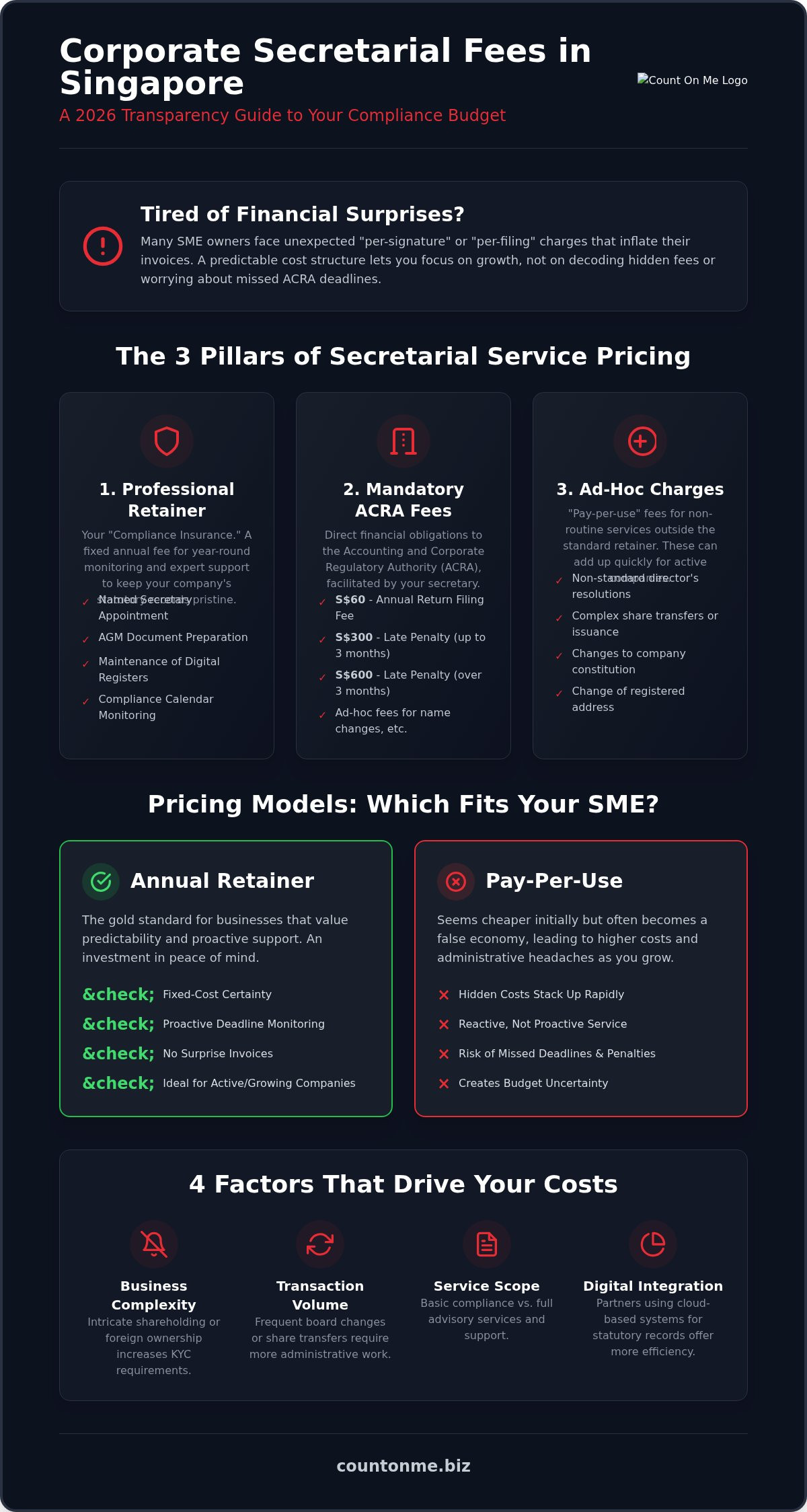
When you evaluate corporate secretarial services fees Singapore, you’re looking at three distinct pillars: professional retainers, ACRA government fees, and ad-hoc charges. A corporate secretarial retainer is a fixed fee for year-round compliance monitoring. We often call this “Compliance Insurance.” While a “pay-as-you-go” model might seem cheaper on day one, it often leads to missed deadlines and reactive stress. Having a dedicated partner means someone is always watching the calendar for you.
Mandatory ACRA Government Fees
Every private limited company has a direct financial obligation to the Accounting and Corporate Regulatory Authority (ACRA). The most common cost is the S$60 annual return filing fee. It’s a small amount, but the timing is everything. If you miss your filing window, ACRA imposes a late lodgement penalty of S$300 for delays up to three months. If you wait longer than that, the fine jumps to S$600. You’ll also encounter ad-hoc government fees if you decide to change your company name, update your directors, or issue new shares. These are standard costs that your secretary facilitates on your behalf.
The Professional Secretary Retainer
Your professional retainer fee covers the expertise and administrative work required to keep your statutory records pristine. This includes the formal appointment of a “Named Secretary,” which is a prerequisite for opening corporate bank accounts and signing official contracts. Understanding the structure of corporate secretarial services fees Singapore helps you see that you’re paying for more than just a name on a form. At Count On Me, we use a cloud-based approach to maintain your digital statutory registers, ensuring they are always accurate and accessible. A typical retainer includes:
- Maintenance of the Register of Controllers and Register of Nominee Directors.
- Preparation of documents for your Annual General Meeting (AGM).
- Drafting standard directors’ resolutions for routine matters.
- Ongoing monitoring of your company’s compliance calendar.
By choosing a fixed annual fee model, you gain predictability. You won’t have to worry about a surprise invoice every time you ask a quick compliance question or need a standard resolution drafted.
Annual Retainer vs. Pay-Per-Use: Which Pricing Model Fits Your SME?
Choosing how to pay for your company’s compliance is just as important as the service itself. In the Singapore market, you’ll generally find two paths: the fixed annual retainer and the pay-per-use (or ad-hoc) model. While the latter might look attractive on a spreadsheet because of its low entry point, it’s often a false economy for a growing business. When you evaluate corporate secretarial services fees Singapore, you have to look beyond the initial quote and consider your 12 month roadmap. If you plan to scale, the “cheap” per-item model can quickly become a administrative headache.
When the Annual Retainer Wins
The annual retainer is the gold standard for businesses that value predictability and proactive support. It’s particularly effective for companies with multiple shareholders or an active board of directors where resolutions are frequent. With a retainer, you aren’t just paying for filings; you’re paying for a partner who keeps a watchful eye on your compliance calendar. This model usually includes a set number of routine resolutions and changes at no extra cost, which means your annual budget remains stable even if you move offices or update your board. It provides that “peace of mind” factor, ensuring you never miss an ACRA deadline because someone forgot to check the calendar.
The Risks of the Pay-Per-Use Model
The pay-per-use model can be a pitfall for startups that underestimate their administrative needs. While a S$50 fee for a change of address or a S$100 fee for a share transfer sounds manageable, these costs stack up rapidly. More importantly, this model creates a transactional relationship. If you don’t specifically ask for a service, your provider might not act, leaving you vulnerable to the late filing penalties we discussed earlier. Most established firms in Singapore steer clients toward retainers because it encourages better governance and prevents compliance gaps that often occur in “on-demand” arrangements. Inconsistent billing also makes cash flow management difficult, as you can’t always predict when a corporate change will be necessary.
To decide which is right for you, look at your upcoming year. Are you planning to raise funds, add new directors, or change your shareholding structure? Each of these triggers an ACRA filing and professional documentation. If your business is active, a fixed-fee approach is almost always the more cost-effective and stress-free choice. You can explore how our corporate secretarial retainers provide the fixed-fee stability your SME needs to grow without surprise costs.
5 Factors That Drive Corporate Secretarial Costs Up (or Down)
Not every SME is built the same, so it makes sense that corporate secretarial services fees Singapore vary based on your specific company DNA. While a “one-size-fits-all” price might seem appealing, it often fails to account for the actual work required behind the scenes. Understanding these variables helps you have a more honest conversation with your service provider and avoids those frustrating “out of scope” invoices. Efficiency matters. When comparing corporate secretarial services fees Singapore, you’ll notice that firms using digital statutory registers can often offer more competitive, fixed-fee retainers because they’ve eliminated the friction of paper-based systems.
Ownership Structure and KYC Complexity
If your company is owned by another corporate entity or has foreign directors, your compliance requirements are naturally higher. Know Your Customer (KYC) regulations require providers to conduct extensive background checks on all beneficial owners, which directly increases the administrative hours needed to onboard and maintain your account. Foreign directors often require extra verification steps to ensure they meet residency requirements, especially if you need a Nominee Director. This isn’t about charging more for the sake of it; it’s about the rigorous due diligence required to keep your company in good standing with Singapore authorities.
Get a transparent quote for your secretarial needs
Additional Compliance Deliverables
Your annual filing is just the tip of the iceberg. If you are fundraising or undergoing a major restructuring, your board minutes become significantly more complex. These aren’t just simple templates; they are legal records that must accurately reflect high-stakes decisions. Additionally, if your company doesn’t have a physical office in Singapore, you’ll need a Registered Office Address service. This ensures that all official government correspondence is received and processed promptly, preventing missed notices from ACRA or IRAS.
You should also consider if your company is required to file financial statements in XBRL format. This is where secretarial duties often overlap with accounting, and a partner who understands both can prevent costly data silos. While some firms charge a “tech premium” for digital tools, a truly modern partner uses technology to drive efficiency, passing those time savings back to you. Complexity doesn’t have to mean confusion. Whether you’re managing a simple cap table or a multi-layered shareholding structure, the goal is always clear, predictable governance.
Choosing a Partner: Beyond the Price Tag
Finding a partner who understands your vision is just as critical as finding a competitive price. While you’ve likely spent time comparing corporate secretarial services fees Singapore, the real value lies in how that partner supports your daily operations. A reactive provider who only files documents when prompted can actually cost you more in the long run through missed opportunities or administrative friction. You need a mentor who proactively identifies compliance needs before they become urgent problems. It’s about building a relationship where your secretary is an ally in your growth, not just a line item in your expenses.
The Synergy of Integrated Services
When your corporate secretary speaks the same digital language as your accountant, your business gains a massive efficiency boost. Centralizing your data through Cloud Accounting & Bookkeeping ensures that changes in your financial structure are immediately reflected in your statutory records. This unified view prevents the classic “founder’s burden” of having to repeat information to multiple vendors. For a deeper dive into how these roles intersect and protect your company, you can refer to The Essential Guide to Corporate Secretary Services in Singapore (2026). By centralizing these functions, you reduce the risk of data silos and ensure that your tax, accounting, and secretarial filings are always in sync.
Your Transparency Checklist for 2026
Before you sign a service agreement, verify that the corporate secretarial services fees Singapore quoted are truly all-inclusive. A transparent partner will be open about their fee structure and won’t hide behind complex jargon. Use this checklist to evaluate your potential partner:
- Unlimited Resolutions: Does the retainer include unlimited standard resolutions for routine changes like address updates or director appointments?
- Government Fee Clarity: Are ACRA filing fees clearly identified so you know exactly what goes to the government versus the provider?
- Digital Access: Do you get 24/7 cloud access to your statutory registers and company documents?
- Proactive Reminders: Does the provider offer automated reminders for filing deadlines to avoid those S$300 or S$600 penalties?
Transitioning to a digital-first partner like Count On Me is simpler than you might think. we handle the heavy lifting of the transfer process, including the coordination with your previous provider. This allows you to focus on scaling your business with the confidence that your compliance is in safe, seasoned hands. We believe in providing the relief and stability you need to lead your company forward.
Empowering Your SME with Compliance Certainty
We’ve explored how understanding the three pillars of secretarial costs can transform your compliance from a source of stress into a stable foundation for growth. By choosing a fixed annual retainer over a transactional pay-per-use model, you ensure your business stays ahead of ACRA deadlines while maintaining predictable costs. Finding the right balance for corporate secretarial services fees Singapore is about prioritizing transparency and long-term value over the lowest initial sticker price. You deserve a partner who acts as a digital ally, integrating your statutory duties with your financial health to prevent costly errors.
With over 20 years of seasoned experience, we specialize in helping startups and SMEs navigate these complexities through a seamless, cloud-based approach. We’re here to handle the heavy lifting of compliance so you can focus on scaling your vision with total peace of mind.
Get a Transparent Quote for Your Secretarial Needs
Your business journey is unique, and we’re ready to provide the stable, supportive partnership you need to reach your next milestone. Let’s build something great together.
Frequently Asked Questions
Is it mandatory to have a corporate secretary in Singapore?
Yes, every company incorporated in Singapore must appoint a corporate secretary within six months of its start date. This is a legal requirement under the Companies Act to ensure your business stays compliant with local regulations. If you’re a sole director, you cannot act as your own secretary, so you’ll need to appoint a resident individual. Having this professional in place protects you from the administrative oversight that often leads to heavy ACRA penalties.
Can I change my corporate secretary if I’m unhappy with the fees?
You can certainly switch providers if you feel your current corporate secretarial services fees Singapore don’t align with the value you’re receiving. The transition is usually seamless. Your new partner will prepare the necessary resignation and appointment resolutions and notify ACRA on your behalf. We recommend looking for a digital-first provider who can migrate your physical records into a cloud-based system, making your future compliance management much more efficient and transparent.
Are ACRA filing fees included in the secretarial service retainer?
In most cases, ACRA filing fees are billed separately from your professional retainer. For example, the standard S$60 fee for filing an Annual Return is a government levy that your secretary pays on your behalf. It’s best to clarify this early to avoid surprises. A transparent agreement will clearly distinguish between the professional expertise you’re paying for and the mandatory pass-through costs that go directly to the Singapore government authorities.
What are the typical ‘hidden’ fees in a secretarial contract?
Watch out for “per-item” charges that aren’t mentioned in the initial quote. Common hidden costs include fees for every director’s resolution, charges for printing and couriering physical documents, or surcharges for manual KYC updates. When evaluating corporate secretarial services fees Singapore, ask for a “fixed-fee” model. This approach typically covers routine board resolutions and digital record maintenance, giving you the cost predictability you need to manage your SME’s budget without unexpected monthly spikes.
How much does it cost to appoint a nominee director?
If your company lacks a locally resident director, you’ll need to pay for nominee director services. The cost typically includes an annual service fee and a refundable security deposit to mitigate the provider’s legal risks. While we don’t quote specific prices here, these fees reflect the high level of responsibility the resident director assumes for your company’s compliance. It’s a vital service for foreign-owned startups looking to establish a compliant presence in Singapore.
Do I need a corporate secretary if my company is dormant?
Even if your company is dormant and has no accounting transactions, you are still legally required to maintain a corporate secretary. You must continue to file Annual Returns with ACRA and maintain your statutory registers. While the workload is lighter, the compliance risks remain the same. Many providers offer scaled-down retainer packages for dormant companies, ensuring you meet your statutory obligations without paying for active business services you don’t currently need.