

What if your quarterly tax deadline felt less like a looming crisis and more like just another automated tick on your to-do list? We know that for many Singaporean entrepreneurs, the phrase GST filing Singapore usually triggers a bit of a headache. Between tracking every cent of input tax and the constant fear of a S$200 late penalty landing in your inbox, it’s easy to feel overwhelmed by the sheer volume of paperwork. You’ve worked hard to build your business, so spending your weekends wrestling with spreadsheets isn’t exactly the dream.
We agree that compliance shouldn’t be this stressful. That’s why we’ve put together this comprehensive guide to help you master the 2026 tax landscape with total confidence. You’ll learn how to navigate the 9% GST rate, understand the new InvoiceNow mandate for voluntary registrants, and implement automated workflows that save you hours of manual entry. We’ll walk you through the essential deadlines and expert strategies you need to maintain a zero-penalty record while focusing on what you actually love: growing your company. It is time to turn tax season from a burden into a seamless part of your digital success story.
Key Takeaways
- Navigate the 9% GST landscape with clarity on how standard-rated supplies impact your 2026 tax obligations.
- Streamline your GST filing Singapore by adopting a fully digital e-filing workflow that keeps your records audit-ready at all times.
- Avoid costly IRAS penalties by mastering the strict quarterly filing timelines and the one-month deadline for submission.
- Leverage cloud accounting software like Xero to automate tax tracking and replace end-of-quarter stress with real-time financial oversight.
- Adopt InvoiceNow e-invoicing to meet 2026 requirements for voluntary registrants while improving your business’s payment efficiency.
Understanding GST Filing in Singapore for 2026
Think of GST as a consumption tax levied on nearly all goods and services supplied in the country. Since the rate has held steady at 9% for the 2026 tax year, your focus should be on precision rather than adjusting to new percentages. Looking back at the history of GST in Singapore, it’s clear the system has evolved to prioritize transparency and digital integration. Most of what you sell likely falls under standard-rated supplies, but you’ll also encounter zero-rated items, such as international services, and exempt supplies like certain financial transactions. We believe that in 2026, maintaining “Digital Tax Health” is the new benchmark for SME success. It’s no longer just about avoiding fines; it’s about having a clean, real-time data trail that proves your business is resilient and ready for strategic growth.
Registration Thresholds: Compulsory vs. Voluntary
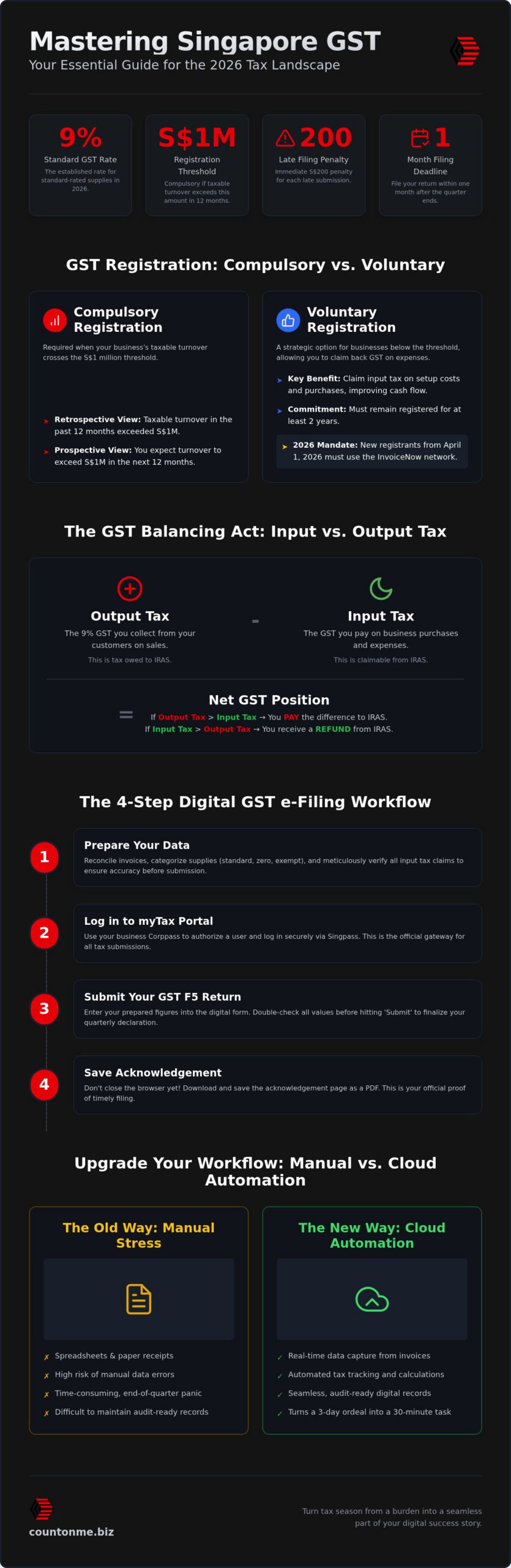
You’re required to register for GST if your taxable turnover exceeds S$1 million. The retrospective view looks at your past 12 months of turnover, while the prospective view requires registration if you reasonably expect your turnover to hit the S$1 million mark in the coming year. For many early-stage startups, voluntary registration is a strategic choice rather than a legal requirement. It allows you to claim back GST on your initial setup costs and equipment, which can be a significant boost to your early cash flow. However, it does come with a commitment to stay registered for at least two years. Starting April 1, 2026, new voluntary registrants must also adopt the InvoiceNow network, making digital adoption a prerequisite for entry.
Input Tax vs. Output Tax: The SME Balancing Act
Managing your GST filing Singapore involves a simple but precise balancing act between what you collect and what you spend. Output tax is the 9% you collect from your customers on behalf of IRAS. Input tax is the GST you’ve paid to your suppliers or on imported goods. Every quarter, you’ll calculate the difference to determine your net position. If your output tax is higher, you pay the balance to IRAS. If your input tax is higher, you’re usually eligible for a refund. We see this as a vital cash flow checkpoint. Using professional Tax Compliance & Advice helps ensure you never miss out on valid input tax claims, keeping your business liquid and compliant without the end-of-quarter panic.
The Step-by-Step GST e-Filing Process
By 2026, the transition to a fully digital tax ecosystem is no longer a suggestion; it’s the standard. We’ve seen how paper-based records lead to transcription errors and missed deadlines, which is why maintaining a digital ledger is your best defense against an IRAS audit. Understanding how Singapore’s GST works at a fundamental level helps, but the real magic happens when your daily transactions are captured in real-time. This digital-first approach ensures that when the quarter ends, you aren’t hunting for lost receipts or manual spreadsheets.
The most effective way to handle your GST filing Singapore is through direct software integration. Utilizing cloud accounting services Singapore allows you to pull accurate data directly into the tax portal. It’s a shift that turns a three-day ordeal into a thirty-minute task, giving you more time to focus on your business growth instead of data entry.
Preparing Your GST F5 Return
Before you even log into the portal, you need to get your data in order. First, reconcile every digital invoice and receipt to ensure your bank balance matches your books. Second, categorize your supplies into standard-rated, zero-rated, and exempt categories to ensure you’re applying the 9% rate correctly. Finally, double-check your input tax claims. IRAS systems are highly sensitive to unusual input tax spikes, so verifying these figures now prevents a lot of questions later.
Navigating myTax Portal and Corppass
Once your numbers are ready, the actual submission happens on the myTax Portal. You’ll need to use Corppass to authorize either yourself, a staff member, or your tax agent to act on behalf of the business. Most owners find it easiest to log in via Singpass for a quick, secure connection. After you hit submit, don’t just close the tab. Save the acknowledgement page as a PDF; it’s your primary proof of compliance. If you’d rather have an expert handle these technical steps, our Tax Compliance & Advice team is here to manage the entire workflow for you.
Timelines, Deadlines, and Compliance Risks
Most SMEs in Singapore follow a quarterly filing cycle, which keeps your tax obligations manageable throughout the year. This means every three months, you’ll need to submit your figures via the official GST e-Filing process. The deadline is strict: you have exactly one month after your accounting period ends to complete your GST filing Singapore. For instance, if your quarter ends on March 31, your return and payment are due by April 30. Missing this window isn’t just a minor slip; it triggers an immediate S$200 penalty for late filing, which can climb by S$200 every month up to a maximum of S$10,000.
Beyond filing, late payments carry a 5% penalty on the unpaid tax. If the bill stays unpaid for 60 days, IRAS adds an extra 2% monthly penalty, capped at 50% of the outstanding tax. In serious cases, you might even face a court summons. We believe that robust SME tax compliance Singapore is the bedrock of your business’s reputation and growth. It keeps your record clean and your cash flow predictable, allowing you to focus on strategic scaling rather than damage control.
Managing GST F7: Correcting Previous Errors
Mistakes happen even in the most diligent businesses. If you discover an error in a past submission, you’ll use Form F7 instead of trying to fix it in your next F5 return. There’s a specific threshold for voluntary disclosure: if the tax error is S$1,500 or less, you can usually adjust it in your next return, but larger errors require an F7. We view the F7 as a tool for transparency that helps you maintain a collaborative relationship with IRAS rather than a sign of failure.
GIRO for GST: Automating Payments and Refunds
We always suggest setting up a GIRO plan to take the manual labor out of tax settlement. It automates your payments so you never have to worry about missing a due date and incurring those 5% penalties. Plus, it speeds up the process when the shoe is on the other foot. E-filers usually receive GST refunds within 30 days via GIRO, which is a massive win for your quarterly liquidity and overall GST filing Singapore efficiency.
Explore our Tax Compliance & Advice services
Modernizing GST Management with Cloud Solutions
We’ve covered the rules and the risks. Now, let’s talk about the solution that makes it all manageable. In 2026, cloud software like Xero has become the gold standard for GST tracking. It moves your finance function from a reactive scramble to a proactive strategy. Real-time data visibility is the best cure for the end-of-quarter “GST panic” because you always know exactly where your tax position stands. You can see your net payable amount at any time, allowing you to set aside funds gradually rather than facing a surprise bill at the end of the month.
Automation vs. Manual Spreadsheets
Relying on manual spreadsheets is a high-stakes gamble with your time and money. Human error in manual calculations often leads to IRAS flags, and the cost of correcting those errors far outweighs the price of a digital subscription. Cloud tools automatically calculate the 9% GST on every digital invoice you issue or receive. They categorize your expenses in the background, ensuring your input tax claims are accurate. If IRAS ever asks for a review, you can generate a GST Audit File (IAF) with a single click. This provides the instant transparency that tax authorities value, making your GST filing Singapore process incredibly smooth.
The Count On Me Advantage: Beyond the Filing
We see ourselves as more than just a service provider; we’re your collaborative partner. Our Count On Me services combine 20 years of experience with modern automation to give you empathy-driven tax support. We don’t just file forms. We use your GST data to provide scaling insights, helping you understand how your business growth is trending. Our team is here to handle the technical heavy lifting so you can focus on your team and your customers.
For founders looking for high-level tax planning, our on demand CFO Singapore perspective ensures your tax strategy aligns with your long-term financial goals. Compliance is a holistic journey. Feel free to explore our corporate tax filing Singapore guides to see how we can streamline your entire tax season. Let’s make GST filing Singapore a secondary thought so you can keep your primary focus on your vision for the future.
Building a Future-Proof Tax Strategy
The 2026 tax landscape rewards businesses that embrace digital precision. By mastering the 9% rate and moving your records to the cloud, you’re doing more than just avoiding IRAS penalties; you’re creating a transparent, audit-ready foundation for your next stage of growth. Staying ahead of your quarterly deadlines isn’t just about paperwork. It’s about maintaining the cash flow and clarity you need to make bold business decisions. Navigating GST filing Singapore doesn’t have to be a solo journey that takes you away from your core mission.
Our team of seasoned experts brings over 20 years of experience to your side. We combine this deep professional heritage with a tech-forward approach using Xero and automation. Whether you’re a new founder using our tailored startup packages or an established SME, we’re here to be the supportive ally you need to reach your goals.
Simplify your GST compliance with Count On Me cloud solutions
You’ve built something incredible, and we’re here to help you protect it. Let’s work together to turn your tax obligations into a seamless part of your success story.
Frequently Asked Questions
What is the deadline for GST filing in Singapore for 2026?
Your GST returns are due exactly one month after the end of your prescribed accounting period. For most SMEs on a quarterly cycle, this means if your quarter ends on March 31, your return and payment must be submitted by April 30. Missing this deadline triggers an immediate 5% penalty. Keeping your digital records updated in real-time ensures your GST filing Singapore is always a smooth, stress-free process.
Can I file a NIL GST return if I had no business activity?
Yes, you’re still required to file a “NIL” GST return even if your business had no taxable transactions during the period. IRAS treats a failure to file a NIL return the same as a missing active return, which can lead to unnecessary penalties. Using cloud accounting software makes this a simple, one-click process. It’s an easy way to maintain your compliance standing and avoid a “Best Judgment” assessment from the authorities.
How do I correct an error in a previously submitted GST return?
You should generally file a GST F7 (Disclosure of Errors) form to rectify any mistakes found in past filings. If the tax error is S$1,500 or less, you can usually adjust the amount in your next GST F5 return instead. For larger discrepancies, the F7 is the correct professional path to take. Voluntarily disclosing errors through the right channels often leads to reduced or waived penalties because it shows you’re acting in good faith.
What are the penalties for late GST filing in Singapore?
Late filing results in an immediate 5% penalty on the tax due plus a fixed penalty that ranges from S$200 to S$10,000. If the tax remains unpaid, IRAS adds an additional 1% penalty for every month it’s outstanding, capped at 12%. Beyond the financial costs, frequent late filing increases your business’s risk profile. This often leads to more frequent audits and closer scrutiny of your SME’s financial records.
Is voluntary GST registration worth it for small startups?
Voluntary registration is often beneficial if your customers are primarily other GST-registered businesses, as it allows you to claim back the input tax paid on your expenses. However, you’ll need to collect 9% GST on your sales and commit to a minimum registration period of two years. A financial advisory for startups can help you determine if the tax savings outweigh the extra administrative effort.