
If you’re searching for “accounting Singapore,” you may be comparing providers or trying to understand what reliable support should cover. Accounting is more than a recurring list of records, payroll tasks, and tax deadlines. Accurate, up-to-date books can show where cash is going and give you a clearer view of what’s working.
Good accounting takes consistent attention, especially as your business grows and responsibilities involving ACRA and IRAS come into view. This guide covers core accounting tasks for Singapore businesses, how reliable records support compliance and day-to-day decisions, and what to consider when improving your finance workflows.
You’ll also learn when cloud accounting and bookkeeping support may help keep information organised and useful. For SMEs that need additional capacity, working with an external team can connect bookkeeping with tax compliance, payroll, and financial visibility. Count On Me provides cloud-based accounting and bookkeeping alongside these related services, helping businesses digitise and streamline finance operations with support that can scale as needs change.
Key Takeaways
- See how accounting in Singapore involves more than filing, and how consistent financial records can support clearer business decisions.
- Learn how bookkeeping, reconciliations, financial statements, tax compliance, payroll, and corporate secretarial work connect while serving distinct roles.
- Use a practical self-assessment to spot gaps in your records, reporting rhythm, and ownership of recurring finance tasks.
- Compare in-house, outsourced, and blended support, then identify questions to ask as your business’s finance needs grow.
Why accounting in Singapore matters beyond filing deadlines
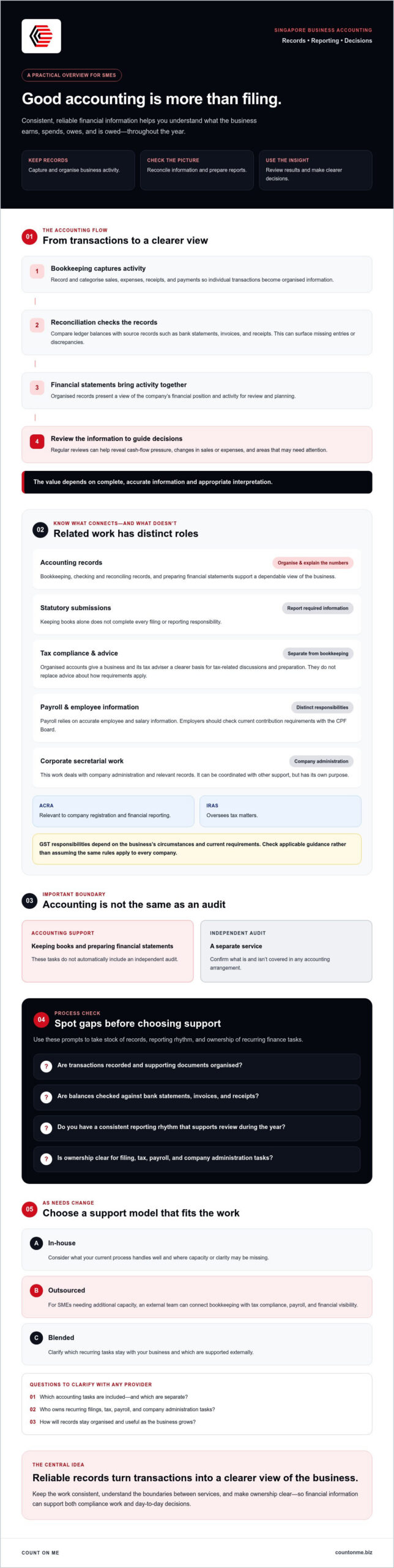
Business accounting is the ongoing work of recording, organising, checking, and interpreting a company’s financial activity. It turns individual transactions into a dependable view of what the business earns, spends, owes, and is owed. That view matters throughout the year, not only when a filing deadline approaches.
Accurate records make financial decisions clearer. When your accounts are current and reliable, you can make business decisions with a clearer view of your finances. Regular reviews can help you spot cash-flow pressure, notice changes in sales or expenses, and plan with better information instead of guesswork. They also make it easier to prepare for relevant tax and company reporting work.
What business accounting does for a Singapore SME
Bookkeeping captures transactions. Checking and reconciling those records helps identify missing or inconsistent entries. Financial statements then bring the activity together in a format that supports planning and review. For a Singapore SME, accounting support should maintain this flow consistently, rather than only assembling figures at year-end.
Accounting isn’t the same as a statutory audit. Keeping books and preparing financial statements do not automatically include an independent audit, which is a separate service. Confirm what is and isn’t covered in any accounting arrangement.
Accounting, tax, and company administration are related but distinct
Singapore’s Accounting and Corporate Regulatory Authority (ACRA) is relevant to company registration and financial reporting, while the Inland Revenue Authority of Singapore (IRAS) oversees tax matters. Accounting records can provide financial information for tax preparation, but they don’t replace advice about how tax requirements apply to your business.
Company secretarial work is another distinct area of company administration. These responsibilities can be coordinated with accounting, tax, and payroll support, but each has a different purpose. Clear ownership helps prevent tasks from falling between people or providers. If you’re comparing software and finance workflows, explore this Singapore cloud accounting guide for more detail.
What accounting in Singapore covers, from records to reporting
Accounting brings together regular tasks that keep a business’s financial information organised and useful. For Singapore SMEs, this commonly includes recording transactions, reconciling balances, maintaining supporting documents, and preparing financial statements. The precise scope depends on the company and the support it needs.
From bookkeeping entries to financial statements
Bookkeeping captures and categorises sales, expenses, receipts, and payments. Reconciliation checks ledger balances against source records such as bank statements, invoices, and receipts. This can surface missing entries or discrepancies before they affect reporting.
Financial statements draw on organised records to present a view of the company’s financial position and activity. They can help owners review results and decide what may need attention. Their usefulness depends on complete, accurate information and appropriate interpretation.
Accounting records explain the numbers; statutory submissions report required information to the relevant authorities. The two are connected, but maintaining books alone doesn’t complete every filing or reporting responsibility.
Where tax, payroll, and company records fit
Organised accounts give a business and its tax adviser a clearer basis for discussions with IRAS and for preparing tax-related information. Tax compliance and advice remain distinct from bookkeeping. GST responsibilities depend on the business’s circumstances and current requirements, so check the applicable guidance rather than assuming the same rules apply to every company.
Payroll also relies on accurate employee and salary information. Employers should check current contribution requirements with the CPF Board. Corporate secretarial work is separate, dealing with company administration and relevant records. These areas can be coordinated, but each has its own tasks and ownership.
For more detail on tax requirements, consult current IRAS guidance and a qualified tax adviser. If you’re reviewing what support may fit your workflow, explore accounting and tax compliance services from Count On Me.
How to assess your Singapore accounting process before outsourcing
Before deciding whether to outsource, take stock of what your current process handles well and where it creates friction. Recurring problems may point to a workflow that needs attention, but one missing document or late report alone doesn’t prove non-compliance or financial distress. Look for patterns and consider whether your team has the time and capability to address them.
Signs your current accounting workflow needs attention
Use this quick self-assessment to identify gaps:
- Record completeness: Are sales, expenses, receipts, and payments recorded with supporting documents, or do you regularly have to chase missing information?
- Reconciliation rhythm: How often are account balances checked against source records? Are reconciliations delayed or left until reporting deadlines?
- Reporting usefulness: Do management reports arrive in time to inform decisions? Are there recurring surprises because you can’t see changes in cash flow or performance early enough?
- Task ownership: Is it clear who handles bookkeeping, review, payroll information, tax preparation support, and company administration, including follow-ups?
These questions help you assess whether your accounting process fits your business, without assuming every issue calls for external help.
Choosing a workable support model
An in-house approach may suit a business with the capacity and expertise to keep records current and produce the reports it needs. Outsourced support can help when recurring tasks compete with other responsibilities, transaction volume grows, or the business needs more consistent financial visibility. A blended model is another option: your team can retain tasks it manages well while external professionals support bookkeeping and reporting.
Before comparing options, document your transaction volume, reporting needs, current systems, and handover requirements. Ask how access will be controlled, who owns each task, how often you’ll communicate, and what information must be provided to keep records current. The right scope should match your workload and capability, not a one-size-fits-all checklist.
If you’d like to compare your needs with available support, explore accounting and bookkeeping services from Count On Me.
Build dependable accounting support as your Singapore business grows
As transactions increase, your team expands, or decisions require a sharper view of cash and performance, a finance process that once felt manageable may need more structure. Reliable accounting support can help keep records and reporting aligned with changing business needs. The aim isn’t to add complexity. It’s to keep responsibilities and information flows clear as the business develops.
What to clarify when discussing accounting support
Before agreeing on a support arrangement, get specific about the day-to-day scope. Ask which records are maintained, what reconciliations are performed, and which financial reports you’ll receive and how often. Confirm who gathers source documents, handles approvals, follows up on missing information, and answers questions. Plan clear handovers, including how records and context will be shared if responsibilities move between your team and an external provider.
Discuss access controls and how sensitive financial information will be handled. Ask how accounting work can connect with tax compliance or payroll support if those needs arise. Clear communication and task ownership help everyone understand what’s due, who acts, and when to expect updates.
How Count On Me can support changing finance needs
Count On Me provides cloud-based accounting and bookkeeping for Singapore SMEs, alongside tax compliance and advice, payroll management, corporate secretary services, and on-demand CFO support. These capabilities can form a broader outsourced finance function, with the scope shaped around the business’s needs. For example, a growing team may need payroll support alongside bookkeeping, while owners seeking more financial perspective may consider on-demand CFO support.
Founders reviewing their early finance processes may also find this guide to startup accounting mistakes in Singapore useful. Before deciding what fits, compare a provider’s proposed scope, reporting cadence, handover process, data access arrangements, and communication approach.
If you’re considering a more dependable finance workflow, you can discuss an accounting and bookkeeping arrangement with Count On Me’s services team.
Make your next finance step a confident one
As your business grows, dependable accounting helps turn everyday transactions into records you can use, not just figures assembled for a deadline. A sound accounting process keeps bookkeeping, reconciliations, and reporting aligned with your needs, while making responsibilities across tax, payroll, and company administration clearer.
Start by checking whether records are complete, reports arrive when you need them, and each recurring task has a clear owner. Then decide whether in-house, outsourced, or blended support best fits your team. The right arrangement should make finance workflows easier to manage and adapt as your business changes.
Count On Me provides cloud-based accounting and bookkeeping, with related payroll, tax compliance and advice, corporate secretary, and on-demand CFO services. Founded by professionals with over 20 years of industry experience, the team supports Singapore SMEs looking to digitise and streamline finance operations.
Start with a clear view of what your business needs, then discuss an accounting and bookkeeping arrangement with Count On Me.
Frequently Asked Questions
What does an accountant do for a small business in Singapore?
An accountant helps organise and review financial information so a business can understand its activity and meet relevant responsibilities. Depending on the agreed scope, this may include checking bookkeeping records, reconciling accounts, preparing financial statements, and supporting tax compliance. Some providers also offer payroll or advisory services. Clarify what’s included, who handles each task, and whether statutory audit work is excluded or arranged separately.
Does a Singapore company need to keep accounting records?
Yes, Singapore companies are generally required to maintain accounting records that explain their transactions and financial position. Keep source documents such as invoices, receipts, and bank statements organised alongside recorded entries so figures can be checked and used for reporting. Requirements can depend on the company’s circumstances, so confirm current obligations with ACRA or a qualified professional rather than relying on assumptions.
What is the difference between bookkeeping and accounting?
Bookkeeping is the regular recording and categorising of transactions, such as sales, supplier payments, and staff expenses. Accounting uses those records to check balances, prepare financial statements, interpret results, and support tax or management decisions. The work connects: reliable accounting depends on complete bookkeeping, while review and reporting make recorded information more useful to the business.
Should a Singapore SME outsource its accounting?
Outsourcing may suit an SME if bookkeeping is falling behind, records need more consistent review, or the team lacks capacity to produce useful reports. Keeping work in-house or using a blended approach may fit better when the business has the time and skills to manage it. Compare transaction volume, reporting needs, task ownership, systems, handovers, and access controls before choosing. No single model suits every business.
Can an accounting provider in Singapore also manage payroll and tax?
Yes, some providers offer accounting alongside payroll management and tax compliance or advice, but these remain distinct services. Check the proposed scope to see who maintains the books, processes payroll information, supports tax preparation, and handles follow-ups. For example, Count On Me provides cloud-based accounting and bookkeeping, payroll management, and tax compliance and advice. Confirm that the arrangement fits your company’s needs and current responsibilities.
How often should a small business review its accounts?
Reviewing accounts monthly is a practical rhythm for many small businesses, though the right frequency depends on transaction volume, reporting needs, and how quickly decisions must be made. Regular checks can help you spot missing records, reconcile balances, and review cash position and business performance before year-end. Agree on a reporting cadence with your accounting support, and adjust it if the business’s activity or needs change.