

What if the right accountant isn’t the one with the longest service list, but the one who can clearly explain what happens after you sign? The questions to ask a potential accountant Singapore businesses should focus on go beyond qualifications. They should show you how the work gets done, what’s included and who is responsible.
Bookkeeping, tax, payroll and advisory services can be difficult to compare. Unclear scope, extra work and uncertainty about software or communication can make choosing a finance partner feel like a gamble. A focused conversation can bring those details into the open before you commit.
Use this practical 2026 checklist to assess an accountant’s Singapore experience, service scope, fees, systems, communication and handover process. You’ll find questions to ask, details a clear answer should cover and criteria for comparing providers. You’ll also learn how to check whether cloud workflows, reporting and support fit your needs now and can adapt as your business grows.
Key Takeaways
- Ask how work is handled, reviewed and kept on track, rather than relying on a list of services.
- Match the scope to your needs, from bookkeeping and tax to payroll, corporate secretary services or advisory support.
- Compare proposals by deliverables, exclusions and triggers for extra work, not just the headline fee.
- Ask how cloud systems support reporting, document sharing, data access and communication, then confirm the details in writing.
- Use a simple scorecard to assess expertise, accountability and fit as your business grows.
Why ask a potential accountant in Singapore these questions before hiring?
An accountant’s work can affect how clearly you understand your finances, how compliance tasks are coordinated and what information you have when making business decisions. The aim of an interview isn’t to collect impressive promises. It’s to find out whether the provider understands your needs, can explain what’s included and accepts clear responsibility for agreed work.
Specific filing duties depend on your company’s circumstances, so confirm current requirements rather than relying on a general answer. You can review the role of the Accounting and Corporate Regulatory Authority (ACRA) and consult relevant Singapore authority guidance. Ask a prospective accountant how they identify which obligations apply to your business and how they keep you informed about upcoming tasks.
Prepare for the conversation by noting your business stage, entity structure, transaction volume and the finance issues taking up your time. The questions to ask a potential accountant Singapore business owners use should relate to those details, not just a generic service list.
What should you prepare before speaking with an accountant?
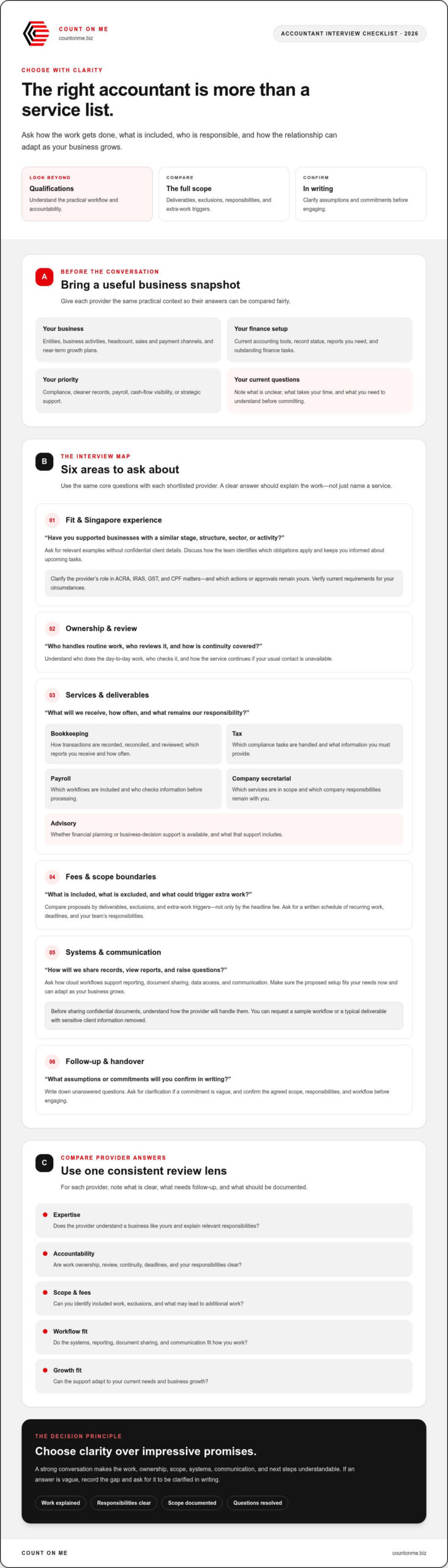
Bring a short overview of your entities, business activities, headcount, sales and payment channels, and near-term growth plans. Summarise your current accounting tools, how up to date your records are, which reports you need and any outstanding finance tasks. Identify your main priority, such as compliance, cleaner records, payroll, cash flow visibility or strategic support. This gives the accountant a practical basis for discussing fit and scope.
How to use the accountant interview checklist
Ask each shortlisted provider the same core questions so you can compare answers fairly. Request a sample workflow or an example of a typical deliverable with sensitive client information removed. You don’t need to share confidential documents before you understand how the provider will handle them.
- Fit: Have you supported businesses with a similar stage, structure or activity?
- Ownership: Who handles routine work, reviews it and provides continuity?
- Scope: Which deliverables are included, and what could trigger additional work?
- Workflow: How will we share records, view reports and raise questions?
- Follow-up: Which assumptions or commitments should be confirmed in writing?
Write down anything that remains unanswered. A clear follow-up process can turn a promising conversation into an informed decision. If a commitment is vague, ask for clarification before engaging.
Questions to ask about an accountant’s Singapore services and expertise
A service list only tells you what a provider might do. Ask how each service works in practice and whether the team has supported businesses with a similar structure, sector, size and operating complexity. For example, a company processing sales through several channels may need a different bookkeeping workflow from one with fewer, simpler transactions.
Use these questions to ask a potential accountant Singapore businesses can adapt to their needs:
- Bookkeeping: How are transactions recorded, reconciled and reviewed? Which reports will we receive, and how often?
- Tax: Which tax compliance tasks do you handle, and what information must we provide?
- Payroll: Which payroll workflows are included, and who checks the information before processing?
- Company secretarial: Which services are in scope, and which company responsibilities remain with us?
- Advisory: Can you support financial planning or business decisions? What does that support include?
Ask who does the day-to-day work, who reviews it and how the service continues if your usual contact is unavailable. Request a written schedule of recurring deliverables, deadlines, exclusions and your team’s responsibilities. This helps prevent assumptions, such as expecting tax advice to include every compliance task.
How to test Singapore accounting and compliance experience
Ask for relevant examples without requesting confidential client details. Find out how the team approaches bookkeeping, financial statements and tax compliance workflows for businesses like yours. Clarify its role in matters involving ACRA, IRAS, GST and CPF, and which actions or approvals remain yours. Rules and filing duties can depend on your circumstances, so verify current requirements through official guidance, including Singapore’s Accounting and Corporate Regulatory Authority.
How to clarify the service scope and responsibilities
Confirm the assigned contacts, review steps, reporting frequency and expected response times in writing. Ask who supplies records, approves submissions and follows up when information is missing. Discuss how the engagement could change if your payroll, compliance or advisory needs grow.
Don’t assume statutory audit services, legal representation or personal wealth management are included. Ask directly what falls outside the scope and whether the provider can explain how to find a suitable separate professional. You can also compare the accounting and finance services available with the support your business needs.
Questions about accounting fees, cloud software, security and communication
A proposal is easier to assess when you look beyond its headline fee. Compare the included work, assumptions about your records and transaction volume, exclusions and situations that may lead to additional work. The questions to ask a potential accountant Singapore businesses rely on should also help you understand how the provider will handle your information and keep you updated.
How to uncover the full fee structure without focusing on price alone
Ask which recurring tasks are included and what could change the agreed scope. Clarify how catch-up bookkeeping, unusual transactions, advisory requests or work outside the regular schedule are handled. Request written billing terms, a process for approving extra work and a point at which the engagement’s scope will be reviewed. If professional credentials matter to your decision, learn about the Institute of Singapore Chartered Accountants (ISCA) and its role in the profession.
How to assess cloud tools, security and service responsiveness
Ask which accounting platform the provider proposes and what access your business will retain. Clarify who owns the data, how permissions are managed, what backup practices apply and how you can export records if the engagement ends. Ask how sensitive financial information is accessed, stored and protected, and verify any requirements that apply to your business and provider. The software should support practical tasks such as reconciliations, reporting and document sharing while giving you visibility into your records.
Agree on communication arrangements before work begins. Ask who handles routine questions, what response window to expect, how urgent issues are escalated and whether regular review meetings are included. Confirm these expectations in writing rather than relying on a general promise to stay in touch.
Use this comparison table for each proposal. A clear answer should explain the process, not simply say that something is handled.
How to compare accountant answers and choose your next step
After your conversations, compare providers using the same criteria instead of relying on who made the strongest first impression. Assess each one on relevant expertise, clarity of scope, practical systems, communication and fit for your business’s next stage. A simple rating with notes can show where a provider stands out and where you still need answers.
Which accountant answers are reassuring, and which need follow-up?
Specific workflows, named responsibilities and clear explanations of exclusions are reassuring. A broad claim that “everything is covered” needs follow-up, especially if the provider can’t explain what they do or what remains your responsibility. Unclear data access or verbal promises aren’t automatic deal-breakers, but ask for details in writing. Check that the proposed support fits your current needs and can accommodate likely changes, such as adding payroll or needing more advisory input.
Use a scorecard like this:
- Expertise: Can they explain how their experience relates to your business?
- Scope: Are deliverables, exclusions and responsibilities clear?
- Systems: Do you understand how records, reports and access will work?
- Communication: Are contacts, response expectations and escalation steps defined?
- Growth fit: Can the proposed service adapt if your needs change?
Ask shortlisted providers for a written proposal, then arrange a follow-up call to resolve open questions. Check that the discussion matches the documented terms before you commit. Meanwhile, accounting practice owners who want to scale their firm and attract the right clients can look to Ape-X Generation for dedicated marketing and growth systems.
What to confirm before onboarding a Singapore accounting provider
Before signing, review the engagement terms, responsibilities, deliverables, access arrangements and exit process. Confirm the start date, records handover, software access and how outstanding tasks will be handled. Make sure the agreed communication rhythm, approval steps and escalation contacts are documented. A clear handover plan helps both sides start with the same expectations.
If your needs span bookkeeping, tax compliance, payroll or advisory support, consider whether coordinating relevant finance services through one provider suits your business. Review Count On Me’s business finance services to understand the support available to Singapore startups and SMEs, and contact Count On Me today to discuss your accounting and finance support needs.
Choose a finance partner with confidence
The right accountant should make responsibilities, deliverables and communication clear, not leave you guessing about what’s covered. Use the questions to ask a potential accountant Singapore businesses can adapt to compare providers consistently, assess relevant expertise and confirm how the provider’s systems support your work.
Before you commit, review the written scope, resolve open questions and check that the proposed support fits your current priorities and likely next steps. Count On Me supports Singapore SMEs with cloud accounting and bookkeeping, tax compliance, payroll, corporate secretary services and on-demand CFO support.
Frequently Asked Questions
What questions should I ask a potential accountant in Singapore?
The questions to ask a potential accountant Singapore business owners find most useful clarify expertise, responsibilities and working processes. Ask which services are included, who handles and reviews the work, what records you must provide, and how deadlines and questions are managed. Also ask how you’ll access reports and financial data, what may incur additional work and how the provider can support your business as it grows. Request important commitments in writing.
How do I choose an accountant for a small business in Singapore?
Choose an accountant whose experience and service scope match your business needs, structure and stage. Compare shortlisted providers against the same criteria: relevant expertise, clear deliverables, cloud workflows, communication and capacity to adapt as your needs change. Ask for a written proposal that explains responsibilities, exclusions and handover arrangements. A lower headline fee may not represent better value if important tasks or support fall outside the agreed scope.
Do I need a certified accountant in Singapore?
Start by checking which qualifications and experience are relevant to the work you need. Ask who will handle and review your company’s accounts, and how their professional credentials can be verified. Different types of accounting and financial work may have different requirements, so don’t assume one credential covers every service. If your engagement involves regulated work, confirm applicable requirements with the relevant Singapore authority before appointing a provider.
What should an accountant’s service proposal include?
A useful proposal should set out the services and recurring deliverables, how often they’ll be provided, who is responsible and what your business must supply or approve. It should also explain exclusions, circumstances that could lead to additional work, billing terms, communication expectations and the process for ending the engagement. Check that it describes software access, records handover and outstanding tasks, so you know how work will begin and conclude.
How should I compare accounting service fees in Singapore?
Compare proposals by matching the included work, assumptions and exclusions, not just the quoted amount. Check whether recurring bookkeeping, tax compliance or payroll support is included, and ask how catch-up work, unusual transactions or advisory requests are treated. Confirm the billing currency, payment terms and how additional work is approved. Ask providers to clarify differences in scope so you can compare like with like before deciding.
Can an accountant handle bookkeeping, tax and payroll for my company?
A provider may offer bookkeeping, tax compliance and payroll together, but confirm each service’s scope and responsibilities in writing. Ask who manages the day-to-day work, what information your company must supply and how the services connect. Count On Me provides cloud accounting and bookkeeping, tax compliance and advice, and payroll management, alongside corporate secretary services and on-demand CFO support. Confirm which combination fits your needs and what each engagement includes.