

What if the lowest accounting quote leaves you paying extra for essential work later? For Singapore SMEs, reasonable accounting fees aren’t simply the smallest number on a proposal. They’re fees that match the support your business needs, with clear responsibilities and no costly gaps.
Comparing quotes can be difficult when one provider includes bookkeeping and financial statements, while another lists payroll, tax or GST support separately. The right scope depends on your transaction volume, business complexity, record quality, GST registration and payroll needs. A low fee may look attractive, but it may not cover the work required to keep your records reliable.
This guide explains what can shape accounting fees in 2026 and how to compare proposals by scope and value, not price alone. You’ll learn how to distinguish bookkeeping, compliance and CFO support, identify what your SME needs now, and choose an arrangement that can scale as the business grows. Cloud-based accounting keeps financial records accessible, while regular reconciliation and financial statement preparation help you understand your business’s position.
Key Takeaways
- Reasonable accounting fees reflect the work involved, business complexity and level of support, not just the quoted amount.
- Separate bookkeeping from payroll, tax compliance, company-secretarial duties and advisory support to see what each scope covers.
- Compare proposals by mapping your needs to deliverables, responsibilities and communication, then assess overall fit.
- Look beyond the cheapest quote: excluded work may still need attention elsewhere in your business.
- Review your support as transaction volumes, headcount and reporting needs change so your accounting setup can grow with your SME.
What Makes Accounting Fees Reasonable for a Singapore SME?
A low quote alone can’t tell you whether accounting support is good value. If it covers only basic transaction entry, you may still need to arrange account reconciliation, financial statements or other work separately. Compare the agreed scope with what your business needs, not just the headline fee.
A reasonable accounting fee is proportionate to the agreed work, your business’s complexity, the expertise required and the level of support you receive. Clear, timely communication also matters because it helps you understand your records and make informed decisions. The aim isn’t to pay for every service available. It’s to know who handles each task and exactly what the fee covers.
Which accounting tasks are usually part of the scope?
Recurring bookkeeping commonly involves maintaining ledger records and reconciling accounts. These tasks organise transactions and help check account balances against supporting records. Financial statement preparation is a distinct deliverable, so confirm that it is included if your business needs it. For Singapore businesses, reporting follows an established accounting framework: the International Financial Reporting Standards (IFRS) form a foundation for Singapore’s reporting standards.
Other responsibilities may sit outside recurring bookkeeping. Payroll covers employee pay and related processing; tax compliance covers tax-related work; corporate secretarial services address company records and filings; and CFO advice supports financial planning and business decisions. These are distinct needs, so a proposal may list them separately. For example, a business needing regular reconciliations and financial statements has a different scope from one that also needs payroll processing and ongoing financial advice. Count On Me provides cloud-based accounting and bookkeeping services to support accessible, ongoing records.
Why two businesses may receive different fees
The workload behind similar-looking businesses can vary. A company with frequent transactions or records arriving in inconsistent formats may need more time for processing and reconciliation than one with fewer transactions and organised documentation. Reporting frequency matters too: regular reporting can require a different workflow from periodic updates.
Complexity also affects the expertise needed. Multiple revenue streams, varied expenses or more involved reporting may require additional review and discussion. A business seeking accurate recurring records has different support requirements from one that also needs help interpreting its financial position. Neither arrangement is automatically better. The right fit depends on your operations and priorities.
To assess value, map each fee to a task, deliverable and responsible party. Check whether the scope reflects your current workload and gives you enough support to keep the records useful. There’s no single fee or service model that suits every Singapore SME; reasonableness comes from matching the work and support to the business.
What Drives Accounting Fees and What Should the Scope Include?
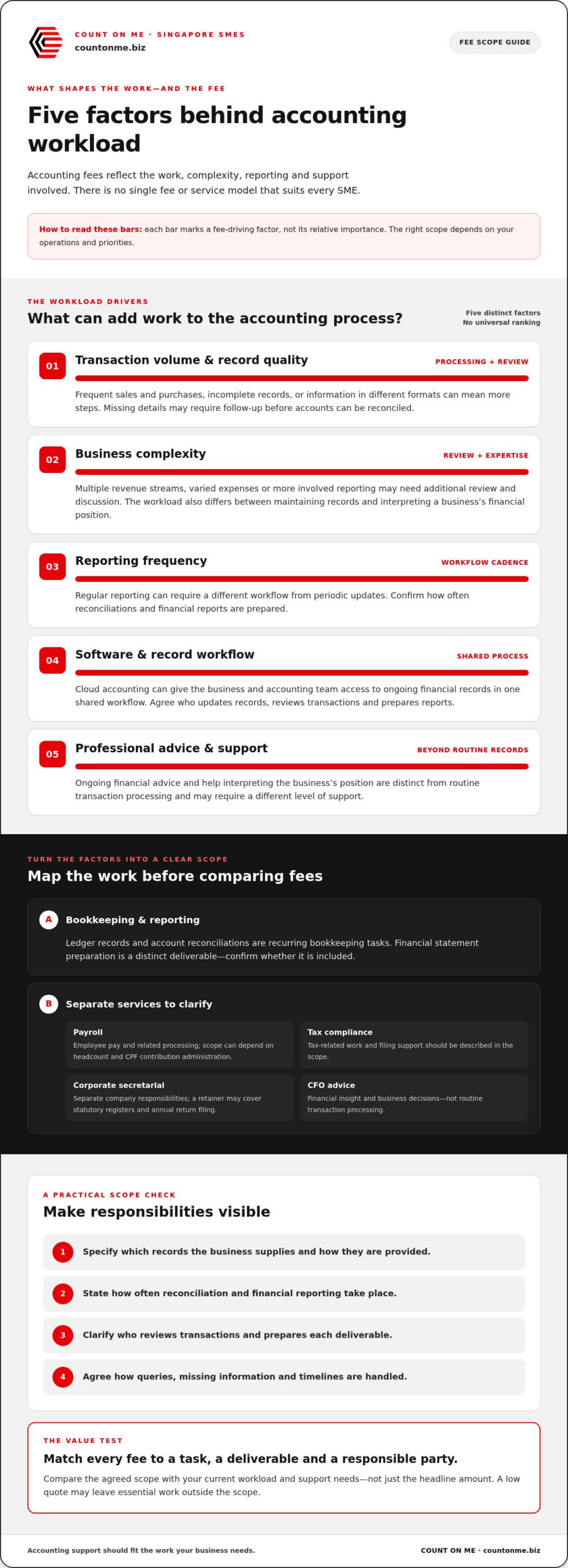
Once you know which tasks your business needs, consider the work behind them. Accounting fees are shaped by workload, complexity, reporting frequency, software workflow and the level of professional advice involved. A clear scope links each factor to a specific task or deliverable, so you can see what ongoing support covers.
How transaction volume and complexity affect the work
Transaction count is only part of the picture. Frequent sales and purchases, several revenue streams, or records that arrive incomplete or in different formats can add steps to processing and review. A tidy, consistent flow of records makes the workflow more predictable. Missing information can mean extra follow-up before accounts can be reconciled.
Consider an SME that sells through several channels and sends records in batches, where tracking product margins adds complexity. As guides from Stewart Accounting Services highlight, properly calculating cost of goods sold is critical for accurate financial reporting. Its accounting workflow may involve organising transactions from each source and reconciling them regularly. The scope should state how often reconciliation and financial reporting take place, which records the business supplies, and how queries or missing information are handled. Clear timelines help both sides understand what to expect.
Cloud accounting can give the business and its accounting team access to ongoing financial records in one shared workflow. It doesn’t remove the need to agree who updates records, reviews transactions and prepares reports. For an overview of how these arrangements work, explore cloud accounting and bookkeeping services.
Which add-on services should be priced separately?
Keep core bookkeeping deliverables distinct from services with different responsibilities. Reconciliations and financial statement preparation relate to maintaining and reporting on the accounts. Tax compliance and advice involve separate tax-related work, so the scope should describe the support and filing work covered. For Singapore-specific company requirements, the Accounting and Corporate Regulatory Authority (ACRA) is an official reference for corporate information.
Payroll scope can depend on employee headcount and the work involved in processing salaries and administering CPF contributions. Corporate secretarial services are separate from accounting: a retainer may cover statutory registers and annual return filing. CFO advice is another distinct layer, focused on financial insight and business decisions rather than routine transaction processing.
To compare proposals, group the work under clear headings: bookkeeping and reporting, payroll, tax, corporate secretarial services, and advisory support. For each, note the frequency, deliverables and responsibilities. This makes it easier to see whether a scope fits your operations today and how support can adapt as your needs change.
How to Compare Accounting Fees Without Choosing on Price Alone
Two proposals can show similar totals but cover very different work. The cheapest quote may leave tasks your business still needs outside the scope, creating extra coordination or cleanup. Use the same comparison process for each proposal so you can judge the service, not just the figure.
- List your needs. Note the records, reporting, payroll, tax support or other help your business requires.
- Map the deliverables. Match each need to a specific output, such as reconciled accounts or regular financial reports.
- Compare responsibilities. Identify who provides records, handles data entry, follows up on missing documents and reviews the work.
- Assess communication. Look for a clear reporting cadence, contact channel and process for resolving discrepancies.
- Review the fit. Consider whether the scope supports your current operations and can adjust as your needs change.
Questions a clear accounting proposal should answer
A practical proposal makes hand-offs visible. Who collects documents and enters data? Who completes reconciliations and reviews the accounts? What reporting timelines apply, and how are questions or discrepancies handled? The proposal should also explain how additional work is identified and approved before it proceeds, so responsibilities and expectations remain clear.
- Which records must your business provide, and by when?
- How often will accounts be reconciled and reports prepared?
- How are queries raised, answered and tracked?
- Which tasks fall outside the agreed scope, and how is extra work approved?
Consistent records make this process easier. Incomplete documents can lead to extra follow-up and avoidable cleanup. For practical context on record-keeping pitfalls, see 10 Critical Startup Accounting Mistakes in Singapore: A Founder’s Guide for 2026.
How to assess value beyond the quoted fee
Consider whether the service gives you timely, usable records for decisions and whether responsibilities are clear enough to support ongoing collaboration. Professional experience and continuity matter too: the people handling the work should understand your business context and communicate changes in a way you can act on. Reasonable accounting fees come from a scope that fits your needs, not from choosing the lowest quote by default.
Count On Me provides cloud accounting and bookkeeping, including regular reconciliation and financial statement preparation. Explore accounting support for your business.
Choose Accounting Support That Can Grow With Your Singapore Business
Your accounting needs can shift as the business develops. A founder managing a small number of transactions may mainly need reliable bookkeeping and financial statements. As sales channels, transaction volume or employee headcount grow, the business may also need payroll processing, tax compliance support or more frequent financial insight. A flexible scope lets you add relevant support without paying for work you don’t currently need.
Match the support model to your current stage
At an early stage, prioritise organised records, regular account reconciliation and a dependable process for closing the books. Cloud-based bookkeeping keeps financial information accessible as transactions come in. As operations expand, consider which additional responsibilities need support: payroll covers salary disbursements and CPF contributions, while tax compliance and advice address tax-related work. Each has a distinct scope.
Other needs are different again. Corporate secretary services can cover statutory registers and annual return filing, while on-demand CFO support can provide financial insight for business decisions. Count On Me provides these service areas alongside cloud accounting and bookkeeping. Its founders bring over 20 years of industry experience. See how the accounting and business support services relate to different SME needs.
Review the scope as your business changes
Revisit the arrangement when transaction volumes increase, you add employees, or managers need more regular reporting. Before reviewing the scope, summarise your current workload, reporting needs and compliance responsibilities. Note which tasks your team handles and where delays or unclear hand-offs arise. This gives you a practical basis for deciding what support is relevant now and what can wait.
Reasonable accounting fees should reflect the support your business needs at its current stage, with a clear way to adjust the scope as those needs evolve. The right arrangement isn’t necessarily the most extensive one. It’s the one that keeps responsibilities clear while giving you dependable records and useful support as your SME grows.
Set Up Accounting Support for Your Next Stage
Your accounting setup can be a practical part of planning, not just a task to revisit when something goes wrong. As your business changes, check whether the support you rely on still matches your workload and priorities. Regular reviews help keep responsibilities clear and make future adjustments more manageable.
Reasonable accounting fees should support a working relationship that fits your business, rather than commit you to work you don’t need. Count On Me combines cloud-based accounting and bookkeeping with regular reconciliation and financial statement preparation. Its founders bring over 20 years of industry experience, and the support can adapt as your needs evolve.
With the right support in place, you can spend less energy untangling accounting responsibilities and more time moving your business forward.
Frequently Asked Questions
What is a reasonable accounting fee for a small business in Singapore?
There isn’t one reasonable accounting fee that fits every small business. The right amount depends on the agreed work, including how transactions are handled, how often accounts are reviewed and what support is needed. For example, a small consultancy with tidy records may need a different scope from a retailer processing sales across several channels. Compare proposals using the same list of tasks, not an assumed market benchmark.
What should monthly accounting fees include?
Monthly accounting fees should spell out the recurring work, rather than rely on a broad label like “accounting.” Check whether the scope covers recording transactions, reconciling accounts and preparing financial statements, and how often each task is completed. Clarify what your team must provide, such as invoices or bank records, and whether catch-up work for earlier periods is separate. A sample monthly report can help you assess whether the output will be useful.
Are accounting fees tax deductible in Singapore?
Accounting fees may be deductible for Singapore tax purposes when they qualify as business expenses under applicable tax rules. The treatment can depend on why the expense was incurred and how it relates to the business, so don’t assume every charge is automatically deductible. Keep the invoice and engagement details with your records, and distinguish recurring business accounting costs from personal or other expenses. For your company’s circumstances, refer to current IRAS guidance or seek tax advice.
Can a startup afford outsourced accounting support?
Outsourced accounting can be considered as a startup’s needs develop, with a scope focused on essential recurring work rather than every available service. A founder might begin by organising records and getting regular accounts prepared, then add payroll or advisory support as the team and reporting needs grow. For founders evaluating external options, firms like ASAP Solutions provide helpful guides on finding support tailored to a growing company’s stage and budget. Compare the work your business needs with the time available to handle it internally, rather than assuming outsourcing requires a full-service arrangement.
How do I know if my accounting fee is too high?
A fee may deserve review if the work no longer matches your operations, the deliverables are unclear, or you’re paying for tasks your team also performs. Compare the current agreement with recent invoices and note changes in transaction volume, employee numbers or reporting needs. Ask for each charge to be mapped to a task and output. A higher fee isn’t automatically poor value if it reflects additional work your business actually relies on.
Are bookkeeping and tax services usually included in the same fee?
They may be bundled or priced as separate services, depending on the agreement. Bookkeeping focuses on maintaining transaction records and reconciling accounts, while tax support relates to tax compliance, advice and filing work. A proposal should make clear which tax tasks are covered, what information you must provide and whether work beyond the stated scope is handled separately. This distinction helps you plan for tax support instead of assuming it’s included in routine bookkeeping.