
What if the best cash flow forecast isn’t the most detailed one, but the one that answers your next business question? Customer payments can arrive later than expected, while payroll and supplier bills still need to be paid on time. Revenue forecasts and accounting reports alone may not show when cash could run short. Choosing the right cash flow forecasting methods for startups starts with the decision you need to make and the timeframe you need to plan for.
You don’t need a complex model to get useful insight. You need a forecast that fits your startup’s stage, uses reliable figures, and gets updated often enough to guide action. In this guide, we’ll compare the direct and indirect methods, show how to build a practical forecast from current financial records, and explain how to spot potential cash gaps early. You’ll also learn how to use scenarios and a regular review routine to make clearer choices about hiring, spending, and growth. With accurate bookkeeping as your foundation, your forecast can become a working tool for decisions, not just another spreadsheet to maintain.
Key Takeaways
- Separate profit, revenue, and available cash to see what each tells you about your startup’s finances.
- Compare cash flow forecasting methods for startups by purpose, inputs, time horizon, and limitations, then combine approaches when needed.
- Build a forecast that distinguishes confirmed balances and commitments from estimates such as sales timing and future hiring.
- Use forecast signals to revisit spending, collections, hiring, and funding assumptions, and keep inputs current with cloud bookkeeping.
Why cash flow forecasting matters for startups before a cash crunch
A cash flow forecast estimates when money is expected to enter and leave a business over a chosen period, and how those movements may change its available cash. It helps founders look beyond whether the business appears successful on paper and consider whether funds will be available when bills fall due.
Revenue, profit, and cash answer different questions. Revenue records sales earned; profit reflects income after expenses under accounting rules; available cash shows what the business can use to pay obligations now. A startup can make profitable sales on credit but wait weeks for customers to pay. If payroll or supplier invoices are due first, that timing gap can create pressure even while sales look healthy.
A profit forecast estimates expected income and expenses, while a cash forecast estimates the timing of actual receipts and payments and their effect on the bank balance. The broader Cash flow forecasting overview explains how forecasts support financial planning. For founders, the practical value is seeing when cash may tighten, not just whether the business expects to earn a profit.
What does a startup cash flow forecast show?
It starts with opening cash, adds expected receipts, subtracts planned payments, and arrives at projected closing cash for each period. Keep known balances and committed transactions distinct from estimates, such as the date a customer may pay or when a planned hire might start. This makes assumptions visible instead of disguising uncertainty as fact.
For example, suppose a customer invoice is expected before a supplier payment is due, but the customer hasn’t confirmed a payment date. Enter the expected receipt in the forecast, but label its timing as uncertain. If payment arrives later, update the projection and see how the closing cash position changes. This makes the effect of a delay easy to identify.
Which decisions can a forecast help founders make?
A projected cash squeeze can prompt a founder to reconsider the timing of a hire, inventory purchase, or marketing campaign. It may also be a cue to follow up on overdue receivables or review when supplier payments are scheduled. An early signal gives you time to assess options; it can’t guarantee that every shortfall will be avoided.
Treat projections as estimates, not promises. Mark assumptions by confidence, compare alternative receipt dates or spending plans, and update the forecast as new information arrives. That way, uncertainty becomes something to plan around rather than a surprise hidden inside a single optimistic figure.
Four cash flow forecasting methods for startups compared
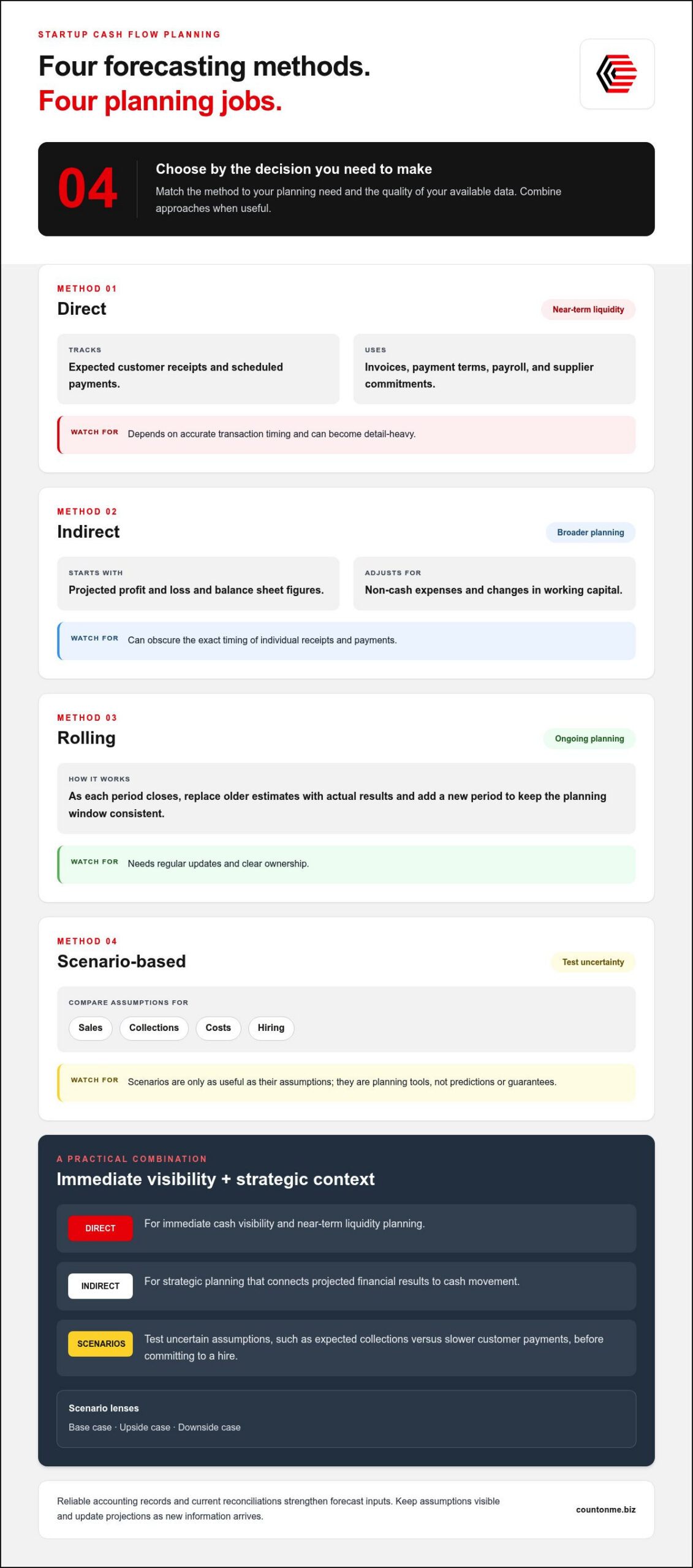
The right choice depends on the decision you need to make and the quality of your available data. A receipts-and-payments forecast estimates cash from expected transaction dates. A financial-statement-based forecast starts with projected results and adjusts for items such as non-cash expenses and changes in working capital. These approaches answer different questions, and a startup can combine them.
Use this comparison to match each of the four cash flow forecasting methods for startups to a planning need:
| Method | Purpose and inputs | Useful horizon | Main limitation |
|---|---|---|---|
| Direct | Tracks expected customer receipts and scheduled payments, using invoices, payment terms, payroll, and supplier commitments. | Near-term liquidity planning, often weeks or months. | Depends on accurate transaction timing and can become detail-heavy. |
| Indirect | Translates projected profit and loss and balance sheet figures into expected cash movement. | Broader planning over months or longer. | Can obscure the exact timing of individual receipts and payments. |
| Rolling | Updates the forecast as each period closes, adding a new period to keep the planning window consistent. | Ongoing operational and strategic planning. | Needs regular updates and clear ownership. |
| Scenario-based | Compares alternative assumptions for sales, collections, costs, or hiring. | Testing uncertainty across near- or longer-term plans. | Scenarios are only as useful as their assumptions. |
Direct and indirect cash flow forecasting
The direct method is strongest for managing near-term liquidity because it shows when cash is expected to arrive and leave. The indirect method is useful for longer-term planning because it connects projected financial results to changes in cash. Direct forecasts need transaction-level timing; indirect forecasts rely on sound financial statements and assumptions about items such as receivables, payables, and non-cash expenses.
Rolling forecasts and scenario-based forecasting
A rolling forecast extends the planning window each time a period closes, replacing older estimates with actual results and adding a new period. Scenario planning tests how the outlook changes under a base case, an upside case, and a downside case. For example, a founder can compare expected collections with slower customer payments before committing to a hire. These scenarios are planning tools, not predictions or guarantees.
In practice, pair a direct forecast for immediate cash visibility with an indirect view for strategic planning, then use scenarios to test uncertain assumptions. Current reconciliations and reliable accounting records strengthen the inputs. Working with dedicated advisors like The Bucket List Accountant alongside cloud tools can help founders interpret forecasts and connect them to business decisions.
How to build and maintain a startup cash flow forecast
Build a useful forecast in stages, keep assumptions visible, and feed actual results into the next version. Choose a horizon, gather reliable records, map cash movements, document assumptions, then compare actual cash with projections and adjust.
Gather records and set a useful forecasting horizon
Start with current bank balances and reconciled transactions, then gather receivables, payables, payroll commitments, and other known payments. Accurate bookkeeping gives you a stronger base; unresolved transactions or outdated balances can distort the starting point. Match the detail to the decision: use shorter intervals to assess immediate liquidity and broader periods to consider strategic plans such as expansion or hiring.
- Set the timeframe and intervals. Decide how far ahead to look and whether to organise the forecast by week or month, based on the decision at hand.
- Record the opening cash balance. Use current account balances and check that recorded transactions have been reconciled.
- Add expected receipts and payments. Include customer invoices, supplier bills, payroll, and other known commitments in the period they are expected to affect cash.
- Label estimates and assumptions. Separate confirmed amounts and dates from uncertain sales timing, future hiring, or planned spending. Note why each estimate is reasonable.
- Compare and update. As each period closes, enter actual movements, compare them with the forecast, and carry the learning into the next version.
Model assumptions, scenarios, and actual results
For each estimate, record its basis. A customer payment date might reflect agreed terms and prior payment behaviour; a planned hire might depend on a sales milestone. Mark assumptions clearly so anyone reviewing the forecast can tell what is known and what could change. For material uncertainties, create labelled base, upside, and downside scenarios, changing only the assumptions that differ.
When actual cash movements differ from projections, investigate the cause before changing the forecast. Was a receipt delayed, a cost higher than expected, or a planned expense brought forward? Record the variance, revise the relevant assumption, and keep the original projection visible for comparison. This turns forecasting into a learning cycle, not an exercise in making the numbers look tidy. Current reconciliations and financial statements help keep inputs consistent, while expert CFO support from Count On Me can help connect scenarios to strategic decisions.
Explore cloud accounting and CFO support with Count On Me today.
Turn startup cash forecasts into confident financial decisions
A forecast is most useful when it changes what you do next. If projected cash is tightening, review planned spending, follow up on customer payments, reconsider the timing of a hire, or revisit assumptions about future funding. In situations where external capital is needed to bridge projected gaps, commercial finance brokerages such as TMS Finance can help businesses assess tailored funding solutions. A warning isn’t a verdict. It’s a prompt to examine the options while there’s still time to make a considered choice.
Make each review specific: identify the cash movement driving the change, check whether its timing or amount has shifted, then decide whether to adjust an action or monitor the assumption. For instance, slower collections could prompt closer follow-up on outstanding invoices before you postpone a planned purchase. The right response depends on your priorities and circumstances.
Set a practical review rhythm and ownership
Assign someone to maintain the forecast, check its assumptions, and share relevant changes with the people making spending and hiring decisions. Set a review cadence that reflects how quickly your business changes and how often the forecast informs decisions. A startup with shifting sales or payment timing may need to revisit its inputs more often than one with steadier activity. For a broader view, explore cash flow management for scaling Singapore startups.
Reliable inputs matter just as much as the review routine. Cloud bookkeeping can keep reconciliations and transaction records current, helping reduce the lag between a change in actual cash and its appearance in the forecast. Cloud accounting and bookkeeping services can support consistent financial records, giving founders a clearer base for reviewing projections.
Know when added finance support can help
If records are difficult to reconcile, assumptions are changing quickly, or different scenarios point to very different choices, a fresh financial perspective can help clarify the picture. On-demand CFO advice can help founders interpret cash flow scenarios, assess the trade-offs behind spending or funding assumptions, and connect projections to business priorities. It supports your decision-making; it doesn’t replace your knowledge of the business. Learn more about on-demand CFO services in Singapore as you consider the level of financial guidance that fits your needs.
Strong cash flow forecasting methods for startups turn uncertainty into questions you can act on: what changed, what decision does it affect, and what should we review next? Count On Me supports startups with accounting and advisory services that help founders work with their financial information more clearly.
Make your next financial decision with greater clarity
Your next forecast doesn’t need to predict every twist in the road. Use it to ask a better question: what should we verify before making this decision? Choose one important assumption, check it against current information, and note what would change your plan. That simple discipline helps make forecasting a practical part of how your startup learns and grows.
The right cash flow forecasting methods for startups are the ones your team can keep using as the business changes. Count On Me’s cloud accounting and bookkeeping includes regular account reconciliations and financial statements, helping keep forecast inputs grounded in current records. When you need help interpreting scenarios, on-demand CFO support focuses on cash flow optimisation and strategic analysis. Count On Me was founded by professionals with more than 20 years of industry experience.
Keep asking clear questions of your numbers. With a steady review habit and the right support, you can move forward with greater confidence. Explore accounting and advisory support for your startup
Frequently Asked Questions
What is the difference between cash flow forecasting and budgeting?
A budget sets a financial plan for a period, while a cash flow forecast estimates when money may actually arrive or leave. A budget might allocate spending for a supplier order in a particular month; the forecast checks whether cash is likely to be available when the payment is due. Use the budget to set targets and the forecast to test timing. Comparing both can reveal when a planned expense may need to move.
Which cash flow forecasting method is best for an early-stage startup?
A direct forecast is usually a useful starting point for an early-stage startup focused on near-term liquidity. Build it from bank balances, customer invoices, expected payment dates, and upcoming bills, without relying on a long history of financial statements. Among cash flow forecasting methods for startups, this approach makes timing assumptions easier to inspect. Keep uncertain receipts clearly labelled so a potential sale isn’t treated as available cash before it’s likely to arrive.
Can a startup forecast cash flow without a long trading history?
Yes. Start with current cash, confirmed customer contracts or orders, known supplier commitments, and planned operating costs. For sales that aren’t yet secured, base estimates on the pipeline and state the assumptions behind them, such as the expected decision or payment date. Keep these estimates separate from confirmed amounts. As actual trading data builds, compare it with the original assumptions and use the differences to refine future estimates.
How often should a startup update its cash flow forecast?
Update it often enough that a change in cash timing won’t leave decision-makers working from stale information. A regular review after accounts are updated can provide a reliable routine, with an extra check after a material event such as a delayed customer payment, a new contract, or an unplanned expense. If assumptions remain stable, the review may need less adjustment; if they shift quickly, revisit the forecast more often.
Should a startup use a spreadsheet or accounting software for cash flow forecasting?
Either can work. A spreadsheet offers a straightforward way to organise assumptions and test scenarios, especially when the forecast is simple and one person maintains it. Accounting software can help keep transaction records and reconciliations current, reducing manual work on the underlying figures. But software doesn’t remove the need to check payment timing or explain assumptions. Choose a setup your team can maintain and review consistently.
How does cash flow forecasting help a startup assess its runway?
A forecast helps estimate how long available cash may support planned operations by mapping expected receipts and payments over time. A simple cash balance divided by average monthly net burn can provide a rough orientation, but it may miss uneven collections, large one-off payments, or upcoming changes in spending. A time-based projection shows when the cash position could become tight under different assumptions, giving founders a clearer basis for reviewing plans.