

You don’t need a large finance team to need dependable accounts. In Singapore, startups, SMEs and foreign founders may need accounting support to keep records organised, understand business performance and manage tax and filing responsibilities. The right setup depends on your transaction volume, reporting needs and how much work you want to handle in-house.
It’s reasonable to consider cost before deciding whether to outsource. This guide explains what bookkeeping fees can depend on, what accounting services may include and how outsourcing compares with hiring in-house, without suggesting one approach suits every business.
You’ll also see how needs can differ for startups, established SMEs and foreign founders operating in Singapore. By the end, you’ll have a clearer basis for choosing accounting support that fits your business and can adapt as it grows.
Key Takeaways
- Identify whether your business needs basic transaction recording, financial reporting, tax support or a combination of these.
- Understand how transaction volume, reporting frequency and service scope shape bookkeeping costs.
- Compare outsourcing with hiring in-house by weighing the workload, expertise and level of control your business needs.
- See how accounting priorities can differ for startups, growing SMEs and foreign founders in Singapore.
- Learn what financial statements and management reports can reveal about business performance and cash flow.
Is outsourcing accounting better than hiring in-house?
Outsourcing suits businesses that need accounting expertise without hiring a full-time finance employee. The right choice depends on workload, reporting needs, the level of control you want and the support required for Singapore compliance.
Outsourcing Benefits and In-House Comparison
An accounting firm can manage recurring bookkeeping and preparation work, while an in-house hire works directly within your business. Outsourcing may suit a startup with uneven workloads or a private company that needs regular reporting but not a dedicated finance team. Compare the tasks, expected turnaround and internal oversight involved in each option.
Risks include data exposure, unclear responsibilities and delays when records arrive late. Use secure access controls, agree on who approves transactions, and establish a consistent process for handing over documents and meeting deadlines.
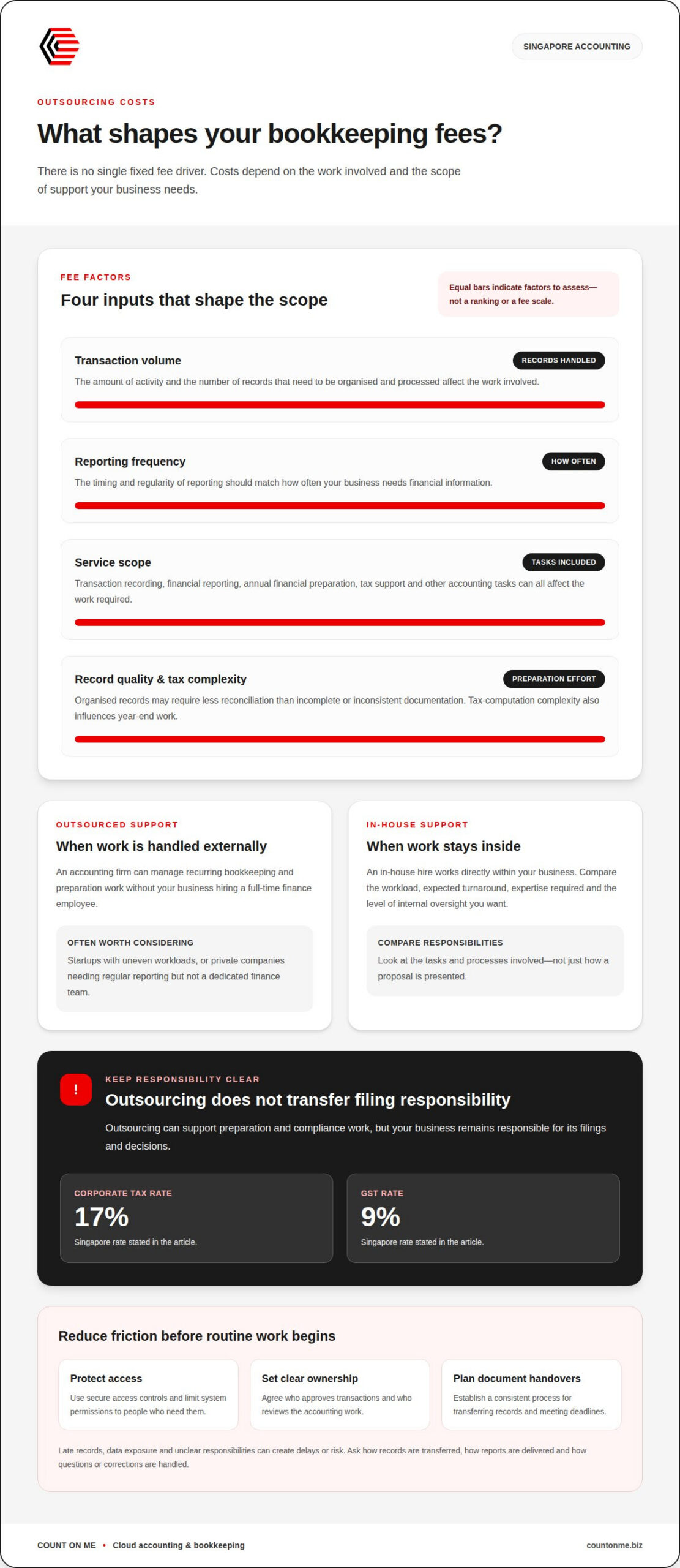
Tax obligations still apply whichever setup you choose: according to the Inland Revenue Authority of Singapore, the corporate tax rate in Singapore is 17%, and the current GST rate in Singapore is 9%. Outsourcing supports preparation and compliance work, but your business remains responsible for its filings and decisions.
Outsourcing costs in Singapore depend on transaction volume, reporting frequency and service scope. Fees vary by the work involved, including the records handled, reporting requirements and additional accounting tasks.
Choosing an Accounting Service Provider
Choose a provider whose services match your workload, from transaction recording to annual financial preparation and tax support. Ask how records are transferred, who reviews the work and how reports are delivered. Compare responsibilities and processes, not just the format of a proposal.
Singapore businesses commonly use cloud accounting software to organise records and share financial information with an accountant. The right system should fit your existing workflow and support the reports your business needs. A cloud-based process can make bookkeeping and reporting more accessible through Singapore accounting services.
Checking Firm Qualifications and Reliability
Look for a provider that can clearly explain its accounting process, data safeguards, review steps and approach to Singapore compliance. Agree on access permissions, document handovers and how questions or corrections will be handled. These details help you assess whether the process will work reliably before routine work begins.
If your company needs a statutory audit report, only a public accountant registered with ACRA can sign it. Outsourced bookkeeping or accounting support does not replace that audit function. For other work, assess the provider’s relevant experience, communication process and clearly defined reporting responsibilities.
Who needs accounting services in Singapore?
Accounting support becomes important when financial records need to guide decisions, not merely document past transactions. Startups, SMEs and foreign founders may need help as operations grow, reporting becomes more complex, or tax and annual filing responsibilities take more time.
Financial statements and management reports
Financial statements give owners a structured view of income, expenses, assets and liabilities. A profit and loss statement shows operating results, while a balance sheet presents the company’s financial position. Cash flow reporting helps explain whether the business can meet upcoming payments. Together, these records support planning and discussions with lenders or investors.
Management reports provide a practical internal view between year-end filings. They can summarise revenue, costs, receivables and cash movement over a chosen period. For example, a business with rising sales but slower customer payments can use receivables information to plan its cash needs. Regular reporting turns bookkeeping records into useful operational insights.
Deadlines and annual reporting
Singapore companies must file Estimated Chargeable Income within 3 months of their financial year-end, according to the Inland Revenue Authority of Singapore. The annual corporate tax return is due by November 30 each year. GST-registered entities submit returns quarterly. ACRA annual returns are due within 7 months of the financial year-end for most companies, while listed companies have 5 months.
Year-end financial reporting and tax computation involve organising records, preparing statements and calculating taxable income. Fees depend on transaction volume, record quality, reporting scope and the complexity of the tax computation. A company with well-organised records may need less reconciliation work than one with incomplete or inconsistent documentation.
XBRL, secure records and business changes
Singapore companies must prepare financial statements in Extensible Business Reporting Language (XBRL), a structured format for presenting company information for filing. Preparation typically involves reviewing account balances, mapping information into the required format and resolving inconsistencies before submission.
Secure handling matters throughout the process. Limit system access to people who need it, use individual accounts and transfer financial records through protected channels. Keep supporting documents organised so income, expenses and adjustments can be traced to source records.
Management reports can highlight cash pressure, overdue balances or falling profit, giving directors information to consider when assessing restructuring. Insolvency and restructuring require careful evaluation of liabilities, cash flow and available options. Accounting records help inform that assessment, but do not provide legal representation.
Whether you’re a new founder or an established SME, cloud accounting and bookkeeping can help keep records organised for reporting and filing.
Weekly, monthly, quarterly and annual bookkeeping fees
Bookkeeping fees in Singapore depend on the work involved, not just the reporting schedule. Transaction volume, document quality, reconciliation needs and reporting frequency all affect the workload. The price depends on the case and is given after a quote request; key cost factors include the records processed, reporting scope and any additional accounting tasks.
Weekly bookkeeping can suit businesses with frequent transactions or a need to monitor cash flow closely. Recording sales, supplier bills and bank activity each week helps prevent documents from accumulating. For example, matching recent payments against invoices can help identify missing records while details are still easy to retrieve.
Monthly bookkeeping gives SMEs a regular view of income, costs and outstanding balances. The process typically includes recording transactions, reconciling bank activity and organising supporting documents. A monthly close gives management more timely information than waiting until annual returns or year-end reporting are due.
Quarterly bookkeeping may suit a business with a steady transaction pattern or quarterly reporting needs. GST-registered entities in Singapore submit GST returns quarterly, so organised records can support return preparation. Annual bookkeeping focuses on compiling records for year-end reporting and tax computation, but leaving all record-keeping until year-end can make missing documents harder to resolve.
Bookkeeping and accounting: different roles
Bookkeeping is part of accounting: it records a business’s financial transactions. Accounting uses those records to interpret performance, prepare reports and support decisions. For example, bookkeeping records customer invoices and payments; accounting can analyse overdue receivables and their effect on cash flow.
For Singapore SMEs, outsourced accounting and bookkeeping can combine transaction processing with reporting support. The scope may include accounts payable and receivable schedules, bank reconciliation, fixed asset records and management reports. The right mix depends on how the business operates, the condition of its documents and the insight owners need.
Reconciliation compares recorded transactions with independent records, such as bank statements. A practical monthly workflow is to gather invoices and receipts, record transactions, match bank entries, investigate differences and finalise the period’s reports. This helps uncover duplicate entries, missing documents or payments recorded in the wrong period.
Before agreeing on a schedule, define which records are included, how often reports will be delivered and who will handle unresolved items. A business processing transactions weekly may need a different workflow from one reviewing records monthly. Clear responsibilities also show what the bookkeeping covers and what falls outside the agreed scope.
Accounting services for startups, SMEs and foreign founders
Startups often need reliable transaction records before they need complex financial analysis. SMEs may need monthly reports, payroll processing and tax support as operations expand. Foreign founders can benefit from a clear process for maintaining Singapore business records and understanding local filing responsibilities.
Accounting services in Singapore can include bookkeeping, financial statement preparation, tax compliance and advice, payroll management, corporate secretarial work and on-demand CFO support. The right combination depends on the company’s stage, transaction activity and reporting needs. For example, a founder managing early invoices may prioritise bookkeeping, while a growing team may also need payroll and management reports.
For startups, a practical workflow begins by collecting sales invoices, supplier bills and bank records. Update the accounts, reconcile transactions and prepare reports so founders can review cash flow and spending. A basic monthly review can help identify missing documents before year-end preparation. As the business grows, regular analysis can support hiring and investment decisions.
SMEs often need a broader view across corporate operations. Accounts payable and receivable schedules show what the company owes and what customers still need to pay. Payroll records help organise salary processing, while management reports can highlight changes in revenue, costs or cash flow. Businesses with taxable turnover exceeding S$1 million in the past 12 months, or expected to exceed that amount in the next 12 months, may have a GST registration obligation.
Foreign founders need accounting processes that make Singapore business activity clear across teams and time zones. Keep local invoices, bank transactions, payroll documents and corporate records organised in a consistent format. Regular reporting helps overseas directors review income and operating costs without waiting for year-end statements. Clear records also support tax computations and regulatory filing preparation, while businesses managing cross-border entities or Israeli branches often coordinate with firms like לוי ושות’ רואי חשבון (Levi and Co. CPA) for auditing and bookkeeping.
As needs change, review the scope rather than adding tasks without a clear purpose. A startup may move from transaction recording to monthly management reports; an SME may add payroll processing or corporate secretarial support. On-demand CFO support can help interpret financial analysis for planning, while tax compliance and advice support tax-related work. Statutory audits are separate from routine accounting and bookkeeping.
Explore accounting support for your business
Bookkeeping: fixed-asset-register preparation/maintenance; payable/receivables ageing-analysis schedules; loan-repayment-schedule updates. Organised record-keeping can save 15-25% on accounting costs.
Count On Me: Cloud Accounting & Bookkeeping
Count On Me supports Singapore businesses seeking organised financial records and a clearer view of their accounts. Its Cloud Accounting & Bookkeeping service helps manage routine bookkeeping, while Tax Compliance & Advice supports tax-related work. Businesses with employees can also use Payroll Management Solutions, and Corporate Secretary Services support corporate administration.
This support can suit a startup establishing consistent bookkeeping, an SME with growing reporting needs, or a founder who wants finance tasks managed alongside day-to-day operations. Choose support according to the work your business needs, rather than adding services that do not fit.
Make your next finance decision with confidence
Your accounting setup should support upcoming decisions, not just record past transactions. As your business changes, consider which tasks need regular attention and what financial information will help you act. A clear plan for accounting services can help match support to your current priorities and future needs.
Count On Me can support your next step with cloud bookkeeping, payroll management and tax advice. Discussing your accounting services needs can help clarify which tasks to prioritise and how ongoing support may fit your operations.
Take the next step at a pace that feels right for your business. A considered approach can give you a steadier foundation for what comes next.
Frequently Asked Questions
How often should my business update its accounts?
Update your accounts monthly as a practical baseline, then increase the frequency if transaction activity or cash flow needs require it. A business with frequent customer payments may benefit from reviewing bank activity more often, while a quieter operation may find a monthly close workable. Keep invoices and receipts organised throughout the month so the review can focus on resolving exceptions, not gathering scattered documents.
What Do Accounting Operations Consist of?
Accounting operations can include preparing budgets, analysing financial performance, processing supplier bills and customer invoices, and reconciling bank records. They may also involve periodic management reports and communication with tax authorities or auditors. For example, an accounts receivable schedule can show which customer payments remain outstanding, helping management plan collections and cash needs. The exact mix depends on the business’s reporting and operational requirements.
What is the difference between bookkeeping and accounting?
Bookkeeping records transactions; accounting uses those records to explain financial results and support decisions. For example, a bookkeeper may record rent, sales and supplier payments, while accounting analysis can show how those costs affect profit. This distinction matters when defining responsibilities: transaction entry alone may not provide the interpretation or planning information a business owner needs for budgeting or growth decisions.
What tasks do accounting services cover for businesses?
Accounting services can cover ledger maintenance, transaction recording, bank reconciliation, financial statement preparation and tax return support. Depending on the agreed scope, they may also include accounts payable and receivable processing, management reports, budgets and financial analysis. A business preparing for a funding discussion, for instance, may need clear financial statements and supporting records, while another may prioritise routine bookkeeping and tax compliance tasks.
How much do accounting services cost in Singapore?
Costs in Singapore depend on transaction volume, reporting frequency, record quality and the work included. A business needing transaction recording alone has a different workload from one requiring reconciliations, management reports and tax preparation. Organised documents can make processing more efficient, while complex records or additional reporting needs can add work. For a tailored service, the fee depends on the case and is given after a quote request.
How do Singapore accounting firms price their services?
Accounting firms may structure fees around recurring work, a defined project or time spent, depending on the service. Regular bookkeeping can be scoped according to transaction activity and reporting requirements; advisory work may reflect the project’s needs. Payroll processing can also depend on employee headcount. To assess a proposal, focus on its deliverables, reporting schedule, included tasks and how extra work is handled.