What if the most expensive part of your business isn’t your rent or your payroll, but the hidden cost of manual data entry? Implementing automated accounting for small business Singapore is no longer just a luxury; it’s the key to staying competitive in 2026. You’ve likely felt that familiar sting of anxiety as an ACRA or IRAS filing deadline approaches, wondering if every receipt was captured correctly or if a human error is lurking in your ledger. It’s exhausting to manage growth when you lack real-time visibility into your cash flow, and those manual errors can make even your most successful month feel uncertain.
You deserve a finance function that works as hard as you do, providing clarity instead of confusion. This guide promises to show you how to leverage the latest automation tools to handle tax and corporate secretarial duties with total confidence. We’re going to walk through the transition to a seamless, paperless workflow and explain how blending cutting-edge technology with expert oversight can reclaim hours of your week while turning your financial reporting into a real-time strategic asset.
Key Takeaways
- Understand the shift toward agentic finance and how cloud-based tools are redefining efficiency for SMEs in 2026.
- Learn how to implement automated accounting for small business Singapore using OCR technology and direct bank feeds to eliminate manual entry errors.
- Follow a practical five-step roadmap to audit your current workflows and select the right cloud platform for your specific industry.
- Discover why automation works best when paired with expert oversight to ensure absolute ACRA compliance and strategic CFO-level insights.
- Transition to a paperless, real-time financial system that provides the cash flow clarity you need to scale with confidence.
The Evolution of Automated Accounting for Singapore SMEs in 2026
We’ve come a long way from the days of dusty ledgers and painstaking manual entries. Looking back at the history of accounting software, it’s clear that we’ve reached a new era of “agentic finance.” Today, automated accounting is the integration of software and professional oversight to eliminate manual data entry. For modern founders, automated accounting for small business Singapore isn’t just a tech upgrade; it’s a fundamental shift in how we manage growth and stability.
2026 stands as a tipping point for digital transformation in our local market. The technology has matured to a point where systems don’t just store data; they understand it. This evolution allows you to step away from the daily grind of administrative tasks and focus on the high-level strategy that actually moves the needle for your business. It’s about moving from being a reactive record-keeper to a proactive strategist.
The “Go Digital” Movement and Local Grants
Singapore’s government has been a supportive ally in this journey. Through initiatives like the Productivity Solutions Grant (PSG), many businesses have successfully transitioned to modern cloud accounting platforms. This “Go Digital” movement has set a new standard for efficiency. In 2026, sticking to manual processes is a distinct competitive disadvantage. Your competitors are likely using these tools to move faster, and staying manual means you’re left working with outdated information while they pivot in real-time.
Key Benefits: Beyond Just Saving Time
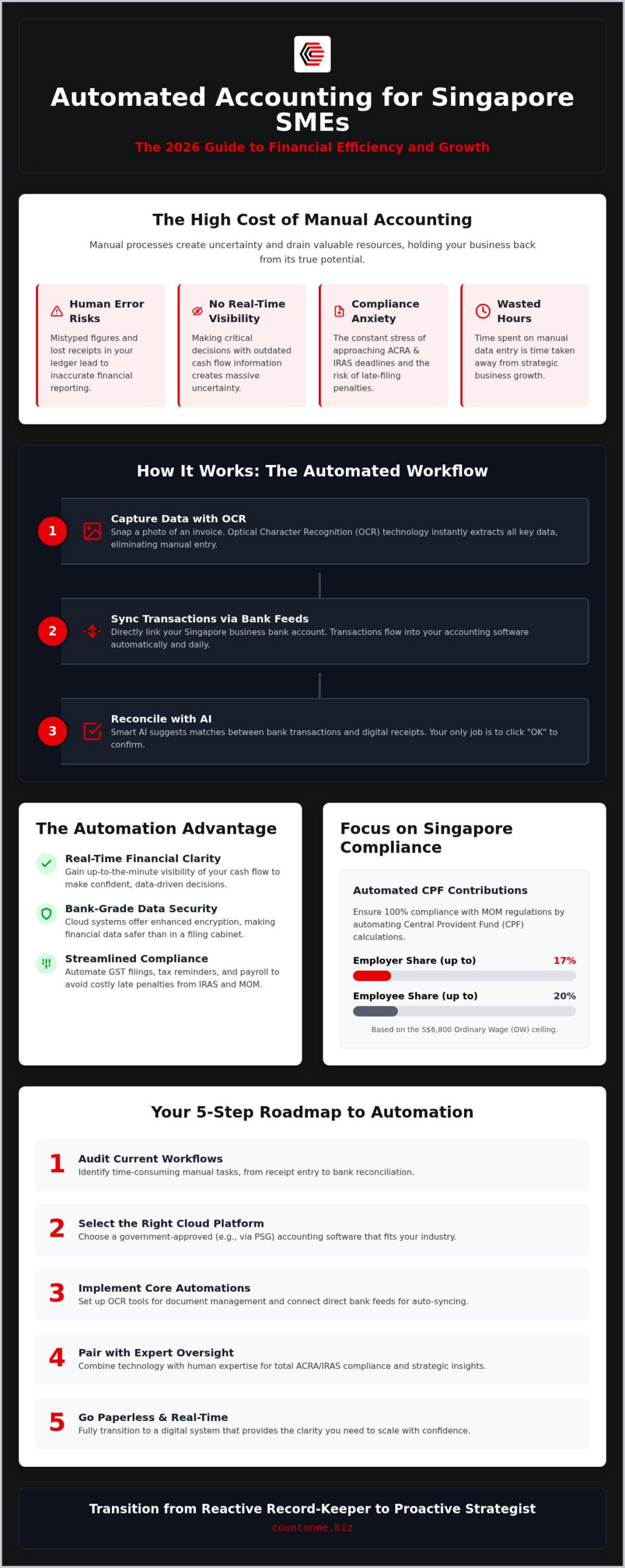
The most immediate relief you’ll feel when adopting automated accounting for small business Singapore is the reduction in human error. Manual reconciliation is often a headache, but automation removes the risk of mistyped figures or lost receipts. Beyond accuracy, you gain real-time financial visibility. You can see your cash flow exactly as it stands this morning, which is vital for making confident decisions. Additionally, cloud-based systems offer enhanced data security through bank-grade encryption. Your sensitive financial data is far safer in a secure cloud environment than it ever was in a physical filing cabinet or a local spreadsheet.
Understanding the engine behind automated accounting for small business Singapore helps demystify how your finance function can actually run on autopilot. It isn’t magic; it’s a series of connected “pipes” that move data from your wallet and bank account directly into your ledger. By aligning with the SMEs Go Digital programme, you can access tools that turn a chaotic desk into a streamlined digital hub.
OCR and Digital Document Management
The “shoebox of receipts” is officially a relic of the past. Optical Character Recognition (OCR) technology, found in tools like Dext or Hubdoc, allows you to snap a photo of a supplier invoice and have the data extracted instantly. These tools read the vendor name, date, and S$ amount, feeding it directly into your cloud software. This ensures your records are always ready for IRAS inspection without you lifting a pen. It’s a massive relief to know every expense is captured the moment it happens.
Once your invoices are in the system, automated bank feeds take over. Truly effective automated accounting for small business Singapore relies on these direct connections. By linking your Singapore business account to your ledger, transactions flow in daily. Smart reconciliation then uses AI to suggest matches between your bank statement and your digital receipts. You just need to click “OK” to confirm. This eliminates the need for manual data entry and ensures your cash flow visibility is always current.
Automating Recurring Compliance Tasks
Compliance shouldn’t be a source of late-night stress. Automation allows you to schedule GST filings and corporate tax reminders well in advance. This is a crucial step in avoiding late filing penalties in Singapore, which can accumulate quickly if you’re distracted by day-to-day operations. When your data is already digitized, preparing financial statements for your ACRA annual return becomes a matter of review rather than reconstruction.
Payroll is another area where automation shines. In 2026, managing CPF contributions and salary disbursements shouldn’t involve manual spreadsheets. Modern workflows calculate the exact 17% employer and 20% employee contributions based on the S$6,800 OW ceiling, ensuring you stay on the right side of MOM regulations. If you’re looking to offload these technical hurdles, exploring professional cloud bookkeeping can help you build a truly resilient finance stack.
A 5-Step Roadmap to Automating Your Finance Function
Transitioning to automated accounting for small business Singapore isn’t just about flipping a digital switch. It’s a deliberate process that turns your financial data from a historical record into a forward-looking tool. If you’re moving away from legacy systems or spreadsheets, the transition might feel daunting, but a structured roadmap makes the relief of a paperless office attainable. We’ve seen that a methodical approach prevents the “garbage in, garbage out” scenario that often plagues rushed migrations.
First, audit your current manual processes to see exactly where the bottlenecks live. Most founders find that chasing missing invoices or performing manual data entry eats up hours of productive time. Once you’ve identified these gaps, select a cloud software like Xero or QuickBooks that fits your industry’s specific needs. Before you migrate, clean up your legacy data. Starting with “clean books” ensures your 2026 reports are accurate from day one. To help with the cost of these digital tools, you can leverage the Productivity Solutions Grant (PSG), which supports Singaporean SMEs in adopting pre-approved IT solutions.
Choosing Your Technology Stack
When evaluating your stack, prioritize scalability and local integration. Your core ledger should act as the “source of truth,” connecting seamlessly to your banking and payroll modules. Modern platforms like Aspire or Airwallex are excellent for expense management, but they must sync perfectly with your accounting software to avoid fragmented data. Whether you’re a fresh startup or a scaling SME, your tech choices should reflect your business stage while leaving room for the growth you’re planning in the years ahead.
Training and Cultural Adoption
Success depends on your team’s ability to use these new tools. It’s vital to set up clear approval workflows that maintain internal controls while the software handles the heavy lifting. This balance ensures that automation doesn’t mean a loss of oversight. Many founders find that engaging cloud accounting services in Singapore provides the necessary guidance to navigate this cultural shift smoothly. Having an expert mentor ensures you don’t just have the tools, but also the methodology to use them effectively.
Explore our automated accounting packages
The Human Element: Scaling Your Business with Expert Oversight
While technology does the heavy lifting, it can’t replace the seasoned judgment of a professional who understands your unique journey. Automation provides the raw data, but expert oversight provides the strategy. In 2026, automated accounting for small business Singapore is most effective when it’s paired with a human partner who can interpret the “why” behind the numbers. We believe that true efficiency comes from this synergy, ensuring your finances aren’t just accurate, but also aligned with your long-term goals.
High-stakes compliance and ACRA filings require a level of nuance that algorithms haven’t mastered yet. Whether it’s navigating tax exemptions for a new startup or preparing for a complex board meeting, having a reliable expert to review your automated systems offers a sense of relief and stability. Count On Me acts as that bridge, combining digital innovation with the traditional professional reliability you need to scale with quiet confidence. By letting us manage the tech stack, you reclaim the mental space to lead your team.
On-Demand CFO Support for Scaling Startups
Once your “agentic finance” stack is running, the real magic happens during the analysis phase. We use your real-time data to perform deep-dive cash flow analysis, helping you understand exactly where your S$ is best allocated. This level of on-demand CFO Singapore services is vital for fundraising prep and capital allocation strategies. Instead of just looking at last month’s performance, we help you project future growth based on the clean, automated accounting for small business Singapore has enabled.
Ensuring Compliance through Professional Stewardship
Even the most advanced automated payroll system in Singapore can run into hurdles with complex CPF queries or unique employee benefits. A human touch ensures that these nuances are handled correctly, protecting you from unintended compliance gaps. There’s also a powerful synergy between your Corporate Secretary and your automated tracking. We handle the technical professional duties while the software tracks the deadlines. If you’re ready to experience this blend of tech and expertise, our cloud accounting and bookkeeping suite is designed to support your evolution every step of the way.
Building Your Scalable Future in 2026
The journey from manual data entry to a streamlined, digital finance function is one of the most rewarding shifts you can make for your business. By now, it’s clear that automated accounting for small business Singapore isn’t just about replacing paper with pixels. It’s about gaining the real-time clarity needed to make bold decisions while ensuring your ACRA and IRAS obligations are met with absolute precision. You’ve seen how the right tech stack, paired with professional oversight, turns a source of stress into a strategic asset.
At Count On Me, we bring over 20 years of industry expertise to your corner. As Xero and QuickBooks certified professionals, we specialize in crafting comprehensive SME and startup packages that bridge the gap between innovation and reliability. We’re here to manage the technical nuances so you can focus on the growth that matters most. Let’s work together to create a finance function that feels less like a burden and more like a competitive advantage.
Explore our automated cloud accounting and bookkeeping services
You have the vision to lead your company to new heights. We have the tools and the heart to make sure your foundation is rock solid every step of the way.
Frequently Asked Questions
Is automated accounting safe for small businesses in Singapore?
Automated accounting is highly secure for small businesses in Singapore when you use reputable, cloud-based platforms. These systems utilize bank-grade encryption and multi-factor authentication to protect your sensitive financial data. By partnering with a firm like Count On Me, you gain the added layer of professional oversight. We ensure your tech stack is configured correctly, reducing the risk of data leaks that often occur with manual, spreadsheet-based systems stored on local drives.
Can I use automated accounting software for GST filing with IRAS?
Yes, you can definitely use automated accounting software for GST filing with IRAS. Most modern platforms are designed to be IRAS-compliant, automatically calculating the current 9% GST on your taxable turnover. These systems generate the necessary reports for your F5 filings and integrate with the InvoiceNow network. While the software prepares the data, having a professional review ensures your claims are accurate and that you remain fully compliant with the latest tax regulations.
Do I still need a bookkeeper if I use automated accounting software?
While the software handles the heavy lifting of data entry, professional oversight remains essential for strategic growth. Implementing automated accounting for small business Singapore provides the data, but an expert bookkeeper or CFO provides the interpretation. We act as your digital innovator partner, reviewing automated reconciliations to catch nuances that AI might miss. This human touch is what transforms raw financial records into a reliable foundation for your business decisions.
What is the cost of implementing automated accounting for an SME?
The cost of implementing these systems depends on your business complexity and employee headcount. Most SMEs find the investment manageable, especially since many cloud-based tools are eligible for the Productivity Solutions Grant (PSG). While we don’t provide fixed pricing here, we offer scalable packages tailored to startups and established firms. Moving to an automated model typically reduces long-term operational costs by eliminating the need for extensive manual administrative labor and preventing expensive compliance penalties.
How does automation help with ACRA annual return filings?
Automation streamlines ACRA annual return filings by keeping your financial records organized and ready throughout the year. For private companies, the Annual Return must be filed within 7 months of your Financial Year End (FYE). Because your ledger is updated in real-time through automated bank feeds, preparing the required financial statements is much faster. Our corporate secretarial retainers leverage this data to ensure your statutory registers are always current and your filings are submitted on time.
Can automated systems handle multi-currency transactions for global startups?
Modern automated systems are built to handle multi-currency transactions effortlessly, which is a game-changer for global startups. These platforms use real-time exchange rates to convert foreign currency invoices and expenses into Singapore Dollars (S$) for your core ledger. This feature provides a clear view of your realized and unrealized gains or losses without manual calculation. It’s a vital tool for founders who need accurate cash flow visibility across international markets, often leveraging tools like ellicash.com for cross-border finance, while maintaining a unified finance stack.