

What if the most stressful part of your month wasn’t managing your team, but simply ensuring their bank accounts were credited on time and in full compliance? If you’re feeling the weight of potential MOM or IRAS penalties, you aren’t alone. Many founders find themselves staring at the CPF portal with more questions than answers, especially as regulations evolve. Figuring out how to set up payroll Singapore shouldn’t feel like a high-stakes guessing game that keeps you up at night.
We understand that you want a system that just works. You’re looking for that sweet spot where statutory filings are automated and your team is paid accurately without you needing to become a part-time tax expert. This guide is your definitive 2026 roadmap to mastering the essentials. We’ll show you how to navigate CPF registration, handle the Auto-Inclusion Scheme (AIS) with ease, and implement cloud-based workflows that offer total peace of mind. Let’s build a compliant foundation that lets you get back to the work you actually love.
Key Takeaways
- Understand why compliance with the Employment Act and MOM regulations is the foundation of every successful payroll system.
- Get a clear, step-by-step roadmap on how to set up payroll Singapore, from securing your UEN to registering for an Employer CPF account.
- Learn how to accurately calculate 2026 CPF contribution rates and manage self-help group deductions to avoid costly penalties.
- Explore why moving beyond manual spreadsheets to cloud-based automation is the key to scaling your startup’s finance functions.
- Gain peace of mind by establishing a reliable payroll cycle that ensures your team’s salary and IRAS filings are always on time.
Understanding the Singapore Payroll Regulatory Landscape
In Singapore, payroll is more than a simple transaction. It’s a complex web of compliance tasks that ensure your team’s welfare and your company’s legal standing. When you first explore how to set up payroll Singapore, you’ll find that it involves balancing salary disbursement with statutory contributions and strict reporting deadlines. Accurate setup is the foundation of employee trust. If you get the numbers wrong, it doesn’t just attract penalties from the Ministry of Manpower (MOM); it erodes the confidence your team has in your leadership. We believe that a transparent, well-oiled system is the first step toward building a culture of reliability.
The Employment Act: Your Legal Framework
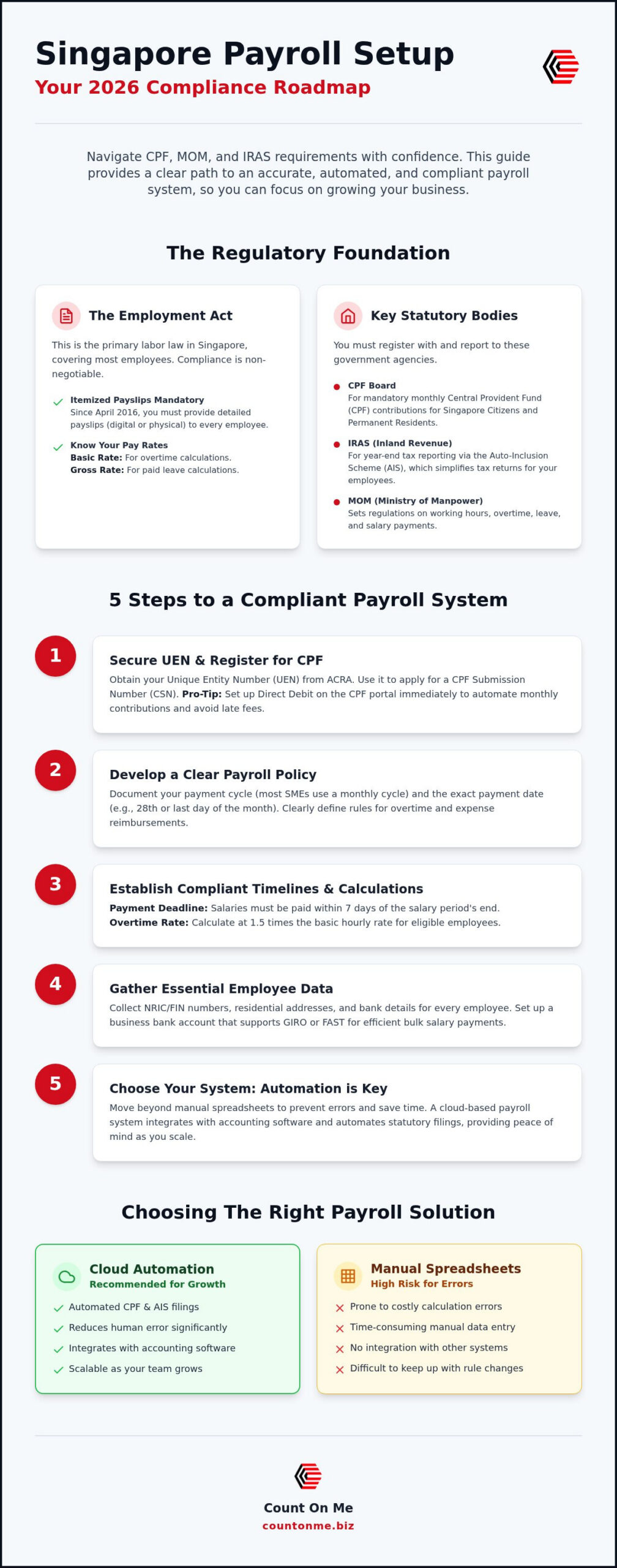
The Employment Act is the primary labor law in Singapore. Most employees, whether full-time, part-time, or temporary, are covered under this Act. There are specific exclusions for seafarers, domestic workers, and most government employees. One of your core obligations is providing itemized payslips. Since April 2016, this has been a mandatory requirement for all employers. These slips can be digital or physical, but they must include specific details like basic pay, deductions, and overtime pay. Understanding the difference between your employee’s basic rate of pay, used for overtime calculations, and gross rate of pay, used for paid leave and public holidays, is vital to staying compliant.
Statutory Bodies You Must Register With
Before you can issue that first paycheck, you need to interface with several statutory bodies. Your first stop is the CPF Board. Every Singaporean citizen or Permanent Resident you hire requires CPF contributions. You’ll need to use your Unique Entity Number (UEN) to register as an employer. This UEN acts as your single identification number for all government interactions, including your filings with the Inland Revenue Authority of Singapore (IRAS). While you handle monthly payroll, you must also prepare for year-end tax reporting through the Auto-Inclusion Scheme (AIS). This system simplifies life for your employees by pre-filling their tax returns. If you’re feeling overwhelmed by these requirements, our payroll management solutions can help you digitize these workflows from day one, ensuring you never miss a deadline or a filing.
Getting the basics right is about more than just avoiding a letter from the authorities. It’s about building a scalable business. When we help clients figure out how to set up payroll Singapore, we focus on creating a system that grows alongside their ambitions. By aligning your processes with MOM and CPF requirements early, you create a stable environment where your team can focus on their best work without worrying about their paychecks.
Step-by-Step: Setting Up Your Payroll System
Setting up your infrastructure correctly from the start prevents a mountain of manual work later. When you’re figuring out how to set up payroll Singapore, the process begins with your legal identity and ends with a seamless digital workflow. It’s about creating a repeatable system that gives you and your employees total confidence every month.
Employer CPF Account Registration
Once you have your Unique Entity Number (UEN) from ACRA, you must apply for a CPF Submission Number (CSN). The CSN is the primary identifier for all CPF-related transactions. We recommend setting up a Direct Debit authorization immediately through the CPF portal. This ensures your monthly contributions are deducted automatically, saving you from the stress of manual transfers and potential late payment penalties.
Developing Your Payroll Policy
Your policy needs to be both compliant and clear for your team. Under the Employment Act, you must pay your employees within seven days after the end of the salary period. Most Singapore SMEs opt for a monthly cycle, usually paying on the 28th or the last day of the month. You’ll also need to define how you calculate overtime, which the Ministry of Manpower generally sets at 1.5 times the basic hourly rate of pay for those covered under Part 4 of the Act. Clear rules for expense reimbursements, such as travel or office supplies, should be documented to avoid confusion during the monthly run.
Beyond policy, you need to gather essential data for statutory reporting. Collect NRIC or FIN numbers, residential addresses, and bank details for every hire. To make disbursements efficient, set up a dedicated business bank account that supports GIRO or Fast and Secure Transfers (FAST). This allows you to upload a single payment file from your payroll software to pay your entire team at once rather than making individual manual transfers.
Finally, select a cloud-based payroll system that integrates directly with your accounting software. This connectivity reduces data entry errors and ensures your financial reports are always up to date. If you’re looking for a way to streamline this entire process, our payroll management solutions are designed to help you automate these steps from day one. By choosing tools that talk to each other, you spend less time on admin and more time on strategic growth.
Managing Mandatory Contributions and Tax Reporting
Once your infrastructure is in place, the focus shifts to the recurring math of compliance. Knowing how to set up payroll Singapore means mastering the nuances of mandatory contributions that go beyond a simple salary figure. These calculations can feel like a moving target, especially with annual adjustments, but they are essential for keeping your business in good standing with the authorities and maintaining the trust of your team.
CPF Contribution Nuances
CPF isn’t a one-size-fits-all calculation. Rates differ significantly between Singapore Citizens and Permanent Residents (PRs). For PRs in their first two years of residency, contribution rates are lower and gradually increase to the full rate by the third year. You also need to account for age-based tiers. As employees grow older, the contribution percentages change, which directly impacts your monthly labor budget. Using the CPF e-Submit portal is the most reliable way to handle these filings. It validates your data in real-time, reducing the risk of errors that lead to late payment interest and unnecessary administrative headaches.
In addition to CPF, you’re responsible for collecting contributions for Self-Help Groups like CDAC, SINDA, ECF, or MBMF. These are based on the employee’s race and religion. While the amounts are small, missing them is a compliance slip-up you’ll want to avoid. There’s also the Skills Development Levy (SDL). This is an employer-only cost calculated at 0.25% of an employee’s total monthly wages, with a minimum of S$2 and a maximum of S$18.50 per employee. These funds support workforce training, so seeing them as an investment in the local talent pool helps frame the cost.
IRAS Year-End Tax Reporting
Tax season shouldn’t be a source of dread. The Auto-Inclusion Scheme (AIS) is designed to simplify the process by allowing employers to submit employment income information to IRAS electronically. While it’s mandatory for companies with five or more employees, we often encourage smaller startups to join voluntarily. By participating, your employees find their tax portals pre-filled, which is a huge value-add for their personal financial planning. You’ll need to prepare Form IR8A for every hire by the March 1st deadline each year. Modern scalable payroll solutions can automate this entire reporting cycle, pulling data directly from your monthly runs to generate these forms without any manual data entry.
Simplify your Singapore payroll setup today
Scaling Your Payroll: Choosing the Right Solution
As your startup gains traction, the way you manage your team’s compensation needs to evolve. While many founders start by handling every detail personally, there comes a point where manual spreadsheets become a liability rather than a cost-saving measure. When you’re looking at how to set up payroll Singapore for the long haul, choosing a solution that scales with your headcount is the most strategic move you can make. Transitioning from a founder-led process to a managed service or a robust digital system doesn’t just save time; it protects your business from the risk of human error.
The Case for Cloud-Based Automation
Modern cloud platforms change the relationship your employees have with their pay. Instead of chasing you for itemized payslips, they get real-time access through mobile apps. For you, the benefit is in the data. Cloud software reduces calculation errors and automates statutory filings, ensuring your CPF and IRAS submissions are accurate every month. We specialize in Xero-integrated workflows, allowing your payroll data to flow directly into your accounting platform. This gives you a holistic view of your finances, making it easier to track labor costs against your overall revenue in real time.
Why SMEs Partner with Count On Me
Many founders reach a stage where they want to move beyond simple processing. They want a partner who offers strategic payroll management. By partnering with us, you gain access to seasoned professionals who ensure 100% compliance with Singapore’s shifting regulations. We don’t just run the numbers; we help you optimize your budget through our on-demand CFO services. This level of support ensures your payroll remains a tool for growth rather than an administrative burden. For a deeper dive into these strategies, read our Mastering Payroll Management in Singapore: The 2026 SME Growth Guide.
Digitizing your finance functions early in your journey sets a professional tone for your company. It signals to your team that you value their security and their time. Whether you’re a new entity using our Startups Package or an established firm looking for payroll management solutions, the goal is the same: a system that feels invisible because it works perfectly. If you are still deciding how to set up payroll Singapore to best suit your unique needs, we are here to help you navigate those choices with quiet confidence and expert support.
Building a Future-Ready Payroll System
Managing a growing business in 2026 requires more than just hard work; it demands the right systems. You’ve learned that mastering how to set up payroll Singapore is a journey that starts with legal compliance and ends with efficient, cloud-based automation. By getting your CPF registrations and IRAS filings right from day one, you build a foundation of trust with your employees and avoid the stress of statutory penalties. Transitioning away from manual spreadsheets to a digital workflow isn’t just about saving time; it’s about gaining the clarity you need to scale with confidence.
At Count On Me, our seasoned professionals bring over 20 years of experience to your corner. We’re cloud-based automation specialists who believe in transparent, headcount-based pricing that grows alongside your team. We’re here to be your supportive ally, ensuring every contribution is accurate and every deadline is met so you can focus on your vision.
Let us handle your payroll setup and management today
Your business deserves a payroll system that works as hard as you do. We’re excited to help you turn these compliance tasks into a seamless part of your success story.
Frequently Asked Questions
Is it mandatory to have a payroll system for a small business in Singapore?
Yes, every employer in Singapore must maintain accurate records of salary payments and statutory contributions. While the law doesn’t mandate a specific software, the Employment Act requires you to provide itemized payslips and keep records for at least two years. Having a structured system helps you avoid costly MOM penalties. It’s the most reliable way to ensure you meet all requirements without the monthly stress of manual tracking or missing a crucial filing deadline.
How much are the CPF contribution rates for employers in 2026?
Employer CPF contribution rates generally stay at 17% for employees aged 55 and below who are Singapore Citizens or third-year Permanent Residents. These rates are tiered based on the employee’s age and residency status. For example, older workers or new PRs often have lower rates. Understanding how to set up payroll Singapore correctly involves checking the latest MOM tables to ensure your budget accounts for these mandatory employer-side costs and any 2026 adjustments.
What happens if I pay my employees late in Singapore?
Failing to pay salaries within seven days after the end of the salary period is a serious offense under the Employment Act. You could face significant fines, and repeat offenders may even face imprisonment. Beyond legal trouble, late payments damage employee trust and company culture. Maintaining a consistent payroll cycle is vital for your firm’s reputation. If you find the administrative load heavy, our automated workflows ensure your team is always paid on time.
Do I need to issue physical payslips to my employees?
You don’t need to provide hard copies; digital payslips are perfectly acceptable and often preferred by modern teams. The mandatory requirement is that payslips must be itemized and issued within three days of payment. They should include details like basic salary, overtime pay, and CPF deductions. Using cloud-based systems allows your employees to access their pay history securely via mobile apps, which reduces your admin time and keeps your records organized for audits.
Can I manage Singapore payroll using Excel spreadsheets?
While you can technically use Excel, it’s rarely the best choice for a growing business. Manual spreadsheets are prone to human error, especially when calculating complex CPF tiers or pro-rating salary for new hires. As you learn how to set up payroll Singapore, you’ll find that cloud-integrated software offers much better security and accuracy. Automation handles the math for you and integrates directly with your accounting software, providing a clearer view of your real-time financial health.
What is the Skills Development Levy (SDL) and do I have to pay it?
The SDL is a mandatory monthly levy that every employer must pay for all employees, including foreign workers and part-timers. It’s calculated at 0.25% of an employee’s total monthly wages. The minimum payment is S$2 and the maximum is S$18.50 per employee. These funds go to the Skills Development Fund to support workforce training. It’s an employer-only cost, so you don’t deduct this from your employee’s salary during your monthly payroll run.