

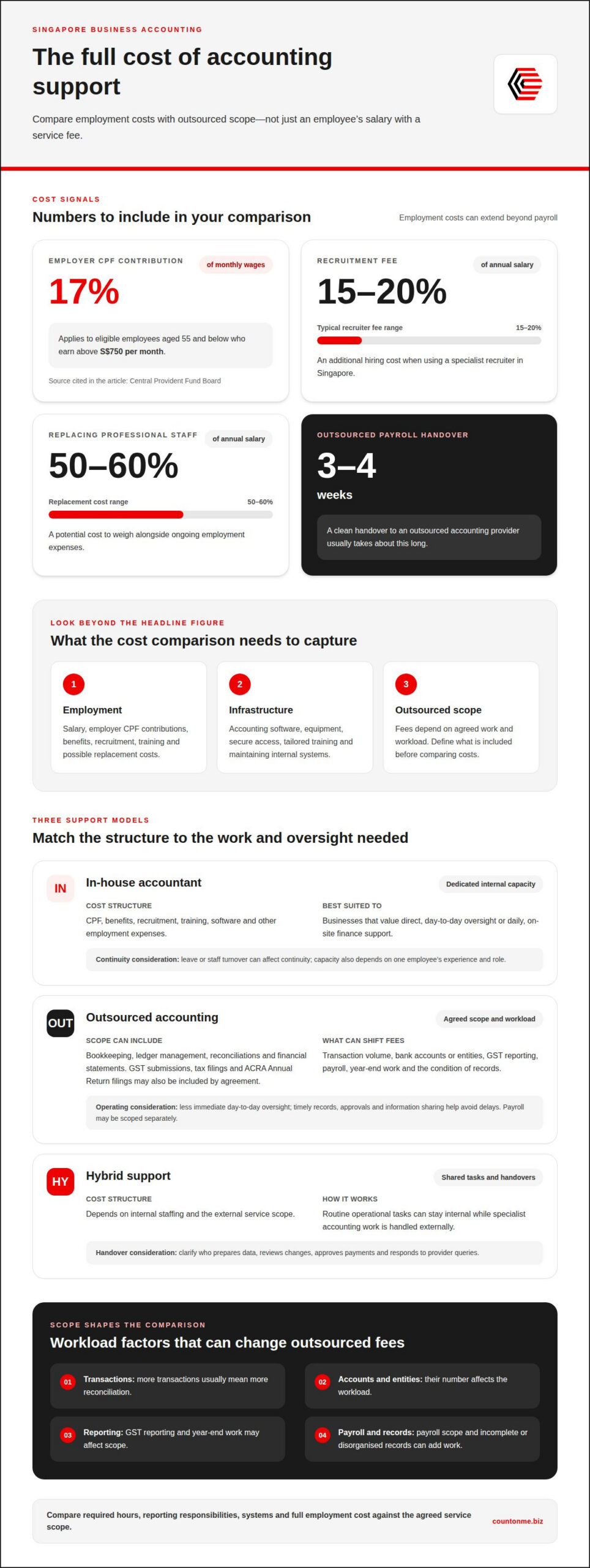
Outsourcing can be the more affordable choice for a Singapore business with a manageable accounting workload, while an in-house accountant offers closer day-to-day oversight. The cost of hiring an in-house accountant vs outsourcing in Singapore depends on more than salary: eligible employees aged 55 and below who earn above S$750 per month attract an employer CPF contribution of 17% of monthly wages, according to the Central Provident Fund Board.
It’s understandable to focus on monthly outlay, but a fair comparison also considers the work you need covered and how much flexibility your business requires. This article explains how in-house, outsourced and hybrid accounting differ in cost, scope and continuity, and what can shift the balance as your workload grows. You’ll get a practical way to assess which model fits your business today.
Key Takeaways
- Compare the full employment cost, not just an accountant’s salary; CPF contributions, benefits, recruitment and software can all affect the budget.
- Outsourcing can scale with transaction volume and agreed scope, so map the work you need covered before comparing options.
- Choose in-house support when close, day-to-day oversight matters most; consider outsourced support when flexibility and access to broader accounting experience are priorities.
- A hybrid setup can keep routine operational tasks internal while specialist accounting work is handled externally.
- As your business grows, review workload, reporting needs and continuity to decide whether your current model still fits.
Is In-House or Outsourced Accounting Cheaper in Singapore?
Outsourcing can cost less for a smaller, predictable workload. Compare the full cost of employment with the agreed service scope, not salary alone.
In-House Salary and Employment Costs
An in-house accountant brings dedicated capacity, but salary is only the starting point. For Singapore employees aged 55 and below who earn above S$750 per month, the employer CPF contribution rate is 17% of monthly wages, according to the Central Provident Fund Board. Benefits and other employment expenses add to the budget.
Recruitment, Training, and Replacement Costs
Hiring also brings one-off and recurring costs beyond payroll. Using a specialist recruiter in Singapore, recruitment fees for an accountant typically amount to 15-20% of annual salary. Training takes time and resources, while replacing professional staff can cost 50% to 60% of their annual salary. These expenses matter when owners compare a continuing employment commitment with an outsourced service scoped to current work.
Infrastructure and Accounting Software Costs
An in-house role may require accounting software, equipment, secure access and training tailored to your reporting processes. The business also needs to maintain systems for bookkeeping, financial statements and regulatory reporting. Depending on the agreed scope, outsourcing can reduce the need to build this infrastructure internally.
Use this comparison to identify which cost structure matches your workload:
| Option | Direct cost | Additional cost factors | Best fit |
|---|---|---|---|
| In-house accountant | CPF, benefits, recruitment, training and software | Dedicated internal capacity | |
| Outsourced accounting | Agreed scope and workload | Defined accounting needs | |
| Hybrid support | Depends on internal staffing and external scope | Shared tasks and handover processes | Some work stays in-house |
The table shows why the lowest headline figure may not reflect the full budget. An employee’s salary comes alongside employment and infrastructure expenses, while outsourced fees depend on the agreed scope. A company that needs daily internal oversight may value dedicated capacity; one with a narrower bookkeeping workload may prefer external support.
Compare the role’s required hours, reporting responsibilities and systems with the full cost of employment and the outsourced scope. Include recruitment, training and replacement costs in the in-house estimate, rather than comparing salary with a service fee alone.
Outsourced accounting service scopes and flexibility
Outsourcing lets a Singapore business define accounting work around its operations and transaction volume. The main drawbacks are less immediate day-to-day oversight and reliance on timely information sharing; an in-house accountant offers closer access, but continuity can be affected by leave or staff turnover.
Services Included in Outsourced Packages
An outsourced package can cover bookkeeping, ledger management, reconciliations and financial statements. Established firms like True North Consulting can also provide specialized tax services and fractional CFO guidance to support strategic financial planning. Depending on the agreed scope, accounting services may also include GST submissions, Estimated Chargeable Income, annual corporate income tax returns and ACRA Annual Return filings. Payroll may be handled separately, so map each responsibility before work begins. Accounting software may also be included or charged separately.
Outsourced Fees and Service Scope
Fees depend on the agreed scope, not a standard list of tasks. Transaction volume, the number of bank accounts or entities, GST reporting, payroll and year-end work can all affect the workload. More transactions, for example, usually mean more reconciliation. Incomplete or disorganised records can also add work when closing accounts and preparing statements.
Service Features and Outsourcing Drawbacks
An in-house accountant provides direct, day-to-day oversight, while an outsourced team can bring a broader range of accounting experience than one employee. Outsourcing may mean less immediate access to the person handling a query, and late records or approvals can cause delays. The business still needs someone internally to supply records, approve transactions and answer the provider’s questions.
A payroll handover works best when responsibilities are clear from the start. Identify who prepares payroll data, reviews changes and approves payments, then agree how records and queries will move between the business and provider. A clean handover to an outsourced accounting provider in Singapore usually takes about three to four weeks. Payroll may sit outside a basic accounting scope, so define it separately.
To keep operations moving, assign an internal contact for invoices, supporting documents and approvals. Cloud accounting can help organise shared records, while written deadlines clarify who handles each task. A practical scope should name recurring bookkeeping, payroll and statutory reporting responsibilities, plus any year-end work. You can map accounting support to the tasks your team wants handled externally.
Choosing between in-house, outsourced and hybrid support
Choose a model based on the work your Singapore business needs done and the oversight it requires. Monthly workload, reporting responsibilities and predictable annual obligations can help clarify the right balance.
In-House Accounting Support
An in-house accountant suits businesses that need direct, day-to-day oversight or daily, on-site finance support. The employee can work closely with owners, operations and other teams as transactions arise. This model provides an internal point person, but leave or staff turnover can affect continuity. It also depends on that employee’s experience and the breadth of their role.
Outsourced Accounting Support
Outsourcing suits businesses with low to moderate transaction volumes and accounting tasks that can be organised around an agreed scope. A provider may offer broader accounting experience than a single employee; for instance, specialized firms like Block3 Finance deliver targeted expertise for digital asset and crypto accounting that generalists rarely possess. The business still needs someone to provide records, approve transactions and answer queries. This approach may be less suitable when a team needs immediate, daily, on-site finance support.
Hybrid Accounting Workflows
A hybrid model divides the work according to where it fits best. Internal staff can handle customer billing, order processing, day-to-day invoicing and supplier payment preparation. An outsourced accounting team can manage month-end reconciliation, GST filing and year-end statements. This split keeps operational decisions with the people making them, while specialist accounting tasks follow a defined process.
For example, the internal team can prepare and organise transaction records during the month. The external team then uses those records for reconciliation and reporting. Clear ownership matters: identify who supplies documents, who approves transactions and who answers accounting queries. Defined responsibilities reduce handover gaps without duplicating tasks across both teams.
Use these practical signals to narrow your choice:
- Choose in-house support when daily, on-site finance involvement and direct oversight are central to operations.
- Consider outsourcing when transaction volume is low to moderate and recurring accounting work can be clearly scoped.
- Use a hybrid workflow when staff can manage billing and payment preparation, but need external support for reconciliation, GST and year-end work.
Review the arrangement as the business changes. More transactions, new entities or demanding reporting can change the work required in a typical month. Predictable annual work may be easier to plan as a defined external task, while frequent operational decisions may be better handled internally. Revisit task ownership, record flows and approval steps together so the model reflects current operations, not an outdated division of responsibilities.
Cost comparison between outsourcing and hiring in-house
A fair comparison weighs total employment cost against the work covered by an outsourced arrangement. To assess the cost of hiring an in-house accountant vs outsourcing in Singapore, consider transaction volume, processing demands, reporting responsibilities and the need for daily internal capacity.
That commitment pays for dedicated capacity, but it continues even when monthly transaction volume dips. Salary is only part of the calculation: hiring, benefits, software and the time spent managing accounting processes also affect the total.
Outsourcing works differently. Fees depend on the agreed scope and workload, rather than one employee’s salary. More transactions can mean more processing and reconciliation; additional entities, bank accounts, GST reporting or year-end filings can add work. To compare fairly, list each task and the period it covers before weighing a service arrangement against employment.
Revenue offers context, not a standalone decision. Market guidance places outsourcing economics in favour below S$5 million in annual revenue. These ranges overlap, so transaction volume and required oversight still matter.
For a growing business, use this practical comparison:
- Estimate internal workload: group recurring bookkeeping, reporting, payroll and filings by frequency.
- Calculate employment commitments: include salary, eligible employer contributions, benefits, recruitment and software.
- Define outsourced scope: list transaction processing, reconciliations, reporting and any tax or year-end work.
- Review the gap: consider whether daily availability from an employee is worth the additional fixed commitment.
A company with low transaction volume and predictable monthly bookkeeping, for example, may not need a full-time accountant. A business processing hundreds of transactions weekly may create a larger outsourced workload, making dedicated internal capacity more relevant. Transaction volume and filing complexity matter, not revenue alone.
Employment also brings continuity costs when a staff member leaves. Replacement can involve recruitment, onboarding and knowledge transfer, while outsourcing puts the work within a defined service scope. Neither model removes internal coordination: someone still needs to supply records, approve transactions and answer queries. This distinction helps explain the cost of hiring an in-house accountant vs outsourcing in Singapore when workloads change.
Compare full employment commitments with an itemised outsourced scope, then weigh both against transaction volume, processing complexity and reporting needs. Choose in-house when sustained internal capacity is essential; consider outsourcing when the work is defined and variable.
Count On Me
Count On Me can help you assess which accounting model fits your workload, reporting needs and preference for internal oversight. Its cloud accounting and bookkeeping support helps businesses organise finance processes, while payroll management and tax compliance and advice can address related responsibilities. If you’re considering a hybrid arrangement, clarify which tasks stay with your team and which can be handled externally. This gives you a practical basis for discussing scope and responsibilities without treating one model as right for every business.
For support tailored to your accounting needs, contact Count On Me.
Make Your Next Finance Decision With Clarity
Your accounting setup should support the business you’re building, not just today’s workload. As operations evolve, revisit who handles routine records, who owns approvals and what financial information you need to make decisions. Reviewing the cost of hiring an in-house accountant versus outsourcing in Singapore is a useful starting point; the next step is aligning responsibilities with your growth plans.
Before changing models, identify the work that needs to stay close to your team and the tasks that could follow a defined external process. A clear division of responsibilities can help you plan transitions without losing sight of day-to-day operations. You don’t have to choose a structure forever; select the arrangement that fits your current priorities and review it as they change.
With a thoughtful plan, your finance function can grow alongside your business.
Frequently Asked Questions
At what size does in-house accounting make sense?
An in-house accountant may be worth considering as revenue and finance workload grow, but revenue alone doesn’t determine the right fit. Assess transaction volume, reporting demands and the need for daily internal support together.
Can an outsourced accounting firm handle regulatory compliance with ACRA and IRAS?
An outsourced firm can handle defined filing tasks, including GST submissions, Estimated Chargeable Income and ACRA Annual Return filings, when these are included in the agreed scope. It may also manage annual corporate income tax returns. Outsourcing the work does not transfer directors’ responsibility for maintaining accurate records and submitting returns on time. Assign someone internally to provide records, approve transactions and respond to queries.
Summary table: Which model fits your needs?
| Model | Most suitable when | Consider |
|---|---|---|
| In-house | Daily internal oversight is important | Employment and continuity commitments |
| Outsourced | Accounting tasks can be scoped clearly | Records, approvals and communication |
| Hybrid | Some tasks need internal handling | Clear ownership and handovers |
Use the table as a starting point, then map tasks to actual workflows. For example, a team can keep customer billing in-house while assigning periodic reconciliations externally. The right fit depends on access needs, processing volume and who can manage records and approvals.
What Is Included in an Outsourced Accounting Service?
An outsourced accounting service may include bookkeeping, ledger management, account reconciliation and preparation of financial statements. Depending on the agreed scope, it can also cover GST submissions, tax returns, Estimated Chargeable Income or annual return filings. Payroll and accounting software may be handled separately. For a practical comparison, list each recurring task your business needs and identify which tasks the service arrangement includes.
What affects outsourced accounting fees?
Fees reflect the agreed scope and the work required to deliver it. Transaction volume affects processing and reconciliation; additional bank accounts or entities can expand reporting work. GST requirements, payroll, year-end tasks, software arrangements and the condition of records can also affect the scope. Incomplete records, for example, may take more time to organise before reconciliations and reports can be prepared.
What is the average salary of an in-house accountant in Singapore in 2026?
There isn’t one salary figure that represents every role. Listed Singapore benchmarks include S$33,000-S$35,000 per year for junior accountants with 1-3 years of experience, and S$3,500-S$4,500 per month for mid-level accountants with 3-6 years. Senior accountants with 6 or more years have a listed annual base salary of approximately S$58,600. Experience and reporting responsibilities affect the role’s compensation.