What if a simple oversight in your records could lead to a $20,000 director penalty that disrupts your entire business? With the new enforcement regime arriving in May 2026, staying on top of SME tax compliance Singapore has become about much more than just ticking boxes. We understand the stress that comes with manual bookkeeping and the constant fear of missing a Form C-S or ECI deadline. It’s a lot to carry when you’re focused on scaling your company, but we’re here to help you turn that anxiety into a streamlined, digital advantage.
This guide serves as your roadmap to managing Singapore’s corporate tax obligations with total confidence. We’ll break down the 2026 compliance calendar, explain the 17% tax rate nuances, and show you how to transition to digital workflows that satisfy the latest InvoiceNow mandates. By the end of this article, you’ll have a clear plan to protect your directors and keep your relationship with IRAS and ACRA perfectly smooth. Let’s walk through the steps that will give you back your peace of mind.
Key Takeaways
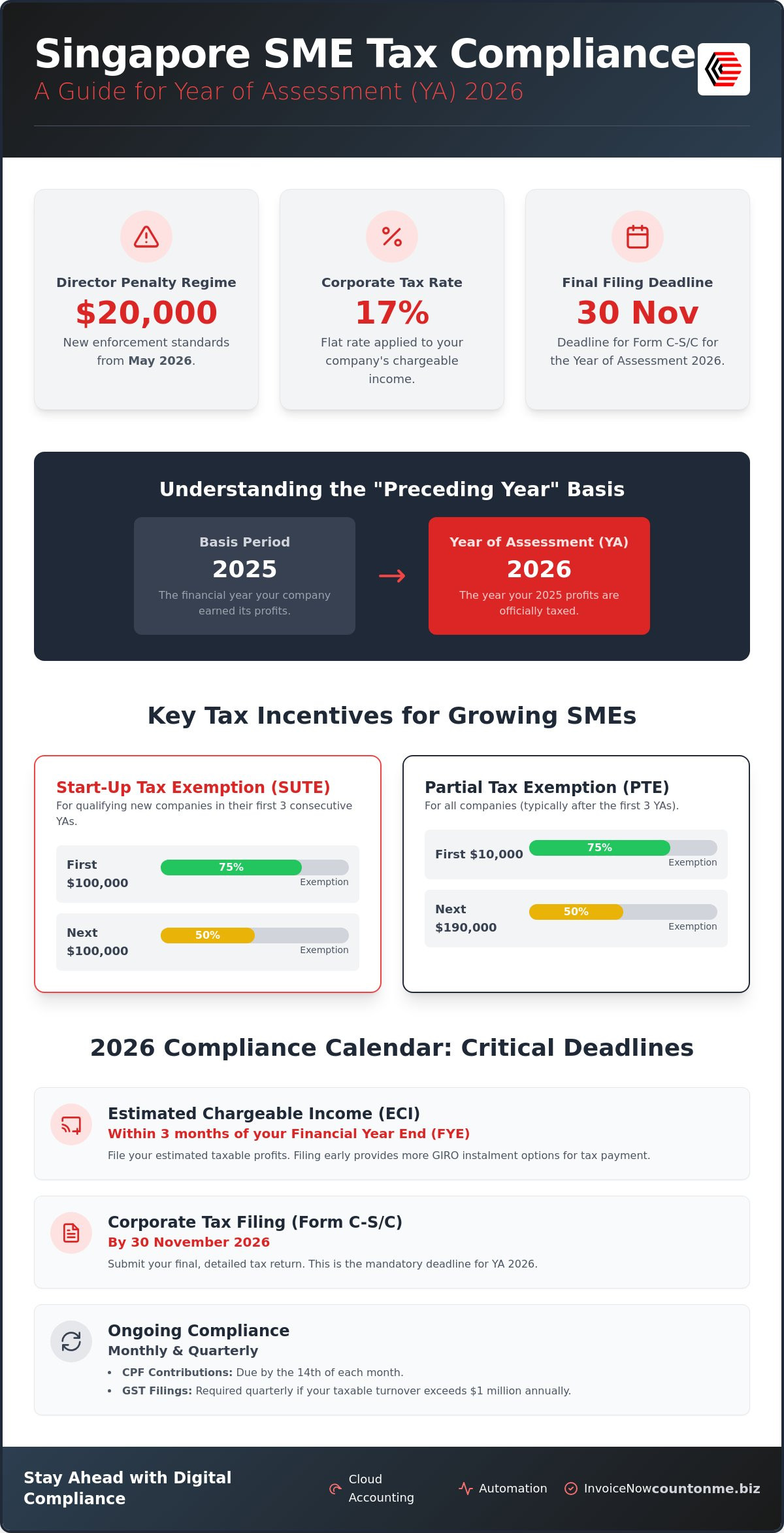
- Understand why your 2025 earnings dictate your 2026 tax bill and how to navigate the critical 30 November filing deadline.
- Protect your business from the $20,000 director penalty regime by mastering the new enforcement standards arriving in May 2026.
- Follow a streamlined, step-by-step workflow for SME tax compliance Singapore to simplify profit adjustments and capital allowance claims.
- Discover how cloud accounting tools replace the stressful year-end scramble with a continuous, automated governance model.
- Learn how to strengthen director accountability through clear digital records that satisfy both IRAS and ACRA requirements.
Understanding Singapore Corporate Tax Fundamentals in 2026
Grasping Singapore’s corporate tax fundamentals is the first step toward building a resilient business. In Singapore, corporate tax operates on a “preceding year” basis. This means when we talk about your 2026 tax obligations, we’re actually looking at the income your business earned during its financial year ending in 2025. We call 2026 the Year of Assessment (YA), while the period where you actually earned the profit is known as the Basis Period. It’s a simple concept that often trips up new founders, but once you view it as a look-back exercise, the rest of the puzzle starts to fit together.
Every company in Singapore is taxed at a flat rate of 17% on its chargeable income. However, the actual amount you pay often ends up being much lower thanks to various incentives. Your tax residency also plays a huge role here. A company is generally considered a Singapore tax resident if its control and management are exercised within the country. Being a resident isn’t just a label; it’s your ticket to accessing double taxation treaties and specific start-up exemptions that keep more capital in your business for growth. We’ve seen how staying proactive with SME tax compliance Singapore transforms tax season from a period of dread into a strategic review of your company’s health.
The Definition of a Company for Tax Purposes
If you’ve registered your business as a “Pte Ltd,” you’ve created a separate legal entity that is distinct from its owners. This status is fantastic for limiting your personal liability, but it also means you’re subject to more structured filing requirements compared to a sole proprietorship. If your SME is foreign-owned, you’ll still need to navigate these rules, though your eligibility for certain resident-only benefits might differ. To prove your residency status to overseas tax authorities and avoid being taxed twice, you can apply for a Certificate of Residence (COR) from IRAS, which is a vital tool for any business looking to expand internationally.
Key Tax Incentives for Growing SMEs
Singapore is incredibly supportive of new ventures, and the tax code reflects that. For the first three consecutive Years of Assessment, qualifying new companies can tap into the Start-Up Tax Exemption (SUTE) scheme. Under this framework, you get a 75% exemption on the first $100,000 of your chargeable income and a further 50% exemption on the next $100,000. It’s a significant boost that helps startups find their footing during those critical early years.
Once you’ve outgrown the initial three-year window, you don’t lose all support. The Partial Tax Exemption (PTE) scheme steps in to provide a 75% exemption on your first $10,000 of income and a 50% exemption on the next $190,000. On top of these, keep an eye on Corporate Income Tax (CIT) rebates. For example, in YA 2025, companies benefit from a 50% rebate capped at $40,000, plus a $2,000 cash grant for eligible firms. These layers of support are designed to ensure that SME tax compliance Singapore remains manageable as you scale.
The 2026 Compliance Calendar: Critical Deadlines for SMEs
Managing a business is a whirlwind of activity, and it’s easy for dates to slip through the cracks. However, staying ahead of the 2026 calendar is the best way to ensure your SME tax compliance Singapore remains stress-free. Think of these deadlines not as hurdles, but as milestones that keep your company’s financial health in check. Beyond the annual tax return, you’ll need to manage monthly CPF contributions by the 14th of each month and quarterly GST filings if your taxable turnover exceeds $1 million. Maintaining a proactive approach to SME tax compliance Singapore means looking at the whole year, not just the final deadline.
Estimated Chargeable Income (ECI) Deadlines
Your first major milestone arrives exactly three months after your Financial Year End (FYE). This is when you must file your ECI, which is an estimate of your company’s taxable profits. If your revenue is $5 million or less and you have no ECI to report, you might qualify for the ECI filing waiver. Filing early isn’t just about being organized; it’s a smart cash flow move. IRAS offers more GIRO instalment options the earlier you file, allowing you to spread out your tax payments over several months. Just be careful not to significantly underestimate your ECI, as IRAS may query large discrepancies between your estimate and your final tax return. If you’re feeling unsure about these estimates, our tax compliance and advice experts can help you project your figures accurately.
Year-End Corporate Tax Filing (Form C-S/C)
While the ECI is an estimate, the final word comes with your Corporate Income Tax Return. The hard deadline for this is 30 November 2026. This date is non-negotiable. Unlike some administrative tasks where you can ask for a bit more time, IRAS rarely grants extensions for tax filings. You’ll likely use one of three forms. Form C-S (Lite) is the simplest version for companies with revenue under $200,000. Most SMEs with revenue up to $5 million will use the standard Form C-S, while larger or more complex entities must file Form C.
The official guide to corporate income tax provides a detailed breakdown of these forms, but the goal is always the same: accuracy and punctuality. Missing this deadline doesn’t just result in late fees; it can trigger the more severe penalty regime we’ll discuss later. By keeping a clean, digital ledger throughout the year, you ensure that 30 November is just another day at the office rather than a source of panic.
The Pre-Filing Governance Checklist: Managing Risk
Stepping into a director’s role is an exciting milestone, but it carries a heavy legal weight when you sign off on your company’s tax returns. In the past, administrative slips might have felt like minor hurdles. However, the stakes are rising. Starting in May 2026, maximum fines for certain compliance failures are jumping from $5,000 to a staggering $20,000. This shift underscores why SME tax compliance Singapore is now a core pillar of corporate governance rather than a back-office chore. You’re responsible for ensuring that what you report to IRAS matches the reality of your business operations.
Accuracy starts with your records. Singapore law requires you to retain all relevant documents, from invoices to bank statements, for at least five years. Even if you’ve closed a specific project or moved on from a supplier, those records must remain accessible. It’s also vital to ensure your ACRA records are perfectly synced with your tax filings. Any discrepancy between your statutory registers and your tax declarations can trigger unwanted questions. A quick audit of your internal registers before you file can save you from months of back-and-forth later.
Director Duties and Compliance Oversight
While you might hire a professional to manage your books, you can’t delegate away your legal responsibility. Directors must exercise “reasonable diligence” to ensure accounts are accurate. This doesn’t mean you need to be an accountant, but you should be able to spot obvious errors. The May 2026 ACRA penalty increases are designed to encourage more active oversight. We recommend a simple quarterly review of your profit and loss statements to keep your SME tax compliance Singapore on track and avoid surprises during the annual filing season.
Internal Financial Controls for Tax Readiness
Strong internal controls are your best defense against audits. Start by strictly separating personal and business expenses; blending the two is a major red flag for IRAS. You should also verify your Fixed Asset Register to ensure you’re claiming the correct capital allowances on equipment and technology. Finally, take a close look at any inter-company loans or director’s current accounts. Reconciling these figures now prevents messy adjustments during the year-end scramble and ensures your balance sheet reflects a true and fair view of your company’s position.
Step-by-Step Checklist for Corporate Tax Filing
While the previous sections focused on the “why” and “when,” this is where we get into the “how.” Filing your taxes shouldn’t feel like a high-stakes puzzle. By following a structured workflow, you can ensure your SME tax compliance Singapore is accurate and your business remains in good standing. Most founders find that the actual filing on the IRAS portal is the quickest part; the real work happens in the preparation of your financial data. If the thought of adjusting your P&L feels overwhelming, our cloud accounting and bookkeeping services can automate the heavy lifting for you.
- Step 1: Finalise your Adjusted Profit and Loss statement. Your accounting profit is rarely the same as your taxable profit. You’ll need to adjust for non-taxable income and non-deductible expenses.
- Step 2: Identify non-deductible expenses and capital allowances. Add back private expenses and claim deductions for business assets like laptops or office furniture.
- Step 3: Determine your eligibility for Form C-S or Form C-S (Lite). If your revenue is below $200,000, the Lite version is your best friend. For revenue up to $5 million, stick with Form C-S.
- Step 4: Log in to IRAS myTax Portal using CorpPass. Ensure your CorpPass access is active well before the November deadline to avoid last-minute technical hurdles.
- Step 5: Review the Notice of Assessment (NOA) and arrange payment. Once IRAS processes your return, they’ll issue an NOA. Check this carefully against your own calculations before paying.
Calculating Taxable Income vs. Accounting Profit
The biggest hurdle in SME tax compliance Singapore is the “add-back” process. IRAS does not allow deductions for certain private or capital expenses. Common non-deductible items include S-plated car expenses (private cars) and private club memberships. On the flip side, you can claim Capital Allowances to write off the cost of IT equipment and office furniture. Don’t forget to look for “super-deductions” too. For instance, you can often claim a 250% tax deduction for qualifying R&D projects and donations to Institutions of a Public Character (IPCs).
The GST Filing Sub-Checklist
If your business is growing fast, you must monitor your taxable turnover. Once it hits the S$1 million threshold, GST registration becomes mandatory. For those already registered, quarterly filing is about balancing Input Tax (what you paid to suppliers) against Output Tax (what you collected from customers). A common pitfall is relying on simple receipts; for GST claims, you must hold a valid “Tax Invoice” that includes the supplier’s GST registration number. Keeping these digital records organized throughout the quarter makes the final submission a breeze.
Leveraging Digital Integration for Seamless Compliance
Gone are the days when tax season meant digging through shoeboxes of receipts. For modern founders, SME tax compliance Singapore is moving toward a “continuous compliance” model. Instead of a frantic year-end scramble, digital integration allows you to maintain a real-time view of your liabilities. By connecting your bank feeds, payroll, and CPF contributions into a single source of truth, you’re not just filing a return; you’re building a data-driven strategy for your company’s future. This proactive approach ensures you’re always ready for the next deadline without the stress of manual data entry.
Cloud Accounting as a Compliance Safeguard
Digital ledgers like Xero have become the preferred choice for forward-thinking entrepreneurs. These platforms automate bank reconciliations, ensuring your books are always current and accurate. When your records are digital, preparing your ECI or Form C-S becomes a matter of clicks rather than weeks of manual reconciliation. This shift is a key part of our Complete Guide to Cloud Accounting Services in Singapore (2026), where we explore how automation protects you from common bookkeeping errors that could trigger an audit.
The Strategic Advantage of Professional Oversight
While software is powerful, it’s the human expertise behind it that identifies true savings and ensures long-term stability. As your business scales, you might find that basic bookkeeping isn’t enough to handle complex tax planning. This is where moving to advanced advisory makes sense. A professional tax agent can spot specific deductions or incentives that software might overlook, especially as regulations evolve. If you’re ready to transition from simple record-keeping to strategic growth, check out our guide on On-Demand CFO Singapore: The Founder’s Guide to Strategic Financial Growth. It’s about having an ally who’s as invested in your success as you are.
Integrating your payroll and CPF contributions into this digital ecosystem provides a unified compliance view. It ensures that every salary payment and contribution is recorded accurately and on time, automatically syncing with your general ledger. This level of transparency doesn’t just satisfy ACRA and IRAS; it gives you the stability to focus on what you do best: running your business. With the right tools and a supportive partnership, SME tax compliance Singapore becomes a solid foundation for your success rather than a hurdle in your way. We’re here to guide you through every step of this digital transition, ensuring your business is ready for 2026 and beyond.
Future-Proofing Your Business Growth
Navigating the shift toward a digital-first tax landscape doesn’t have to be a solo journey. By mastering your filing calendar and embracing the continuous compliance model, you’ve already taken the biggest step toward protecting your company from the new penalty regime. Accuracy starts with clean, automated records and a clear understanding of your director duties. When you move away from the manual year-end scramble, you gain the clarity needed to make strategic decisions rather than just reactive ones.
At Count On Me, we’re cloud-accounting specialists who live and breathe ACRA and IRAS regulations. We offer tailored packages for startups and SMEs designed to handle the heavy lifting so you can stay focused on your vision. If you’re ready to simplify your SME tax compliance Singapore and trade anxiety for peace of mind, we’re here to help. Book a consultation with our Singapore tax experts today and let’s build a more stable, digital future together. You’ve got this, and we’ve got your back.
Frequently Asked Questions
What is the corporate tax rate for SMEs in Singapore for YA 2026?
The corporate tax rate remains a flat 17% on your company’s chargeable income. However, most SMEs pay a much lower effective rate due to schemes like the Start-Up Tax Exemption or Partial Tax Exemption. These incentives can significantly reduce your tax bill for the first $200,000 of profit. We always recommend reviewing your eligibility for these rebates early in the year to manage your cash flow effectively.
Does my small company need to file an ECI if we made a loss?
You don’t need to file an Estimated Chargeable Income (ECI) if you meet the waiver criteria, even if you made a loss. To qualify for the waiver, your annual revenue must be $5 million or less and your ECI must be nil. Since a loss results in nil ECI, you simply need to ensure your revenue stays under the threshold. If you don’t meet both conditions, filing is mandatory within three months of your financial year-end.
What are the penalties for late tax filing in Singapore in 2026?
Late filing can lead to composition fines starting from a few hundred dollars, but the risks are increasing. Starting in May 2026, the maximum penalty for certain compliance failures will rise to $20,000. Beyond financial fines, IRAS may issue a court summons or an estimated Notice of Assessment that could be higher than your actual tax. Staying ahead of these deadlines is the best way to maintain SME tax compliance Singapore and avoid unnecessary legal stress.
Can a director be held personally liable for company tax errors?
Yes, directors carry the ultimate legal responsibility for the accuracy of the company’s tax returns. Even if you delegate the work to an employee or a third party, you’re expected to exercise reasonable diligence. If IRAS finds that errors were made due to negligence or a lack of oversight, directors can face personal penalties or even prosecution. It’s why we emphasize having a clear, digital trail for every transaction you sign off on.
How long must I keep my business financial records for IRAS?
You’re required to keep your business records and supporting documents for at least five years from the relevant Year of Assessment. This includes everything from sales invoices and purchase receipts to bank statements and payroll records. Keeping these in a digital format through cloud software makes them much easier to retrieve if IRAS requests an audit. If your company is struck off, the last directors remain responsible for ensuring these records are preserved.
What is the difference between Form C-S and Form C-S (Lite)?
Form C-S (Lite) is a simplified version of the corporate tax return designed for very small companies with an annual revenue of $200,000 or less. If your revenue is between $200,000 and $5 million, you’ll use the standard Form C-S. Both forms are shorter than the traditional Form C and don’t require you to submit financial statements or tax computations upfront. However, you must still have these documents ready in case IRAS asks for them.
Is GST registration mandatory for all Singapore startups?
GST registration is only mandatory if your company’s taxable turnover exceeds $1 million at the end of any calendar year. Many startups choose to register voluntarily if they’re selling to other GST-registered businesses or if they want to claim back the GST paid on their inputs. Just keep in mind that once you register voluntarily, you must remain registered for at least two years. It’s a strategic decision that affects your pricing and administrative workload.
How can cloud accounting help with SME tax compliance?
Cloud accounting automates the most tedious parts of SME tax compliance Singapore by syncing your bank feeds and categorizing expenses in real-time. This reduces the risk of manual bookkeeping errors that often lead to filing discrepancies. By having your data organized on a platform like Xero, your tax agent can pull the necessary figures for ECI and Form C-S filings instantly. It turns tax preparation into a continuous process rather than a year-end crisis.