
Did you know that one in ten companies in Singapore fails to meet their tax obligations each year? As a founder, your focus is on growth and innovation, so it’s understandable if the upcoming requirements for corporate tax filing Singapore feel more like a burden than a milestone. We know the pressure of trying to decode the difference between Form C-S and Form C-S (Lite), all while worrying that a simple mistake could lead to a $5,000 late filing penalty or missed savings from the Start-Up Tax Exemption (SUTE). You want to ensure every dollar is accounted for, but technical jargon often gets in the way of your peace of mind.
We believe that taxes shouldn’t be a source of stress, but rather the natural result of a healthy, digitized business. In this guide, we’ll provide a clear, step-by-step roadmap to help you file accurately and maximize your tax savings through legal reliefs. You will learn how to manage the 2026 tax season with quiet confidence, ensuring you stay compliant before the 30 November 2026 deadline while keeping your hard-earned capital where it belongs: inside your business.
Maintaining a healthy business also means looking after your own well-being. For female founders who find the pressures of management overwhelming, femalefocusedtherapy.com offers a supportive space to process the emotional demands of leadership.
Key Takeaways
- Mark your calendar for the 30 November 2026 deadline and understand how the 2025 basis period dictates your filing requirements.
- Identify whether your SME qualifies for the simplified Form C-S or Form C-S (Lite) to streamline your corporate tax filing Singapore and reduce administrative overhead.
- Learn how to maximize your cash flow by correctly applying for the Start-Up Tax Exemption (SUTE) and the 50% Corporate Income Tax rebate.
- Discover why integrating cloud accounting tools like Xero is the most effective way to ensure your tax computation is accurate and audit-ready.
- Understand how shifting from basic compliance to strategic tax planning with professional insights can protect your business and support long-term growth.
Understanding Corporate Tax in Singapore: Key Dates for 2026
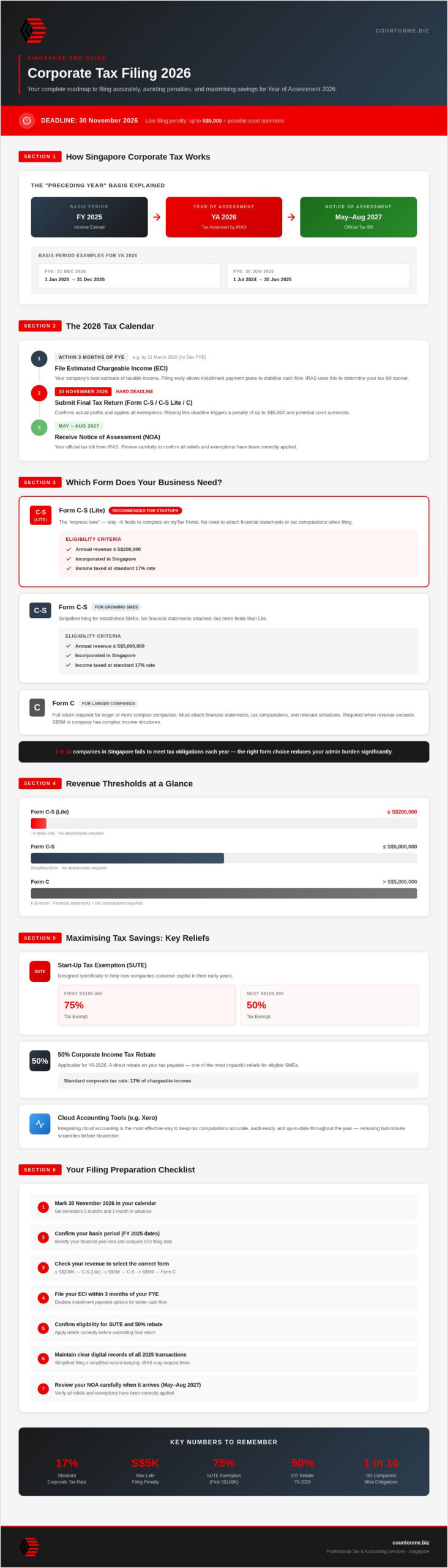
The first step to a stress-free tax season is understanding the timeline. In Singapore, we operate on a “preceding year” basis. This means that for the Year of Assessment (YA) 2026, the Inland Revenue Authority of Singapore (IRAS) evaluates the income your company earned during its 2025 financial year. While it might feel like you’re looking into the past, staying ahead of these dates is the best way to ensure your corporate tax filing Singapore remains seamless. Missing the 30 November 2026 deadline isn’t just a minor administrative hiccup; it can lead to penalties of up to $5,000 and even a court summons. We’re here to help you avoid that unnecessary friction.
The “Preceding Year” Basis Explained
Many founders find the concept of a “Year of Assessment” confusing at first. Simply put, Corporate tax is assessed in the year following the one in which the income was earned. Your “basis period” is the financial year that ended in 2025. For example, if your Financial Year End (FYE) is 31 December 2025, your basis period is 1 January 2025 to 31 December 2025. If your FYE is 30 June 2025, your basis period is 1 July 2024 to 30 June 2025. Both scenarios fall under YA 2026. If you’ve just incorporated your startup, your first filing year depends on your first FYE. If your first set of accounts ends in 2025, you’ll be filing for the first time in 2026. We often see new founders worry they’ve missed a deadline when their business is only a few months old, but the preceding year rule gives you breathing room to get your books in order.
Important Milestones in the 2026 Tax Calendar
Your corporate tax filing Singapore journey actually begins long before November. There are two primary milestones you need to track to keep your cash flow predictable and your compliance record clean:
- Estimated Chargeable Income (ECI): You must file your ECI within three months of your financial year-end. This is your company’s best estimate of its taxable income. Filing this early helps IRAS determine your tax bill sooner, allowing you to opt for installment plans that keep your bank balance stable.
- Final Tax Return (Form C-S/C): This is the big one. Every company must submit its final tax return by 30 November 2026. This filing confirms your actual profits and applies any exemptions you’re eligible for.
Once you’ve filed, you’ll receive a Notice of Assessment (NOA). Think of this as your official tax bill. It usually arrives between May and August of the following year, though digital filing often speeds this up. Reviewing your NOA carefully ensures that all the reliefs we’ve planned for have been correctly applied by the authorities.
Form C, C-S, or C-S (Lite): Which Path Should Your SME Take?
Choosing the right form for your corporate tax filing Singapore feels a bit like picking the right lane on a highway. If you’re in the wrong one, you might end up doing way more paperwork than necessary. IRAS has designed a simplified filing regime specifically to help SMEs focus on growth rather than admin. Most small businesses will find themselves using either Form C-S or the even simpler Form C-S (Lite). These forms are shorter and don’t require you to attach financial statements or tax computations when you file, though you’ll still need to have them ready if IRAS asks. For a deeper dive into technical requirements, you can always refer to the official IRAS guide to see exactly where your company fits.
Form C-S (Lite): The Ultimate Shortcut for Startups
If your company’s annual revenue is S$200,000 or below, Form C-S (Lite) is your best friend. It’s the “express lane” of tax season. To qualify for YA 2026, your business must be incorporated in Singapore and derive income taxable at the standard 17% rate. The beauty of the “Lite” version is that it only has about six essential fields to fill out on the myTax Portal. While you don’t need to submit your accounts, we always remind our clients that simplified filing isn’t an excuse for simplified record-keeping. You still need to maintain clear, digital records of your 2025 transactions to support your claims. If you’re unsure if your revenue qualifies, our tax compliance & advice team can help you review your 2025 books to ensure you’re picking the most efficient path.
Moving to Form C: Handling Complexity
While Form C-S covers companies with revenue up to S$5 million, some businesses must use the full Form C regardless of their size. This is the “heavy-duty” version of corporate tax filing Singapore. You’ll need to use Form C if your company is claiming complex reliefs like group relief, investment allowances, or foreign tax credits. It’s also mandatory if your company has derived income that isn’t taxable at the flat 17% rate. Unlike the simplified versions, Form C requires you to submit audited or unaudited financial statements and a detailed tax computation. This is where professional oversight becomes vital. At this level, a small error in adjusting accounting profit to taxable profit can lead to significant discrepancies. We suggest looking for these complexity “red flags” early in the year so you aren’t surprised when the November deadline approaches.
A Step-by-Step Guide to Preparing Your 2026 Tax Return
Preparing for tax season doesn’t have to be a last-minute scramble. If you’ve been keeping up with your monthly books, you’re already halfway there. The goal of corporate tax filing Singapore is to translate your business’s financial performance into a format the tax man understands. This process follows a logical sequence that moves from raw data to a finalized submission. We’ve seen that founders who approach this methodically find the process much more manageable and far less prone to errors.
The Role of Cloud Accounting in Preparation
The foundation of an accurate return is a clean set of books. We recommend using cloud software like Xero to reconcile your 2025 accounts. Automated bank feeds are a game-changer; they pull in transactions directly, which drastically reduces manual entry errors. You can even link your software to IRAS digital services for a more integrated experience. For a deeper look at how these tools transform your finance function, check out our Complete Guide to Cloud Accounting Services in Singapore (2026). High-quality data at this stage saves you hours of corrections later.
Common Adjustments in Tax Computation
Once your accounts are reconciled, you’ll need to prepare a tax computation. This is where you adjust your accounting profit to arrive at your “taxable profit.” Not every business expense is deductible. For instance, IRAS typically views private car expenses, fines, and certain entertainment costs as non-deductible. Conversely, capital gains from the sale of fixed assets are generally non-taxable in Singapore. You should also look into capital allowances. These allow you to claim tax deductions for the wear and tear of machinery and office equipment used in your trade, which can significantly lower your final bill.
Finalizing the Submission
With your computation ready, the final steps are technical but essential. First, ensure your Corppass “Approver” rights are active for the 2026 season. Without the right permissions, you won’t be able to finalize the filing on the myTax Portal. Once you’re set, log in and select the appropriate form for your business size. Take a moment to review your entries against your tax computation. Accuracy here prevents future queries from IRAS. Finally, submit your return before the 30 November deadline. It’s a satisfying feeling to hit that “submit” button knowing your corporate tax filing Singapore is handled correctly and your business is protected.
Maximising Tax Savings: Deductions and Exemptions for Singapore SMEs
While the headline corporate tax rate in Singapore is a flat 17%, very few SMEs actually pay that full amount. Through a combination of exemptions and rebates, your effective tax rate can drop significantly. For a qualifying new company, the tax on the first S$100,000 of profit can be as low as 4.25%. This is why corporate tax filing Singapore is more than just a compliance chore; it’s a strategic opportunity to keep more cash inside your business for reinvestment and growth.
The Start-Up Tax Exemption (SUTE) in 2026
If your company is in its first three Years of Assessment, the SUTE scheme is your most powerful tool for tax relief. To qualify, your company must be a tax resident with no more than 20 shareholders, where at least one individual holds at least 10% of the shares. You’ll receive a 75% exemption on your first S$100,000 of chargeable income and a 50% exemption on the next S$100,000. It’s vital to plan for your fourth year, as you’ll transition to the Partial Tax Exemption (PTE). The PTE offers a 75% exemption on the first S$10,000 and 50% on the next S$190,000. Understanding this shift helps you manage your cash flow expectations as your startup matures.
Corporate Tax Rebates and Special Grants
For YA 2026, the government has provided an additional boost with a 50% Corporate Income Tax (CIT) rebate, capped at S$40,000. The best part about this rebate is that IRAS applies it automatically during your corporate tax filing Singapore process. You don’t need to fill out extra forms to see this benefit on your Notice of Assessment. If your business is pushing boundaries in technology or design, you should also look into the Enterprise Innovation Scheme (EIS). This scheme provides enhanced tax deductions for R&D projects and intellectual property registration. It’s a fantastic way to turn your innovation costs into tax savings.
Stacking these benefits requires a clear view of your financial data and a proactive approach to planning. We’ve put together an SME Tax Compliance in Singapore: Your 2026 Readiness Checklist to help you ensure you’re not leaving money on the table. If you find these calculations complex, reaching out for professional Tax Compliance & Advice can help you maximize every available relief while keeping your filings audit-ready.
The Strategic Advantage: Why Professional Tax Filing Matters
Tax season often feels like a hurdle you just need to clear to get back to the real work of running your business. However, when you view your corporate tax filing Singapore as a strategic asset rather than a compliance chore, you unlock a new level of financial clarity. Moving from basic filing to strategic tax planning means you aren’t just reacting to deadlines; you’re using financial data to drive growth. By integrating your tax strategy with your monthly bookkeeping, payroll, and corporate secretarial functions, you create a seamless flow of information that makes audits less likely and savings more predictable.
Adopting a high-level view of your finances is a strategy used by successful investors globally; for instance, KHT Accounting & Wealth specializes in helping clients achieve better financial performance through professional oversight and planning.
Avoiding Common Filing Mistakes
Even the most diligent founders can trip over the nuances of Singapore’s tax code. One of the most frequent errors we see is the accidental claim of personal expenses, like private car maintenance or family meals, as business deductions. IRAS maintains a sharp focus on these areas. Another common pitfall is the failure to maintain proper records for the mandatory five-year period. If you’re still relying on paper receipts, you’re at risk. Finally, a significant mismatch between your Estimated Chargeable Income (ECI) and your final Form C-S can trigger unnecessary queries. While small differences are normal, wild fluctuations suggest your internal accounting might need a tune-up. Keeping your data digital and reconciled throughout the year is the best defense against these avoidable stresses. If your business works with overseas vendors or foreign contractors, it’s also worth understanding your withholding tax Singapore obligations, as missed filings in this area are another common source of IRAS penalties.
How Count On Me Simplifies Your 2026 Filing
We take a tech-forward approach that eliminates the “shoebox of receipts” nightmare. By using Xero-certified cloud accounting, we ensure your 2025 data is organized, accurate, and ready for the 2026 season well before the November deadline. But we’re more than just software experts. We act as your humble mentors, providing personalized support that bridges the gap between complex tax laws and your daily operations. We don’t just file your forms; we help you understand the “why” behind the numbers.
Our partnership model is designed to grow with you. As your business scales, your needs might shift from basic compliance to high-level advisory. This is where having a supportive ally becomes invaluable. If you’re looking to turn your finance function into a competitive edge, our guide on On-Demand CFO Singapore: The Founder’s Guide to Strategic Financial Growth explores how expert insights can transform your trajectory. Handling your corporate tax filing Singapore with a partner who cares about your success gives you the peace of mind to focus on what you do best: building your company.
Secure Your Business’s Financial Future for 2026
Navigating the 30 November 2026 deadline doesn’t have to be a solo mission. By now, you should have a clearer understanding of how to pick the right form, reconcile your books with cloud tools, and stack exemptions like SUTE to keep your effective tax rate low. Remember that corporate tax filing Singapore is a natural extension of your daily operations. When your data is clean and your strategy is proactive, the filing process becomes a simple confirmation of your business’s success rather than a year-end crisis.
We’re here to help you bridge the gap between complex regulations and strategic growth. Our team of seasoned professionals brings over 20 years of industry experience and deep expertise in Xero-certified cloud accounting to every partnership. We don’t just process numbers; we act as your supportive ally, providing the relief and stability you need to focus on innovation. Let Count On Me handle your 2026 tax filing; start your stress-free compliance journey today. We’re excited to help you turn tax season into a stepping stone for your next big milestone.
Frequently Asked Questions
What is the corporate tax filing deadline for 2026 in Singapore?
The deadline for all companies to complete their corporate tax filing Singapore for the Year of Assessment 2026 is 30 November 2026. This is a fixed date set by IRAS and applies to every company, even those that didn’t conduct business or weren’t profitable during the 2025 financial year. We recommend starting your preparations at least two months early to avoid any last-minute stress.
Can I file my own corporate taxes or do I need a tax agent?
You can certainly file your own returns through the myTax Portal using your company’s Corppass credentials. While it’s possible to manage this internally, many founders choose to partner with a tax agent to ensure they’re maximizing legal reliefs and avoiding technical errors. We often act as a humble mentor in this process, providing the expertise needed to navigate complex forms while you focus on scaling your business.
What happens if I miss the 30 November filing deadline?
Missing the 30 November deadline for corporate tax filing Singapore can result in a late filing penalty of up to $5,000. Beyond the financial fine, IRAS may issue an estimated Notice of Assessment, which requires you to pay the estimated tax amount even if it’s higher than your actual liability. In persistent cases of non-compliance, the authorities may even issue a court summons to the company directors.
What is the difference between Form C-S and Form C-S (Lite)?
The primary difference is the revenue threshold and the number of fields you need to complete. Form C-S (Lite) is an ultra-simplified version with only six essential fields, available to companies with an annual revenue of S$200,000 or below. Form C-S is for companies with revenue up to S$5 million. Both forms are designed for SMEs with simple tax affairs and don’t require the submission of financial statements unless requested.
How long do I need to keep my company tax records in Singapore?
You must keep all your business and tax records for at least five years from the relevant Year of Assessment. For the YA 2026 filing season, this means you’re legally required to store your 2025 invoices, receipts, and bank statements until the end of 2031. Digital record-keeping through cloud accounting is the most reliable way to ensure you’re always ready for a potential IRAS review.
Are start-up tax exemptions still available for new companies in 2026?
Yes, the Start-Up Tax Exemption (SUTE) scheme is still a major benefit for new companies in 2026. If your company qualifies, you’ll receive a 75% exemption on the first S$100,000 of chargeable income and a 50% exemption on the next S$100,000 for your first three years. To qualify, your company must be a Singapore tax resident with no more than 20 shareholders, at least one of whom is an individual holding 10% of the shares.
What is ECI and do I need to file it every year?
ECI stands for Estimated Chargeable Income, which is your estimate of the company’s taxable profit for the financial year. Most companies must file this within three months of their financial year-end. However, you’re exempt from filing ECI if your annual revenue is S$5 million or below and your ECI is nil for the year. This waiver is a helpful way to reduce paperwork for smaller startups.
How much is the corporate tax rate in Singapore for 2026?
The headline corporate tax rate in Singapore is a flat 17%. However, for the 2026 Year of Assessment, a 50% Corporate Income Tax rebate is available, capped at S$40,000 per company. When you combine this rebate with other available exemptions, your actual tax bill is often significantly lower than the 17% rate suggests. This rebate is applied automatically when you file, so you don’t need to make a separate claim. If your business makes payments to overseas vendors or non-resident service providers, be sure to also review your withholding tax Singapore obligations for 2026 to ensure full compliance with IRAS requirements.