

What if your biggest roadblock to scaling your startup wasn’t a lack of funding, but a missed 6-month deadline tucked away in the Companies Act? We know that for many founders, the legal mandate to fill this role feels like just another administrative hurdle that slows down your momentum. It’s stressful to worry about S$1,000 fines or getting tangled in the BizFile+ system when you’d rather be focused on your customers.
We’re here to help you turn that stress into a sense of security. This guide simplifies the process of appointing a company secretary Singapore requires, moving beyond the jargon to give you a clear, digital-first roadmap. You’ll learn the exact legal requirements for 2026, the step-by-step appointment process, and how to choose a secretary that scales alongside your vision. We’ll show you how to move from manual filing fears to a streamlined, automated compliance strategy that keeps your focus where it belongs.
Key Takeaways
- Understand the strict six-month deadline under Section 171 of the Companies Act to keep your startup on the right side of ACRA regulations.
- Master the step-by-step process of appointing a company secretary Singapore requires, including how to handle board resolutions and Form 45B with ease.
- Discover the core responsibilities of a secretary, from maintaining statutory registers to ensuring your board meetings and AGMs are perfectly documented.
- Compare the costs and benefits of in-house hires versus outsourced corporate secretary services to find a solution that scales with your business.
- Learn how a digital-first approach to corporate governance can automate your filing reminders and provide strategic stability as you grow.
Legal Requirements for Appointing a Company Secretary in Singapore
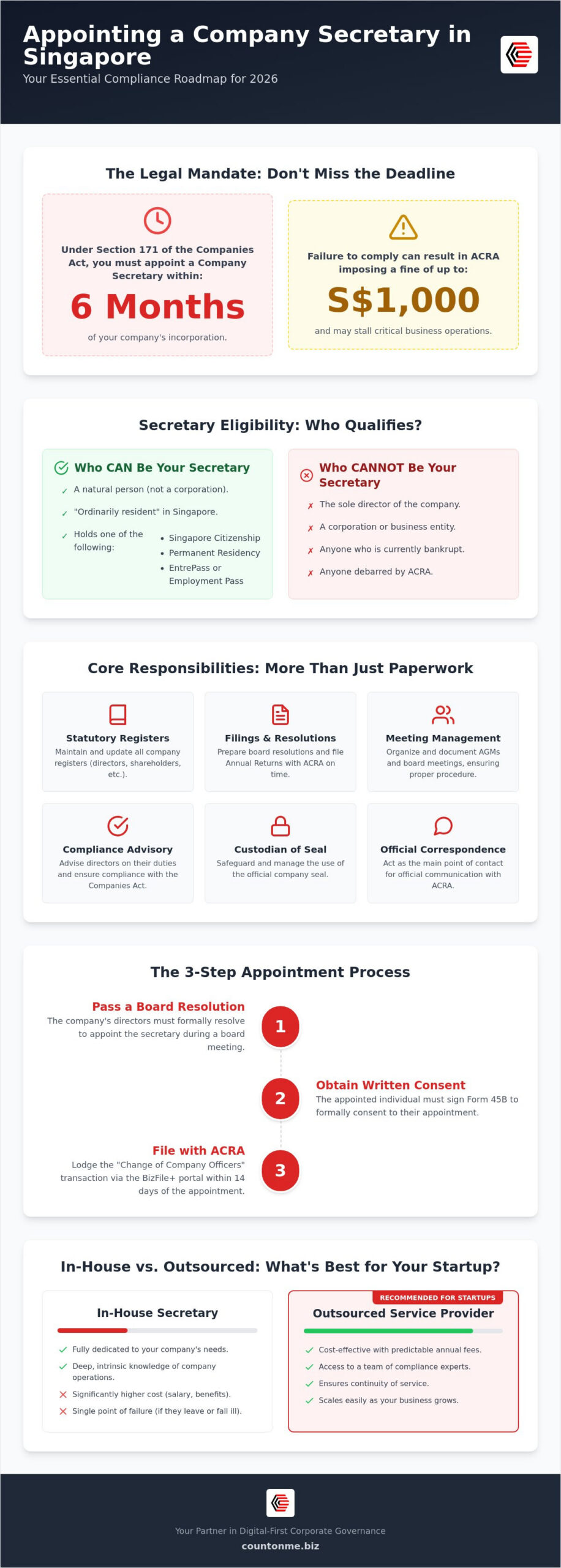
Think of Section 171 of the Companies Act as the rulebook for your company’s structure. It’s the legal mandate that makes appointing a company secretary Singapore a requirement for every firm within six months of incorporation. While it might feel like a box-ticking exercise, this role is the backbone of your corporate governance. We often see founders treat this like a low-priority task, but waiting until the last minute creates unnecessary pressure. A secretary isn’t just a name on a form; they manage the role of a company secretary by ensuring your legal identity remains spotless and compliant.
The law is clear: your secretary must be a natural person who is ordinarily resident in Singapore. This isn’t just about having a local mailing address; it’s about being physically present and accountable within the jurisdiction. To meet this criteria, the appointee usually holds one of the following:
- Singapore Citizenship
- Singapore Permanent Residency
- A valid EntrePass or Employment Pass
For private companies, there isn’t a strict professional certification requirement, but the “experience” clause in the Act implies they must have the knowledge to fulfill the role. For public companies, the bar is much higher. They must be a lawyer, accountant, or chartered secretary. Even for a private startup, having someone who truly understands the nuances of the Companies Act is the difference between a smooth operation and a compliance nightmare.
Who Can (and Cannot) Be Your Secretary?
If you’re running a lean operation as a sole director, you’ve hit a specific legal wall. You cannot be your own secretary. It’s a system of checks and balances designed to prevent a single individual from having total, unchecked control over statutory filings. Also, anyone currently bankrupt or debarred by ACRA is strictly off-limits. Most modern startups choose to work with a registered Corporate Service Provider (CSP). Under the CSP Act 2024, these firms must have a Qualified Individual (QI) overseeing the work. This ensures that the person handling your records has the professional standing and regulatory oversight to keep your business safe.
Statutory Deadlines and Penalties
ACRA doesn’t just wait for you to tell them you missed a deadline. They track everything through the BizFile+ dashboard. If you fail to fill the vacancy within those first six months, your company could face a fine of up to S$1,000. It’s a steep price for a simple administrative task. Beyond the fine, a lack of a secretary can stall your ability to open bank accounts or sign legal contracts. If your secretary resigns later, you must appoint a replacement within 180 days of the vacancy to maintain your standing with the authorities.
Core Responsibilities: What Does a Secretary Actually Do?
When you’re busy building a product, the last thing you want to think about is a minute book. But a company secretary is far more than a record-keeper. They are the gatekeepers of your corporate integrity. While we’ve already highlighted the legal necessity of appointing a company secretary Singapore mandates, let’s look at how they actually add value to your day-to-day operations. They don’t just fill out forms; they ensure the internal machinery of your business runs without friction.
Their primary job involves maintaining your statutory registers. These documents are the definitive legal proof of who owns and runs your company. If these aren’t updated within 14 days of a change, you’re technically in breach of Section 171 of the Companies Act. Beyond registers, they orchestrate your Annual General Meetings (AGMs) and ensure your Annual Returns are filed within seven months of your financial year-end. Missing that S$60 filing fee can lead to tiered penalties, so having a pro in your corner provides a massive sense of relief.
The Administrative and Fiduciary Shield
Think of your secretary as a shield. Directors often face personal liability for compliance slips, but a secretary mitigates this risk. They ensure every board resolution is drafted correctly and every “Directors’ Statement” is prepared for your annual financial filings. They handle confidential information with a high duty of care. This acts as a steady hand when corporate decisions get complex. By managing the company seal and official correspondence with regulators, they act as the primary point of contact for ACRA, protecting your time and focus.
Modern Governance: Beyond Paperwork
In 2026, compliance isn’t about dusty binders. It’s about digital agility. A modern secretary manages your Register of Registrable Controllers (RORC) online and facilitates electronic signatures, so you don’t have to chase physical documents across the island. By integrating these processes with cloud accounting services Singapore startups rely on, you create a seamless flow of data between your finances and your legal filings. If you want to see how this looks in practice, our team at Count On Me can show you how we bridge that gap with technology that scales with you.
Step-by-Step: The Process of Appointing a Company Secretary
Found the right partner for your startup’s compliance? Great. Now comes the part that often trips up even the most organized founders: the actual paperwork. While the legal framework of the Companies Act 1967 sets the stage, the execution happens in the details of your board minutes and the digital corridors of ACRA. The process of appointing a company secretary Singapore requires is methodical, but when you break it down into these four clear steps, it becomes much less daunting.
- Step 1: Board Resolution – Your directors must formally meet (or pass a written resolution) to approve the appointment. This document serves as the internal green light.
- Step 2: Form 45B – This is the “Consent to Act.” Your new secretary must sign this to legally confirm they’re willing to take on the responsibilities and aren’t disqualified from doing so.
- Step 3: BizFile+ Lodgement – Once the internal papers are signed, you have 14 days to update ACRA. This is done through the BizFile+ portal using a director’s or professional filer’s Singpass.
- Step 4: Updating the Internal Register – The final step isn’t just the ACRA update. You must reflect this change in your company’s Register of Secretaries.
Documenting the Appointment Internally
Don’t make the mistake of thinking an ACRA filing is enough. Your corporate secretarial file must hold the original signed Board Resolution and the Form 45B. The resolution should clearly state the date of appointment and the fact that the directors have verified the appointee’s qualifications. Form 45B is particularly vital because it’s a safeguard. It’s a formal declaration that the secretary understands their duties. We recommend keeping high-quality digital scans of these in a secure cloud drive so they’re ready for any future due diligence or banking requests.
Navigating the BizFile+ Portal
Logging into BizFile+ can feel like stepping into another world. To complete the lodgement, you’ll need to navigate to the “Change in Company Officers” section. It’s not enough to just input the details; the system requires the new secretary to “accept” the appointment via their own Singpass login if they aren’t part of a registered filing firm. This digital handshake is what finalizes the record. If you’re working with a professional firm, they’ll usually handle this lodgement as a “Qualified Individual,” which streamlines the process and ensures every field is filled correctly the first time.
In-House vs. Outsourced: Which is Best for Your Startup?
Deciding who will hold the keys to your corporate compliance is a pivotal moment for any founder. You’ve already navigated the legal nuances of appointing a company secretary Singapore requires, but now you face a strategic choice: do you manage it internally or partner with an external expert? This decision isn’t just about cost; it’s about how much mental bandwidth you want to reclaim for your core mission. We’ve seen many startups struggle under the weight of manual paperwork, only to find relief once they transition to a model that matches their growth pace.
The “Founder-Secretary” model is often the first instinct for multi-director teams. While legally permissible for companies with more than one director, it’s frequently a false economy. Every hour you spend deciphering ACRA’s latest update or drafting a board resolution is an hour stolen from your product roadmap. In contrast, an in-house secretary offers total control and immediate access, but the overhead is substantial. With annual salaries for experienced in-house professionals often ranging from S$54,000 to S$60,000, it’s a heavy commitment for a seed-stage venture. Outsourced firms bridge this gap, providing access to a pool of Qualified Individuals (QIs) who bring collective wisdom from across the industry at a fraction of the headcount cost. To make the most informed decision, it helps to evaluate your options using a structured framework for choosing the best corporate secretary provider in Singapore that aligns with your growth stage and compliance needs.
The Cost of Compliance
When you look at the numbers, the choice often becomes clear. An outsourced retainer typically costs between S$300 and S$800 annually, depending on the complexity of your needs. Beyond the sticker price, consider the hidden costs of “DIY” compliance. You might need to invest in specialized software to track deadlines or risk the tiered penalties ACRA imposes for late filings. To avoid surprises on your invoice, it’s worth reviewing a detailed breakdown of corporate secretarial services fees in Singapore for 2026 so you can budget accurately from the start. An on-demand partner provides strategic advice when you need it, without the burden of a fixed-contract employee on your monthly payroll.
Tech-Enabled vs. Traditional Firms
This is where modern startups really find their edge. Traditional secretarial firms often rely on physical folders and wet-ink signatures, which slows down your momentum in a digital-first world. Cloud-native partners use automated filing alerts to ensure you never miss an AGM deadline. They provide digital document vaults where your statutory records are accessible 24/7, from anywhere in the world. This transparency is vital when you’re preparing for a funding round and need to share your “clean” records with investors instantly. To support this professional image, you can learn more about C Me Online and their award-winning web design services for growing businesses.
Ready to modernize your governance and protect your focus? Explore our Corporate Secretary Services to see how we blend professional expertise with the digital tools your startup deserves.
Why Count On Me is the Strategic Choice for Singapore Founders
At Count On Me, we don’t believe in being just another name on your ACRA filing. We bring over 20 years of industry experience to the table, but we’ve distilled that deep knowledge into a modern, boutique experience specifically for startups. When you’re appointing a company secretary Singapore mandates, you aren’t just looking for a signature. You’re looking for a partner who understands the high-stakes, fast-moving environment of a growing business. We bridge the gap between traditional professional expertise and the digital agility you need to stay competitive in 2026.
Our digital-first approach means we integrate seamlessly with your cloud accounting and payroll. This creates a single source of truth for your corporate data, which eliminates the silos that often lead to compliance errors. We take a proactive stance on governance. Instead of waiting for a filing deadline to approach, we monitor your records to discover potential issues before ACRA does. Our pricing is as transparent as our communication. You won’t find hidden “per-page” fees or surprise charges for basic statutory updates; we believe in simple, predictable costs that help you manage your burn rate. For a full picture of what transparent pricing looks like in practice, our guide to corporate secretarial services fees walks you through every line item you should expect.
A Partnership, Not a Transaction
We see ourselves as a mentor-guide for our clients. For first-time founders, the maze of corporate governance can be overwhelming, but we replace that confusion with a collaborative rhythm. We provide regular updates that keep you informed without the stress of deciphering legal jargon. We aren’t here to just send an annual invoice. We’re here to help you build a foundation that lasts. For example, we recently helped a local SME automate their entire ACRA compliance process, moving them away from a paper-heavy traditional firm to a streamlined digital workflow that saved their team dozens of hours each quarter.
Ready to Appoint Your Secretary?
Our onboarding is designed to be swift and painless. We understand that in the startup world, speed is everything. We can typically take over your registers and finalize the lodgement in as little as 48 hours. This quick transition ensures there’s no gap in your compliance coverage, especially if you’re nearing that critical six-month deadline. By integrating your secretarial needs with your CFO and tax strategy, we ensure your legal structure always supports your broader financial goals.
If you’re ready to secure your startup’s future with a partner who is as invested in your success as you are, schedule a consultation with Count On Me today. We’ll help you navigate the requirements of the Companies Act so you can get back to what you do best: growing your business.
Future-Proof Your Startup’s Compliance
Building a business in Singapore is an exhilarating journey, but it shouldn’t be stalled by administrative friction. We’ve explored how the 6-month mandate is more than just a legal hurdle; it’s an opportunity to establish a foundation of trust and transparency. By moving away from paper-heavy traditional models and embracing digital governance, you protect your focus and your directors from unnecessary liability. The process of appointing a company secretary Singapore requires can be the moment you shift from a reactive startup to a proactive, scale-ready enterprise.
To complement your professional corporate structure with a market-leading brand, learn more about Phoenix Design and their specialized branding solutions for local enterprises.
We’re here to make that transition effortless. With over 20 years of professional industry experience, our team provides a specialized “Startups Package” tailored for new incorporations. We use cloud-native workflows to give you 24/7 transparency into your statutory records, ensuring you’re always ready for your next funding round. You don’t have to navigate these regulations alone. Let us be the supportive ally that keeps your corporate standing spotless while you focus on changing the world.
Frequently Asked Questions
Can a director also be the company secretary in Singapore?
A director can serve as the secretary, but a sole director is legally prohibited from doing so. This rule ensures a system of checks and balances within your company structure. If you’re running a one-person startup, you’ll need to look into appointing a company secretary Singapore requires from an external source to stay compliant with the Companies Act.
What happens if I fail to appoint a company secretary within 6 months?
Missing the strict six-month deadline is a breach of the Companies Act and can lead to a fine of up to S$1,000. ACRA monitors these vacancies through the BizFile+ system. Beyond the financial penalty, being without a secretary can make it difficult to open corporate bank accounts or secure business licenses since the position is a legal requirement for active companies.
Does a company secretary need to be a Singapore citizen?
No, they don’t have to be a citizen, but they must be “ordinarily resident” in Singapore. This means they should hold Singapore Citizenship, Permanent Residency, or a valid Employment Pass, EntrePass, or S Pass with a local residential address. They must be physically present in the country to fulfill their statutory duties and be accountable to ACRA.
What is the difference between a “Qualified Individual” and a regular secretary?
A Qualified Individual (QI) is a professional registered under the Corporate Service Provider (CSP) Act 2024 who meets specific educational and experience criteria, such as being a chartered secretary or lawyer. While a private company can technically appoint any resident as a secretary, professional firms must have a QI to oversee filings. This provides an extra layer of regulatory oversight for your business.
How much does it cost to appoint a corporate secretary in 2026?
Outsourcing this role typically costs between S$300 and S$800 annually, depending on the volume of resolutions and filings your startup needs. In contrast, hiring an in-house professional can cost between S$54,000 and S$60,000 per year. Most founders find that a digital-first outsourced partner offers the best balance of expertise and cost-efficiency as they scale.
Can I change my company secretary after incorporation?
Yes, you can change your secretary at any time by passing a board resolution to formally approve the resignation and new appointment. Once the new appointee signs their consent, you must update ACRA via BizFile+ within 14 days. It’s a common move for startups as they outgrow their initial setup and require more specialized or tech-enabled support.
What is Form 45B and why is it important?
Form 45B is the formal “Consent to Act as Secretary” that the appointee must sign before they are officially appointed. It’s a legal declaration that the individual is not disqualified from holding the position under the Companies Act. You must keep this signed document in your statutory records as it serves as proof that the appointee has accepted the legal responsibilities of the role.
Do dormant companies still need a company secretary?
Yes, even if your company is dormant and has no accounting transactions, you are still legally required to maintain a secretary. You must continue to file Annual Returns and maintain statutory registers even if you are exempt from audit requirements. While the workload is lighter for dormant firms, the legal requirement to have a resident secretary remains in place to ensure basic corporate governance.