
Have you ever stared at a manual spreadsheet on a Friday afternoon, wondering if a client’s late payment will mean a stressful conversation with your team about payroll? For many local business owners, the reality of cash flow management Singapore involves a constant cycle of checking bank balances and bracing for the next surprise 9% GST or CPF payment spike. It’s exhausting to feel like you’re always one step behind your own data, especially when those manual records are never quite as current as you need them to be.
We understand that these pressures can make the dream of scaling your business feel more like a burden than an achievement. However, your liquidity shouldn’t be a source of stress; it should be your most powerful tool for growth. In this practical guide, we’ll show you how to move away from reactive firefighting and toward a system that offers real-time visibility into your finances. We will walk through the steps to create predictable payment cycles and build the financial stability you need to make bold investments in your company’s future with total peace of mind.
Key Takeaways
- Understand why profit doesn’t always equal available cash and why this distinction is vital for survival in the competitive local market.
- Learn to master cash flow management Singapore by optimizing your payment cycles and accelerating your accounts receivable.
- Discover the efficiency of moving from manual spreadsheets to cloud-automated accounting for real-time visibility into your bank balances.
- Follow a practical five-step guide to build a reliable forecast that maps out your historical data and future variable costs.
- Explore how on-demand CFO services can provide the high-level analysis you need for strategic growth without a full-time salary commitment.
What is Cash Flow Management and Why is it Critical in Singapore?
Understanding what cash flow is goes beyond just looking at a bottom-line figure on your monthly report. It’s the pulse of your business. In essence, it’s the movement of funds into your company from sales and out of your company for expenses like rent, supplies, and taxes. For any entrepreneur, cash flow management Singapore is the art of ensuring that the timing of these movements doesn’t leave you stranded.
In our local market, liquidity is high-stakes. We operate in a high-cost environment where overheads like office space and specialized talent don’t wait for your clients to pay. This creates what we call the “Cash Gap.” This is the period between when you pay your vendors or staff and when you actually receive the funds from your customers. If that gap is too wide, your business can stall even if you’re technically successful. Cash isn’t just numbers. It’s time.
Profit vs. Cash: The Founder’s Trap
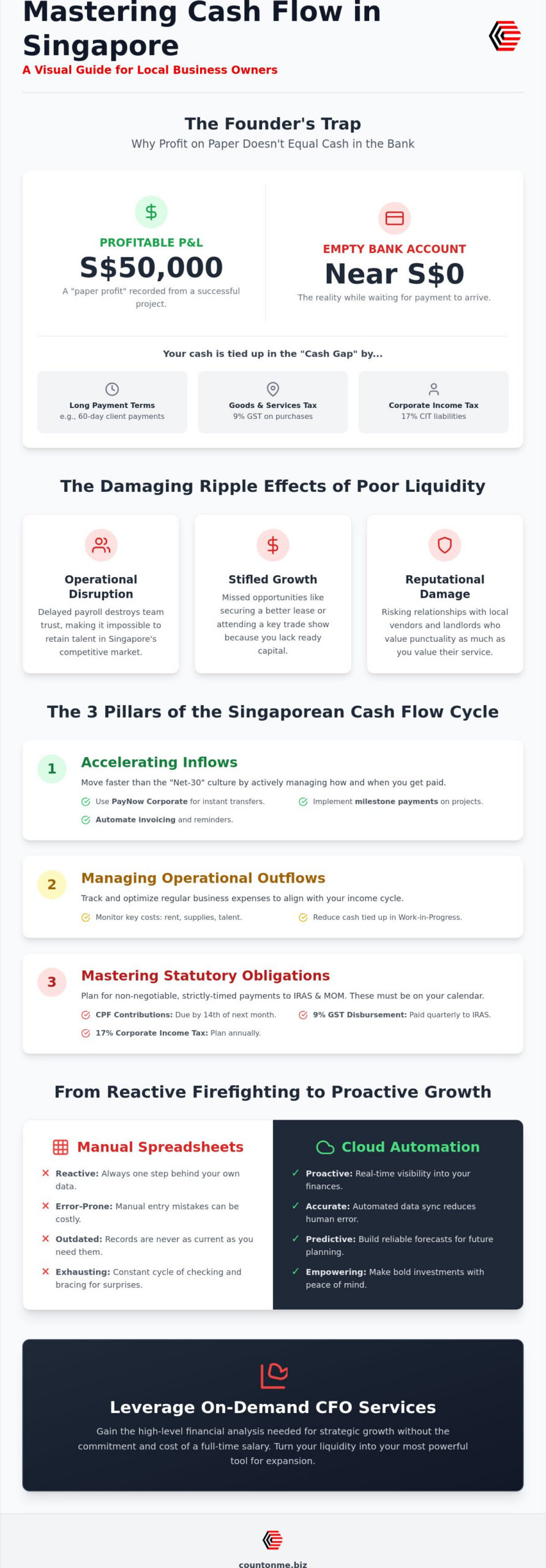
It’s a common story: a founder looks at a profitable Profit and Loss (P&L) statement and wonders why the bank account is nearly empty. This is the founder’s trap. Profit is an accounting concept, but cash is a reality. You might record a S$50,000 “paper profit” from a big project, but if that client has 60-day payment terms, you still have to cover two months of 9% GST on your purchases and your 17% Corporate Income Tax liabilities before that money ever arrives. For a Singaporean service firm, this delay can be the difference between a smooth month and a financial crisis. You can’t pay your team with a signed contract; you need the funds in the bank.
The High Cost of Poor Liquidity
When cash is tight, the stress ripples through every part of your operation. Delayed payroll doesn’t just cause anxiety; it destroys the trust you’ve built with your team, making employee retention nearly impossible in Singapore’s competitive talent market. Beyond the human cost, poor liquidity means you’re forced to say no to growth. Whether it’s a sudden chance to secure a better lease or an invitation to a major regional trade show, you can’t move without ready capital. You also risk your reputation with local vendors and landlords, who value punctuality as much as you value their service. Effective cash flow management Singapore ensures you’re always ready to say yes to the right opportunity when it knocks.
The 3 Pillars of the Singaporean Cash Flow Cycle
Mastering cash flow management Singapore requires more than just watching your sales grow. It involves balancing three distinct pillars: your inflows, your operational outflows, and your statutory obligations. While many founders focus solely on closing the next deal, the most resilient businesses are those that understand how these three forces interact within the local ecosystem. If you don’t synchronize these cycles, you might find yourself with a full order book but an empty bank account when the month ends.
One often overlooked area is Work-in-Progress (WIP). This represents the value of projects you’ve started but haven’t yet billed. In a service-heavy market like ours, unbilled hours are essentially interest-free loans you’re giving to your clients. Reducing the time your cash stays tied up in WIP is just as important as chasing an overdue invoice.
Accelerating Inflows in a “Net-30” Culture
Singapore’s business culture often leans on “Net-30” payment terms, but that doesn’t mean you have to wait 30 days to see your money. You can significantly speed up settlements by using PayNow Corporate, which allows for near-instant B2B transfers. Coupling this with automated professional invoicing and polite reminders ensures your bill is at the top of your client’s pile. For longer projects, we always recommend implementing milestone payments. Breaking a large contract into smaller, deliverable-based chunks keeps your cash moving and reduces your risk if a project timeline shifts.
The Statutory Outflow Calendar (CPF & GST)
This is where many SMEs stumble. Unlike standard vendor bills, statutory payments are non-negotiable and strictly timed. You must manage your monthly CPF contributions by the 14th of the following month to avoid issues with the Ministry of Manpower or ACRA. Then there’s the quarterly 9% GST disbursement to IRAS, which can be a significant sum if you haven’t set it aside. Finally, you need to plan for Corporate Income Tax (CIT). While the flat rate is 17%, remember that for the Year of Assessment 2026, there is a 50% CIT rebate capped at S$40,000. These specific dates should be the first items on your financial calendar. If you’re feeling overwhelmed by these deadlines, our tax compliance and advice team can help you build a more predictable schedule.
By treating these statutory dates as fixed milestones rather than surprises, you transform your financial planning. You’ll move from a state of constant reaction to a position of quiet confidence, knowing exactly when every dollar needs to be in place.
Manual vs. Cloud-Automated Cash Flow Management
We’ve all been there. It’s late on a Tuesday, and you’re squinting at a spreadsheet with forty tabs, trying to figure out why your bank balance doesn’t match your projections. While manual spreadsheets were the standard for years, modern cash flow management Singapore has evolved into a digital-first discipline. Relying on “old school” methods isn’t just tedious; it’s risky. When you’re manually entering data, you’re always looking at a snapshot of the past. In a fast-moving market, making decisions based on data that’s already three weeks old is like trying to drive while only looking in the rearview mirror.
Cloud automation changes the conversation from “What happened?” to “What’s next?” By moving your financial records to a cloud-based environment, you gain a live connection to your business. You’re no longer tethered to a specific office or a single computer. Whether you’re at a client meeting or working remotely, you have the same real-time visibility as your accounting team. This transparency builds a foundation of trust and allows for much faster pivots when opportunities arise.
The Hidden Cost of “Old School” Bookkeeping
The biggest expense of manual bookkeeping isn’t the software subscription you’re avoiding; it’s your own time. You’re a founder, not a data entry clerk. Every hour you spend reconciling bank statements is an hour you aren’t spending on product development or client relationships. Beyond the time drain, manual systems are magnets for human error. A single misplaced decimal point in a spreadsheet can lead to a significant overestimation of your liquidity, potentially resulting in a missed CPF payment or an unexpected GST shortfall. For a deeper look at how to modernize your stack, check out our Complete Guide to Cloud Accounting Services in Singapore (2026).
The Power of Xero and Add-on Ecosystems
How to Build a Cash Flow Forecast: A 5-Step Guide
Having the right cloud tools is a great start, but the real power lies in how you use that data to look ahead. Creating a forecast isn’t about having a crystal ball; it’s about building a roadmap that helps you navigate the months ahead with confidence. For effective cash flow management Singapore, your forecast needs to be a living document that you review and adjust as new information comes in. We recommend a simple five-step process to get started.
- Step 1: Consolidate your historical data from the last 6 to 12 months to see your natural spending patterns.
- Step 2: Map out your fixed costs, like rent and base salaries, versus variable costs like marketing or project-based freelancers.
- Step 3: Estimate your future sales based on your current pipeline, being careful to use realistic closing dates rather than best-case scenarios.
- Step 4: Layer in your statutory payment dates, including monthly CPF and quarterly 9% GST disbursements.
- Step 5: Run “What-If” scenarios to see how your bank balance handles changes like losing a major account or hiring new team members.
Step 1 & 2: Building Your Baseline
Your baseline is the foundation of your forecast. Start by identifying the recurring monthly expenses that stay the same regardless of your sales volume. This includes your office lease, software subscriptions, and core payroll. Once you have these fixed points, look at your historical collection times. Days Sales Outstanding (DSO) is the average number of days it takes your business to collect payment after a sale, which directly dictates how quickly your baseline cash replenishes. If your average DSO is 45 days, you need to ensure your baseline can cover at least six weeks of outflows without a fresh injection of funds.
Scenario Planning: Preparing for the Unexpected
The true value of cash flow management Singapore comes when you prepare for the “what-ifs.” We suggest looking at two primary scenarios. First, the “Worst Case”: what happens to your ability to pay vendors if your largest client pays 30 days late? Second, the “Growth Case”: can you afford the upfront hardware and recruitment costs of a massive new project before the first milestone payment arrives? Running these numbers helps you decide when to lean on a credit line or when to tighten your belt. If you find this level of analysis daunting, our on demand CFO Singapore services can provide the strategic guidance you need to interpret these scenarios and make informed decisions for your company’s future.
Leveraging On-Demand CFO Services for Strategic Growth
Once you’ve built your forecast and automated your bank feeds, you might find yourself asking a new question: what do these numbers actually tell me about my future? This is where many founders hit a ceiling. You have the data, but you don’t necessarily have the time or the specialized training to translate it into a long-term growth strategy. Professional cash flow management Singapore isn’t just about keeping the lights on; it’s about knowing when you have the financial “dry powder” to expand your team or enter a new market.
At Count On Me, we believe that high-level financial expertise shouldn’t be reserved for multinational corporations. Our on-demand CFO services provide you with a fractional advisor who acts as a strategic partner. We bridge the gap between your daily bookkeeping and your long-term vision. By conducting regular financial health checks, we help you spot trends that a standard balance sheet might hide, ensuring your scaling journey is built on a stable foundation. It’s about having a mentor who is as invested in your success as you are.
Beyond the Ledger: Strategic Advisory
A strategic advisor helps you move your focus from the past to the future. Instead of just asking “what happened last month?”, we work with you to answer “what will happen if we pivot next quarter?”. This involves more than just monitoring bank balances. We look at optimising your capital structure and managing your debt-to-equity ratios to ensure you’re as attractive as possible to future investors or banks. If you’re just starting out, our startup financial package is designed to give early-stage founders the exact level of support they need to navigate these complex decisions without the overhead of a full finance department.
Digitising Your Finance Function for Long-Term Success
True success comes when your finance function runs like a well-oiled machine in the background. When you digitise your compliance stack, you aren’t just saving time; you’re buying peace of mind. An automated system ensures you’re always audit-ready, whether you’re applying for an Enterprise Financing Scheme loan or preparing for a due diligence process with venture capitalists. It removes the friction from your growth, allowing you to focus on what you do best: building your business. Many founders who have outgrown their initial startup accounting package Singapore find that pairing a fractional CFO with a digitised finance function is the most effective path to investor-ready books and long-term scalability.
Don’t let financial uncertainty hold your startup back. Partner with Count On Me to transform your cash flow management Singapore from a daily chore into a strategic advantage. Let’s work together to secure your business’s future and turn your liquidity into a launchpad for growth.
Secure Your Path to Sustainable Growth
Managing your business finances shouldn’t feel like a constant battle against the calendar. By embracing real-time cloud tools and mastering the timing of your statutory obligations, you shift from reacting to crises to planning for expansion. You’ve seen how a digital-first approach and a solid five-step forecast can transform your daily operations. You now have the roadmap to bridge the “Cash Gap” and use your liquidity as a strategic asset rather than a source of anxiety.
We bring over 20 years of experience to the table as a Xero Certified Platinum Partner. Our team provides the quiet confidence you need to scale, offering specialised startup and SME compliance packages tailored to the local market. Mastering cash flow management Singapore is a collaborative effort; we’re ready to be the partner you can rely on. Let’s optimise your cash flow; book a consultation with Count On Me today.
Your business has incredible potential. Let’s make sure your finances are ready to support it every step of the way.
Frequently Asked Questions
What is the best cash flow management software for Singapore SMEs?
Xero is widely considered the gold standard for cash flow management Singapore because of its robust ecosystem and live bank feeds. It allows you to see your actual liquidity at a glance rather than waiting for a month-end report. By connecting with local banks, it automates data entry and gives you a real-time view of your financial health.
How often should I update my cash flow forecast?
You should ideally review your forecast weekly and perform a deep-dive update every month. For high-growth startups, market conditions and project timelines change quickly. Keeping your forecast as a “live” document ensures that your strategic decisions are always based on your current bank balance rather than outdated projections from the previous quarter.
Does a profitable business always have positive cash flow?
No, a profitable business can still face insolvency if its cash is tied up in unpaid invoices or inventory. You might record a S$100,000 profit on paper, but if your clients have 60-day payment terms, you still need liquid funds to cover your immediate costs. This “cash gap” is why monitoring liquidity is just as important as tracking sales.
How does GST filing affect my monthly cash flow?
GST filing requires you to pay the prevailing 9% tax on your taxable supplies to IRAS every quarter. This can create a significant dip in your bank balance if you haven’t been setting aside the GST collected from your customers. Planning for these quarterly disbursements is a vital part of cash flow management Singapore to avoid sudden liquidity crunches.
Can I use Excel for cash flow management in 2026?
While you can technically use Excel, it’s increasingly risky in 2026 due to the lack of real-time data and the high potential for manual entry errors. Automated cloud accounting provides a level of accuracy and speed that a static spreadsheet simply cannot match. Moving away from manual entry allows you to focus on analysis rather than just data collection.
What are the main causes of cash flow problems for Singapore startups?
The primary causes are usually extended payment terms from clients and high fixed overheads like office rent and specialised talent. To help manage these costs, you can learn more about Havelock Tech and their managed remote support for technology and operations teams based in Singapore. Rapid growth can also paradoxically cause problems. You often have to pay for new staff and supplies upfront long before the customer settles their bill, which stretches your available working capital to the limit.
How does a fractional CFO help with cash flow?
A fractional CFO provides the high-level analysis needed to interpret your financial data into actionable growth steps. They help with complex scenario planning and capital structure optimisation, giving you the expertise of a seasoned executive without the full-time salary. This partnership allows you to make bold investments with the confidence that your baseline is secure. To learn more about how this works in practice, read our founder’s guide to on demand CFO Singapore services and how fractional advisors bridge the gap between bookkeeping and strategic growth.
Is there government support for SMEs to digitise their accounting?
Yes, the Singapore government provides significant support through initiatives like the Productivity Solutions Grant (PSG). This grant has been expanded to include more digital and AI-enabled solutions, helping SMEs offset the costs of adopting modern accounting tools. These incentives make it much more accessible for local founders to build a tech-forward finance function.