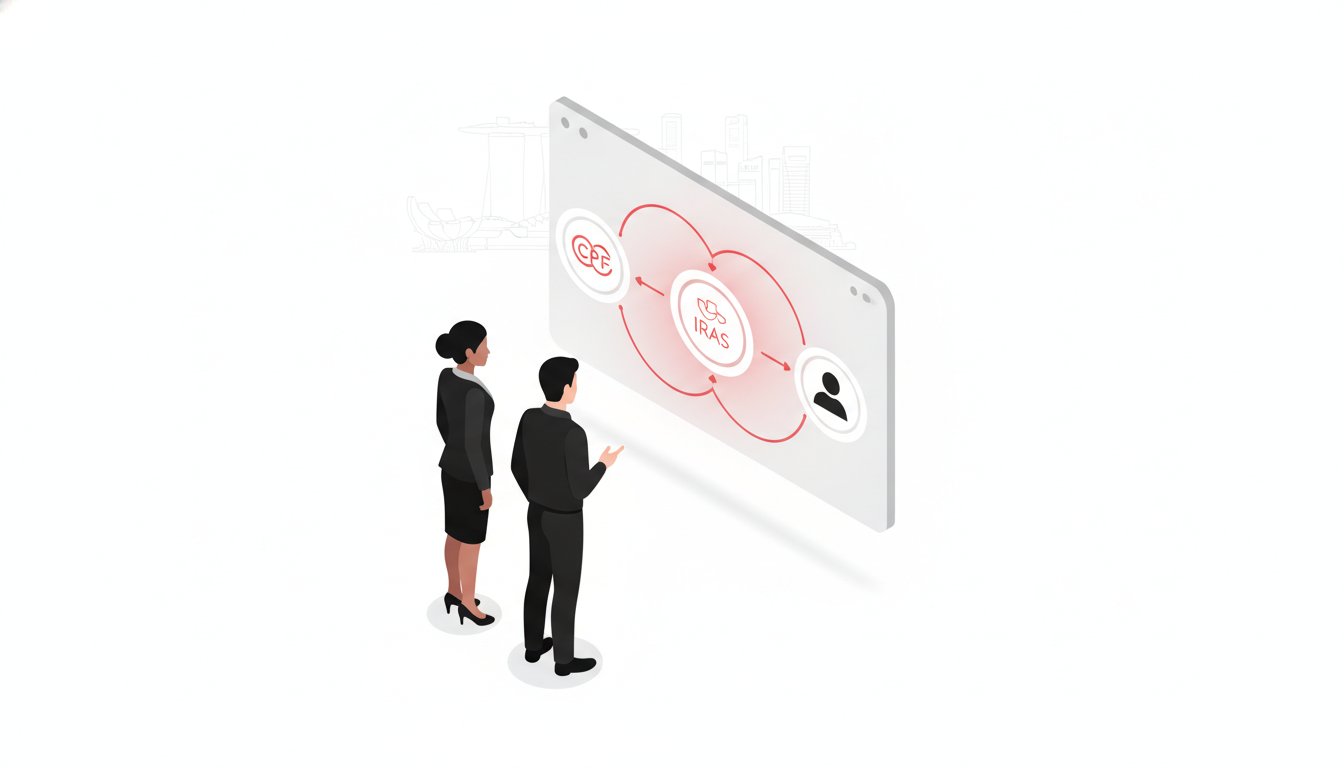
How many hours did you lose last month double-checking CPF contributions or fixing a tiny typo in a spreadsheet? If you’re like many Singaporean business owners, payroll day isn’t just about paying your team; it’s a stressful marathon of manual data entry and a constant fear of IRAS or CPF penalties. We understand that pressure. You want to focus on growing your business, but instead, you’re stuck in a loop of administrative tasks that feel like they’re designed to catch you out. It’s a common hurdle, but it’s one you don’t have to clear alone.
Moving to an automated payroll Singapore system is the strategic shift you need to reclaim your time and ensure 100% compliance. In this 2026 guide, we’ll show you exactly how to transition from clunky manual spreadsheets to a modern, cloud-based workflow that practically runs itself. We’ll explore the steps to setting up a system that eliminates errors, integrates with your accounting software, and gives you the peace of mind that comes with knowing your statutory obligations are handled perfectly every single month. Let’s look at how we can turn your payroll from a monthly chore into a seamless, set-and-forget asset.
Key Takeaways
- Shift your focus from reactive manual entry to proactive exception management, turning payroll from a monthly stressor into a streamlined process.
- Ensure your automated payroll Singapore transition is successful by prioritizing clean data audits and accurate employee records from the very start.
- Automate complex statutory calculations for CPF, SDL, and IRAS to eliminate the risk of late-filing penalties and manual calculation errors.
- Create a unified business ecosystem by integrating your payroll engine with attendance tracking, leave management, and cloud accounting software.
- Learn how to balance modern technology with expert verification to keep your systems compliant and ready for future business growth.
Beyond Spreadsheets: Why Automated Payroll is Non-Negotiable in 2026
We’ve all been there. It’s the end of the month, and you’re staring at a complex Excel sheet, praying that the formulas for this month’s SDL and CDAC contributions are still correct. In 2026, relying on manual data entry isn’t just a headache; it’s a risk to your business stability. When we talk about automated payroll Singapore, we aren’t just referring to a digital calculator. We’re describing a sophisticated, rule-based system that programmatically calculates wages, deductions, and statutory contributions based on the latest Singaporean labor laws. It’s about moving from a reactive state, where you’re constantly fixing errors after they happen, to a proactive model of exception management. You should be the pilot overseeing the system, not the engine doing the heavy lifting.
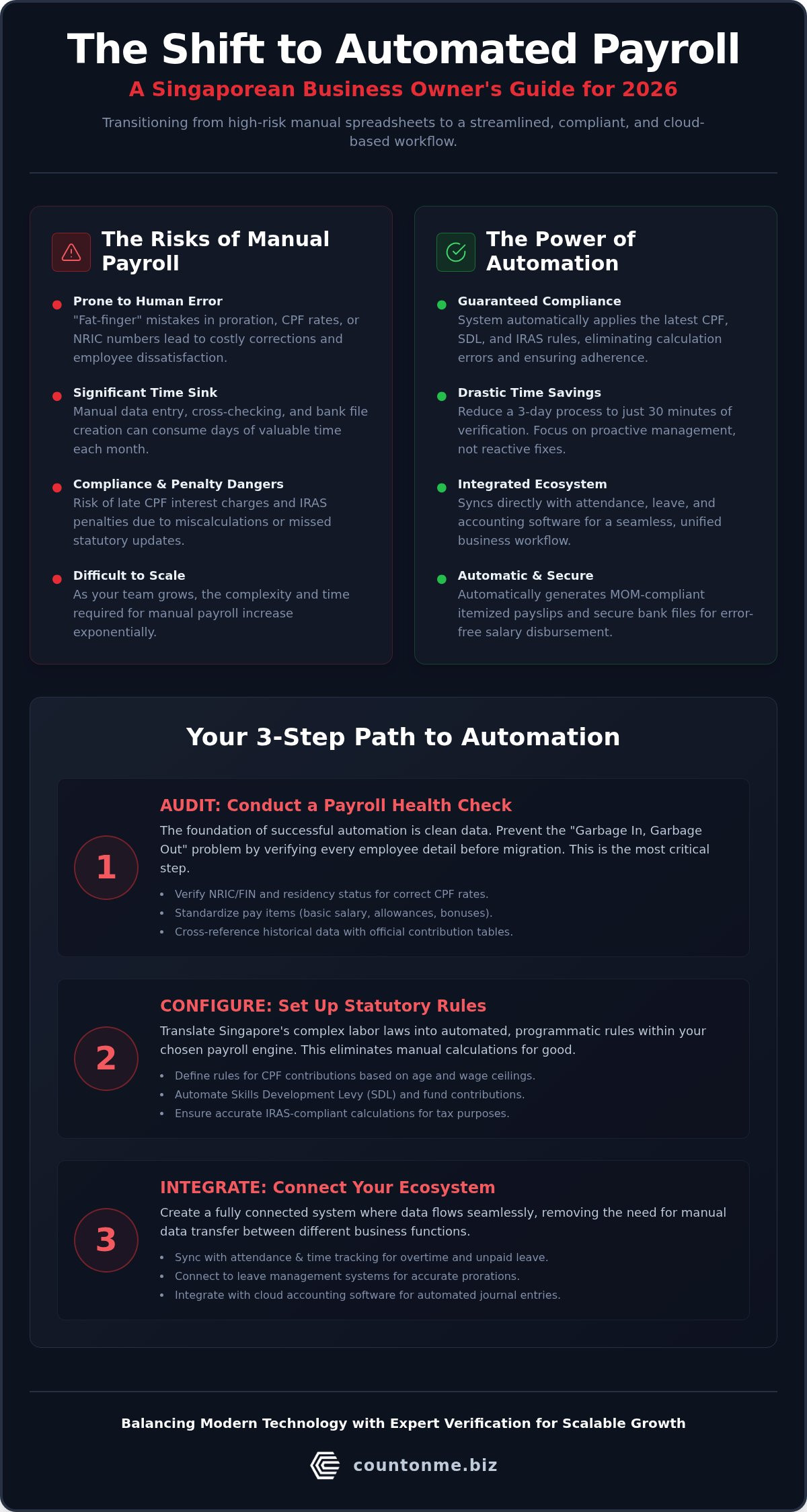
The shift toward digital-first compliance is no longer optional for SMEs. As the regulatory environment becomes more integrated, the margin for error shrinks. A single typo in a NRIC number or a missed update on a contribution ceiling can lead to unnecessary friction with authorities. Automation provides a safety net, ensuring that your payroll workflow is consistent, transparent, and scalable as your team grows. It’s the difference between spending three days on salary disbursement and spending thirty minutes verifying a pre-calculated report.
The Risks of Manual Payroll in Singapore
Manual payroll is a minefield of hidden costs. One of the most common pitfalls we see involves proration for mid-month joiners or leavers. Calculating these figures by hand is tedious and prone to “fat-finger” errors that lead to employee dissatisfaction. Then there’s the complexity of the Central Provident Fund (CPF). With different contribution rates based on age groups and residency status, keeping track of every change in a spreadsheet is a recipe for non-compliance. These small mistakes often snowball into late CPF interest charges or even penalties for failing to adhere to the Employment Act’s strict requirements for timely and accurate payment.
What ‘Fully Automated’ Actually Means for Your SME
True automation creates a connected ecosystem. It’s not just about the final paycheck; it’s about how the data gets there. A fully automated setup syncs directly with your time-tracking and leave management modules, meaning unpaid leave or overtime is factored in without you lifting a finger. It also ensures you meet the Ministry of Manpower (MOM) requirement for itemized payslips by generating them automatically for every employee. Finally, the system produces direct bank files. Instead of manually entering dozens of bank account numbers into your corporate portal, you simply upload one file, and the disbursement is handled securely and accurately. This level of integration is what allows you to focus on your people rather than your paperwork.
Step 1: Auditing Your Data and Choosing a Compliant Payroll Engine
Many business owners think buying software is the finish line. It’s actually the starting block. You’ve probably heard the phrase “Garbage In, Garbage Out.” This is especially true for automated payroll Singapore. If your current spreadsheets are riddled with typos or outdated residency statuses, moving that data into a new system just automates your mistakes. We believe the foundation of any successful digital transformation is a thorough data audit. It’s about ensuring that the rules you set today don’t cause compliance headaches tomorrow.
Conducting a Payroll Health Check
Before you migrate, you need to verify your “source of truth.” This means cross-referencing your records with the official CPF contribution rates for employers to ensure historical accuracy. Are your NRIC/FIN numbers correct? Is every employee’s residency status up to date? In the context of payroll migration, data hygiene is the process of scrubbing, standardizing, and verifying every employee data point to ensure the automated engine calculates figures based on 100% accurate information. You’ll also want to standardize your pay items. Grouping basic salary, fixed allowances, and variable bonuses clearly prevents confusion when the system starts its first run. Taking the time to do this now saves you from the stress of fixing errors during a live pay cycle.
Selecting the Right Technology Stack
Choosing the right engine is about more than just price. It’s about compliance and connection. Your chosen platform must be IRAS-approved and ready for the Auto-Inclusion Scheme (AIS). This ensures your year-end tax reporting is a click away rather than a manual nightmare. We always recommend cloud-based solutions over on-premise software. Cloud platforms offer the flexibility your team needs to access payslips and submit leave requests from their phones, which is vital for modern, remote-ready Singapore teams. It makes the administrative side of work feel supportive rather than restrictive for your employees.
Think about how this engine fits into your wider business ecosystem. Seamless integration with cloud accounting services Singapore allows your payroll data to flow directly into your general ledger, saving you hours of manual reconciliation. Finally, consider scalability. A system that works for five employees should be able to handle fifty without a total overhaul. If you’re feeling overwhelmed by the technical choices, our team can help you audit your current setup to find the perfect fit for your 2026 growth plans. We’re here to ensure your technology supports your people, not the other way around.
Step 2: Configuring Statutory Rules for CPF, SDL, and IRAS Automation
Once your data is clean, it’s time to build the “brain” of your system. This is where the true power of automated payroll Singapore comes to life. Instead of manually calculating how much to withhold for each staff member, you’ll configure the software to apply Singapore’s statutory rules automatically. Think of this as setting the guardrails for your business. When these rules are locked in, the system handles the heavy lifting of compliance, allowing you to focus on your team’s growth rather than legislative updates.
Automating Statutory Contributions
The most critical component is the calculation logic for the Central Provident Fund. Your system should be set up with the 2026 contribution tables, specifically accounting for the ongoing adjustments in rates for older workers. A modern payroll engine uses age-dependent triggers; it knows exactly when an employee moves into a new age bracket and adjusts the contribution percentage without any manual input from you. We also ensure the system distinguishes between Ordinary Wages (OW) and Additional Wages (AW). This is vital because there are different caps on how much CPF is payable on a monthly salary versus a year-end bonus. Get this wrong, and you’re either overpaying or facing a compliance audit. For a deeper understanding of how to manage these obligations correctly, our guide on CPF payroll services Singapore walks through every rate, cap, and filing requirement in detail.
Beyond CPF, your automation should handle the Skills Development Levy (SDL) and ethnic fund contributions like CDAC, ECF, MBMF, or SINDA. The SDL is calculated at 0.25% of an employee’s total monthly wages, with a minimum of $2 and a maximum of $11.25. While these amounts seem small, they’re mandatory. Your system can also track foreign worker levies and quotas in real-time. This gives you a clear picture of your hiring capacity and ensures every dollar is accounted for before the payment file is even generated.
IRAS Compliance and Year-End Reporting
Tax season shouldn’t be a period of dread. By configuring your system for the IRAS Auto-Inclusion Scheme (AIS), you turn a weeks-long manual task into a few clicks. The software gathers all the salary, bonus, and benefit data from the past twelve months to generate IR8A forms automatically. Enrolling in AIS means you no longer need to issue hardcopy tax forms to your team, as their income information is sent directly to IRAS and pre-filled in their individual tax portals. This transparency builds trust with your employees and keeps your business in the “good books” of the tax authorities. It’s about building a workflow that respects your time and your legal obligations simultaneously.
Step 3: Connecting Your Ecosystem—Attendance, Leave, and Accounting
Setting up your payroll engine is a huge win, but the real magic happens when you stop treating it like a lonely island. In a modern business, your payroll should be the heart of a connected ecosystem. When we help clients implement automated payroll Singapore solutions, we focus on breaking down the silos between attendance, leave management, and accounting. This integration ensures that data flows naturally from the moment an employee taps “clock-in” on their phone to the second the final journal entry hits your balance sheet. It’s about creating a single, reliable source of truth for your entire business.
Similarly, for other sectors requiring bespoke technical solutions, CoreData provides professional IT support and custom application development to bridge the gap between disparate business systems, helping companies build a more resilient digital foundation.
The Power of Unified HR and Payroll
Think about the time you spend manually adjusting salaries for unpaid leave or calculating proration for a new hire. By linking your leave management module directly to your payroll, these adjustments happen instantly. When a manager approves a leave request, the system automatically updates the upcoming pay cycle without any intervention from you. This doesn’t just save you time; it builds a culture of transparency. Employees can access self-service portals to view their leave balances and itemized payslips in real-time, which drastically reduces the back-and-forth of payroll disputes. You can learn more about how these moving parts work together in our detailed guide on payroll processing for SME Singapore.
Closing the Loop with Cloud Accounting
The final piece of the puzzle is connecting your payroll to your cloud accounting software. Instead of re-typing figures into your general ledger at the end of every month, your system can automatically generate and post journal entries. This ensures that your bank reconciliation always matches your payroll disbursement files, leaving no room for manual data entry errors. Beyond the basics, this integrated data becomes a strategic asset for your growth. By mapping payroll costs to specific cost centers or projects, you get a clear, real-time view of your department-level spending. This level of financial visibility is exactly what we use to provide on demand CFO Singapore insights, helping founders forecast cash flow with high precision. If you’re ready to stop the manual data shuffle and start making data-driven decisions, our team can help you integrate your payroll ecosystem today.
Maintaining the Human-in-the-Loop: How Count On Me Scales Your Automation
While a robust system for automated payroll Singapore removes the drudgery of manual entry, it doesn’t replace the need for professional judgment. Technology is an accelerator, but without the right direction, it can simply accelerate mistakes. We believe that the most effective payroll strategy is a collaboration between smart software and seasoned experts. At Count On Me, we don’t just hand you a login and leave you to figure it out. We act as your supportive ally, handling the complex initial configuration and providing ongoing oversight so you can scale with quiet confidence. You stay in control of the big picture while we manage the technical nuances.
Software is incredibly efficient at following rules, but it lacks the empathy and context that human experts bring to the table. Our role is to ensure that your automation reflects the reality of your business, especially when things aren’t “standard.” Whether you’re dealing with a unique bonus structure or a complex residency change, we provide the verification that keeps your system compliant. We perform monthly audits and reconciliations to ensure the data remains clean and the calculations stay precise. This methodical approach gives you the peace of mind that your payroll is accurate every single time.
Expert Oversight in a Digital World
Even the best algorithms can struggle with the nuances of unique employment contracts or specific commission structures. Our team provides the expert verification needed to ensure your “auto-pilot” stays on course. We catch the discrepancies that software might miss, such as misaligned proration for a staff member on a specific leave type. Because we stay at the forefront of digital innovation, we provide proactive alerts on regulatory changes from MOM or IRAS. This ensures your system is always updated before new rules take effect. If you find that managing these technical details is still taking too much of your focus, you might consider the benefits of payroll outsourcing Singapore to let our professionals handle the entire workflow for you.
Your Partner in Strategic Growth
We see payroll as a goldmine of strategic data rather than just a cost center. By analyzing your payroll trends, we help you understand your true labor costs and their impact on your bottom line. This level of insight is especially vital for new founders who need to manage their burn rate carefully. Our “Startups Package” is designed specifically to provide high-level expertise on a lean budget, ensuring you’re compliant from day one without the overhead of a full-time finance team. As your headcount grows, our support scales with you, moving from basic processing to strategic financial advice. We’re invested in your success because we view our relationship as a partnership, not just a transaction. By reducing your administrative burden, we give you the space to focus on what you do best: building your business.
Take the Next Step Toward Effortless Compliance
Transitioning to automated payroll Singapore is more than a technical upgrade; it’s a commitment to your business’s long-term stability and your team’s peace of mind. By auditing your data, locking in statutory rules, and connecting your HR ecosystem, you turn a complex administrative burden into a streamlined asset. You’ve seen that while the right software provides the foundation, it’s the expert oversight that ensures you’re always on the right path. Compliance doesn’t have to be a monthly crisis when you have a system that works for you, not against you.
Our team at Count On Me brings over 20 years of experience to your side. As Xero-certified cloud accounting partners, we specialize in building scalable solutions that grow alongside your startup or SME. We handle the technical heavy lifting so you can stay focused on your vision. Ready to automate? Get a custom quote for your SME payroll today. You don’t have to navigate these digital transformations alone. We’re here to be your supportive ally, ensuring your payroll is 100% compliant and perfectly integrated from day one. Let’s build a more efficient future for your business together.
Frequently Asked Questions
Is automated payroll mandatory for SMEs in Singapore?
Automated payroll itself isn’t strictly mandatory by law, but the administrative requirements it fulfills are. The Ministry of Manpower (MOM) requires all employers to issue itemized payslips, and many SMEs must participate in the IRAS Auto-Inclusion Scheme (AIS). While you could technically manage this manually, the risk of non-compliance is high. Most businesses find that automation is the only practical way to stay on the right side of these regulations as they grow.
How does automated payroll handle CPF for employees over 55?
Your system handles these adjustments automatically by using the employee’s date of birth to trigger rate changes. As employees cross into the 55 to 60 or 60 to 65 age brackets, the software applies the specific 2026 CPF contribution rates for older workers. This eliminates the need for you to manually track birthdays or look up contribution tables. It ensures your staff receive their correct entitlements while keeping your company fully compliant with CPF Board requirements. For a comprehensive breakdown of these age-based rate structures, our dedicated resource on CPF payroll services Singapore covers every bracket and employer obligation in full detail.
Can automated systems handle different pay cycles?
Yes, most modern platforms are designed to accommodate various pay frequencies, including weekly, bi-weekly, or monthly cycles. You can configure different groups within the same system to follow their specific schedules. This is particularly helpful for businesses with a mix of full-time salaried staff and part-time workers who may require more frequent disbursements. The automation ensures that statutory deductions like CPF are still calculated correctly regardless of how often you pay your team.
What happens if there is an error in the automated pay run?
If you discover an error after a pay run is finalized, you can usually perform a reversal or apply an adjustment in the following month. Most automated payroll Singapore engines include features for supplementary pay runs to fix urgent mistakes. We recommend a human-in-the-loop approach where an expert verifies the data before the final click. This proactive check catches the vast majority of errors before they ever reach your employees’ bank accounts.
Do I still need a payroll manager if I have automated software?
You don’t necessarily need a full-time payroll manager, but you do need expert oversight. While the software does the heavy lifting, a human still needs to verify that the inputs are correct and handle complex edge cases. Many SMEs choose to partner with a specialized service provider to act as that expert eye. This allows you to benefit from high-level professional expertise without the overhead of hiring a dedicated in-house staff member for administrative tasks.
How secure is employee data in a cloud-based automated payroll system?
Cloud-based systems are generally more secure than keeping sensitive data in local spreadsheets or paper files. Reputable providers use bank-level encryption and multi-factor authentication to protect employee NRIC numbers and bank details. Data is stored in secure, redundant servers that are regularly audited for security compliance. This setup provides a much higher level of protection against data breaches or accidental loss than traditional manual methods, giving you and your team peace of mind.
Is automated payroll integrated with the IRAS Auto-Inclusion Scheme (AIS)?
Yes, integration with the IRAS AIS is a standard feature of compliant automated payroll Singapore software. The system automatically compiles all salary and benefit data throughout the year and submits it electronically to IRAS on your behalf. This means your employees don’t have to manually file their employment income, as it’s already pre-filled in their tax portals. It’s a significant time-saver that ensures your year-end reporting is accurate and submitted well before the deadline.
How much does it cost to implement automated payroll in Singapore?
Costs typically depend on your total headcount and the level of support you require. Many cloud-based platforms use a subscription model where you pay a base fee plus a small amount per employee. While we don’t quote specific industry prices here, we focus on providing scalable fees that grow with your business. This ensures even small startups can access professional-grade tools without a massive upfront investment, making the transition to a modern workflow highly accessible. For a broader perspective on building a stress-free, growth-ready framework, our guide on payroll management Singapore walks through the complete workflow from compliance fundamentals to scaling your operations efficiently.