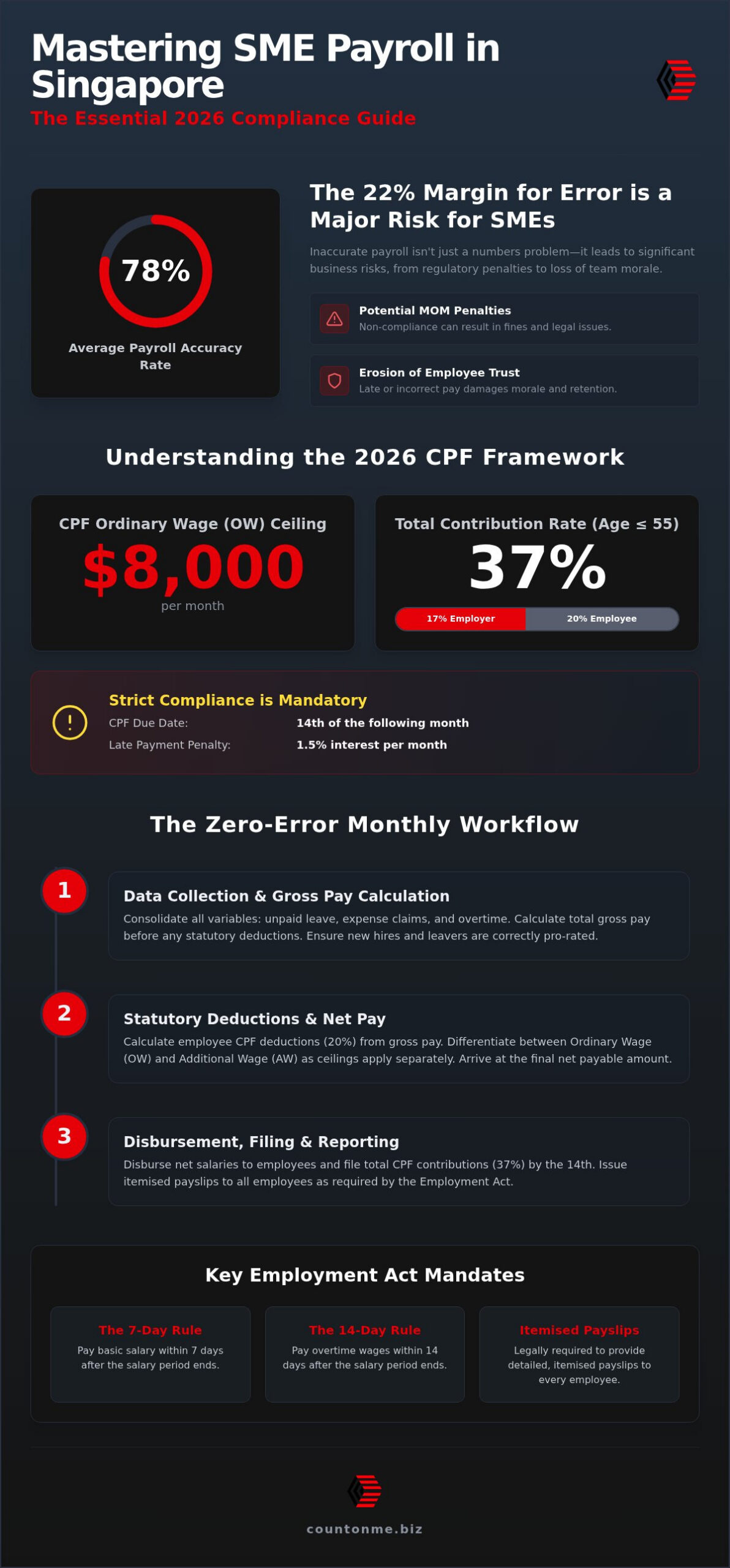
Did you know that the average payroll accuracy rate sits at just 78%? For a growing business, that 22% margin for error isn’t just a statistic; it’s a potential penalty from MOM or a late-night headache over payroll processing for SME Singapore. We know how it feels to double-check every spreadsheet cell while worrying if you’ve missed the latest 2026 regulatory update.
You want to focus on your team’s growth, not the administrative burden of manual filings. We agree that your time is better spent on strategy than on calculating the $8,000 CPF wage ceiling for the tenth time this month. Our goal is to help you turn that stress into a streamlined, scalable system that ensures every cent is accounted for and every deadline is met.
This guide will show you exactly how to achieve zero-error runs and full compliance with IRAS and MOM. We’ll walk through the essential 2026 contribution rates, explore automation tools that save you time, and help you build a payroll function that grows alongside your headcount. Let’s transform your monthly processing from a burden into a seamless, digital-first operation.
Key Takeaways
- Understand the 2026 regulatory landscape to ensure your business stays fully aligned with MOM guidelines and the Employment Act.
- Implement a structured monthly workflow to eliminate the “end-of-month scramble” and maintain perfect data hygiene.
- Evaluate the efficiency of your current systems against modern solutions for payroll processing for SME Singapore to reduce manual risk.
- Master year-end reporting and the Auto-Inclusion Scheme (AIS) to maintain a seamless relationship with IRAS.
- Leverage payroll analytics as a strategic tool to better understand your cash flow and the true cost of scaling your team.
The Landscape of Payroll Processing for SME Singapore in 2026
When we talk about the heartbeat of a business, we often point to sales or product innovation. However, for your team, the real pulse is felt on payday. At its core, payroll processing for SME Singapore is the systematic calculation of wages, deductions, and statutory contributions. If you are curious about the broader global context of what is payroll, it essentially encompasses the entire administrative task of compensating employees, from tracking hours to filing taxes. In our local market, this process is heavily shaped by the Ministry of Manpower (MOM) and the Employment Act.
By 2026, the landscape has shifted decisively toward mandatory digital record-keeping. The days of “getting by” with manual ledgers or basic spreadsheets are fading. This digital-first mandate isn’t just a hurdle; it’s an opportunity. Accurate, transparent payroll is a powerful retention tool. In a competitive hiring market, a single error in a CPF contribution or a late salary payment can erode the trust you’ve worked hard to build. We see payroll as a trust-building exercise that proves you value your people as much as your profits.
Core Statutory Obligations
The Employment Act is the primary legislation protecting employees in Singapore. It covers almost all employees, regardless of nationality, though specific provisions for rest days and hours of work apply mainly to those earning below certain thresholds. One of your most critical duties is the “7-day rule.” You must pay basic wages within 7 days after the end of the salary period. Overtime pay has a slightly longer window of 14 days. Additionally, you are legally required to issue itemised payslips. These must clearly detail basic salary, deductions, and employer contributions to avoid any ambiguity during a MOM inspection.
The Central Provident Fund (CPF) Framework
Managing CPF is often the most complex part of payroll processing for SME Singapore. As of 2026, the CPF Ordinary Wage (OW) ceiling has reached its final phased increase to $8,000 per month. This means contributions are calculated on wages up to this cap. For employees aged 55 and below, the total contribution rate is 37%, which is split between a 17% employer contribution and a 20% employee deduction. If you find yourself staring at a spreadsheet wondering if you’ve correctly calculated the contribution rates for your senior employees versus your new hires, our detailed resource on CPF payroll services Singapore walks you through every rate tier and obligation for 2026.
Precision is vital here because the CPF Board is strict about deadlines. Contributions are due by the 14th of the following month. If you miss this date, you’ll face a late payment interest charge of 1.5% per month. Beyond the total percentage, you must ensure the correct allocation between the Ordinary, Special, and Medisave accounts. Getting these details right every month provides your team with the financial security they expect and gives you the peace of mind to keep scaling.
Step-by-Step: The Monthly Payroll Processing Workflow
Managing payroll processing for SME Singapore shouldn’t feel like a monthly race against the clock. When we see business owners struggling with the “end-of-month scramble,” it’s usually because the workflow lacks a clear structure. The secret to a stress-free payday lies in data hygiene. If your time-tracking and leave systems aren’t accurately updated throughout the month, you’re essentially building your payroll on shaky ground. By establishing a repeatable sequence, you can move from data collection to bank disbursement with quiet confidence.
Handling ad-hoc payments is where many manual systems break down. Commissions, performance bonuses, and transport allowances all have different impacts on statutory contributions. For instance, a bonus is classified as an “Additional Wage” for CPF purposes, which has a different calculation ceiling than basic “Ordinary Wages.” Keeping these distinct in your records ensures you don’t overpay or underpay contributions, protecting you from future audits and keeping your team happy.
Phase 1: Data Collection and Gross Pay Calculation
Your first priority is consolidating all variables that deviate from the standard monthly salary. This includes unpaid leave, expense claims, and overtime (OT). You’ll want to refer to MOM’s official salary guidelines to ensure your OT rates are calculated correctly, typically at 1.5 times the hourly basic rate of pay. Gross Pay is the total remuneration before any statutory deductions or employee contributions. If you have new joins or employees leaving mid-month, ensure you apply the correct pro-rated formula based on the number of working days in that specific month to remain compliant.
Phase 2: Statutory Deductions and Levies
Once your gross figures are locked in, the focus shifts to deductions and levies. This is where the math gets granular. You’ll need to calculate the Skills Development Levy (SDL) for every employee, which is currently 0.25% of their monthly total wages, with a minimum of $2 and a maximum of $11.25. Don’t forget the Self-Help Group (SHG) contributions, such as CDAC, ECF, MBMF, or SINDA. These amounts are small but mandatory, and they vary based on the employee’s race and income level. Finally, if you employ foreign workers, you must account for the Foreign Worker Levy (FWL), ensuring your calculations align with your company’s specific sector and quota tier.
Before you finalize the run, perform a final verification check. Does the total net pay on your payroll register match the disbursement total in your bank file? This simple step prevents the nightmare of reversed payments or incorrect transfers. If you’re finding these manual steps too time-consuming as your team grows, exploring professional payroll management solutions can help you automate the heavy lifting while maintaining 100% accuracy in your payroll processing for SME Singapore.
Internal Management vs. Payroll Outsourcing in Singapore
You’ve likely asked yourself if you really need to outsource or if you can keep things in-house for a little longer. DIY payroll often feels like the cheaper option on paper. You pay for a software subscription, and you or an admin handles the rest. However, the true cost of payroll processing for SME Singapore isn’t just the software fee; it’s the man-hours lost to data entry and the constant anxiety of making a mistake. When you factor in the time spent researching new regulations, the “free” or “cheap” version of payroll often becomes your most expensive overhead.
Manual spreadsheets are a ticking clock in a strict regulatory environment. They lack the audit trails and security features required to protect sensitive salary data. Storing employee bank details and NRIC numbers in an unprotected local file is a risk that most modern startups simply can’t afford to take. Outsourcing provides a “compliance shield” that allows you to offload these risks to experts. For a deeper dive into how this looks in practice, check out our guide on Payroll Outsourcing in Singapore: The 2026 SME Guide to Scalable Compliance.
When to Move Beyond Spreadsheets
If your headcount is creeping past five employees, or if you’ve started dealing with complex commissions and varied leave types, you’ve likely outgrown your manual system. Frequent errors in CPF calculations or the occasional “oops” in an expense claim are clear signs that your current process is redlining. Cloud-based integration has become the 2026 standard for Singapore businesses. It ensures that your data is encrypted and accessible from anywhere, removing the bottleneck of a single local file that only one person can edit. If you’re ready to make the switch, our guide on automated payroll Singapore setup for SMEs walks you through exactly how to transition from clunky spreadsheets to a modern, cloud-based workflow.
The Collaborative Advantage of Outsourcing
Staying on top of CPF employer obligations is a full-time job in itself. By partnering with a payroll provider, you gain access to professional expertise without the hefty price tag of a full-time HR manager. This partnership also ensures business continuity. What happens to your payroll if your only admin leaves or takes a long leave of absence? With a dedicated team behind you, your payroll processing for SME Singapore never skips a beat. At Count On Me, we act as your supportive ally, providing the tech-forward expert guidance you need to keep your focus on strategic growth while we handle the compliance heavy lifting.
Reporting and Year-End Compliance: Beyond the Monthly Run
Successfully hitting “send” on your bank transfer feels like the finish line, but for payroll processing for SME Singapore, it’s only the midpoint. The final lap involves reporting that data to the Inland Revenue Authority of Singapore (IRAS) to ensure your team’s tax filings are seamless. If you have five or more employees, participation in the Auto-Inclusion Scheme (AIS) is mandatory. This digital system allows you to submit income information directly to the authorities, meaning your staff don’t have to manually enter their salary details when tax season rolls around. It’s a huge win for employee experience and a major step toward a paperless office.
Beyond the annual filings, you must keep a sharp eye on your documentation. MOM rules require you to maintain accurate payroll records for up to five years. This isn’t just about compliance; it’s about having a clear audit trail if a dispute ever arises. We’ve seen how a well-organized digital archive can turn a stressful audit into a non-event. Managing these moving parts requires a holistic view of your business’s obligations. For a broader look at your responsibilities, explore The SME Guide to Tax Compliance Services in Singapore (2026).
IRAS Year-End Reporting (IR8A)
Every year, you’ll need to prepare Form IR8A for your employees. This isn’t just about their basic salary. You must declare benefits-in-kind, such as housing allowances or company cars, which are often overlooked in manual calculations. The deadline for AIS submission is March 1st each year. Missing this can lead to unnecessary stress and potential penalties. Modern, automated systems take the sting out of this process by generating these forms with a few clicks, ensuring your reporting is as accurate as your monthly runs.
Handling Special Cases: IR21 and NS Claims
Then there are the “one-off” scenarios that can disrupt your rhythm. If a non-citizen employee plans to leave the country or your company, you must file Form IR21 for tax clearance at least one month before they depart. You are legally required to withhold their final payment until IRAS gives the green light. We also help clients manage National Service (NS) make-up pay claims and reimbursements for Government-Paid Maternity or Paternity Leave (GPML/GPPL). These tasks require meticulous record-keeping and a deep understanding of payroll processing for SME Singapore to ensure you are reimbursed correctly by the government.
We know that tax season can feel like a mountain of paperwork, but you don’t have to climb it alone. If you’d rather spend your time growing your business than filing forms, our payroll management solutions can handle the entire year-end cycle for you, giving you the relief and stability you deserve.
Scaling Your SME with Strategic Payroll and CFO Insights
Many founders view payroll processing for SME Singapore as a monthly exercise in data entry. We see it differently. When your payroll is integrated into your broader financial ecosystem, it transforms from a compliance task into a rich source of business intelligence. Your payroll data is the largest line item on your profit and loss statement, and understanding its nuances is key to managing cash flow effectively. By looking at these numbers through a strategic lens, you can start to understand your true “cost per hire,” which includes everything from basic wages to statutory contributions and hidden administrative overheads.
To get the full picture, you should be integrating your payroll with your general ledger. Our Complete Guide to Cloud Accounting Services in Singapore (2026) explains how this synchronisation eliminates manual journal entries and provides a real-time view of your company’s financial health. At Count On Me, our approach is built on reassuring expertise. We don’t just want to tick a compliance box; we want to turn your payroll function into a growth lever that gives you the confidence to expand your team.
From Compliance to Strategic Analysis
This is where the role of a financial partner becomes invaluable. An on demand CFO Singapore uses your payroll data to build accurate head-count forecasts and scenario models. By monitoring staff turnover and compensation trends through digital ledgers, you can identify if your salary packages remain competitive in the 2026 market. Automated payroll reporting identifies hidden overheads in real-time, allowing you to spot inefficiencies in overtime or allowance structures before they impact your bottom line. This level of insight ensures that every dollar spent on your team is an investment in your future growth.
Next Steps: Securing Your Payroll Future
If you’re still feeling the weight of monthly admin, it might be time for a “payroll health check.” We recommend reviewing your current setup to see where manual bottlenecks are slowing you down. Transitioning to a paperless, cloud-first finance function is the most effective way to secure your payroll processing for SME Singapore as you scale. It moves your data out of vulnerable spreadsheets and into a secure, collaborative environment that grows with you. Our step-by-step resource on setting up an automated payroll system in Singapore can help you plan and execute this transition with confidence.
We’re here to help you navigate this transition with quiet confidence and empathy. If you’re ready to move beyond the “end-of-month scramble” and start using your financial data strategically, we invite you to start a consultative dialogue with us. Let’s work together to build a scalable payroll system that feels less like a burden and more like a partnership. Reach out to Count On Me today for personalized support tailored to your unique business journey.
Empowering Your Business Through Seamless Payroll
We’ve walked through the essential components of a digital-first strategy, from mastering the 2026 CPF caps to leveraging payroll analytics for strategic growth. Building a robust system for payroll processing for SME Singapore isn’t just about avoiding MOM penalties; it’s about creating a stable foundation where your employees feel valued and your financial data is crystal clear. By moving beyond manual spreadsheets and embracing cloud integration, you reclaim the time needed to focus on your core mission.
Our team at Count On Me brings over 20 years of professional industry experience to your side, acting as an approachable mentor in your compliance journey. We specialize in expert cloud-accounting integration that turns complex numbers into actionable insights. Let us handle your payroll compliance so you can focus on growth. Explore Count On Me’s scalable solutions today.
You’ve worked hard to build your team and your vision. We’re here to ensure your administrative systems are just as strong and scalable as the rest of your business. Let’s make your next payday the easiest one yet.
Frequently Asked Questions
What is the deadline for monthly payroll processing in Singapore?
You must pay your employees’ basic salary within 7 days after the end of the salary period. If your team has worked overtime, those specific payments must be disbursed within 14 days after the end of the period. Staying on top of these dates is vital for maintaining trust and ensuring your business remains fully compliant with the Ministry of Manpower’s regulations.
Do I need to pay CPF for part-time or internship employees?
Yes, you are required to make CPF contributions for any employee who is a Singapore Citizen or Permanent Resident (PR) earning more than $50 a month. This rule applies regardless of whether they are working part-time, on a temporary contract, or as an intern. It’s a common area where small businesses face accidental non-compliance, so it’s best to track these hours carefully from day one.
Is it mandatory for SMEs to provide itemised payslips to all staff?
It is absolutely mandatory for all employees covered under the Employment Act to receive itemised payslips. You can issue these in either hard copy or soft copy, but they must include specific details such as the payment period, basic salary, and any statutory deductions. Providing clear, digital payslips is an excellent way to build transparency and professionalize your relationship with your team.
What are the penalties for late CPF contributions in 2026?
The penalty for late payment is a 1.5% interest charge per month, which starts accruing the day after the 14th of the following month. The minimum interest charge is $5, and the CPF Board takes these deadlines very seriously. Avoiding these unnecessary costs is one of the primary benefits of automating your payroll processing for SME Singapore to ensure every submission is on time.
How does the Auto-Inclusion Scheme (AIS) work for small businesses?
The AIS allows you to submit your employees’ income information directly to IRAS electronically. If you have 5 or more employees, joining this scheme is mandatory. Once you’ve submitted the data, the information is automatically pre-filled in your employees’ individual tax returns. This digital-first approach saves your staff significant time during tax season and reduces the risk of reporting errors.
Can I process payroll manually using Excel for a team of 10?
While it’s technically possible, we don’t recommend it once your team grows beyond a few people. With 10 employees, the manual calculation of CPF, SDL, and various self-help group contributions becomes a significant administrative burden. Using payroll processing for SME Singapore software or a professional service reduces the risk of the “78% accuracy rate” common in manual systems, giving you much-needed peace of mind.
What is the Skills Development Levy (SDL) and how is it calculated?
The SDL is a mandatory levy that supports workforce training and development in Singapore. It’s calculated at 0.25% of an employee’s total monthly wages. There’s a minimum levy of $2 for employees earning less than $800 a month and a maximum cap of $11.25 for those earning more than $4,500. Every employer must pay this, and the funds go toward upgrading the skills of the local workforce.
Does Count On Me provide payroll services for foreign employees (EP/S-Pass holders)?
Yes, we provide comprehensive support for both local and foreign employees, including EP and S-Pass holders. We manage the specific requirements for foreign staff, such as the Foreign Worker Levy (FWL) and the IR21 tax clearance process when an employee leaves. Our goal is to act as your supportive ally, ensuring every member of your team is paid accurately and in full compliance with current laws. For a comprehensive breakdown of contribution rates by age group and wage type, our guide on CPF payroll services Singapore provides the detailed employer compliance information you need.