
What if your tax season didn’t involve a frantic scramble through messy spreadsheets or the nagging fear of an unexpected IRAS penalty letter? We know that for many Singaporean entrepreneurs, managing the current 9% GST rate and the pressure of corporate filing deadlines can feel like a full-time job you never actually applied for. It’s completely normal to feel a bit lost in the jargon, but you don’t have to navigate these requirements alone. By partnering with professional tax compliance services in Singapore, you can shift your focus from manual data entry to strategic scaling.
We’re here to help you master the essentials with a clear, supportive approach designed specifically for growing startups and SMEs. We understand that you want a partner who values your success as much as you do. In this guide, we’ll walk you through the 2026 tax landscape, including the 50% Corporate Income Tax rebate and the latest digital filing mandates from IRAS. You’ll learn how to optimize your tax position using legal incentives like the Start-Up Tax Exemption, ensuring you keep more of your hard-earned revenue. We’ll also show you how to move toward a digital-first workflow that replaces administrative stress with total peace of mind.
Key Takeaways
- Understand the distinct roles of ACRA and IRAS in your business journey to ensure every regulatory requirement is met with confidence.
- Master the essential filing milestones, from Estimated Chargeable Income (ECI) to annual returns, to maintain a flawless compliance track record.
- Protect your bottom line by using professional tax compliance services in Singapore to avoid heavy penalties and the mental burden of DIY filing.
- Discover how a digital-first workflow using cloud accounting tools can automate your data capture and streamline your entire tax process.
- Learn how specialized startup packages and on-demand CFO insights can help you optimize your tax position as your business scales.
Understanding the Singapore Tax Compliance Landscape in 2026
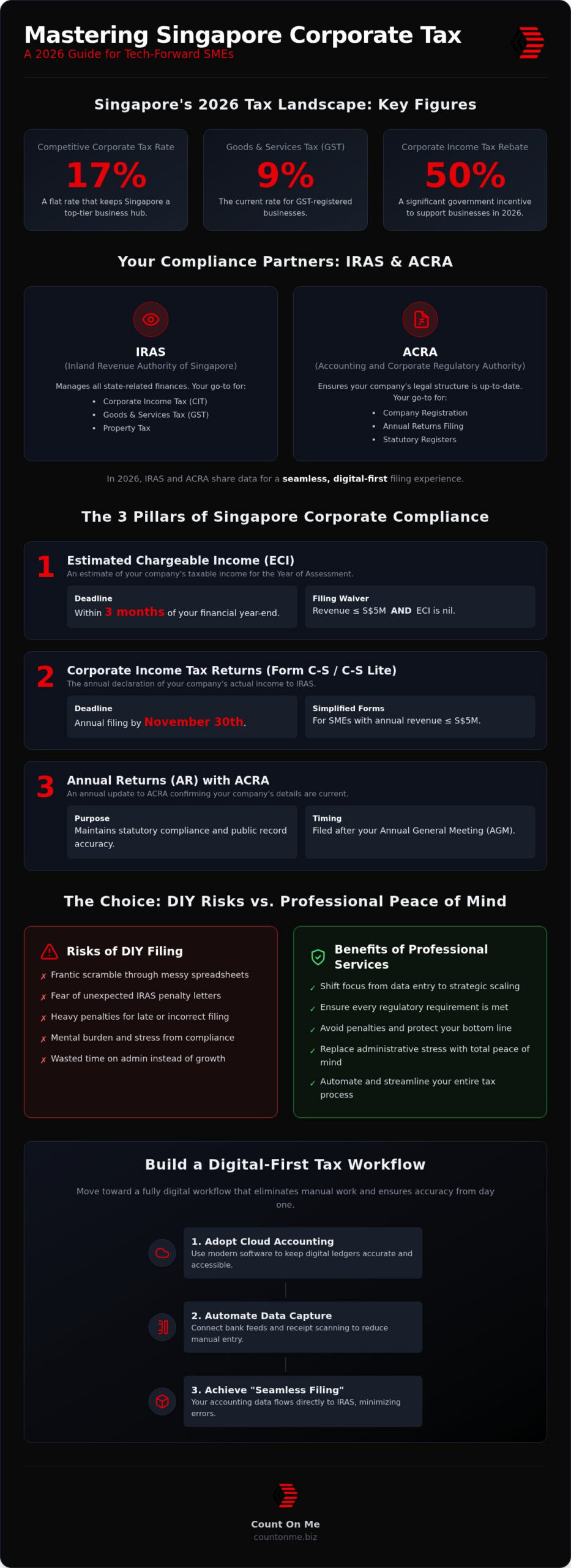
Singapore has built a reputation as a global business haven, but what does that look like for you in 2026? It’s a supportive ecosystem where the government actively encourages your success through clear rules and digital efficiency. We’ve seen a massive shift toward “Seamless Filing,” where your accounting software talks directly to the authorities. This reduces the manual grind that used to haunt SME owners. This digital-first approach is why Singapore remains a top-tier hub for startups. It’s not just about the competitive 17% corporate tax rate; it’s about the ease of doing business.
The Definition of Corporate Tax Compliance
At its heart, compliance is your company’s commitment to the rules that keep the city-state running. It’s your legal obligation to report earnings and pay the correct dues on time. However, Singapore’s approach is unique because it prizes voluntary compliance. The authorities prefer to guide you toward correct filing rather than focusing solely on enforcement. This is why keeping accurate digital ledgers is so vital. It’s not just about staying out of trouble; it’s about having a clear view of your business health. Understanding the nuances of Singapore’s tax system helps you see compliance as a strategic tool rather than a chore.
Key Regulatory Bodies: IRAS and ACRA
You’ll interact with two main entities. Think of them as the twin pillars of your corporate standing. First, there’s the Inland Revenue Authority of Singapore (IRAS). They handle everything related to money flowing to the state, including corporate income tax, GST, and property tax. Then, you have the Accounting and Corporate Regulatory Authority (ACRA). They ensure your company’s legal structure and statutory registers stay current.
By 2026, the digital ecosystem has matured. IRAS and ACRA now share data more fluidly than ever. When you update your annual return with ACRA, that information helps streamline your tax obligations with IRAS. This connectivity is a game-changer for efficiency. If you feel overwhelmed by these moving parts, engaging professional tax compliance services in Singapore ensures these two agencies always see a consistent, accurate picture of your business. It turns a complex regulatory landscape into a smooth, automated background process for your startup. Choosing the right tax compliance services in Singapore means you’re never guessing about which agency needs what document or which deadline is approaching next.
The 3 Pillars of Singapore Corporate Tax Compliance
Do you ever feel like you’re chasing shadows when it comes to filing dates? It’s a common stressor for founders, but compliance actually follows a very logical, chronological flow. Once you understand the three main pillars, the process feels less like a hurdle and more like a routine check-up for your business health. By integrating professional tax compliance services in Singapore early in your journey, you can automate these milestones and focus on what you do best: growing your company.
Estimated Chargeable Income (ECI) Explained
Your compliance journey begins shortly after your financial year ends. Estimated Chargeable Income (ECI) is an estimate of a company’s taxable income for a Year of Assessment. You generally have a three-month window to submit this to IRAS. However, many SMEs qualify for a filing waiver. In 2026, your company doesn’t need to file an ECI if your annual revenue is S$5 million or below and your ECI is nil. It’s a helpful exemption that simplifies life for early-stage startups, but you still need to ensure your bookkeeping is accurate to prove you meet these criteria.
Corporate Income Tax Returns: Form C-S vs. Form C
The second pillar is your annual tax return, which is due by November 30th every year. For most SMEs with an annual turnover of S$5 million or less, you’ll use Form C-S or Form C-S Lite. These are simplified versions of the standard Form C, designed to make reporting easier for smaller businesses. You can find more detail on these specific forms in our Founder’s Guide to Corporate Tax Filing.
During this stage, your focus shifts to tax adjustments. Not every business expense is deductible, and some capital investments qualify for allowances that reduce your taxable profit. For a deeper dive into the rules, the official IRAS corporate tax guide provides a comprehensive breakdown of what qualifies. If you’re looking for a partner to handle these complex calculations, our Tax Compliance & Advice service provides the steady hand you need to optimize your position.
GST Compliance for Growing Businesses
The final pillar is the Goods and Services Tax (GST). Currently, the GST rate stands at 9%. You must register for GST if your taxable turnover exceeds S$1 million at the end of any calendar year or if you expect it to exceed that amount in the next 12 months. Some businesses choose voluntary registration even before hitting that threshold to claim back GST on their inputs, though this comes with quarterly filing responsibilities. Maintaining digital-first records is essential here, as IRAS expects precise tracking of every transaction to ensure your quarterly returns are flawless. For a comprehensive walkthrough of the entire process, our guide to GST filing Singapore SMEs need in 2026 covers everything from the InvoiceNow mandate to automated workflows that save you hours of manual entry.
Navigating these pillars effectively requires a mix of traditional expertise and modern tools. Using specialized tax compliance services in Singapore ensures that whether you are calculating ECI or managing GST, your data is always ready for the digital-first reporting environment of 2026.
The High Cost of Non-Compliance vs. Professional Tax Services
Managing your own tax filings might seem like a way to save costs, but the hidden price of a DIY approach can be steep. We often see entrepreneurs grappling with what we call the “Anxiety Tax.” It’s that low level of constant stress that comes from wondering if you missed a deadline or misinterpreted a complex IRAS rule. Beyond the mental burden, the financial consequences of errors are very real. Engaging professional tax compliance services in Singapore isn’t just about outsourcing paperwork; it’s a strategic move to protect your capital and ensure your business remains in good standing with the authorities.
Common Penalties and How to Avoid Them
The Inland Revenue Authority of Singapore (IRAS) and ACRA are supportive, but they’re also firm about deadlines. If you miss your Corporate Income Tax Return filing, you could face a composition sum ranging from S$200 to S$5,000. For those who are late with tax payments, an initial 5% penalty is applied immediately, followed by an additional 1% each month the amount remains unpaid. ACRA also imposes late filing fees for annual returns, which start at S$300 and double to S$600 if you’re more than three months overdue.
We believe in proactive risk mitigation. If you’ve already made an error, don’t panic. The IRAS voluntary disclosure programme allows businesses to correct mistakes and potentially receive reduced penalties. To help you stay ahead of these risks, we recommend using our SME Tax Compliance Checklist to audit your current readiness. It’s a simple way to identify gaps before they become expensive problems.
Strategic Tax Planning and Incentives
The true value of expert tax compliance services in Singapore lies in identifying opportunities you might otherwise overlook. For instance, qualifying new startups can tap into the Start-Up Tax Exemption (SUTE) scheme. This provides a 75% exemption on your first S$100,000 of chargeable income and a 50% exemption on the next S$100,000 for your first three consecutive Years of Assessment. Even for more established SMEs, the Partial Tax Exemption (PTE) offers significant relief on income up to S$200,000.
In 2026, companies can also benefit from a 50% Corporate Income Tax Rebate, capped at S$40,000. Our team doesn’t just file your forms; we act as a supportive ally to ensure you’re claiming every incentive you’re entitled to. By utilizing on-demand CFO insights, we help you use this tax data to optimize your cash flow and plan for future growth. We’re here to turn your tax obligations into a clear roadmap for financial stability.
Building a Digital-First Tax Compliance Workflow
How much time did you spend last month chasing down missing receipts or manually updating a spreadsheet? If you’re like most SME owners, the answer is probably “too much.” In 2026, compliance isn’t a manual chore; it’s a digital process that runs quietly in the background of your business. By shifting to a digital-first workflow, you move from reactive panic to proactive management. This transition is built on cloud accounting, which serves as the single source of truth for your entire financial operation. For a deeper look at this foundation, explore our Cloud Accounting Services in Singapore guide.
Step 1: Digitise Your Source Documents
The days of keeping shoeboxes filled with faded thermal receipts are over. Modern tax compliance relies on high-fidelity digital scans. When you digitise your source documents immediately, you create a permanent, searchable audit trail. This isn’t just about saving physical space. It’s about data integrity. If IRAS ever requests a clarification on an expense, you can pull up the original digital scan in seconds. Real-time expense tracking also prevents that dreaded year-end rush where you’re trying to remember what a specific transaction was for six months after it happened.
Step 2: Automate Recurring Tax Obligations
Automation is your best friend when it comes to staying on top of the 9% GST and cross-border payments. Within platforms like Xero, you can set up automated trackers that categorize your taxable turnover. This makes it much easier to monitor if you’re approaching the S$1 million mandatory registration threshold. Automation also plays a vital role in managing Withholding Tax for payments made to non-resident professionals or companies.
We recommend scheduling automated reminders within your accounting module for key milestones. You can set alerts for your ECI filing three months after your year-end and for your Form C-S submission by November 30th. This ensures you never miss a deadline simply because you were busy running your company. When you combine these tools with professional tax compliance services in Singapore, you gain a partner who monitors these systems for you. We help you fine-tune these automations to ensure every calculation is precise and every incentive is captured.
Ready to leave the manual grind behind? Let our experts help you build a seamless, automated system with our Tax Compliance & Advice solutions.
Why Count On Me is the Compliance Partner for Tech-Forward SMEs
Choosing the right partner for your tax compliance services in Singapore is about more than just finding someone to check boxes. It’s about finding a team that acts as a natural extension of your own. We understand that as a founder, your time is your most valuable asset. You need a partner who doesn’t just hand you a list of problems, but provides clear, decisive resolutions. Our approach is built on a foundation of quiet confidence and empathy. We’ve been in your shoes, and we know that the right support can turn tax season from a period of stress into a moment of stability.
Our team brings together seasoned professionals with over 20 years of experience. We pair this deep industry knowledge with a modern, Xero-certified tech stack. This combination allows us to offer specialized startup packages that are designed to scale alongside you. Whether you’re just starting out or approaching the S$1 million GST registration threshold, our workflow adapts to your needs. We don’t just look at your ledgers; we look at your future. Through our on-demand CFO services, we use your tax data to provide strategic insights that help you optimize your cash flow and prepare for your next big milestone.
The Count On Me Difference: Authoritative yet Accessible
The financial sector is often filled with cold, detached formality that can make tax law feel more confusing than it needs to be. We’ve intentionally chosen a different path. We act as an authoritative yet humble mentor, bridging the gap between complex IRAS regulations and the daily reality of running an SME. You won’t find any unnecessary jargon here. Instead, you’ll get transparent communication and a clear understanding of our professional service fees. We believe that a successful partnership is built on honesty and accessibility, ensuring you always know exactly where your compliance standing sits.
Ready to Simplify Your Singapore Tax Compliance?
Mastering your tax obligations doesn’t have to be a solo journey. We’re here to handle the heavy lifting of your ECI filings, Form C-S submissions, and quarterly GST returns. By choosing Count On Me as your dedicated digital partner, you’re investing in total peace of mind. We’ll ensure your filing deadlines are met with precision while you stay focused on what truly matters: growing your business and leading your team. Let’s move away from manual spreadsheets and toward a digital-first strategy that supports your long-term success. When you’re ready for a more collaborative way to manage your tax compliance services in Singapore, we’re ready to start the conversation.
Securing Your Business Future with a Digital-First Strategy
Navigating the 2026 regulatory landscape doesn’t have to be a source of anxiety. We’ve explored how a digital-first workflow and a deep understanding of Singapore’s tax pillars can transform compliance from a burden into a strategic asset. By embracing cloud accounting and leveraging incentives like the Start-Up Tax Exemption, you’re not just avoiding penalties. You’re actively optimizing your cash flow for future growth. Success in this environment starts with choosing the right tax compliance services Singapore has to offer.
Our team of Xero-certified cloud accounting experts brings over 20 years of industry experience to your side. We provide tailored startup and SME packages designed to scale as you do, offering the stability you need to lead with confidence. We’re invested in your journey and ready to act as the supportive ally your business deserves. We believe in building relationships that go beyond the ledger, ensuring you have a master of both traditional foundations and contemporary digital tools in your corner.
You’ve built something incredible. We’re here to ensure the administrative details never slow you down. Let’s grow together.
Frequently Asked Questions
What are the key tax filing deadlines for Singapore companies in 2026?
Your primary deadlines depend on your financial year-end. You must file your Estimated Chargeable Income (ECI) within three months of that date. The final Corporate Income Tax Return for the Year of Assessment 2026 is due by November 30, 2026. If you’re GST-registered, you must file your returns quarterly, usually within one month after each accounting period ends. Staying ahead of these dates ensures you maintain a clean record with the authorities.
Is my small startup exempt from corporate tax in Singapore?
While no company is entirely exempt, the Start-Up Tax Exemption (SUTE) scheme offers significant relief for new businesses. Qualifying startups receive a 75% exemption on the first S$100,000 of chargeable income and a 50% exemption on the next S$100,000 for their first three consecutive years. This effectively lowers your tax bill during those critical early stages. It’s a supportive measure that allows you to reinvest more capital back into your growing venture.
Do I need to register for GST if my turnover is below S$1 million?
Registration is only mandatory if your taxable turnover exceeds S$1 million in a 12-month period. If you’re below this threshold, you don’t have to register, but you can choose to do so voluntarily. This is often beneficial if you want to claim back GST on your business inputs. However, voluntary registration requires you to stay registered for at least two years. You’ll also need to maintain strict quarterly filing and digital record-keeping once you’re in the system.
What is the difference between ECI and the final corporate tax return?
Think of the ECI as a quick check-in and the final return as the official record. The ECI is an estimate of your company’s taxable income filed within three months of your financial year-end. The Corporate Income Tax Return is the final, detailed submission due by November 30. It accounts for all actual income and deductible expenses. This official filing serves as the basis for your final tax assessment and any rebates you’re eligible to receive.
Can I file my own corporate taxes using cloud accounting software?
It’s technically possible, especially with the Seamless Filing features in modern software. However, while tools like Xero simplify data entry, they don’t always catch complex tax adjustments or specific capital allowances. Many founders use tax compliance services in Singapore to ensure their digital records are translated correctly into tax-ready formats. This prevents accidental errors that could trigger an audit. It also ensures you’re not missing out on legal incentives that can reduce your overall tax liability; for those seeking a partner with deep expertise, you can explore Tax Preparation and Accounting Services with Catherine Accounting & Tax Services LLC to protect your bottom line.
What happens if I miss a tax filing deadline in Singapore?
Missing a deadline triggers immediate penalties. For a late Corporate Income Tax Return, IRAS may impose a composition sum between S$200 and S$5,000. If you also miss the payment deadline, you’ll face an initial 5% penalty on the unpaid tax. This can increase by 1% each month it remains outstanding. Persistent non-compliance is serious and can lead to a court summons for directors. It’s always better to proactively manage your filings to avoid these unnecessary costs.
What are the benefits of outsourcing tax compliance services?
Outsourcing provides total peace of mind and ensures you never miss a critical deadline. Professional tax compliance services in Singapore help you identify legal incentives like the 50% corporate tax rebate for YA 2026 that you might otherwise overlook. Beyond just filing forms, a dedicated partner offers strategic advice that optimizes your tax position, much like the comprehensive consulting provided by Wright CPAs, LLC. This allows you to focus on high-level business decisions. We act as a supportive ally, translating complex regulations into clear, actionable steps.
How does withholding tax work for Singapore SMEs hiring foreign freelancers?
If you pay a non-resident professional for services provided in Singapore, you’re generally required to withhold a percentage of that payment. You then remit this amount to IRAS. The rate depends on the type of payment, such as management fees or technical assistance. You must file a withholding tax form and pay the amount by the 15th of the second month following the payment date. It’s a vital step to ensure your cross-border collaborations stay fully compliant and penalty-free.