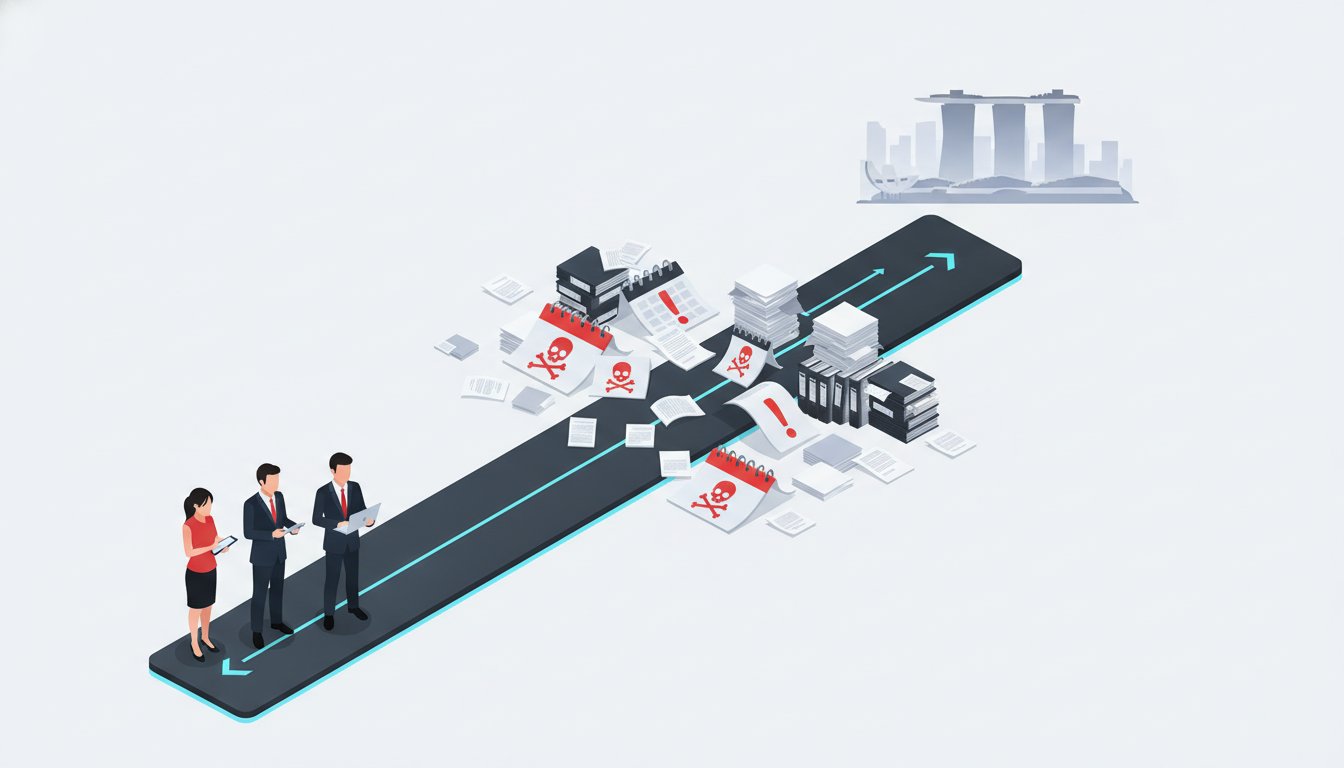
A simple oversight on your BizFile+ dashboard could cost you more than just a late fee; it could eventually cost you your seat at the boardroom table. Whether it is a missed Annual Return deadline or a late update to your registered address, ACRA filing penalties Singapore business owners face are designed to be swift and automated. We understand how overwhelming it feels to balance growth with the rigid complexity of AGM timelines and statutory filings. It is stressful to see a penalty notice when you are already working around the clock to scale your SME.
We are here to help you turn that anxiety into a sense of control. In this guide, you will learn how to identify, rectify, and prevent ACRA late filing penalties with our comprehensive compliance roadmap. We will walk you through the current 2026 penalty tiers, explore the narrow windows for successful appeals, and show you how integrating cloud technology can make manual tracking a thing of the past. Let’s look at how you can protect your company and your reputation by making compliance a background process rather than a constant worry.
Key Takeaways
- Understand the updated 2-tier penalty system to avoid automated fines that escalate significantly after the three-month mark.
- Learn how to map your compliance calendar by aligning your Financial Year End with critical AGM and Annual Return timelines.
- Discover the specific steps required to rectify missed lodgments and the strict criteria ACRA uses for evaluating penalty appeals.
- Identify how to manage ACRA filing penalties Singapore by transitioning from manual spreadsheets to automated, cloud-based compliance workflows.
- See how a strategic partnership with a digital corporate secretary can protect your directors from disqualification and legal repercussions.
Understanding ACRA Filing Penalties: More Than Just a Fine
When you receive a notification about a late filing, it is easy to view it as just another administrative bill. However, these charges are statutory fines issued by the Accounting and Corporate Regulatory Authority (ACRA) for failing to meet legal obligations under the Companies Act. Singapore maintains these strict standards to ensure a high level of corporate transparency and to protect the interests of stakeholders, investors, and the public. In our experience, the most successful SMEs view compliance not as a hurdle, but as a foundation for trust. Maintaining a clean regulatory record provides an immense sense of relief, allowing you to focus on growth without the shadow of pending enforcement actions hanging over your boardroom.
It is helpful to weigh the predictable cost of professional corporate secretary services against the volatile nature of ACRA filing penalties Singapore businesses often encounter. While a professional service is a planned investment in your company’s health, penalties can quickly escalate into the thousands of dollars across multiple directors. We believe in being a supportive ally that helps you avoid these unnecessary drains on your capital. By staying ahead of the clock, you ensure your resources are spent on innovation rather than avoidable fines.
The Real Cost of Non-Compliance
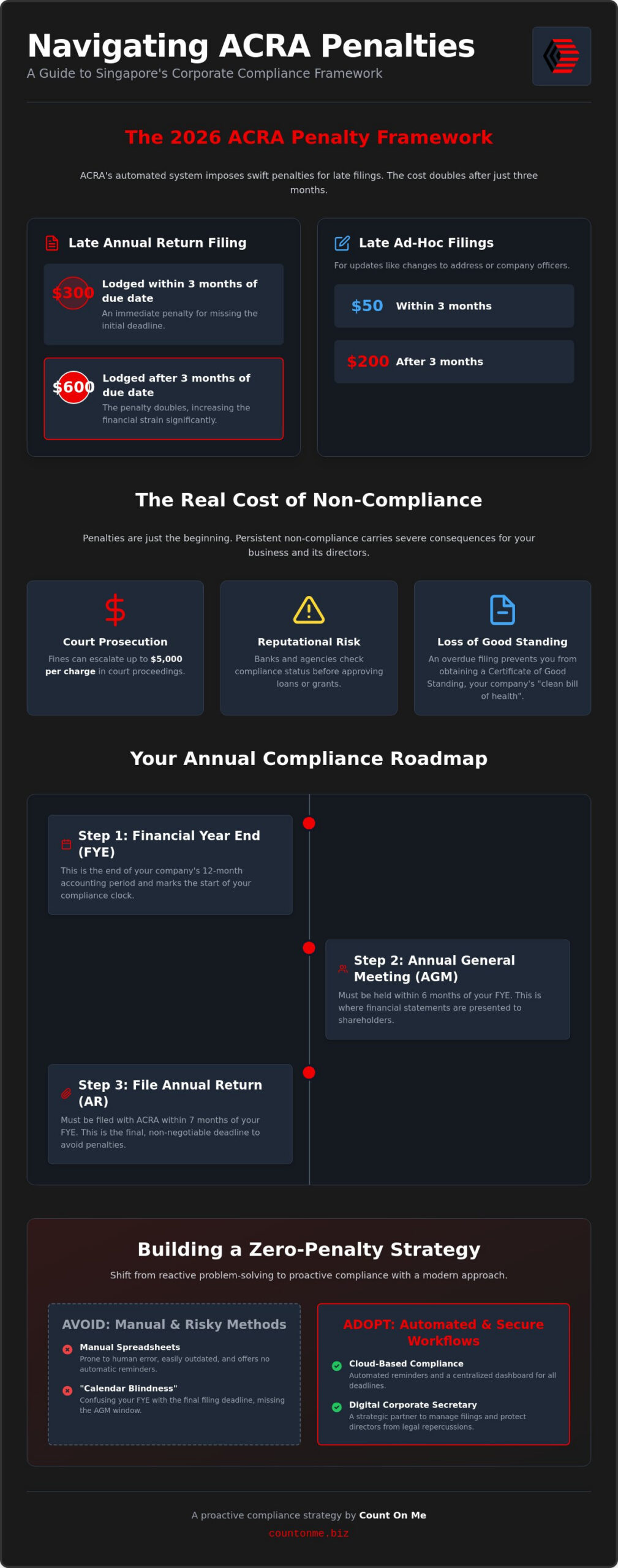
The financial impact of a penalty is rarely limited to the initial fine. These costs stack over time, and persistent neglect can lead to court prosecutions where fines reach up to $5,000 per charge. Beyond the balance sheet, your reputational risk is significant. Banks and government agencies often check your compliance status before approving loans or grants. A Certificate of Good Standing is an official document issued by the regulator that confirms your company is live and has filed all required documents; you lose the ability to obtain this the moment a single filing becomes overdue. Without it, your business effectively loses its “clean bill of health” in the eyes of the financial world.
Common Reasons SMEs Miss ACRA Deadlines
We often see early-stage startups struggle with “calendar blindness” where the excitement of building a product overshadows statutory dates. It’s common for founders to confuse their Financial Year End (FYE) with the actual filing deadline, not realizing there is a specific window for holding an AGM and lodging the Annual Return. Relying on manual spreadsheets or an inactive company secretary creates a single point of failure. If your secretary isn’t proactive, you might not realize a deadline has passed until the penalty notice arrives in your inbox. Shifting to a tech-forward approach ensures these dates are tracked automatically, giving you back the mental bandwidth to lead your team.
The 2026 ACRA Penalty Framework: Tiers and Enforcement
The regulatory landscape in 2026 is designed for efficiency; however, it doesn’t leave much room for error. ACRA uses a simplified two-tier framework for late annual lodgments, which has changed the way we look at ACRA filing penalties Singapore SMEs must manage. This means the clock starts ticking the moment you miss your deadline, and the system automatically calculates the fine via the BizFile+ portal. It’s not just a single charge for the company, either. ACRA often views these as “per offence” issues. If you have multiple directors, the total financial burden can multiply quickly because each director is personally responsible for the company’s compliance. To resolve these without a court appearance, ACRA offers a “Composition of Offences.” This is essentially a legal settlement where you pay a fixed sum to avoid prosecution. It’s a way for the regulator to ensure compliance while giving you a chance to rectify the mistake before it becomes a criminal matter.
Late Lodgment Tiers for Annual Returns
For most SMEs, the most common ACRA filing penalties Singapore has in place relate to the Annual Return (AR). The current framework is straightforward but unforgiving. If you lodge your AR within three months of the due date, you’ll face a $300 penalty. Wait longer than three months, and that fine doubles to $600. For ad-hoc updates, such as changing a director’s address or your registered office, the tiers are $50 and $200 respectively. We’ve seen some business owners try to file “placeholder” or incorrect data just to stop the clock and avoid the late fee. We strongly advise against this. ACRA views the lodgment of false or misleading information as a much more serious offense than a late filing. This can lead to heavy fines or even imprisonment, which is a far higher price than a late filing fee. To ensure you never miss a step, our annual return filing Singapore checklist for founders walks you through every requirement in plain language.
Beyond Fines: Summons and Disqualification
If a company persistently ignores its filing duties, the situation moves beyond simple automated fines. ACRA can issue a court summons to directors, leading to potential fines of up to $5,000 per charge. If you’re convicted of three or more filing-related offenses within a five-year period, you face disqualification under Section 155 of the Companies Act. This means you’re barred from acting as a director for five years. In extreme cases, ACRA may even strike your company off the register entirely if they believe it’s no longer operational. It’s a heavy price to pay for what often starts as a simple calendar oversight. If you’re feeling a bit lost in these timelines, our team can help you streamline everything through our Corporate Secretary Services, ensuring you never have to worry about these tiers again. We focus on building a partnership where we handle the technical dates, giving you the stability to focus on your strategic goals.
Identifying Key Deadlines to Protect Your Business
Mapping out your corporate calendar is the single most effective way to stay ahead of the regulator. Everything starts with your Financial Year End (FYE). This date acts as the anchor for your entire compliance schedule. If you don’t have a clear grasp of this date, the risk of incurring ACRA filing penalties Singapore business owners often face increases exponentially. We see many entrepreneurs treat these dates as suggestions rather than strict legal requirements, but in the eyes of the law, the clock is always running. This is where a proactive corporate secretary becomes an invaluable ally. They don’t just file papers; they act as a strategic partner to ensure your company remains in good standing while you focus on scaling.
The compliance calendar is your roadmap to stability. Without it, you’re essentially driving in the dark. We’ve found that when founders visualize their deadlines as a cycle rather than a series of chores, the stress levels drop significantly. It’s about moving from a reactive state to a proactive one. By understanding the rhythm of your filings, you can allocate resources more effectively and avoid the last-minute rush that leads to errors.
The AGM and Annual Return Cycle
For private companies, the sequence is clear. You must hold your Annual General Meeting (AGM) within six months of your FYE. Following that, you have one month to lodge your Annual Return (AR), which means the AR must be filed within seven months of your FYE. For example, if your FYE is 31 December, your AGM must happen by 30 June, and your AR must be lodged by 31 July. Remember that many private companies now opt for the “AGM-less” path. If your company meets specific criteria or has a resolution to dispense with AGMs, you can skip the meeting and go straight to filing. Even with these shortcuts, the seven-month deadline for the AR remains immovable. Missing this window by even a day triggers the automated penalty system.
Ad-hoc Filings: 14-Day and 30-Day Windows
While annual returns get all the attention, ad-hoc filings are the silent traps that catch many SMEs off guard. These are triggered by specific events in your company’s life. If you move offices and forget to update BizFile+ within 14 days, you’re already in default. Similarly, the appointment or cessation of directors and secretaries must be reported within that same two-week window. Share-related changes, like an allotment of new shares or changes in share capital, typically require notification within 14 to 30 days depending on the specific transaction. These deadlines are short, and it’s easy to forget them in the middle of a business expansion. By delegating this tracking to experts, you ensure that every change is recorded instantly, leaving no room for “silent” ACRA filing penalties Singapore to take root.
How to Rectify a Missed Filing and Appeal Penalties
Discovering a missed deadline is stressful, but it’s not the end of the road. You need a clear plan to stop the automated clock on ACRA filing penalties Singapore. The first step is a full audit of your BizFile+ dashboard. Don’t just look at the most recent year; check for any ad-hoc updates that might have slipped through. Once you’ve identified the gaps, you must prepare your financial statements. If your company is required to file in XBRL format, this step is critical and often takes more time than expected. Accuracy is your best defense here, as lodging incorrect data just to “beat the clock” can lead to much harsher consequences than a late fee.
We see rectification as a collaborative effort between your internal team and your compliance partners. It’s about more than just paying a fine; it’s about cleaning up your corporate record so you can move forward with confidence. By handling these issues methodically, you demonstrate to the regulator that you take your statutory duties seriously. This proactive stance is often the first step in rebuilding your company’s status and ensuring you don’t face director disqualification further down the line.
Lodging Overdue Returns via BizFile+
The BizFile+ portal has a “Pending Filings” section that acts as your to-do list. Before you rush to submit, it’s wise to consult a corporate secretary provider singapore to ensure your back-dated documents are legally sound. You need to ensure your accounts are “AGM-ready” even if you’re filing late. This means having the directors’ statement and financial statements signed and dated correctly. Only after these are in order should you proceed with the lodgment. Remember, you can’t even apply for an appeal until the overdue documents are successfully filed and the breach is rectified. Our step-by-step annual return filing Singapore guide can help you confirm every document is in place before you submit.
Navigating the ACRA Appeals Process
Once you’ve rectified the breach, you might consider an appeal. It’s important to be realistic here. ACRA rejects routine excuses like “I forgot,” “I was traveling,” or “my secretary was busy.” Successful appeals usually require proof of exceptional circumstances, such as a documented medical emergency involving a key officer or a verified technical glitch on the BizFile+ portal. If you’re facing a rejection, don’t panic. The best move is to pay the penalty and implement a system that prevents it from happening again. If you’re ready to leave these stresses behind and automate your future filings, book a consultation with us to explore our tech-forward compliance solutions.
Building a Zero-Penalty Compliance Strategy with Count On Me
We believe that the best way to manage ACRA filing penalties Singapore is to make them impossible to incur in the first place. For many SMEs, the root cause of a late filing isn’t a lack of intent; it’s the reliance on outdated, manual processes. Tracking statutory deadlines on a spreadsheet is a recipe for “calendar blindness,” especially when you are focused on the daily demands of running a business. Our approach replaces this anxiety with the quiet confidence of specialized cloud-based compliance workflows. By automating the “when” and the “how” of your filings, we ensure that your company remains in good standing without you ever having to lift a finger.
Proactive advisory is always more cost-effective than reactive penalty management. When you treat compliance as a digital hygiene factor rather than a regulatory hurdle, you protect your capital and your reputation simultaneously. We don’t just want to be your service provider; we want to be your supportive ally. We take the time to understand your specific business goals, allowing us to build a tailored compliance roadmap that scales as you grow. This partnership moves you away from the stress of looming deadlines and into a position of stability and strategic control.
The Role of a Tech-Forward Corporate Secretary
Modern compliance requires modern tools. Our digital secretarial services utilize automated reminders and digital document execution through platforms like DocuSign and SignWithSingpass. This means you can sign resolutions and filing documents from your phone, whether you’re in the office or traveling for a meeting. We also provide real-time monitoring of regulatory changes, so you are never caught off guard by a new ACRA requirement. If you’re ready to move beyond the friction of traditional paperwork, you can learn more about appointing a company secretary Singapore founders trust to handle the heavy lifting of statutory governance.
Integrating Accounting and Compliance
The true magic happens when your financial data and your secretarial duties live in the same ecosystem. By utilizing cloud accounting services Singapore, your bookkeeping stays up-to-date in real time. This makes the preparation of financial statements for your AGM effortless, as the data is already organized and ready for lodgment. Having a single partner for your accounting, tax, and secretarial needs eliminates the communication gaps that often lead to ACRA filing penalties Singapore. We invite you to review our corporate secretarial services fees as a strategic investment in your peace of mind. Let’s start a conversation today about how we can streamline your operations and keep your focus where it belongs: on your success.
Mastering Your Compliance Roadmap
Your journey toward a zero-penalty future starts with shifting from a reactive mindset to a proactive strategy. Compliance shouldn’t be a burden. We’ve explored how the automated 2-tier system works and why tracking ad-hoc updates is just as vital as filing your Annual Return. By mapping out your compliance calendar and integrating cloud-based workflows, you remove the guesswork that leads to ACRA filing penalties Singapore business owners often fear. It is about building a foundation of transparency that bank lenders and government agencies respect.
We are here to act as your strategic partner, bringing 20+ years of professional expertise and cloud-native secretarial workflows to your boardroom. Our transparent, SME-friendly pricing ensures you get high-level support without the hidden costs of traditional firms. Let us handle your ACRA compliance so you can focus on growth. Explore our Corporate Secretary services. Handling these rules shouldn’t be a solo mission. With the right tools and a seasoned mentor by your side, you can focus on what you do best: building your business.
Frequently Asked Questions
How much is the ACRA late filing penalty for an Annual Return?
ACRA applies a two-tier penalty system for late Annual Returns to encourage timely compliance. You’ll face a $300 fine if you lodge your return within three months of the due date, which increases to $600 if the filing is more than three months late. These penalties are automated through the BizFile+ portal, so it is best to resolve any outstanding lodgments as quickly as possible to avoid the higher tier.
Can I appeal an ACRA penalty if it is my first time missing a deadline?
You can submit an appeal, but simply being a first-time offender is rarely accepted as a valid reason for a waiver. ACRA typically only considers appeals in exceptional cases, such as documented medical emergencies or verified system errors on their portal. We recommend rectifying the breach first, as an appeal cannot even be processed while the filing is still outstanding.
What happens if a Singapore company does not file its Annual Return for several years?
Persistent failure to file can lead to severe enforcement actions beyond simple fines. Directors may face prosecution in court with fines reaching up to $5,000 per charge, and those with three or more offenses within five years risk disqualification. Eventually, ACRA may strike the company off the register if they believe it’s no longer operational. This is why managing ACRA filing penalties Singapore is critical for long-term business health.
Is the company secretary responsible for paying ACRA penalties?
Legally, the directors are personally responsible for ensuring the company meets its filing deadlines, even if the task is delegated. While your company secretary handles the administrative work, the financial liability for penalties remains with the company and its officers. Choosing a proactive partner helps you stay ahead of these dates so that the question of who pays never even arises.
How do I check if my company has any outstanding ACRA fines?
You can check your company’s status by logging into the BizFile+ portal using your Singpass. Once logged in, navigate to the dashboard or “Pending Filings” section to see any overdue lodgments or automated penalties. It’s a good habit to check this regularly, or better yet, let your corporate secretary monitor it for you to ensure everything stays green and compliant.
Can a company be struck off for missing a single filing deadline?
It’s highly unlikely that ACRA would strike off a company for missing a single deadline, but they will certainly apply a late filing penalty. Striking off is typically a last-resort measure for companies that show persistent non-compliance or appear to be inactive. However, even a single missed filing affects your Certificate of Good Standing, which can impact your ability to apply for bank loans or government grants.
What is the difference between a late lodgment penalty and a court summons?
A late lodgment penalty is an automated administrative fine for missing a deadline, whereas a court summons is a legal escalation for persistent failure to comply. If you ignore multiple penalty notices, ACRA may prosecute the directors in court. This escalation can lead to significantly higher fines and a criminal record, making it much more serious than a standard administrative late fee.
How long does it take for ACRA to process a penalty appeal?
ACRA does not specify a fixed timeline, but the process generally takes several weeks depending on the complexity of your case. You’ll receive a notification of the outcome via the email address registered on BizFile+. While you wait for a decision, it’s important to have already filed the missing documents, as ACRA won’t review appeals for active breaches.