
Have you ever stared at your calendar and wondered if you’ve missed a critical deadline for ACRA or IRAS? It’s a common anxiety for SME owners, especially when the consequences of a simple oversight include hefty late fees and unnecessary stress. We understand that the process of filing annual returns Singapore requires often feels like a mountain of paperwork, particularly when you’re trying to balance financial statements with the technical demands of XBRL formatting.
You shouldn’t have to feel like a part-time compliance officer just to keep your company in good standing. We’re here to help you reclaim your time and peace of mind. This guide is your roadmap to mastering the 2026 compliance landscape without the headache of dense jargon or confusing timelines. We’ll show you exactly how to stay ahead of the curve, from understanding the latest ACRA requirements to streamlining your tax submissions with IRAS. By the end of this article, you’ll have a clear, step-by-step plan to ensure your business remains compliant and penalty-free, allowing you to focus on what you do best: growing your company.
Key Takeaways
- Distinguish between your ACRA statutory filings and IRAS tax obligations so you never miss a requirement for either authority.
- Follow a clear roadmap for preparing financial statements under SFRS and holding your Annual General Meeting on schedule.
- Stay ahead of the 2026 deadlines for filing annual returns Singapore requires to protect your business from tiered late fees and legal complications.
- See how cloud-based tools and automated alerts can turn a complex manual chore into a streamlined, hands-off process.
- Use our 2026 compliance calendar to align your internal reporting with official ACRA and IRAS milestones for a stress-free year.
What is Filing Annual Returns in Singapore and Why Does It Matter?
Think of filing annual returns Singapore requires as a mandatory health report for your business. It isn’t just a bureaucratic hurdle; it’s a formal declaration to the Accounting and Corporate Regulatory Authority (ACRA) that your company is active, solvent, and transparent. For most founders, this process involves a dual requirement. You have the statutory filing with ACRA to update your company’s vital signs, and the tax filing with the Inland Revenue Authority of Singapore (IRAS) to settle your accounts. Staying on top of these tasks signals to investors and banks that your business is a reliable, well-governed entity. When you apply for a loan or seek venture capital, a clean filing history is often the first thing they check. This is where Corporate Secretary Services become a vital ally, managing this entire lifecycle so you don’t have to.
The Difference Between ACRA and IRAS Filings
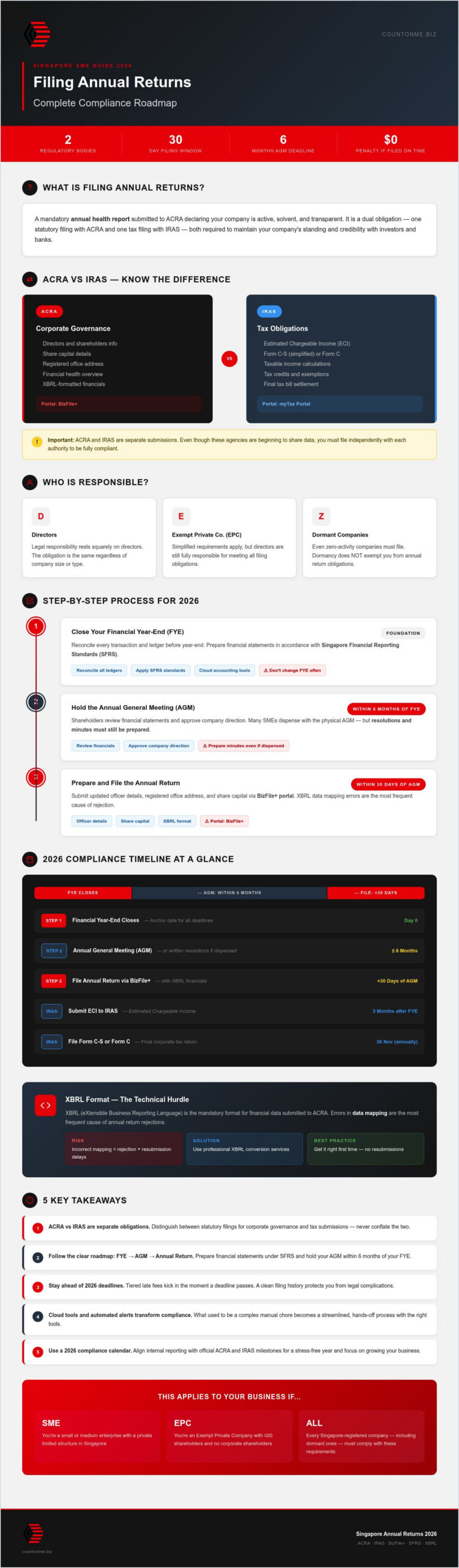
It’s easy to get these two confused, but they serve different masters. ACRA focuses on corporate governance. They want to know who your directors are, what your share capital looks like, and the general state of your financial health. IRAS, however, is strictly about the numbers that affect your tax bill. They require your Estimated Chargeable Income (ECI) and your final tax return (Form C-S or Form C). While these agencies are beginning to share more data to simplify the process, you still need to make separate, distinct submissions to each authority to remain fully compliant.
Who is Responsible for Filing in 2026?
As a director, the legal responsibility for filing annual returns Singapore mandates rests squarely on your shoulders. Whether you’re running an Exempt Private Company (EPC) with simplified requirements or a larger firm needing to prepare financial statements in XBRL format, the obligation is the same. Even if your company is “dormant” and hasn’t conducted any business during the financial year, you aren’t off the hook. You still have filing obligations to maintain your company’s standing on the official register. We often see founders surprised by this, but keeping your records current is the only way to avoid the tiered penalty system that kicks in the moment a deadline passes.
The Step-by-Step Process for a Successful Filing in 2026
The process of filing annual returns Singapore mandates is a methodical one, and getting it right means starting early. It isn’t just a matter of logging into a portal; it’s the final result of a year’s worth of careful record-keeping and governance. By following a structured timeline, you can turn a potentially stressful season into a routine business task. We’ve broken down the essential milestones to help you stay ahead of the curve.
Step 1: Closing Your Financial Year-End (FYE)
Your compliance journey begins long before you log into any government portal. It starts with your Financial Year-End (FYE), which serves as the anchor for your entire accounting cycle. Consistency is key here; changing your FYE too often can trigger unwanted scrutiny from authorities. Before the year closes, ensure every transaction is captured and every ledger is reconciled. Preparing your financial statements in accordance with Singapore Financial Reporting Standards (SFRS) is non-negotiable for accuracy. Utilizing Cloud Accounting & Bookkeeping tools makes this reconciliation nearly instantaneous, giving you a head start on the 2026 season.
Step 2: Holding the Annual General Meeting (AGM)
For most private companies in Singapore, you must hold an AGM within six months of your FYE. This meeting is where shareholders review the financial statements and approve the company’s direction. However, many SMEs choose to dispense with the AGM if they meet specific criteria under the Companies Act to save time. Even if you skip the physical meeting, you still need to prepare the necessary resolutions and minutes to document that the financial statements were sent to all members. Keeping these statutory records organized is a fundamental part of a healthy business.
Step 3: Preparing and Filing the Annual Return
Once the AGM is settled or dispensed with, you have a 30-day window for filing annual returns Singapore requires. You’ll need updated details on your company officers, registered office address, and share capital ready for submission. A major hurdle for many founders is converting financial data into the mandatory XBRL format. Errors in data mapping here are the most frequent cause for rejection during the final submission via the BizFile+ portal. Getting these technical details right the first time saves you from the stress of resubmissions. If the technical side of XBRL feels overwhelming, our Corporate Secretary Services can handle the heavy lifting for you.
2026 Deadlines and the Real Cost of Late Filing
Missing a deadline isn’t just about the money; it’s about the reputation and health of your business. In Singapore, the regulatory environment is firm but predictable. If your Financial Year-End (FYE) is December 31, 2025, your compliance calendar for 2026 is already set. Keeping these dates on your radar is the first step toward a stress-free year, ensuring you stay in the good books of both ACRA and IRAS.
ACRA Filing Timelines for 2026
For most private, non-listed companies, the “4-month/7-month” rule is your guiding light. You must hold your AGM within six months of your FYE and complete the process of filing annual returns Singapore mandates within seven months. For a December 31 FYE, this means your AGM deadline is June 30, 2026, and your AR must be filed by July 31, 2026. Listed companies face tighter windows, with AGMs required within four months and ARs within five. If you run into unexpected hurdles, you can apply for an Extension of Time (EOT) through BizFile+, but you’ve got to do this before the original deadline expires.
Understanding Late Filing Penalties
The financial cost of delay adds up quickly. ACRA imposes a simplified penalty system; typically, it’s S$300 for a late AGM and another S$300 for a late AR filing. If the delay stretches beyond a few months, these fines can double to S$600 per section. IRAS also issues composition fines for late tax returns, which can eventually lead to a court summons if left unaddressed. We don’t want to see your hard-earned capital wasted on avoidable fees.
Beyond the cash outflow, there’s a hidden cost to your “Green Tick” status on BizFile+. A “No” in the compliance column can make it significantly harder to open corporate bank accounts or secure government grants. In extreme cases, directors of non-compliant firms face disqualification or even legal prosecution. We believe compliance should be a badge of honor that helps your business grow, not a source of recurring stress.
Stay ahead of your deadlines with our Corporate Secretary Services
How Count On Me Simplifies Your Annual Compliance
We believe that filing annual returns Singapore requires shouldn’t be a source of year-end panic. By integrating our Corporate Secretary Services with cloud-based accounting, we create a seamless flow of information that keeps your business always-ready. This isn’t just about meeting a deadline; it’s about building a digital foundation where compliance happens in the background while you focus on scaling your operations. When your accounting and secretarial functions speak the same language, the friction of manual data transfer simply disappears.
The “Digital Innovator” Approach to Secretarial Services
Gone are the days of chasing physical signatures and dusting off paper registers. We use modern cloud tools to maintain your statutory registers in real-time, ensuring every change in share capital or directorship is recorded as it happens. This digital-first mindset allows us to automate the preparation of AGM minutes and resolutions, significantly reducing the lead time for your filings. Because we use automated mapping for XBRL, we minimize the risk of manual data entry errors, ensuring your submission to ACRA is accurate on the first try. It’s a faster, cleaner way to manage your statutory obligations.
Why SMEs Choose Professional Outsourcing
Choosing a partner is about more than just checking boxes. It’s about having access to seasoned professionals with over 20 years of experience who treat your business with the same care you do. Our team acts as a collaborative ally, providing on-demand CFO support to analyze your financial health before the final filing. This high-level oversight ensures that your annual returns aren’t just compliant, but also reflect a strategically sound business. We don’t just file your papers; we help you understand what the numbers mean for your future growth.
For new founders, our “Startups Package” offers a supportive entry point into the Singapore regulatory landscape. We take the ACRA heavy lifting off your plate so you can dedicate your energy to product development and market growth. You get the peace of mind that comes from a quiet confidence in your compliance, knowing that automated alerts and expert eyes are watching every deadline. Transitioning from paper-based stress to a streamlined digital posture isn’t just an efficiency gain; it’s a strategic advantage in a fast-moving market.
Similarly, for entrepreneurs looking to expand or start operations in South Africa, Express Shelf Company offers specialized support for company registration and ongoing compliance needs.
This strategic advantage extends beyond compliance to every aspect of your operations, including internal security and integrity; to see how professional polygraph services can support your business, you can learn more about Morgan Polygraph.
Securing Your Company’s Future for 2026 and Beyond
Staying on top of your statutory obligations doesn’t have to be a source of constant worry. We’ve explored how aligning your financial year-end with a proactive filing schedule helps you avoid tiered penalties and keeps your “Green Tick” status intact. By understanding the distinct roles of ACRA and IRAS, you can approach the process of filing annual returns Singapore requires with quiet confidence and clarity.
Our collaborative approach bridges the gap between high-level expertise and the personalized support every SME deserves. With over 20 years of experience and a deep focus on cloud-based efficiency, we help you transition from paper-based stress to a digital-first compliance posture. You can focus on your vision while we ensure the technical details, from XBRL mapping to AGM resolutions, are handled with precision.
Let us handle your ACRA compliance-explore our Corporate Secretarial Services
You’ve built something incredible, and we’re here to help you protect it. Let’s work together to make 2026 your most compliant and successful year yet.
Frequently Asked Questions
What happens if I miss the filing annual returns Singapore deadline?
You’ll immediately face composition fines from ACRA, typically starting at S$300 for each late section. If both your AGM and AR are overdue, that’s S$600 in initial penalties. Beyond the money, your company loses its “Green Tick” compliance status on BizFile+, which can alert banks and investors to potential governance issues. If you’re struggling to meet a date, it’s better to apply for an Extension of Time before the deadline hits.
Do dormant companies need to file annual returns in 2026?
Yes, even if your business hasn’t had a single transaction all year, filing annual returns Singapore mandates is still required. While you might qualify for exemptions from preparing full financial statements, the act of filing the return itself is how ACRA knows your company is still active on the register. Skipping this step can lead to penalties or even your company being struck off the register entirely.
Can a director file the annual return themselves on BizFile+?
Any company officer can legally file the return using their Singpass on the BizFile+ portal. It’s a direct way to handle the task if your company’s affairs are very simple. However, the process becomes technical when you have to map financial data into the XBRL format or document AGM dispensations. Most directors find that having a professional handle the submission ensures everything is accurate and penalty-free.
What is the difference between ECI and a Corporate Tax Return?
ECI is your Estimated Chargeable Income, which is a “quick look” at your profits filed within three months of your year-end. The Corporate Tax Return (Form C-S or Form C) is the final, detailed submission due by November 30. Think of ECI as a placeholder that helps IRAS manage tax collections, while the final return settles your actual tax bill for the year.
How much are the corporate secretarial fees for annual filing?
Prices for annual filing services depend on your company’s specific needs and whether you require XBRL preparation. We typically provide fixed-fee corporate secretarial retainers to give our clients cost predictability throughout the year. This collaborative model covers your routine filings and resolutions without the surprise of hidden costs, making it easier to budget for your annual compliance cycle.
Does my company need to file financial statements in XBRL format?
Most Singapore companies must file in XBRL unless they qualify as a solvent Exempt Private Company (EPC). If your company is insolvent or has a corporate shareholder, you’ll likely need to convert your financial statements into this digital format. It’s a technical process that ensures your data is readable by ACRA’s systems, and getting it right is crucial for a successful filing.