
Did you know that for the Year of Assessment 2026, the Singapore government has enhanced the Corporate Income Tax rebate to 50%, capped at a generous S$40,000? While that is excellent news for your cash flow, we know the real challenge often lies in the fine print. Staying on top of the latest tax deductions for Singapore SMEs can feel like a second full-time job, especially when you are already focused on growing your team and serving your customers.
We understand the stress of complex IRAS rules and the fear of missing out on new budget rebates due to manual tracking errors. It is a lot to manage, but you don’t have to do it alone. We are here to help you unlock every eligible tax saving for your business with this comprehensive guide to Singapore’s 2026 SME tax deductions and incentives.
We will walk you through the specifics of deductible versus non-deductible expenses, explain how to claim the latest innovation credits, and show you how digital automation creates a stress-free filing process. You will gain a clear path to a lower tax liability and the peace of mind that your compliance is fully under control.
Key Takeaways
- Understand how to apply the enhanced 50% CIT rebate for YA 2026 to keep more capital within your business.
- Identify the specific criteria for SUTE and PTE. This ensures you aren’t overpaying on your first income tiers.
- Learn the “wholly and exclusively” rule to capture all eligible tax deductions for Singapore SMEs while staying compliant.
- Clarify the difference between deductible staff costs and non-deductible capital expenses to eliminate manual filing errors.
- Discover how cloud accounting transforms tax season into a strategic opportunity for growth rather than a paperwork hurdle.
Navigating Singapore’s Corporate Tax Landscape in 2026
Singapore keeps things simple with a flat 17% corporate tax rate. It’s one of the most competitive systems globally, and Navigating Singapore’s Corporate Tax Landscape reveals a territorial basis that rewards growth. Maximizing tax deductions for Singapore SMEs starts with understanding this baseline. However, 2026 stands out because the government has stepped up support to help businesses manage rising operational costs. For most entrepreneurs, this year is about more than just filing; it’s about strategic cash flow management in a high-inflation environment.
The YA 2026 Rebate Enhancement Explained
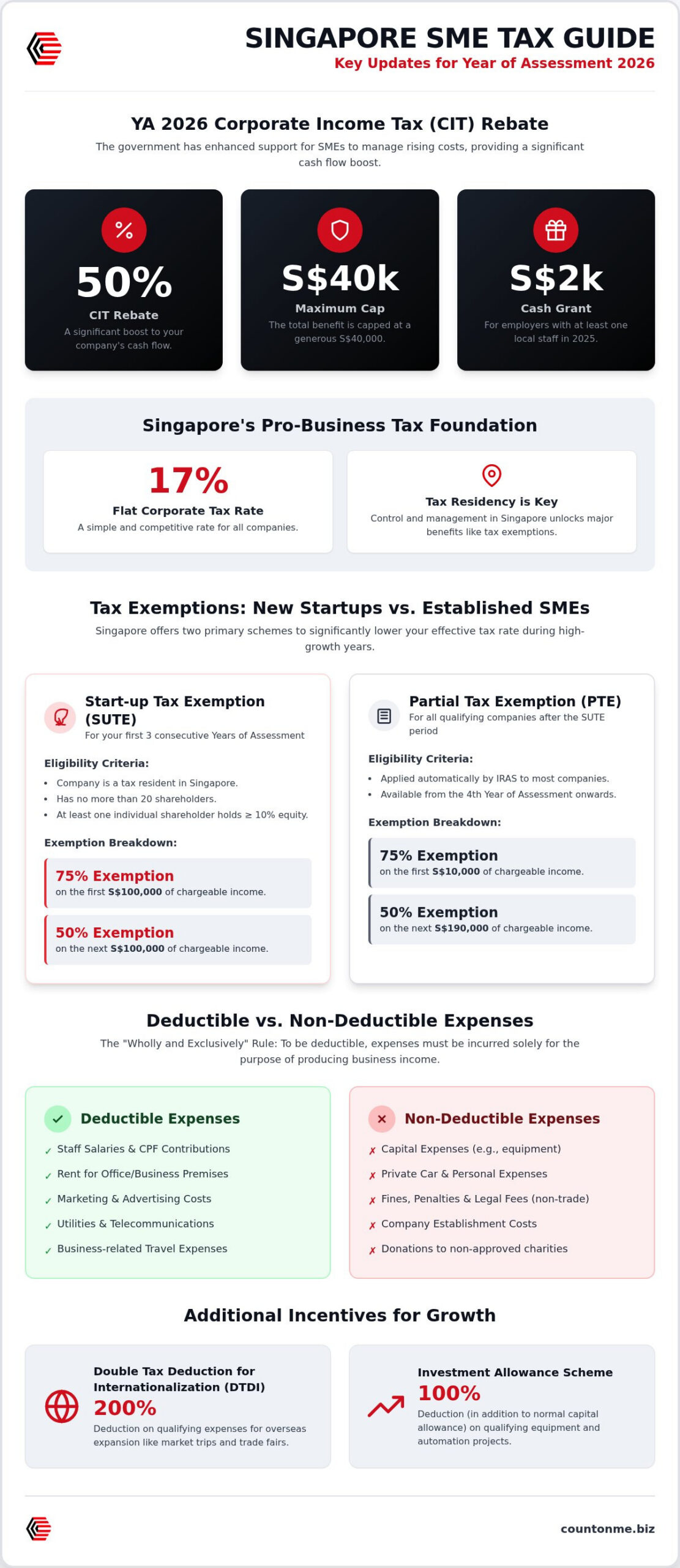
The biggest headline for the Year of Assessment (YA) 2026 is the 50% Corporate Income Tax (CIT) rebate. This is a significant jump from the previously planned 40%. If your company pays tax, you’ll see half of that liability wiped away, up to a maximum cap of $40,000. This enhancement specifically targets the challenges SMEs face with utility and logistics costs. To manage these risks effectively, you can discover Cargo Insure Online for specialized freight coverage. We see this as a vital cushion that allows you to reinvest in your operations rather than just covering overheads.
There’s also an immediate boost for active employers. If you employed at least one local staff member in 2025, you’ll receive a $2,000 CIT Rebate Cash Grant. This grant is part of the total $40,000 benefit. It’s a proactive way the government is putting money back into your hands to fuel next year’s projects. You don’t even need to apply; IRAS calculates this automatically based on your CPF records, making it a seamless win for your bank balance.
Tax Residency and Its Impact on Your Deductions
Your company’s tax residency status determines which tax deductions for Singapore SMEs you can actually claim. A resident company is generally one where the control and management of the business are exercised in Singapore. This isn’t just about where you’re incorporated; it’s about where the board meetings happen and where the big decisions are made. If your leadership team is based here, you’re likely in a good position.
Being a resident company is the essential “golden ticket” to accessing major benefits like the Tax Exemption Scheme for New Start-Up Companies. To prove this to overseas tax authorities or to secure local treaty benefits, you might need a Certificate of Residence (COR). We often find that managing these residency nuances is where a dedicated Tax Compliance & Advice partner makes the most difference. We help you secure that resident status so you aren’t left paying more than your fair share while ensuring every decision you make is audit-proof.
Primary Tax Exemption Schemes for Singapore SMEs
The Tax Exemption Scheme for New Start-Up Companies (SUTE) is a massive boost for your first three consecutive Years of Assessment. To qualify, your company must be a tax resident and have no more than 20 shareholders, where at least one individual holds 10% of the equity. If you fit, you’ll enjoy a 75% exemption on your first $100,000 of normal chargeable income. The next $100,000 gets a 50% exemption. It’s a powerful way to protect your early-stage capital while you’re still finding your footing in the market.
Partial Tax Exemption (PTE) for Established SMEs
Once you move past that initial three-year honeymoon phase, you’ll transition to the Partial Tax Exemption (PTE). It’s slightly less aggressive than SUTE but still offers a 75% exemption on the first $10,000 and a 50% exemption on the next $190,000 of income. The best part? It’s applied automatically by IRAS. You don’t need to file extra paperwork, but you do need to be clear on what counts as Deductible vs. Non-Deductible Business Expenses to maximize the income that actually reaches these exempt tiers.
For businesses looking beyond our shores, the Double Tax Deduction for Internationalization (DTDI) allows you to claim a 200% deduction on expenses like overseas market trips or trade fairs. If you’re investing heavily in equipment, the Investment Allowance Scheme can provide a 100% deduction on qualifying capital expenditure. Balancing these options requires a bit of foresight. If you’re feeling overwhelmed by the math, our team provides tailored Tax Compliance & Advice to help you map out the best strategy. It’s about making sure your tax plan grows as fast as your business does. If you’re ready to optimize your filing, you can explore our specialized packages to see how we simplify the process.
Common Business Expenses: Deductible vs. Non-Deductible
Maximizing tax deductions for Singapore SMEs starts with a clear grasp of the “wholly and exclusively” rule. This IRAS standard means that for an expense to be deductible, it must be strictly related to earning your business income. If an expense has a personal element or doesn’t directly support your revenue-generating activities, it’s likely off the table. It’s a simple filter, but applying it correctly across hundreds of transactions requires a methodical approach.
Staff-related costs are a primary area for savings. You can deduct gross salaries, bonuses, and your mandatory employer CPF contributions. Even employee medical benefits are deductible, though these are typically capped at 1% of your total staff remuneration. Beyond the office, don’t forget about marketing and internationalization. Under the DTDI scheme, many costs associated with overseas trade fairs and market surveys allow for a 200% deduction, providing a significant boost to your cash flow during global expansion. If your growth plans involve the European market, TaxSlovenia offers the specialized tax and accounting support required to navigate the Slovenian regulatory environment.
Many entrepreneurs overlook the professional fees that keep their business compliant. You can fully deduct fees paid for accounting, tax advisory, and corporate secretary services. Digital transformation is another high-value area. Subscription fees for cloud accounting platforms and costs for employee training or skill development are generally deductible. These aren’t just overheads; they’re strategic investments that reduce your taxable income while modernizing your operations.
Common Non-Deductible Pitfalls to Avoid
Let us help you identify every eligible tax deduction for your business
Maximizing Deductions Through Digital Accounting
Capturing every eligible expense shouldn’t feel like a hunt for lost paper. When you use cloud accounting, your financial records transform from a static list of numbers into a real-time strategic asset. This digital-first approach is the most reliable way to secure tax deductions for Singapore SMEs because it eliminates the human error inherent in manual tracking. By the time the 2026 tax season arrives, your accounts are already organized, categorized, and ready for review.
The transition to automated bookkeeping doesn’t just save time; it builds an audit-proof foundation. IRAS expects you to maintain records for five years, but digital ledgers go beyond mere storage. They provide a clear link between every transaction and its business purpose. For founders looking to scale, leveraging on-demand CFO services allows you to move from reactive filing to proactive tax optimization. We help you look at the data to see where you can legally reduce your liability before the financial year ends.
Automating Your Tax Readiness
One of the biggest leaks in SME tax planning is the “shoebox of receipts” method. Integrating receipt scanning apps with your cloud ledger ensures that even a small coffee meeting or a quick supply run is captured instantly. Missing these small claims can add up to thousands in lost deductions over a year. Similarly, automating your CPF and payroll records ensures that your staff cost deductions are accurate to the cent. If you want to ensure total accuracy, professional tax compliance services in Singapore can bridge the gap between software and strategy, ensuring you meet every regulatory deadline without the last-minute panic.
Strategic Planning Beyond the Ledger
Real-time data lets you forecast your tax liabilities months in advance. This foresight is crucial for optimizing your year-end spending. If you know you have a high taxable income, you might choose to accelerate a digital transformation project or invest in staff training to maximize tax deductions for Singapore SMEs within the current period. We also help you identify industry-specific grants that complement your tax incentives. At Count On Me, we partner with you through our cloud accounting and bookkeeping solutions to turn your finance function into a growth engine. It’s about more than just compliance; it’s about giving you the clarity to lead with confidence.
Secure Your Business Growth for 2026 and Beyond
Navigating the various tax deductions for Singapore SMEs doesn’t have to be a source of year-end stress. By leveraging the enhanced 50% CIT rebate and choosing the right exemption scheme, you’re already ahead of the curve. The real magic happens when you pair these incentives with a digital-first mindset. Real-time expense tracking ensures no claim is left behind, while clear categorization protects you from common compliance pitfalls.
Optimize your 2026 tax strategy with Count On Me’s expert services
Tax season is simply an opportunity to review your success and plan for the next big milestone. We’re excited to partner with you on that journey, ensuring every dollar works as hard as you do. Let’s make 2026 your most efficient and profitable year yet.
Frequently Asked Questions
What is the corporate tax rate for Singapore SMEs in 2026?
The corporate tax rate for Singapore SMEs in 2026 remains a flat 17% on all chargeable income. While this headline rate is competitive, it’s often much lower in practice due to various exemption schemes and rebates. For the Year of Assessment 2026, the effective rate is further reduced by the enhanced 50% tax rebate. This stability allows you to plan your long-term growth with confidence; knowing exactly what to expect from the tax authorities.
Can I claim tax deductions for my startup’s initial setup costs?
You can generally claim tax deductions for Singapore SMEs on setup costs incurred within one year before your business officially starts. These “pre-commencement” expenses must be revenue in nature; such as staff salaries or rent; rather than capital investments like furniture. We recommend tracking these early costs meticulously in your cloud ledger. It’s a simple way to ensure your startup begins its journey with a healthy cash flow and a reduced tax bill.
How does the 2026 CIT Rebate Cash Grant work for small businesses?
The 2026 CIT Rebate Cash Grant provides an immediate S$2,000 payout to companies that employed at least one local worker in 2025. This grant is part of the total S$40,000 cap for the Year of Assessment 2026. The best part is the simplicity; IRAS applies this automatically based on your CPF contribution records. You don’t need to file a separate application; making it a stress-free boost for your company’s working capital.
Are employee entertainment expenses tax-deductible in Singapore?
Employee entertainment expenses are generally tax-deductible if they are incurred for business purposes; such as client meetings or staff team-bonding events. However; IRAS distinguishes between genuine business needs and personal leisure. To stay compliant; you should maintain clear records of who attended and the specific business purpose of the event. We find that using digital receipt scanning makes this process much easier; ensuring you have the evidence needed if the tax office ever asks.
What is the difference between SUTE and Partial Tax Exemption?
SUTE is designed for qualifying new companies during their first three Years of Assessment; offering a 75% exemption on the first S$100,000 of income. Once those initial three years pass; you automatically transition to the Partial Tax Exemption (PTE) scheme. PTE offers a 75% exemption on the first S$10,000 and 50% on the next S$190,000. While SUTE is more generous; PTE still provides a significant annual tax saving for established businesses.
Do I need a professional accountant to file my SME tax returns?
While you aren’t legally required to hire an expert; professional support is the best way to maximize tax deductions for Singapore SMEs. Tax rules can be complex; and manual filing often leads to missed opportunities or costly errors. Partnering with a specialist ensures your accounts are audit-proof and your strategy is optimized. Our team uses modern digital tools to keep your records accurate; giving you the peace of mind to focus on your business growth.