
What if the accounting software you choose today becomes the very thing that stalls your business growth by 2026? It’s a valid fear, especially when you’re worried about making a “sunk cost” mistake or facing a messy data migration. We know how stressful it feels to balance your daily operations while trying to decode which features actually matter for Singapore’s GST and CPF requirements. When comparing Xero vs QuickBooks Singapore, the right choice isn’t just about the monthly fee. It’s about how well the tool talks to IRAS and your local bank.
We believe your accounting should offer relief, not more paperwork. In this guide, we’ll show you exactly how these two giants stack up against the April 2026 InvoiceNow mandates and local banking integrations with DBS, OCBC, and UOB. We’ll provide a clear recommendation based on your business size so you can move forward with confidence. From understanding Xero’s native compliance to QuickBooks’ third-party flexibility, you’ll discover which platform allows you to focus on your vision while a dedicated partner handles the technical heavy lifting.
Key Takeaways
- We’ll help you navigate the 2026 InvoiceNow mandate to ensure your software choice keeps you compliant with IRAS from day one.
- Compare Xero vs QuickBooks Singapore to find the right balance between an intuitive interface and the robust reporting your business needs.
- Learn the truth about local bank integrations with DBS, OCBC, and UOB to keep your financial data moving without manual entry.
- Identify the best way to handle payroll and CPF disbursements within your cloud ecosystem to save time and reduce administrative stress.
- Follow our simple assessment to match your specific industry needs with a scalable tool that supports your long-term growth.
Understanding the Cloud Accounting Landscape in Singapore
For years, Singaporean business owners kept their books in spreadsheets or desktop software. That era has ended. Today, Cloud computing is the backbone of modern financial management. It allows you to access your data via a secure internet connection rather than being tied to one office computer. This shift isn’t just about convenience; it’s about staying relevant in a digital-first economy. When you evaluate Xero vs QuickBooks Singapore, you’re choosing the foundation for your business’s digital transformation.
The transition from “DIY” accounting to pro-managed digital ledgers is a game changer. Instead of spending weekends reconciling bank statements, you can lean on automation to handle the heavy lifting. This reduces human error and ensures your records are always ready for a quick pulse check or a formal review.
Why Singapore SMEs are Moving to the Cloud
The Role of IRAS-Compliant Software
IRAS has made it clear: digital is the only way forward. By 2026, the InvoiceNow mandate will be a critical part of the tax framework for many businesses. Using software from the IRAS Accounting Software Register ensures your records meet local standards. Both Xero and QuickBooks are on this list, which means they’re designed to help you stay on the right side of the law. These platforms simplify complex tasks like the GST F5 filing by pulling data directly from your daily transactions. This automation provides a sense of relief, knowing your filings are based on accurate, real-time data.
Many founders now realize that while they can use the software themselves, they shouldn’t spend their limited time doing it. Partnering with experts for Cloud Accounting & Bookkeeping ensures your software is optimized. You get the benefits of the technology without the headache of managing the technical nuances yourself, allowing you to focus on growth while we handle the compliance.
Xero vs QuickBooks Singapore: A Side-by-Side Comparison
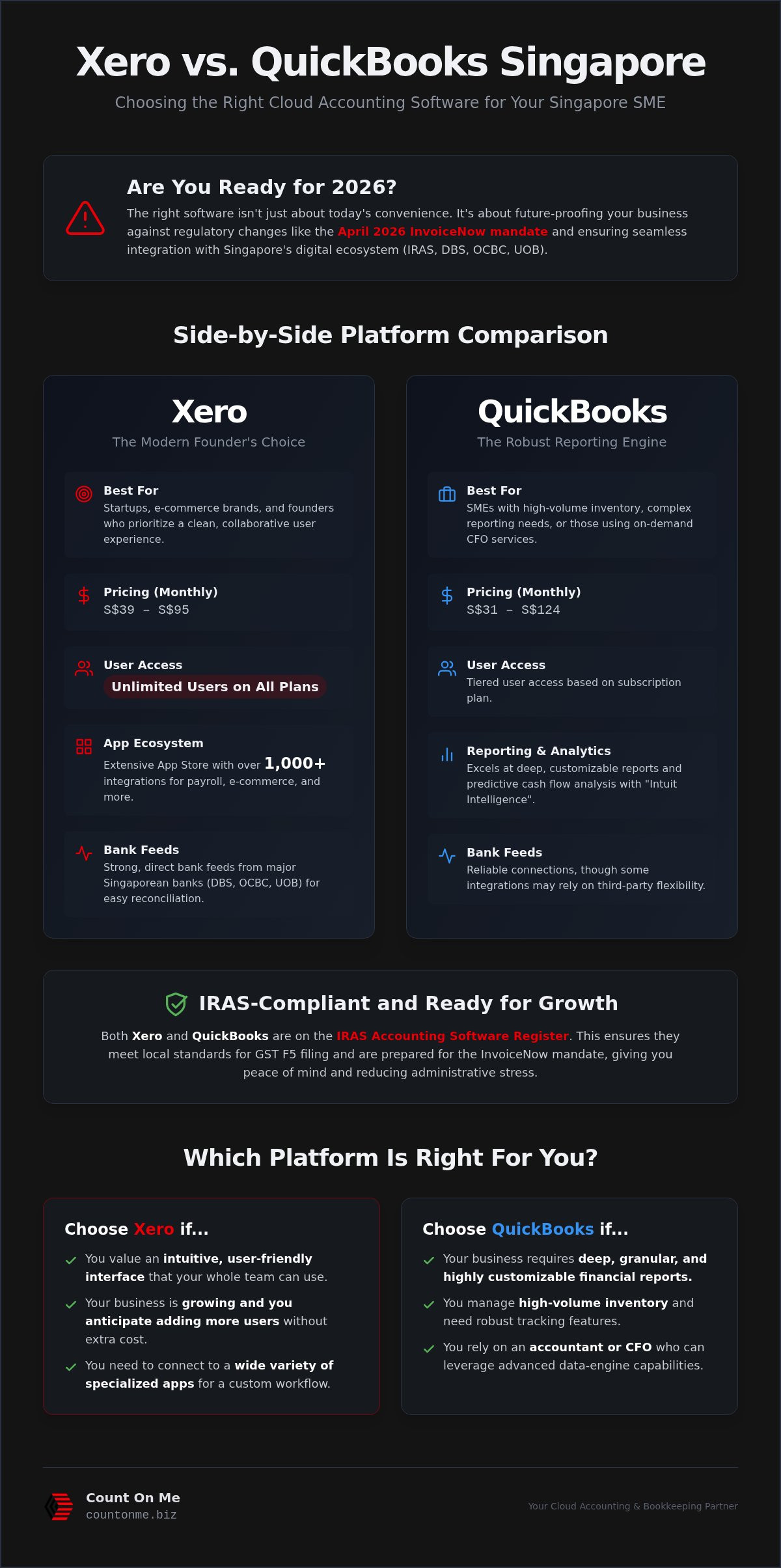
Choosing between these two platforms often comes down to a simple philosophical difference: Xero is designed to make accounting “beautiful” and collaborative for the business owner, while QuickBooks is built as a high-powered data engine for the technical accountant. We’ve seen that your choice in the Xero vs QuickBooks Singapore debate will dictate how much time you spend in the “engine room” of your business versus looking at the horizon. Both tools are highly capable, but they serve different styles of management.
Pricing is a practical starting point for any SME. As of August 2026, Xero’s standard monthly plans range from S$39 for the Starter tier up to S$95 for Premium. QuickBooks offers a slightly different ladder, starting at S$31 for Simple Start and reaching S$124 for their Advanced version. While QuickBooks might seem more affordable at the entry level, Xero’s unlimited user access across all plans often makes it the more scalable choice for growing teams. Both platforms are recognized under the SMEs Go Digital programme, which helps local businesses adopt these digital tools to stay competitive.
Xero: The Modern Founder’s Choice
Many startups naturally gravitate toward Xero because the dashboard is clean and doesn’t overwhelm you with financial jargon. The mobile app is particularly strong, allowing you to reconcile bank transactions while you’re on the move. If you run an e-commerce brand or need specialized Payroll Management Solutions, Xero’s App Store offers over 1,000 integrations to customize your workflow. It simplifies local bank reconciliation by pulling feeds directly from major Singaporean banks, making it easy to see your actual cash position at any moment.
QuickBooks Online: The Robust Reporting Engine
If your SME deals with high-volume inventory or requires granular financial statements, QuickBooks might be your best ally. It excels at deep, customizable reporting that provides immense value if you utilize on-demand CFO services to drive strategy. The “Intuit Intelligence” features offer predictive cash flow analysis, helping you spot potential bottlenecks before they happen. While the interface is more data-heavy, it provides a level of detail that established businesses with complex supply chains often require. If you’re feeling stuck on which path to take, we can help you evaluate the best fit for your specific workflow.
Integrating with the Singapore Digital Ecosystem
The true power of choosing between Xero vs QuickBooks Singapore lies in how these tools connect to the local infrastructure you use every day. It’s one thing to have a digital ledger; it’s another to have a system that talks directly to your bank, the tax man, and your employees’ CPF accounts. In 2026, these integrations are no longer optional. They’re essential for staying compliant with the latest IRAS digital mandates, including the InvoiceNow requirement for voluntary GST registrants. We’ve seen how a well-integrated system can turn a mountain of paperwork into a few simple clicks, providing the relief you need to focus on growth.
Local Bank Connectivity and Reconciliation
Connecting your DBS, OCBC, or UOB accounts directly to your software creates a seamless flow of data. Direct bank feeds mean you don’t have to waste hours downloading CSV files and manually uploading them, which often leads to duplicate entries or missed transactions. Xero generally offers broader native integration with these major local banks, while QuickBooks has a particularly strong relationship with DBS. This automation allows you to see your actual cash position at any moment. If you want to ensure your setup is flawless, our Cloud Accounting & Bookkeeping experts can help bridge the gap between your bank and your books.
Payroll and Statutory Contributions
Managing staff in Singapore comes with specific duties, particularly regarding CPF and year-end reporting. Both platforms offer modules or integrations that calculate these contributions automatically based on current rates. You can generate IRAS-ready IR8A forms with a single click, ensuring your year-end tax season is a period of calm rather than chaos. For a deeper dive into these requirements, check out our guide on Mastering Payroll Management in Singapore.
Beyond payroll, your software should also support your Corporate Secretary Services by keeping your financial records in sync with ACRA requirements. Whether you’re using PayNow for instant payments or the Peppol-based InvoiceNow network for e-invoicing, your accounting tool should be the central hub for all government interactions. Xero is an IMDA-accredited InvoiceNow-ready provider, meaning it handles these transmissions natively. QuickBooks currently requires a third-party integration for the same result. Choosing between Xero vs QuickBooks Singapore isn’t just about the software; it’s about how that software fits into your broader digital ecosystem.
Let us help you build a seamless digital ecosystem
Making the Right Choice for Your Singapore SME
Choosing between Xero vs QuickBooks Singapore shouldn’t feel like a coin toss. It’s about matching a tool to your unique business rhythm. Start by assessing your industry requirements. If you’re a service-based agency, you’ll likely prioritize ease of invoicing and project tracking; some even leverage custom software from NimbleNest Technologies to better align their operations with their financial tools. In contrast, a retail business managing thousands of SKUs across multiple locations needs a system that handles heavy inventory data without breaking a sweat. Proper software configuration is ultimately more critical than the software brand itself.
- Evaluate your team’s technical comfort level. If your staff isn’t tech-savvy, a simpler interface will save you hours in training and manual error correction.
- Consider your three-year growth path. Think about whether you’ll eventually need high-level strategic insights from On-demand CFO Services to guide your expansion.
- Consult a certified partner early. This helps you avoid common migration pitfalls, like losing historical data or breaking bank feed connections during the transition.
The ‘Count On Me’ Recommendation Framework
We generally recommend Xero for tech-forward startups and service businesses that value a clean, “beautiful” interface and a massive app ecosystem. It’s built for agility and collaborative work. However, QuickBooks becomes the logical choice when you have complex operational needs, like deep inventory management or specific predictive reporting. Our Startups Package is designed to support either choice. We provide the professional oversight you need without the high overhead of a full-time finance team, ensuring your chosen platform scales with you.
The Value of Professional Implementation
A “DIY” setup often leads to messy ledgers that cause significant stress during tax season or ACRA filing windows. We’ve seen many founders struggle because their Chart of Accounts wasn’t structured for Singapore’s specific GST and tax environment from the start. A professional firm ensures your system is “IRAS-ready” from day one. This prevents common errors that can lead to penalties or costly cleanup projects later. For more on what to watch out for, read our guide on 10 Critical Startup Accounting Mistakes in Singapore. We believe your accounting software should be a source of stability, not another item on your worry list.
Secure Your Digital Foundation for 2026
The choice between Xero vs QuickBooks Singapore isn’t just about picking a software; it’s about building a workflow that supports your vision. We’ve explored how Xero’s intuitive interface suits tech-forward startups, while QuickBooks offers the deep reporting required by established SMEs. The most critical takeaway is that your system must be IRAS-compliant and fully integrated with the local digital ecosystem to avoid the stresses of manual record-keeping.
At Count On Me, we bridge the gap between high-level expertise and personalized support. Our team consists of certified advisors with over 20 years of industry experience, and we provide transparent, SME-friendly pricing that fits your budget. We’re here to ensure your migration is seamless and your financial data stays accurate, giving you the quiet confidence to focus on scaling your business.
Let’s find your perfect accounting fit—explore our services today
You deserve a partner who is as invested in your success as you are. Let’s work together to turn your finance function into a pillar of stability for the years ahead.
Frequently Asked Questions
Is Xero better than QuickBooks for Singapore SMEs?
Both Xero and QuickBooks are listed on the IRAS Accounting Software Register, making them compliant choices for local businesses. This means they support digital tax filing and meet strict record-keeping standards. By 2026, Xero has a slight edge with native InvoiceNow integration. QuickBooks often requires a third-party connector to meet these same e-invoicing mandates, so check your requirements before you commit to one over the other.
Can I switch from QuickBooks to Xero (or vice versa) easily?
Yes, you can switch platforms, but it requires a methodical approach to ensure your historical data remains accurate. Most businesses use specialized migration tools or partner with a professional firm to move opening balances and transaction history. It’s usually best to perform this transition at the end of a financial year or a GST period. This keeps your reporting clean and ensures you don’t lose vital records during the move.
Does Xero or QuickBooks support Singapore CPF and GST?
Yes, both platforms are built to handle local tax and labor requirements through integrated modules or regional settings. You can automate GST F5 filings and calculate monthly CPF contributions for your employees. When choosing between Xero vs QuickBooks Singapore, note that Xero utilizes its extensive app store for specialized payroll, while QuickBooks frequently includes these features within its main tiers. Both tools ensure you stay on the right side of digital tax regulations.
Do I still need an accountant if I use Xero or QuickBooks?
While the software automates data entry, you still benefit from an expert to ensure your strategy and compliance are sound. Software doesn’t provide tax advice or catch subtle coding errors that could lead to an IRAS audit. Many SMEs use our professional support to manage the technical setup and provide high-level CFO guidance. This ensures your digital tools actually drive growth rather than just recording your past transactions.
What are the typical monthly fees for cloud accounting software in Singapore?
Typical monthly fees for these platforms range from S$30 to over S$120, depending on the complexity of your business. As of August 2026, Xero plans sit between S$39 and S$95 per month. QuickBooks offers promotional pricing for new users, but standard rates for their Simple Start plan begin around S$31, while their Advanced tier reaches S$124. These costs are a small investment compared to the time saved through automation.