What if your annual tax deadline wasn’t a source of dread, but a strategic tool to protect your company’s cash flow? We know how it feels. That three-month window after your financial year-end often feels like a race against the clock, especially when you’re trying to figure out if you qualify for the $5 million revenue waiver. Missing the mark with IRAS isn’t just about the stress of late fees; it’s the missed opportunity to keep more capital in your business. That’s why finding an ECI filing service Singapore SMEs trust is about more than just compliance; it’s about partnership and peace of mind.
We’re here to help you master your Estimated Chargeable Income obligations with total confidence. You’ll learn exactly how to verify your waiver eligibility, avoid the trap of estimated assessments, and use GIRO installments to manage your liquidity like a pro. This guide provides a clear roadmap for the 2026 filing season, showing you how to automate the process so you can get back to what you do best: growing your business.
Key Takeaways
- Understand the strict three-month deadline for your Estimated Chargeable Income to avoid IRAS penalties and protect your company’s compliance record.
- Identify if your SME qualifies for the administrative waiver by meeting the S$5 million revenue threshold and nil income requirements.
- Learn how to turn a tax obligation into a cash flow strategy by using early filing to secure the maximum number of interest-free GIRO installments.
- Discover how a professional ECI filing service Singapore startups rely on can automate your data entry and transition your business to a more efficient cloud-based model.
- Gain clarity on why your ECI is more than just a filing; it’s a strategic “early report card” that helps you plan for your 2026 corporate tax liabilities.
What is Estimated Chargeable Income (ECI) and Why Does It Matter?
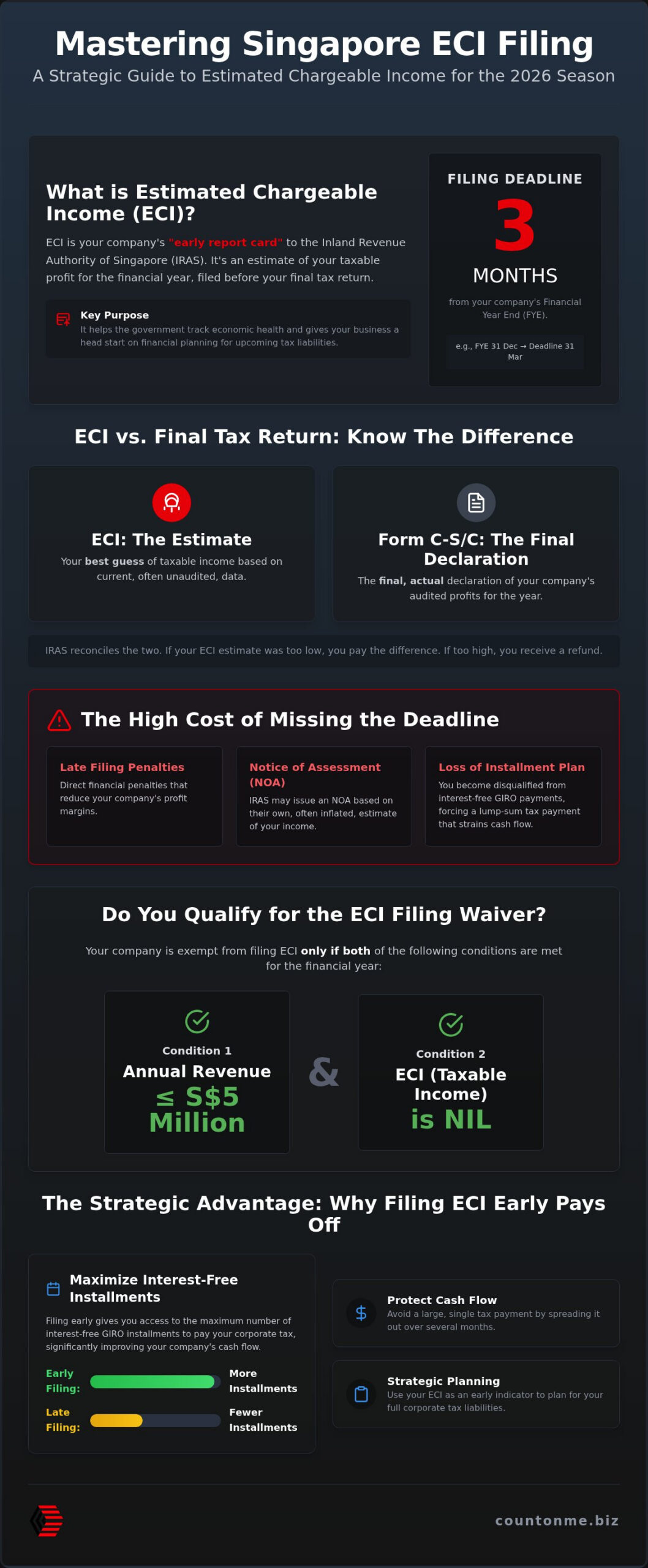
Think of ECI as your company’s early report card to IRAS. It provides a snapshot of your annual taxable profit before you even reach the final tax filing stage. Technically, ECI is the estimate of a company’s taxable income before specific exemptions like the Startup Tax Exemption (SUTE) are applied. Within the broader framework of Singapore’s tax system, this filing must happen within three months from the end of your financial year (FYE). If your year ends on December 31, your deadline is March 31. This system helps the government track economic health while giving you a head start on financial planning for the year ahead.
The Difference Between ECI and Final Tax Filing
It’s easy to confuse ECI with your final tax return, but they serve different roles. ECI is your best guess based on current data; Form C-S or Form C is the final declaration of your actual, audited profits. Once you file your final return later in the year, IRAS reconciles the two documents. If your estimate was too low, you’ll simply pay the difference. If it was too high, you’ll receive a refund. Utilizing a modern ECI filing service Singapore providers offer ensures your estimate is backed by real-time cloud accounting data. This makes the reconciliation process a non-event rather than a stressful surprise.
Consequences of Missing the ECI Deadline
Punctuality is everything when dealing with IRAS. If you miss that three-month window, you risk facing late filing penalties that eat into your margins. Worse, IRAS may issue a “Notice of Assessment” based on their own estimate of your income. This government estimate is often significantly higher than your actual profit, leading to an inflated tax bill you’ll have to dispute later. A missed deadline also disqualifies you from interest-free installment plans, forcing a lump-sum payment that can strain your cash flow. If you’re feeling behind, don’t panic. It’s never too late to get compliant when you have a supportive partner to automate the heavy lifting and protect your eligibility for installments.
Determining Your Filing Status: Who Needs to File ECI?
Generally, every company incorporated in Singapore has a duty to file. However, IRAS provides generous “administrative concessions” to reduce the burden on smaller businesses. The most critical one to remember is the waiver rule. You are exempt from filing if your annual revenue is S$5 million or less for the financial year and your ECI is nil. Working with an ECI filing service Singapore teams trust ensures you don’t miss these nuances. Referencing the IRAS ECI Filing Requirements is the best way to confirm these conditions for your specific Year of Assessment.
It’s a common trap to assume that a lack of accounting profit equals a “NIL ECI.” In reality, tax adjustments for non-deductible expenses or capital allowances might result in a taxable position even if your books show a loss. Conversely, you might have a profit but zero taxable income after accounting for tax incentives. Certain entities are also consistently exempt from this requirement, including:
- Foreign ship owners or charterers handled by a local agent.
- Foreign universities.
- Designated unit trusts and approved CPF unit trusts.
- Real Estate Investment Trusts (REITs) that meet specific IRAS payout conditions.
The S$5 Million Revenue Threshold Explained
Revenue refers to your company’s main income source before deducting any expenses. If your management accounts aren’t finalized by the three-month mark, estimating this figure accurately can be tricky. Using expert tax compliance services Singapore business owners rely on helps you verify your waiver eligibility without the guesswork. We look at your gross income trends to ensure you don’t accidentally skip a required filing, keeping your record with IRAS spotless.
Common Misconceptions About ECI Exemptions
Many founders believe new startups are automatically exempt during their first few years. That isn’t true. Startups follow the same revenue and nil income rules as established firms. Another myth is that “dormant” status means no filing is needed. Even if you’re inactive, you must meet the formal waiver criteria or submit a nil return to stay compliant. Our startup accounting services are designed to help you navigate these rules from day one. If you’re unsure where your revenue stands this year, let’s chat about a quick review of your accounts to give you total peace of mind.
The Strategic Advantage of Early ECI Filing
Filing your taxes early might sound like extra homework, but it’s actually one of the smartest cash flow moves an SME can make. It isn’t just about meeting a deadline; it’s about securing interest-free financing for your business. By submitting your ECI early, you unlock the ability to pay your tax bill in smaller, manageable chunks rather than one large sum. Understanding Singapore Corporate Income Tax Basics helps you see how this fits into your overall tax strategy, giving you a clear view of your upcoming liabilities well in advance.
Maximizing Your GIRO Installment Plan
The GIRO installment scheme is the primary vehicle for this benefit. The logic is straightforward: the earlier you file, the more installments you receive. For example, filing within the first month after your financial year-end allows you to spread payments over the maximum number of installments allowed by IRAS. This is why a professional ECI filing service Singapore innovators prefer is about more than just compliance; it’s about liquidity. Using your ECI as a forecasting tool allows you to set aside the exact amount needed for each monthly installment, removing the tax season surprise that many entrepreneurs fear. This setup is a win-win for SME liquidity management, as you keep your cash for operational needs while staying perfectly compliant.
Revising Your ECI After Submission
Business is unpredictable, and we know your numbers can change as you finalize your year-end accounts. We often help clients who worry that their initial estimate might be off once the final audit is done. If you realize your estimate was too high or too low, you can file a revised ECI through the myTax Portal. Our team handles this reconciliation through our tax compliance and advice services, ensuring your cloud ledger and tax filings stay in perfect sync. This prevents the headache of overpaying and waiting for a refund, allowing you to maintain a steady financial rhythm throughout the year.
Streamlining Compliance with a Professional ECI Filing Service
Navigating the myTax Portal on your own often feels like a chore that takes you away from your actual work. While the government has made strides in digitalization, manual data entry still leaves room for human error. For a growing SME, a small mistake in revenue reporting can trigger unwanted queries from IRAS. We believe tax compliance shouldn’t just be a box-ticking exercise. By choosing an ECI filing service Singapore founders trust, you move from reactive “firefighting” to a proactive digital finance strategy. Our cloud accounting services ensure your financial data is always current, making the ECI filing a natural extension of your monthly books rather than a year-end scramble.
We also look at the bigger picture. In Singapore, your tax obligations are closely tied to your statutory filings with ACRA. Integrating your ECI workflow with your corporate secretary and annual return schedule creates a seamless compliance loop. This holistic approach means you aren’t just filing forms; you’re building a stable foundation for your company’s future growth. It’s about creating a rhythm where every part of your administration supports the others.
Tech-Forward Tax Support for Modern Founders
We don’t believe in manual spreadsheets. Our team leverages automation to pull data directly from Xero or QuickBooks into our tax computation engines. This precision reduces the risk of overestimating your income and missing out on cash flow benefits. Maintaining monthly bookkeeping hygiene means we can spot potential tax issues long before the three-month deadline hits. If your numbers look different than expected, our on-demand CFO advice helps you understand what your ECI is telling you about your business health. It’s about having a mentor in your corner who understands the tech as well as the tradition.
Next Steps: Getting Your ECI Filed Today
Ready to clear this off your plate? Start by gathering your latest management accounts and revenue statements. Even if they aren’t finalized, we can work with your current data to determine the most strategic filing path. We’ll help you confirm your waiver status and ensure you don’t miss the window for those interest-free installments we discussed earlier. Take the stress out of tax season and let Count On Me handle your ECI filing so you can focus on your next big milestone.
Take Control of Your 2026 Tax Season
Compliance doesn’t have to be a source of anxiety for your leadership team. By understanding your waiver eligibility and leveraging the GIRO installment scheme, you’re transforming a statutory requirement into a strategic financial advantage. It’s about moving away from the manual stress of the myTax Portal and embracing a digital-first approach that keeps your business agile and ready for expansion.
We’ve spent over 20 years supporting Singapore startups, helping them navigate these regulatory hurdles with quiet confidence and empathy. Our team of expert Xero-certified accountants is ready to ensure your cloud-based compliance is seamless, accurate, and completely stress-free. When you partner with a specialized ECI filing service Singapore innovators rely on, you gain more than just a filed form; you gain a dedicated ally invested in your long-term success.
Secure your SME’s tax compliance with Count On Me’s ECI filing services
Let’s work together to make 2026 your most organized and efficient year yet. Your focus should stay on building your vision while we handle the technicalities with precision and care.
Common Questions About ECI Filing
What is the exact deadline for ECI filing in Singapore?
Your filing is due exactly three months after your company’s financial year-end. For example, if your year ends on December 31, 2025, you must complete the process by March 31, 2026. Missing this window can lead to penalties or a government-estimated tax bill. We recommend setting a reminder for the two-month mark to ensure your data is ready for a smooth submission through an ECI filing service Singapore teams trust.
Can I change my ECI amount after I have already submitted it to IRAS?
Yes, you can submit a revised ECI if your initial estimate needs correction. You’ll need to log in to the myTax Portal and provide the updated figures before you file your final tax return. If you’ve overpaid based on the first estimate, IRAS will eventually reconcile the difference. Our team often helps clients manage these revisions to keep their cash flow projections as accurate as possible during the year.
Do I need to file ECI if my company is in a loss position?
You are still required to file even if you’re in a loss position, unless you meet the specific waiver conditions. Specifically, you only skip the filing if your annual revenue is S$5 million or less and your ECI is nil. If your revenue exceeds that threshold, you must file a “Nil” return. It’s a common point of confusion, but staying on top of this prevents IRAS from issuing their own estimate.
What information do I need to have ready before starting the ECI filing process?
You should have your management accounts, revenue statements, and preliminary tax computations ready. Having your books updated in a cloud platform like Xero makes this significantly easier, as the revenue figures are already categorized. If you’re using a professional ECI filing service Singapore startups rely on, your partner will just need access to these digital records to verify your waiver eligibility and calculate the most accurate estimate for your business.
How do the GIRO installments work for Estimated Chargeable Income?
GIRO installments allow you to pay your tax bill in interest-free monthly bites rather than one lump sum. The number of installments you get depends on how early you file; filing in the first month after your year-end yields the most payments. You must have an active GIRO arrangement with IRAS to qualify. This is a powerful way to keep capital in your business while meeting your tax obligations on time.
Is it possible to get an extension on the 3-month ECI filing deadline?
IRAS generally doesn’t grant extensions for the three-month ECI filing deadline. Because the filing is an estimate rather than a final audited return, the government expects companies to provide their best guess within the standard timeframe. If you’re struggling to meet the date, it’s better to file a reasonable estimate and revise it later than to miss the deadline entirely. We’re here to help you automate this process today.