
How can your business be “profitable” on an Excel sheet while your bank balance tells a completely different story? It’s a stressful paradox that many local founders face, especially when you’re trying to make big hiring or investment decisions based on data that’s already weeks old. If you’ve ever felt the sting of a manual spreadsheet error or the anxiety of flying blind, you aren’t alone. Most entrepreneurs treat their books as a chore for the taxman, but there’s a better way to stay in control.
We understand that managing your finances shouldn’t feel like a second job. This guide will show you how management accounts Singapore business owners use for growth can transform your financial data from a compliance burden into a strategic engine. You’ll discover how to gain real-time visibility into your cash flow, ditch the manual errors, and finally make decisions with quiet confidence. We’ll walk through the essential reports every SME needs and how to shift your focus from past filings to future success.
Key Takeaways
- Stop treating your books as just a tax chore; learn why statutory accounts look at the past while management reports guide your future.
- Discover how to automate your management accounts Singapore to eliminate manual Excel errors and save your team hours of tedious data entry.
- Master the four core financial components that act as a real-time cockpit for every hiring and investment decision you make.
- Transition from just knowing your numbers to actually growing your business with data-driven strategies that protect your cash flow.
- Move away from last-minute filing stress by using your financial visibility for proactive, year-round tax efficiency and planning.
What are Management Accounts vs. Statutory Accounts in Singapore?
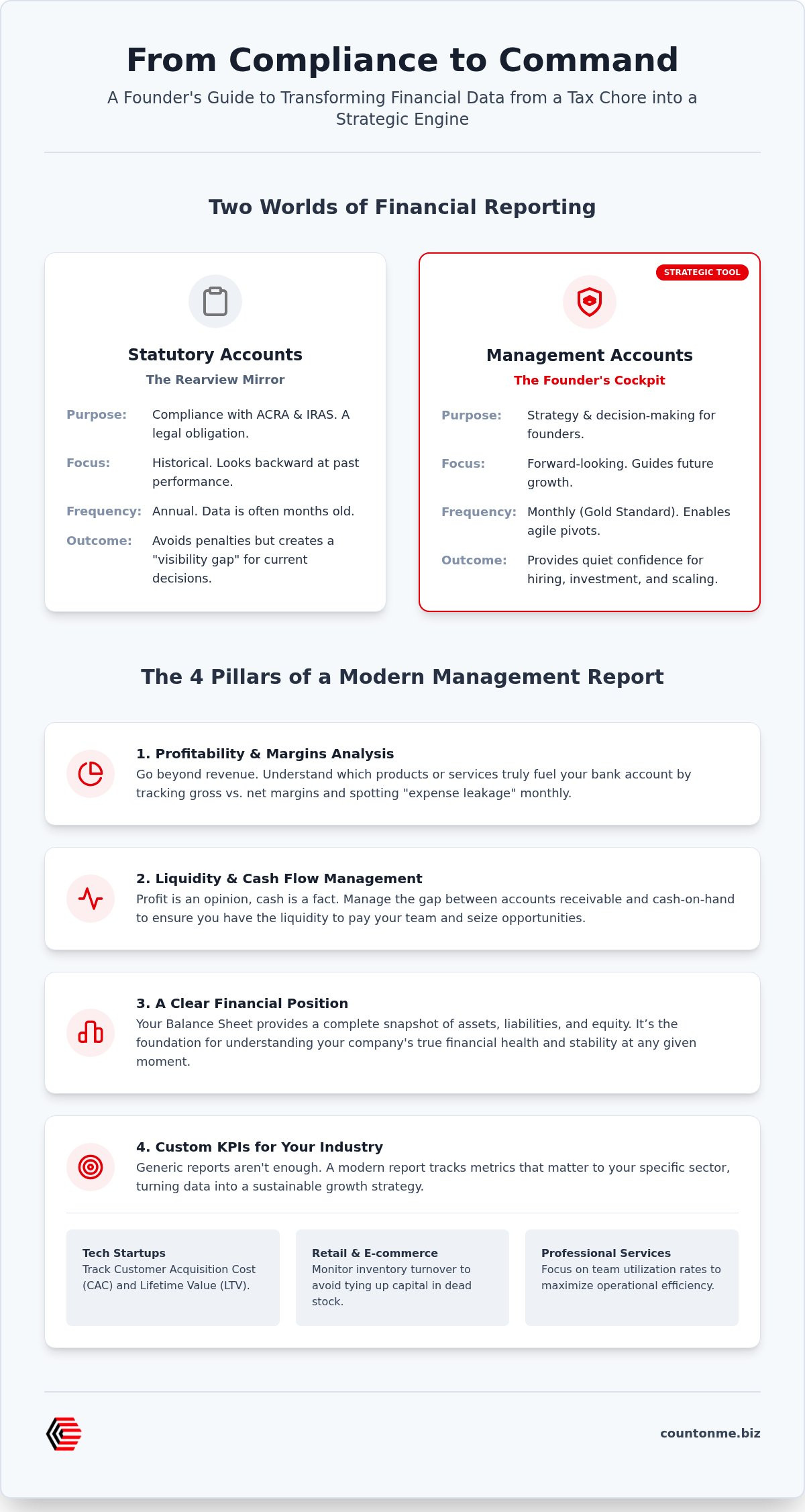
Every company in Singapore has a legal obligation to maintain proper accounting records. It isn’t just about staying on the right side of the law; it’s about having a clear map for your business journey. However, there is a distinct line between the reports you file for the government and the ones you use to grow your revenue. Management accounts are internal financial reports prepared monthly or quarterly to guide business strategy.
Think of it this way: statutory accounts are history, while management accounts Singapore leaders rely on are the daily news. One looks backward to satisfy regulators, while the other looks forward to help you win. Understanding this difference is the first step toward moving from a “compliance first” mindset to a “growth first” strategy.
Statutory Reporting: Meeting ACRA and IRAS Requirements
When we talk about statutory reporting, we’re focusing on compliance with ACRA and IRAS. Your Corporate Secretary plays a vital role here, ensuring your Annual Return is filed within seven months of your Financial Year End for non-listed companies. These reports must follow the Singapore Financial Reporting Standards (SFRS) and typically include a profit and loss statement, a balance sheet, and a cash flow statement.
While these filings are necessary to avoid penalties, they often create a “visibility gap.” Because they are usually prepared months after the year ends, the data is often too old to help you fix a current cash flow leak or seize a new market opportunity. Relying solely on year-end filings is like trying to drive a car while only looking at the rearview mirror.
Management Reporting: The Founder’s Decision-Making Tool
This is where management accounts Singapore SMEs use for scaling come into play. Unlike statutory filings, these reports are strictly internal. They are designed for founders and stakeholders who need to know exactly how the business performed last month, not last year. Monthly reporting is the gold standard for Singapore startups because it allows for rapid pivots and agile decision-making.
These insights form the foundation for on-demand CFO services, where a strategic partner helps you interpret the data rather than just recording it. By applying principles of Management accounting, you move from simply tracking transactions to building a scalable roadmap. You’ll see exactly where your margins are thinning and where your cash is tied up, giving you the quiet confidence to make your next big move.
The 4 Essential Components of a Modern Management Report
A modern report isn’t just a list of numbers. It’s a clear, living picture of your business health. When we build management accounts Singapore founders actually use, we focus on four pillars that turn raw data into a strategic story. These components work together to show you not just where you’ve been, but exactly where you’re going next. They transform your financial function from a back-office chore into a cockpit for growth.
Analyzing Profitability and Margins
Your Profit & Loss (P&L) statement is the first pillar. While total revenue is a great vanity metric, the real magic happens when you analyze your margins. We look at gross vs. net margins to identify which products or services are truly fueling your bank account. By tracking operational efficiency monthly, you can spot “expense leakage” or subscription creep before it impacts your bottom line. Comparing these figures against your monthly budgets helps you stay disciplined while you scale.
Liquidity and Cash Flow Management
Profit is an opinion, but cash is a fact. In Singapore’s competitive market, being “profitable” on paper won’t save you if you can’t pay your team on the 28th. This is why the Balance Sheet and Cash Flow Statement are vital. You need to understand the gap between your accounts receivable and the actual cash on hand. Effective cash flow management for startups ensures you have the liquidity to survive seasonal dips or seize unexpected opportunities. It’s about moving from “hoping the check clears” to knowing exactly where you stand.
Custom KPIs for Your Industry
The fourth component is the KPI dashboard. In 2026, generic reports aren’t enough; you need metrics that matter to your specific sector. Tech startups should watch Customer Acquisition Cost (CAC) and Lifetime Value (LTV) closely to ensure their growth is sustainable. Retail and e-commerce businesses need to monitor inventory turnover to avoid tying up capital in dead stock. For professional service firms, tracking utilization rates is the key to operational success. High-quality Management Reports For SMEs include these tailored insights to drive real action. If you feel like your current reports are missing these vital signs, we can help you design a dashboard that actually speaks your language.
Transitioning to Digital: Automating Your Management Accounts
By 2026, the era of the manual Excel ledger has firmly come to an end. With 95.1% of Singaporean SMEs already adopting digital solutions according to 2024 data, staying manual isn’t just slow; it’s a competitive disadvantage. For many founders, the old way meant spending 8 to 10 hours every month just on data entry and reconciliations. Automating your management accounts Singapore workflow ensures your data is always current and, more importantly, accurate. It’s about moving from a reactive “catching up” phase to a proactive “staying ahead” strategy.
Modern cloud accounting services act as the digital spine of your business. By connecting your platform directly to real-time bank feeds, you eliminate the need to wait for monthly paper statements. You see every transaction as it happens, giving you a level of visibility that helps you spot cash flow trends before they become problems. This shift doesn’t just save time; it builds a foundation of data integrity that you can actually trust.
Step 1: Selecting the Right Cloud Platform
Choosing between Xero and QuickBooks is often the first big decision. Both platforms dominate the Singapore landscape because they offer seamless integration with local banks like DBS, UOB, and OCBC. This connectivity is the foundation of real-time reporting. You want a platform that doesn’t just handle today’s volume but scales effortlessly as your headcount and transaction numbers grow. We often recommend platforms that support the Productivity Solutions Grant (PSG) to help offset initial adoption costs.
Step 2: Digitizing the Finance Function
Once your platform is live, the focus shifts to removing friction from your daily operations. We help you automate invoice processing and expense claims so that receipts never go missing in a drawer. Setting up automated payroll management is another quick win, ensuring your team is paid accurately while keeping your records perfectly synced for IRAS. Centralizing this data allows for on-demand access from any device, anywhere in the world.
Step 3: Establishing the Reporting Cadence
Automation is powerful, but it still requires a disciplined “Month-End Close” process to ensure every entry is verified and tax-compliant. We work with you to train your team on how to interpret these real-time dashboards. Having a collaborative partner to review these numbers ensures you aren’t just looking at charts, but understanding the story they tell about your growth. This partnership turns raw management accounts Singapore data into a reliable strategic tool for your next board meeting.
Automate your financial reporting today
Strategic Growth: How to Use Management Accounts to Scale
Most founders think of accounting as a way to stay out of trouble with IRAS. But the most successful SMEs use management accounts Singapore to leap from simply “knowing” their numbers to actually “growing” them. When you have a clear view of your financial health every 30 days, you aren’t just reacting to the market; you’re shaping your place in it. This visibility is exactly what investors look for when you’re seeking funding, as it proves you have a firm grip on your unit economics and burn rate. For founders who want to extend this oversight to their personal holdings, IOMI offers an AI-powered platform to consolidate all assets into one strategic dashboard.
In Singapore, your taxable turnover matters more than you might think. By using monthly data, you can predict exactly when you’ll hit the S$1 million GST registration threshold, avoiding last-minute scrambles or back-dated liabilities. You can also restructure director compensation throughout the year based on real-time profit, rather than waiting for a year-end surprise. This proactive approach helps you avoid ACRA filing penalties because your books are always “audit-ready” and reconciled, making the final submission a non-event.
Budgeting and Forecasting for 2026
Scaling requires a roadmap. For 2026, we encourage founders to use “What-If” scenarios to test their assumptions before committing capital. What happens to your cash flow if you hire three new engineers in Q2? How does a 10% increase in marketing spend affect your CAC? Aligning your monthly spend with these long-term strategic goals ensures you don’t overextend. It also helps you identify underperforming business units early, allowing you to pivot before a small leak becomes a flood.
Partnering for Success
Running an SME is often a solo journey, but your finance function shouldn’t be. Many founders find immense value in having a mentor figure who brings two decades of industry experience to their boardroom without the overhead of a full-time executive. This collaborative approach is what makes on-demand CFO support so effective for growing firms. You get a tech-forward ally who helps you interpret your management accounts Singapore, ensuring every dollar spent is a step toward your next milestone. It’s about building a relationship based on transparency and shared goals.
Explore our Cloud Accounting & CFO services
Take Control of Your Financial Future
You’ve seen how moving beyond simple year-end filings can change the way you run your business. By embracing real-time visibility and ditching the manual Excel grind, you’re not just staying compliant; you’re building a foundation for sustainable growth. Whether it’s mastering your cash flow or preparing for your next funding round, having the right data at your fingertips makes all the difference.
We’re here to help you bridge that gap. As Xero-certified digital innovators with over 20 years of industry experience, we specialize in making finance functions feel effortless for local founders. Our solutions are specifically tailored for Singapore startups and SMEs who want to spend less time on paperwork and more time on strategy. Implementing high-quality management accounts Singapore business owners trust is the first step toward that quiet confidence you’ve been looking for.
Ready to see your numbers clearly? Explore our SME Accounting Packages
Your growth journey doesn’t have to be a solo effort. We’re ready to act as your collaborative partner, providing the stability and expert guidance you need to scale with certainty.
Frequently Asked Questions
Are management accounts mandatory for all companies in Singapore?
No, management accounts aren’t legally mandated by ACRA or IRAS. While you’re required to keep proper records for statutory financial statements, management accounts Singapore leaders use are strictly for internal decision-making. They give you a real-time view of your performance that year-end filings simply can’t provide. Most successful SMEs choose to prepare them to stay agile and informed, even though there’s no official filing deadline or prescribed format for internal use.
How much do professional management accounting services cost?
The cost for these services depends on your transaction volume, the complexity of your business model, and whether you need high-level advisory like on-demand CFO support. We focus on providing scalable solutions that grow with you. Instead of a one-size-fits-all price, we look at your specific needs to ensure you’re getting the best value. This approach helps you maintain professional oversight without the overhead of a full-time finance team or expensive executive hires.
Can I prepare management accounts myself using Excel?
You can use Excel, but it often leads to manual errors and a significant “visibility gap” in your data. By 2026, most Singaporean SMEs have moved to cloud-based automation—using tools like Flowca to unify their agenda, clients, and cash flow—to save the 8 to 10 hours typically spent on manual data entry every month. Spreadsheets are static and don’t offer the real-time bank feeds that modern platforms provide. Switching to a digital workflow ensures your data is accurate and ready for strategic analysis at any moment.
Monthly reporting is the gold standard for startups and growing companies. Quarterly reports are better than nothing, but they often miss rapid shifts in cash flow or sudden market trends. Monthly management accounts Singapore founders rely on allow you to make quick pivots and catch expense leaks before they drain your bank balance. If you’re looking to scale quickly, having a fresh set of numbers every 30 days is essential for staying in control and confident.
How do management accounts help with corporate tax filing?
They turn tax season from a stressful event into a simple confirmation of your data. Because your records are reconciled monthly, you’ll always know if you’re approaching the S$1 million GST registration threshold. This constant oversight allows for proactive tax planning, such as adjusting director compensation or timing asset purchases. You’ll avoid the panic of last-minute filings and significantly reduce the risk of ACRA penalties because your data is already audit-ready and accurate.
Do I need an audit if I have monthly management accounts?
Having monthly reports doesn’t exempt you from a statutory audit if your company meets the ACRA “small company” thresholds. While management accounts provide excellent internal control, the legal requirement for an audit is based on criteria like annual revenue, total assets, and employee headcount. It’s important to remember that we specialize in accounting and CFO support, but we don’t provide statutory audit services. You should check current ACRA guidelines to see if your entity qualifies for an exemption.