

What if the biggest threat to your restaurant’s survival isn’t a sudden drop in footfall, but the hours you spend wrestling with delivery platform spreadsheets after the kitchen has closed? In the fast paced culinary scene, effective accounting for F&B Singapore has evolved into a high stakes balancing act. You likely entered this industry to create memorable dining experiences, not to get buried under manual reconciliations for Grab or Foodpanda. We understand that thin margins and high staff turnover make every cent and every minute feel incredibly precious.
This guide is designed to provide you with a sense of relief and a clear path forward. We’ll show you how to navigate the complexities of modern F&B finance, from automating daily platform settlements to ensuring your tax and CPF compliance is always bulletproof. By leveraging cloud based solutions, you can move away from the stress of “guesstimating” your food costs. Instead, you’ll gain real time visibility into your margins and build automated workflows that actually save you time. We’re going to explore the exact tools and strategies you need to transform your back office into a lean, digital engine for growth in 2026.
Key Takeaways
- Learn why daily sales reconciliation is the backbone of successful F&B operations and why standard bookkeeping often falls short.
- Discover how to streamline your accounting for F&B Singapore by integrating your POS system with cloud based platforms like Xero for real time data.
- Solve the manual settlement headache by automating the reconciliation of delivery platform payouts from GrabFood, Foodpanda, and Deliveroo.
- Simplify payroll management for your transient workforce while staying fully compliant with MOM regulations and automated CPF contributions.
- Move beyond basic compliance to use cash flow forecasting and CFO advisory as strategic tools for scaling your restaurant brand.
The Unique Complexity of F&B Accounting in Singapore
Running a kitchen is an art, but managing the books is a science. Unlike a consultancy where you might send three large invoices a month, F&B involves hundreds of small transactions daily. This high volume of micro transactions creates a unique set of challenges for accounting for F&B Singapore. If you aren’t reconciling these daily, you’re essentially flying blind. Generic bookkeeping services often wait until the end of the month to look at your bank statements. By then, any “leakage” from cash handling errors or missed digital payments is long gone.
High-Volume Micro-Transactions and Margin Pressure
Your profit lives in the margins. When you’re dealing with low value items, even a small discrepancy in cash or a slight increase in ingredient costs can wipe out your day’s profit. Traditional monthly accounting is simply too slow for this industry. You need real time visibility into your P&L to make smart decisions about menu engineering. If a signature dish’s food cost spikes because of a supplier price hike, waiting thirty days to find out could be a costly mistake. Effective inventory management isn’t just about counting stock; it’s about protecting your bottom line from invisible losses. We focus on helping you spot these trends before they become crises.
Multi-Channel Revenue Streams
Today’s restaurants aren’t just physical locations; they’re digital hubs. Managing the mix of dine in, takeaway, and third party delivery apps like GrabFood or Deliveroo adds layers of complexity. Each platform has its own settlement schedule and commission structure. These commissions are often hidden costs that founders fail to account for properly. Manual data entry is the number one growth killer for local cafes. If your team is manually typing delivery orders into your accounting software, they aren’t focusing on the guest experience. Modern accounting for F&B Singapore requires a digital first approach to capture every dollar across every channel.
IRAS and ACRA have specific expectations for food businesses. You must maintain clear records of all sales, including GST if you’ve crossed the registration threshold. Keeping these records accurate isn’t just about staying out of trouble; it’s about building a stable foundation. If you’re looking for support with these requirements, our cloud accounting and bookkeeping services are designed to handle these specific F&B pressures. We act as your supportive ally, ensuring your compliance is bulletproof so you can focus on the food.
Mastering Sales Reconciliation and Food Cost Control
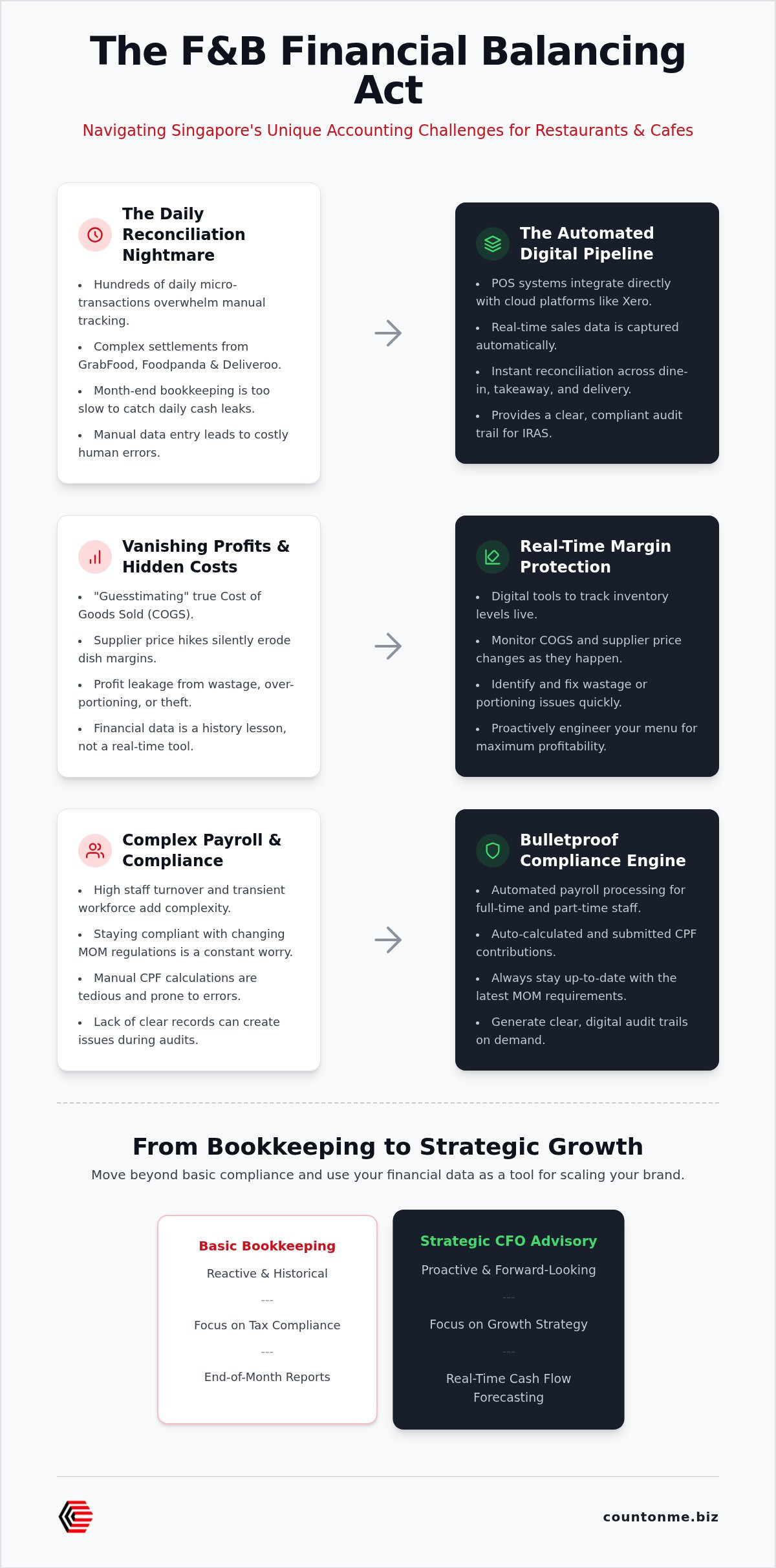
Reconciling sales shouldn’t feel like a part time job. When you’re managing GrabFood, Foodpanda, and Deliveroo alongside dine in customers, the settlement statements can be a nightmare. Each platform deducts commissions and fees differently, often leaving you with a lump sum that doesn’t seem to match your POS reports. If you’re doing this manually, you’re likely losing track of your actual cash flow. Automating this flow is the only way to stay sane and ensure your accounting for F&B Singapore remains accurate.
The POS to Cloud Accounting Pipeline
Direct integration is your best defense against human error. When your POS talks to your ledger, it automatically maps different payment types like NETS, credit cards, and cash to the right accounts. This isn’t just about convenience; it’s about compliance. IRAS requires robust record keeping, and digital logs provide a clear audit trail that manual spreadsheets simply can’t match. We’ve seen how much time this saves for busy founders. If you’re feeling overwhelmed by the technical setup, our Cloud Accounting & Bookkeeping team can help you build this pipeline from scratch.
Protecting Profit with Accurate Food Costing
Do you know your true Cost of Goods Sold (COGS)? There’s often a painful gap between your theoretical food costs and what actually leaves the kitchen. This discrepancy usually points to wastage, over portioning, or even inventory theft. By using digital tools to track inventory levels in real time, you move away from messy manual spreadsheets that are often outdated the moment they’re printed.
Leveraging cloud accounting services Singapore allows you to monitor supplier price fluctuations as they happen. This data lets you spot when a specific ingredient is eating into your margins, giving you the chance to adjust your menu or negotiate with vendors before the month ends. This proactive approach is essential for modern accounting for F&B Singapore. It turns your financial data from a history lesson into a real time survival tool.
Navigating Payroll and Compliance for a Transient Workforce
Managing people is arguably the most volatile part of your business. In the kitchen and on the floor, high staff turnover isn’t just a recruitment challenge; it’s a massive administrative burden. When your team includes a mix of full timers, students on part time shifts, and casual weekend help, your accounting for F&B Singapore needs to be exceptionally agile. Calculating varying overtime rates and accurate CPF contributions manually is a recipe for errors that can damage staff morale and attract unwanted attention from the Ministry of Manpower (MOM).
Efficient Payroll and CPF Management
Variable hours shouldn’t lead to variable stress levels. We believe that maintaining staff trust starts with a payslip that’s correct every single time. By implementing modern payroll management Singapore solutions, you can automate the complex math of shift differentials and public holiday pay. This digital approach also streamlines your year end obligations, such as IR8A submissions, ensuring you’re always ahead of the curve during tax season. It turns a chaotic monthly chore into a steady, reliable process.
Tax Compliance and GST Essentials
GST for restaurants comes with its own set of quirks. You have to be precise about what counts as taxable revenue, especially when service charges and complimentary staff meals are involved. It’s equally important to claim every cent of input tax on your high value kitchen equipment and bulk ingredient purchases. Accuracy here is a cornerstone of effective accounting for F&B Singapore. Mistakes are common, but they’re also avoidable with the right oversight.
Our tax compliance services Singapore are designed to help you maximize your allowable deductions while keeping your records audit ready. Beyond taxes, staying compliant with ACRA filing deadlines is vital for long term stability. Proactive corporate secretarial support ensures you never face late fees or penalties, giving you the mental space to focus on your culinary vision. We act as your supportive ally, catching the details so you can lead your team with confidence.
Explore our payroll and compliance packages
Strategic Growth: From Bookkeeping to CFO Advisory
Once you’ve cleared the fog of daily reconciliations and manual payroll, you’ve reached an exciting turning point. You’re no longer just surviving the week; you’re ready to build a legacy. Strategic accounting for F&B Singapore isn’t just about looking backward at what you spent last month. It’s about using those historical patterns to predict your future. We help you move beyond basic compliance to see the story your numbers are telling. Whether you’re considering a second outlet or a major kitchen renovation, data should be the foundation of that decision rather than just a gut feeling. For those looking to understand the global standard for this level of financial leadership, pcfo.co.uk offers excellent insights into how outsourced CFO services support scaling businesses.
Cash flow is the heartbeat of any restaurant. It’s often the difference between a thriving brand and a closed door. Identifying seasonal trends, like the spike during Chinese New Year or the quiet lulls in mid year, helps you prepare without the stress of a sudden cash crunch. You might find that renegotiating supplier payment terms keeps more cash in your business for longer, providing a safety net for unexpected repairs. If you’re looking to scale, an on demand CFO Singapore provides the high level modeling needed to secure business loans or attract investors. They’ll help you evaluate the ROI of every major move, ensuring your expansion is as profitable as it is ambitious.
The Count On Me Advantage
Transitioning from a “one man show” to a professionally managed finance function is a major milestone for any founder. Our Count On Me services are built specifically for the high intensity pace of the food industry. We take a digital first approach because it’s the most efficient way to give you access to seasoned experts without the overhead of a full time executive. It’s an affordable way to bring 20 years of professional experience into your corner.
Professionalizing your accounting for F&B Singapore is about more than just software; it’s about partnership. We act as your tech forward mentor, helping you interpret complex financial reports so you can make confident, informed choices. We’re as invested in your restaurant’s success as you are, valuing the human relationship behind every balance sheet. By letting us handle the strategic financial oversight, you’re free to focus on what you do best: creating incredible food and hospitality experiences for your guests.
Building a Resilient Future for Your Restaurant
Mastering your finances is the first step toward long term success in Singapore’s competitive dining scene. By automating your POS integrations and streamlining delivery platform reconciliations, you reclaim the hours needed to focus on your guests. Professionalizing your payroll and staying ahead of tax compliance ensures your business remains stable while you scale. Modern accounting for F&B Singapore is no longer a burden; it’s a strategic advantage that provides the clarity you need to make bold moves.
We’re here to act as your supportive ally. Our team of seasoned experts brings over 20 years of experience to your business, offering seamless cloud based automation and transparent, scalable pricing that grows with you. You deserve a partner who is as invested in your culinary vision as you are.
Let Count On Me handle your F&B accounting so you can focus on the food
Take the leap from managing daily chaos to leading a thriving brand. We’re ready to help you build a more profitable and stress free future starting today.
Frequently Asked Questions
Do I need a specialized accountant for my restaurant in Singapore?
Yes, because the food industry deals with unique challenges like high volume micro transactions and complex third party delivery settlements. Specialized accounting for F&B Singapore ensures your partner understands the specific pressures of food cost control and inventory leakage. While a generalist might manage your books, a specialist identifies the thin margins that keep your kitchen running. We act as a tech forward mentor to help you navigate these industry hurdles with quiet confidence.
How do I reconcile GrabFood and Foodpanda sales in Xero?
You should use direct integrations between your POS and Xero to automate the data flow. This eliminates the need for manual spreadsheets and reduces human error. By mapping platform payouts against your daily POS reports, you can easily account for commissions and service fees. This digital first approach provides a clear audit trail and ensures your bank reconciliations are accurate every single day. It’s about moving from guesswork to real time financial clarity.
What are the common GST mistakes made by F&B businesses?
Many F&B owners struggle with service charges and complimentary staff meals when filing their returns. It’s also common to see errors in claiming input tax on kitchen equipment or bulk ingredient purchases. Ensuring your accounting for F&B Singapore is compliant means tracking these details meticulously to avoid IRAS penalties. We help you stay audit ready by implementing automated workflows that capture every taxable transaction accurately, giving you much needed peace of mind during tax season.
How often should I review my restaurant’s financial statements?
You should monitor your sales and cash flow daily to spot immediate issues like inventory theft or wastage. However, a deep dive into your full Profit and Loss (P&L) statement should happen at least once a month. This regular review allows you to identify long term trends in food costs and labor expenses. Consistent monitoring helps you make proactive decisions about menu pricing or staffing levels before they impact your bottom line significantly.
Is it better to outsource payroll for a cafe with high staff turnover?
Outsourcing is often the most efficient choice because managing variable shifts and CPF contributions for a transient workforce is incredibly time consuming. High staff turnover increases the risk of administrative errors in overtime and public holiday pay calculations. By using professional payroll management solutions, you ensure your team is paid accurately and on time, which helps maintain staff trust. It also frees you to focus on your culinary vision rather than back office paperwork.
How can an on-demand CFO help my F&B business scale?
An on-demand CFO provides the high level financial strategy needed to move beyond basic bookkeeping. They help you evaluate the ROI of opening a second outlet or investing in a major kitchen renovation. By providing detailed cash flow forecasting and seasonal trend analysis, they prepare your business for growth without the risk of a cash crunch. This partnership allows you to leverage 20 years of expertise to secure loans and attract potential investors for your expansion.