

What if the best first response to an IRAS tax audit isn’t to rush into explanations, but to organise the facts? If you’re wondering how to handle an IRAS tax audit, start by reading the notice carefully. Identify the tax type, period under review, records requested and response date. Receiving a notice doesn’t, by itself, mean your company made a mistake or will face penalties.
It’s understandable to feel concerned, especially when invoices, bank statements and accounting records are spread across different systems. A clear, documented workflow makes the process more manageable and helps you respond accurately to IRAS’s instructions.
This guide explains how to interpret an audit notice, organise complete and traceable supporting documents, and prepare a clear response. It also covers how bookkeeping and tax compliance support can ease the administrative workload. Well-maintained digital ledgers and regular reconciliations make it easier to retrieve records and trace figures back to their source.
Key Takeaways
- Use a step-by-step process to assign responsibility, understand the request and prepare a clear submission.
- Link each figure IRAS asks about to the relevant tax return and supporting records, so your response is easy to trace.
- Assess proposed findings by separating confirmed errors from differences in tax interpretation and points that need more evidence.
- Compare last-minute record gathering with ongoing bookkeeping and reviews to identify practical ways to strengthen audit readiness.
What an IRAS tax audit notice means for your Singapore business
An IRAS tax audit reviews information your business has submitted to check whether it is accurate and supported by records. The focus depends on the tax type. A GST review may examine transactions reported in GST returns and the records supporting them. A corporate income tax review may look at income, expenses and claims reported for the relevant Years of Assessment. These are distinct reviews, so follow the scope and requirements in your notice rather than assuming the same rules apply to both.
The Inland Revenue Authority of Singapore (IRAS) administers Singapore’s tax system. Its audit notice tells you what it wants to review and how to respond. An audit notice is a request for review, not a verdict on your company’s compliance. Selection alone doesn’t establish that your business made a mistake or acted improperly.
What to identify in the IRAS audit notification
Read the notice closely and record the tax type, Years of Assessment or accounting periods involved, documents requested, response instructions and stated due date. Note how IRAS expects you to communicate and whether the notice mentions an interview, premises visit or document submission. Keep the original notice and follow-up correspondence together in a restricted-access audit file, so the response owner can track instructions and decisions.
If any part of the request is unclear, identify the specific point before preparing your response. Don’t treat a broad request as a reason to send unrelated records. Keeping the response within scope makes it easier to organise and check that every requested item is covered.
Does an audit notice mean your company made a mistake?
No. IRAS corporate compliance guidance describes both risk-based and random audit approaches across industries. The notice alone doesn’t explain why your business was selected, so avoid speculating. Findings depend on what the review establishes from the records and the relevant tax treatment, not simply on the fact that IRAS contacted you.
Focus first on understanding the request and preserving relevant documents. Regular reconciliations and organised bookkeeping make supporting records easier to retrieve. Cloud accounting and tax compliance support can also help Singapore SMEs keep financial records structured and tax obligations clearer as part of their regular processes.
How to prepare records and communicate with IRAS during an audit
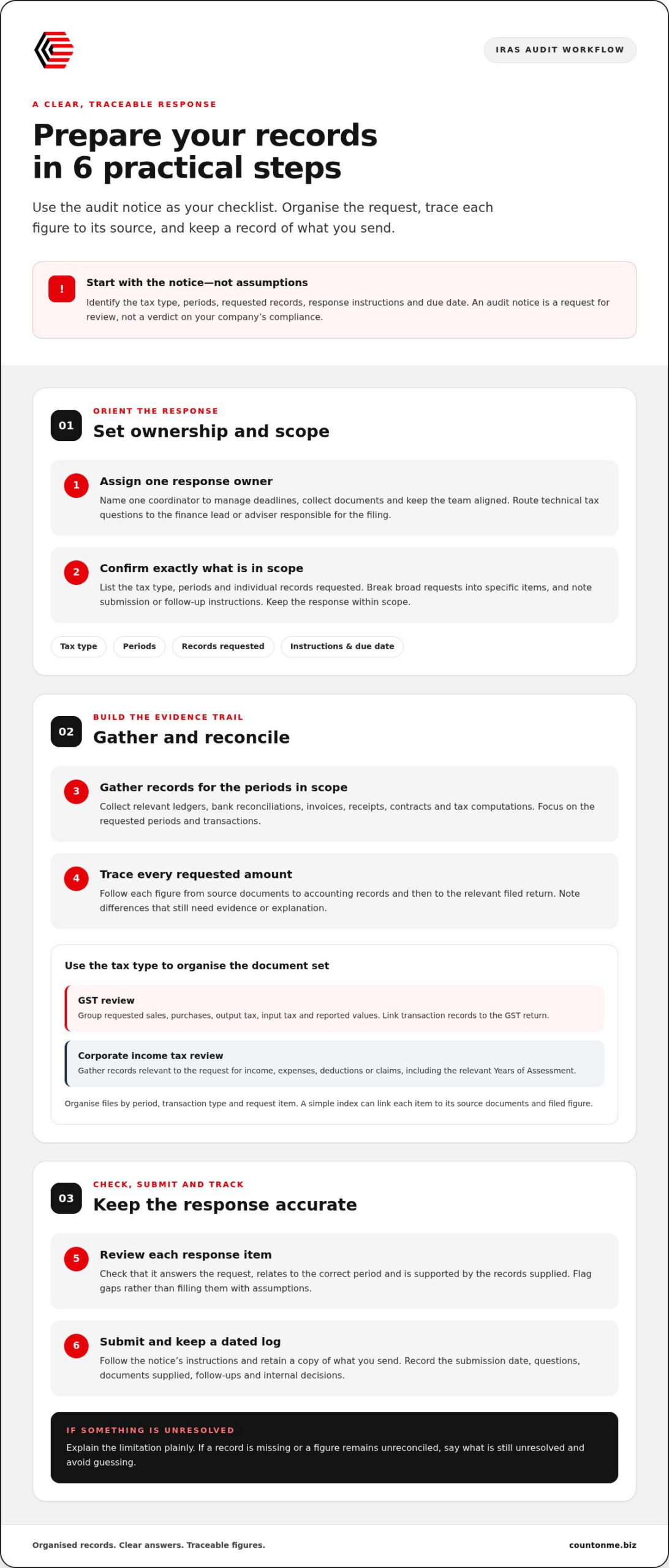
A structured response makes it easier to show where each reported figure came from. Use the notice as your checklist and work through the request in a consistent order. This workflow helps you understand how to handle an IRAS tax audit without rushing to send records that haven’t been checked.
- Assign an owner. Name one response coordinator to manage deadlines, collect documents and keep the team aligned. Route technical tax questions to the finance lead or adviser responsible for the relevant filing.
- Confirm the scope. List the tax type, periods and individual records requested. Break broad requests into specific items, and note any instructions for submission or follow-up.
- Gather the records. Collect relevant ledgers, bank reconciliations, invoices, receipts, contracts and tax computations. Focus on the periods and transactions in scope.
- Reconcile the figures. Trace each requested amount from its source documents to the accounting records and then to the relevant filed return. Note any differences that still need evidence or explanation.
- Review the response. Check that each item answers the request, relates to the correct period and is supported by the records supplied. Flag gaps rather than filling them with assumptions.
- Submit and log. Follow the notice’s instructions and retain a copy of what you send. Record the submission date and any follow-up actions in the audit log.
Build a clear, traceable audit document set
Organise files by period, transaction type and request item. Use consistent labels such as “GST sales, quarter ending [date]” or “Corporate tax expenses, YA [year].” For a GST review, group requested sales, purchases, output tax, input tax and reported values so each figure can be traced from transaction records to the GST return. For a corporate income tax review, gather records relevant to the request for income, expenses, deductions or claims. A simple index that links each item to its source documents and filed figure can save time during the review.
Keep IRAS responses accurate and coordinated
Have the coordinator maintain a dated log of questions, documents supplied, follow-ups and internal decisions. Answer each question directly and explain any limitation plainly. If a record is missing or a figure remains unreconciled, say what’s unresolved and avoid guessing. Regular reconciliations and cloud-based bookkeeping make documents easier to retrieve. Bookkeeping and tax compliance support can help your team maintain organised records as part of its ongoing processes.
How to handle audit findings, errors, and disagreements
An audit finding is a point to assess, not something to accept or reject automatically. At this stage, review each proposed adjustment against three things: the return filed, the source records and the tax treatment applied. For example, if IRAS questions an expense, trace the amount to its ledger entry and supporting invoice, then consider whether it was treated correctly for that tax type and period.
Sort each point into a clear category before replying:
- Confirmed error: The records support the finding, and the filed figure appears incorrect.
- Difference in interpretation: Your records may be complete, but you and IRAS may view the tax treatment differently.
- More evidence needed: The issue can’t yet be resolved because documents or clarification are outstanding.
Respond item by item with relevant documents and a concise explanation. Avoid defensive claims or assumptions about why a figure differs. Penalties, objection procedures and deadlines depend on the case and current IRAS rules, so check the instructions in the relevant correspondence before taking action.
If the review identifies a possible error
Use reconciled records to establish which transactions and periods are affected. Separate confirmed amounts from items still under review, and avoid estimating the impact from an incomplete sample. If the correct tax treatment is uncertain, seek qualified tax compliance advice before responding. Check any disclosure or correction process against current IRAS guidance, since the appropriate step can depend on the tax and circumstances involved.
If your company disagrees with a finding
State the specific point in dispute, explain your reasoning briefly and attach the records that support it. If IRAS’s reasoning or evidence request isn’t clear, ask for clarification rather than replying to an assumption. If the communication includes an assessment, check the applicable objection route and time limit in that notice. Keep a copy of your response and supporting documents with the audit correspondence.
Careful bookkeeping and tax compliance advice can help you assess discrepancies using organised records and a clear view of your filings.
How Singapore SMEs can build audit readiness and get practical support
Audit readiness comes from keeping everyday finance work organised, rather than assembling a special set of files at the last minute. Regular reconciliations, clear ownership and periodic checks of tax submissions help your team spot gaps while supporting documents are still accessible. These habits can make it easier to respond if IRAS asks questions, but they don’t guarantee a particular audit outcome.
| Approach | What it can mean for your team |
|---|---|
| Ad hoc record collection | Documents may be scattered across inboxes and folders, differences may take longer to investigate, and key knowledge can sit with one person. |
| Ongoing reconciliations | Figures are checked routinely, supporting records are easier to trace, and unresolved differences can be flagged before a filing or review. |
A repeatable audit-readiness routine for a small finance team
Keep the routine manageable. Reconcile bank statements to accounting records regularly and investigate mismatches while transaction details are easy to retrieve. Store tax returns, computations, invoices and other supporting documents in a consistent digital structure, labelled by period and document type. Assign someone to review tax submissions and retain evidence for significant claims. Periodic checks can compare return figures with the underlying ledger and flag items that need follow-up.
Cloud-based records make ledgers and supporting files more convenient to retrieve, while regular reconciliations help connect reported figures to recorded transactions. These practices support an organised process, not a guaranteed audit outcome. Count On Me provides cloud-based accounting and bookkeeping, including regular account reconciliations and financial statement preparation, alongside tax compliance support for SMEs.
When accounting and tax compliance support can help
Bookkeeping, reconciliations, tax compliance and financial record organisation can ease the workload when your team has limited time or needs a more consistent process. This support can also clarify who maintains records and checks filings. If you’re considering how to handle an IRAS tax audit as part of stronger ongoing compliance, build readiness into routine finance work rather than waiting for a notice.
Make audit readiness part of your next finance cycle
Your next step doesn’t need to be a major overhaul. Choose one recurring finance task, such as reviewing reconciliations or checking that important tax documents are filed consistently, and assign someone to own it. Small routines can strengthen your records over time and make audit readiness part of how your business operates.
If you’re still considering how to handle an IRAS tax audit, organised processes can help you respond with greater clarity, though no adviser can promise a particular audit outcome. Count On Me supports Singapore businesses with cloud-based bookkeeping, regular account reconciliations and tax compliance advice. Its professionals bring more than 20 years of industry experience to helping SMEs manage their finance and compliance needs.
With a steady process and practical support, you can approach compliance tasks with more confidence and keep your attention on running the business.
Frequently Asked Questions
Does being selected for an IRAS tax audit mean my company did something wrong?
No. IRAS conducts both risk-based and random audits, so selection alone doesn’t establish that your company made an error. The review checks the relevant records and tax reporting within its scope. For example, a request about one GST period doesn’t automatically mean every tax filing is under review. Use the notification to identify what IRAS is reviewing and follow its instructions rather than guessing why your company was selected.
Can IRAS conduct random audits of companies in Singapore?
Yes. IRAS states that it conducts risk-based and random audits across industries. A random audit programme doesn’t explain why a particular company received a notice, so avoid treating assumptions about selection as fact. Focus on the tax type, periods and records identified in the communication. If you need to clarify the request, use the official channel stated in the notice and keep your response grounded in that communication.
Can IRAS conduct a tax audit by email or telephone?
Yes. IRAS audit contact can include letters, emails or telephone interviews, and a premises visit may also be requested. The method depends on the review and its requirements. Follow the communication you receive, but take care with unexpected messages or calls. Before sharing confidential company information, verify the contact through official IRAS channels. Once verified, note what was requested and use the communication’s instructions to guide your next steps.
How much time does a company have to respond to an IRAS audit request?
Use the response date in the specific IRAS communication, because you shouldn’t assume one standard period applies to every audit. Check the notice for the submission date and any instructions about how to respond. If the date or request is unclear, seek clarification promptly through the stated official channel. If gathering a particular record may take time, raise the issue early rather than waiting until the response date has passed.
What should I do if I cannot find a document requested by IRAS?
Search the relevant accounting system, bank records, shared folders and email, and check with colleagues responsible for the transaction. Keep a note of where you looked and explain factually if the document remains unavailable. Don’t recreate evidence or guess at its contents. If needed, ask IRAS what alternative records it may accept. If the missing document affects a filed figure or claim, get accounting or tax advice before explaining the potential impact.
Does every IRAS tax audit result in a penalty?
No. An audit is a review, and receiving a notice doesn’t automatically mean a penalty will apply. Any consequence depends on what the review establishes, the applicable tax rules and the circumstances of the case. Read IRAS’s written findings carefully and distinguish questions or requests for evidence from formal conclusions. Before responding to a finding, check the current rules and the instructions in the relevant communication. Don’t assume the outcome in advance.