
What if the first step in an XBRL filing isn’t choosing software, but identifying the right filing category? For xbrl companies in Singapore, that distinction matters because the applicable requirements and template determine how financial information must be prepared and tagged.
It’s understandable to want a clear answer on whether your company must file in XBRL and which format applies. The details depend on the company’s circumstances, and tagged figures should agree with the approved financial statements. A small-company assessment may affect the filing format, but audit exemption and XBRL filing are separate questions.
This guide explains what XBRL means for Singapore company filings, what to verify against current ACRA requirements, and how to prepare financial data accurately and consistently. We’ll cover how to identify the relevant filing category and template, then outline a reviewable workflow for checking figures against your financial statements. Orderly, reconciled accounting records make statement preparation more straightforward and give your team a stronger starting point for the filing process.
Key Takeaways
- Understand how XBRL tags financial statement information so it can be processed digitally, and why each tagged figure must match the source statements.
- For xbrl companies, identify the applicable filing category before selecting a template or beginning preparation.
- Use current ACRA guidance to verify your company’s requirements and template, then organise the financial statements and supporting data.
- Build a practical workflow that includes preparing, validating and reviewing the XBRL data before filing.
- Keep books reconciled and reporting records organised to make financial statement preparation easier for your team.
XBRL for Singapore companies: what it is and when filing may apply
XBRL can sound technical, but a requirements-first approach makes the process easier to understand. For xbrl companies in Singapore, the first question isn’t which software to use. It’s whether the company must file financial statements with ACRA and, if so, which format applies. Filing obligations, exemptions and templates can depend on the company’s type and circumstances, so use current ACRA guidance rather than assuming one rule applies to every company.
Keep two questions separate: whether financial statements must be filed, and how required information must be submitted. XBRL is a format for structuring financial information; it doesn’t determine whether a company has a filing obligation. A company may also have separate obligations, such as filing an Annual Return. Check each requirement and its applicable deadline against current ACRA guidance.
What does XBRL mean for a company’s financial statements?
XBRL stands for eXtensible Business Reporting Language. It uses digital tags to identify financial information so software can recognise and process items consistently. For a broader overview of the standard, see What is XBRL?
Financial statements present information for people to read; XBRL adds digital tags that make the reported data machine-readable. A tag may identify a figure as revenue, assets or profit. It doesn’t replace the underlying figure, supporting records or accounting judgement. Tagged information should reflect the approved financial statements, not become a separate version of them.
How can a company establish whether XBRL filing applies?
Start with the company’s legal type and circumstances, then compare them with ACRA’s current criteria for filing financial statements and any applicable exemption. Don’t infer an exemption from company size or audit status alone. Audit requirements and financial statement filing requirements are separate assessments, and each conclusion should be checked against the relevant official criteria.
Once applicability is clear, identify the filing category and corresponding format or template using ACRA’s current guidance. Eligibility criteria and filing details can change, so verify them for the relevant financial year before preparing a submission. This requirements-first check helps prevent a common mistake: starting with a tool before establishing what information the company is expected to file.
How XBRL tagging turns financial statements into structured company data
An XBRL submission is more than a digital copy of a set of accounts. It connects figures in the source financial statements to digital tags and required fields in the relevant filing template. The preparation chain is straightforward in principle: work from the final statements, map each applicable item to a tag, complete required fields, run validation, then review the data against the statements. Each stage depends on the one before it.
A tag describes what a figure represents, not how that figure was calculated. The underlying accounting records and judgements still matter. Accurate XBRL depends on both correct tagging and consistent source data. A well-matched tag cannot make an incorrect or outdated source figure reliable.
How are financial statement items mapped to XBRL tags?
A taxonomy is a structured set of labels for financial information. For example, a revenue figure in a statement could be matched to the tag that identifies it as revenue, so digital systems can interpret it accordingly. This is an illustration, not an instruction for a specific ACRA filing. The applicable taxonomy, template and required fields depend on the company’s filing category and current ACRA guidance. Understanding XBRL Tagging provides a broader explanation of how tags make business information structured and usable.
What does validation check, and what does it not prove?
Validation can flag technical or data issues, such as missing required information or fields that fail a system check. A clean validation result is useful, but it doesn’t confirm that every figure has the right accounting treatment or that each judgement is correct. Those are review tasks, not checks to delegate entirely to software.
For xbrl companies, trace important tagged amounts back to the final approved statements. If revenue appears differently in the XBRL data, pause and identify the reason before proceeding. Check that:
- Each figure is drawn from the correct final statement or supporting schedule.
- The selected tag reflects the item’s meaning and presentation.
- Required fields and validation messages have been reviewed and resolved where appropriate.
- The completed XBRL data agrees with the approved financial statements.
Keep a clear record of corrections and review decisions so the process is easy to follow. Reconciled books and carefully prepared statements provide a stronger starting point. Accounting and bookkeeping support can help SMEs maintain that organised foundation.
A practical XBRL preparation checklist for Singapore SMEs
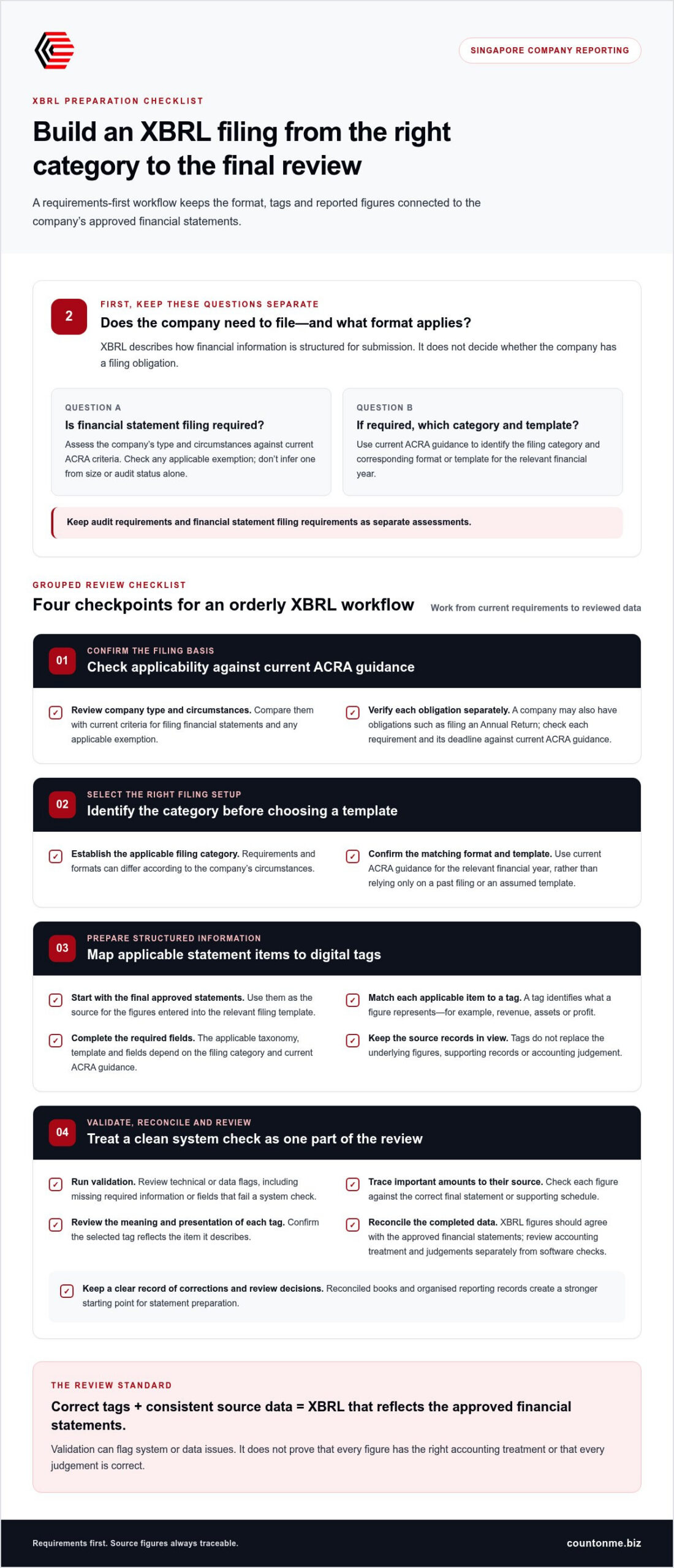
A clear workflow helps xbrl companies keep filing preparation organised and reviewable. Assign someone to coordinate the steps, and use current ACRA guidance for your company’s filing category and template. Requirements can differ, so don’t rely on a past filing or an assumed template as your only reference.
- Verify applicability. Check your company’s circumstances against current ACRA guidance, including relevant filing obligations or exemptions.
- Identify the template. Confirm the applicable filing category and template before entering data.
- Organise the source documents. Gather the final financial statements and reconciled accounting records that support their figures.
- Prepare the information. Work through the relevant tags and required fields in the current template, using ACRA’s preparation guidance when needed.
- Validate the submission. Review system messages and resolve issues using the relevant official guidance and preparation resources.
- Review and retain. Compare the completed data with the final statements, record corrections and keep the reviewed version with its source documents.
What should finance teams gather before preparing an XBRL filing?
Start with the final financial statements, not a working draft, and keep reconciled accounting records available to explain the figures. Then identify the company information and filing details requested by the applicable template. Assign a preparer to complete the data and a reviewer to check it. Recording questions, changes and decisions as they arise makes handovers clearer and helps the reviewer focus on unresolved items.
How can teams review XBRL data before submission?
Compare key tagged balances and totals with the approved statements, including figures that affect the overall presentation. Check that validation messages have been considered, but don’t treat a successful system check as proof that every tag or accounting judgement is correct. Keep a simple review record showing corrections made, who reviewed the data and which version was approved for submission.
For a small team, coordinating financial reporting with annual company compliance can also clarify responsibilities. Count On Me’s corporate secretarial services support statutory registers and Annual Return work alongside the finance workflow. Corporate secretarial services can help organise these responsibilities.
Explore corporate secretarial support
Make XBRL reporting more manageable with organised finance support
XBRL preparation is easier to review when the underlying records are in order. Reconciled books, clearly labelled schedules and well-organised financial statements help a team trace reported figures to their source instead of searching across spreadsheets and email threads. That groundwork won’t determine the filing category or replace ACRA guidance, but it can make preparation and follow-up more structured for xbrl companies.
How does cloud bookkeeping support reporting readiness?
Regular reconciliation helps identify unexplained differences in accounts before financial statements are prepared. Keeping ledgers and supporting records organised also gives reviewers a clearer path from a statement figure to the transactions behind it. A consistent routine makes questions easier to resolve and reduces the scramble to assemble information at reporting time. Count On Me’s cloud-based bookkeeping includes regular account reconciliation and financial statement preparation.
For SMEs, accounting and compliance services bring relevant finance and company compliance work into a more coordinated workflow. The practical aim is to keep records and responsibilities clear so the team can focus its review on the figures and decisions that need attention.
When can external accounting or compliance support help?
Extra support can help when a small team has limited capacity, records have become difficult to reconcile, or no one is clearly responsible for checking completed reporting data. A bookkeeping routine can help maintain organised ledgers and prepare financial statements; corporate secretarial support can assist with statutory registers and Annual Return work. These are related but distinct responsibilities, so define who owns each task and how information is handed over.
Before a reporting cycle, agree on who maintains the records, who prepares the statements, who reviews them and where final versions are stored. This division of work makes it easier to track questions and keep the reporting process reviewable. It also gives a stretched team a clearer view of which tasks it can manage internally and where additional support would help.
Count On Me provides accounting and corporate compliance support to help your team organise its finance workflow.
Discuss your finance workflow
Build a steadier reporting routine
For xbrl companies, the next step is to make reporting readiness part of the regular finance routine, not a task that begins under pressure. Set clear ownership for maintaining records, preparing statements and reviewing figures. Keep the process aligned with current ACRA guidance, and make sure everyone involved knows where to find the latest supporting documents.
If your team is stretched, coordinated accounting and compliance support can help keep responsibilities connected. Count On Me’s cloud bookkeeping includes regular account reconciliation and financial statement preparation, while its corporate secretarial services support statutory registers and Annual Returns. Count On Me was founded by professionals with over 20 years of industry experience and supports Singapore SMEs with practical finance and compliance needs, with attention to the details that make records easier to review.
A consistent workflow gives your business a stronger foundation for future reporting cycles. You don’t have to solve every process challenge at once. Start by identifying the task that most often slows your team down, then build from there.
Frequently Asked Questions
Do all Singapore companies have to file financial statements in XBRL?
No. Most locally incorporated companies must file financial statements in XBRL, but obligations depend on the entity type and circumstances. A solvent exempt private company that qualifies not to file financial statements has no XBRL filing obligation. A dormant company with no accounting transactions during the financial year may also be exempt from filing statements, while still needing to file its Annual Return. Check current ACRA criteria before assuming all xbrl companies follow the same rule.
Is XBRL the same as filing a PDF of financial statements?
No. A PDF is a document designed for people to read, while XBRL uses tags that allow systems to identify and process individual financial data items. The applicable ACRA rules determine whether a company submits tagged data, a PDF, or a combination for its filing category. A PDF copy doesn’t automatically satisfy an XBRL requirement, and an XBRL filing doesn’t necessarily remove any separate document submission requirement.
How do I know which XBRL template my company needs?
Use current ACRA guidance to identify your company’s filing category and corresponding template. For simplified XBRL, the criteria describe a small company as meeting at least two of these three tests: annual revenue of S$10 million or less, total assets of S$10 million or less, and 50 or fewer employees. Verify the applicable criteria and template for your filing, since company circumstances and ACRA guidance determine what applies.
Can I prepare an XBRL filing using ACRA’s BizFinx tools?
Yes. ACRA provides the BizFinx Preparation Tool, a desktop application for preparing XBRL financial statements. Check ACRA’s current BizFinx resources for the applicable version and instructions before starting, as tool guidance can be updated. The tool supports preparation, but it doesn’t determine your filing category or make accounting judgements for you. You’ll still need to check that the information entered reflects the company’s final financial statements.
What happens if the XBRL data does not match the financial statements?
Pause and investigate the difference before submission. Trace the tagged figure to the relevant statement and supporting records, then check for a data-entry error, an incorrect tag or an outdated statement version. Don’t change a figure just to clear a validation message. Correct the underlying issue through the appropriate review process, rerun relevant checks, and retain a record of what changed and which version was reviewed.
Does XBRL replace a company’s financial statements?
No. XBRL is a way of structuring and submitting financial information, not a replacement for the financial statements or the accounting work behind them. The statements remain the source for the figures and should be approved through the company’s usual process. Whether a PDF or another document must also accompany the tagged data depends on the filing category and current ACRA requirements, so confirm the applicable submission instructions.