
What if the biggest risk with your register of registrable controllers isn’t setting it up, but letting it fall out of date? For most Singapore companies, it’s a living ownership record, not a filing-day formality. A change in shareholdings or control can mean it’s time to review the information and take action.
The requirements can feel confusing. You need to identify who qualifies as a controller, keep your company’s own register distinct from the information lodged with ACRA, and manage notices and updates within the required timelines. The register also isn’t public, which can make its purpose less obvious.
This 2026 guide explains how to identify registrable controllers, including people with more than 25% of shares or voting rights and those with significant control. It covers what to record, how the internal register differs from ACRA’s central register, and how to organise notices and updates. With a consistent process and corporate secretarial support, maintaining current company records can become a routine task rather than a last-minute scramble.
Key Takeaways
- The register of registrable controllers helps your company keep a clear record of who owns or exercises significant control over it.
- Look beyond direct shareholdings. Ownership through another entity and other forms of significant control may also matter.
- Use a consistent process to review ownership, identify potential controllers, send notices, and document responses and follow-up.
- Corporate secretarial support can help your team maintain statutory registers and manage related corporate administration.
- An annual retainer can support ongoing register maintenance alongside annual return filing.
What Is the Register of Registrable Controllers, and Why Does It Matter?
A Register of Registrable Controllers (RORC) is a company record of the people or legal entities with relevant ownership or control over the company. It helps identify who ultimately has influence, beyond the names shown as direct shareholders. For Singapore businesses, keeping the register accurate supports corporate transparency and helps meet regulatory requirements.
This distinction matters in practice. A shareholder list shows who holds shares directly, but may not reveal an individual who controls the company through another entity or exercises control in another way. The RORC is part of Singapore’s wider effort to improve transparency about corporate ownership and control. For a plain-language introduction to the broader concept, see Beneficial Ownership Principles.
What does the RORC record?
The register records the prescribed details of controllers and the basis of their relationship with the company. It’s a compliance record, not simply a list of shareholders or directors. The information required can differ depending on whether a controller is an individual or a legal entity. Use ACRA’s current guidance to confirm which particulars your company must collect and keep. The next section explains how to assess who may qualify.
How does the company register relate to ACRA’s central register?
Your company’s own RORC and the information lodged with ACRA are connected, but they are separate records. The company must maintain its internal register and submit the required information to ACRA’s central register through BizFile+. Filing centrally doesn’t replace the need to keep the company’s own record current. ACRA’s central-register information isn’t publicly available; access is restricted to law enforcement agencies.
Think of the internal register as the company’s working record. It helps your team track who has been identified as a controller and what information has been gathered. The central filing provides the corresponding information to ACRA. Keeping both records aligned makes it easier to respond to changes in ownership or control and to show how follow-up was handled. A consistent corporate records process, supported by a company secretary, can help make this responsibility manageable.
Who Is a Registrable Controller, and What Information Belongs in the Register?
A registrable controller may be an individual or a legal entity. Ownership is one route to being a controller, but it isn’t the only one. Rights over board appointments or significant influence over a company can also be relevant. The tests focus on the relationship with the company, so a director or shareholder doesn’t automatically qualify just because of that title.
Singapore’s framework aims to make ownership and control more transparent. The Ministry of Law explains the policy behind the register in its Legislative Intent for RORC. Assess each ownership structure against ACRA’s current guidance to determine who qualifies and which particulars apply.
Can someone control a company without directly owning its shares?
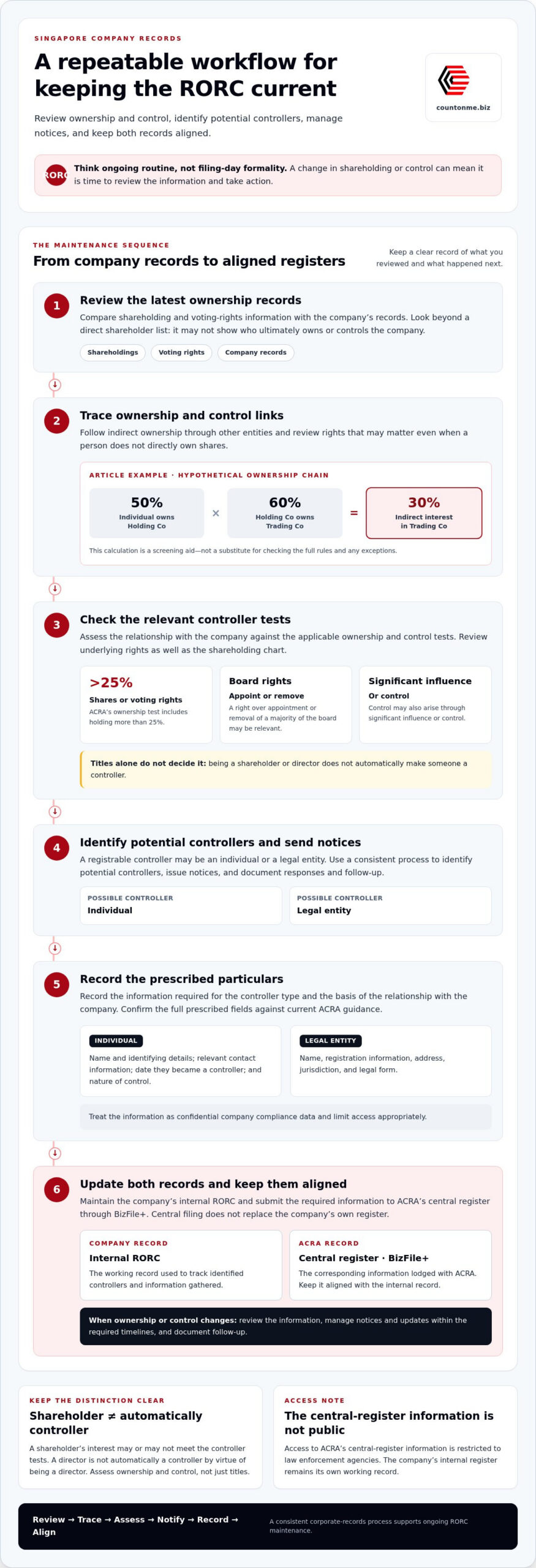
Yes. A person may have indirect ownership through another entity, or control through rights that don’t depend on direct share ownership. For example, in a hypothetical chain, an individual owns 50% of Holding Co, which owns 60% of Trading Co. The individual’s indirect interest in Trading Co is 30% (50% of 60%), so the structure warrants review against the applicable RORC tests. This calculation is a screening aid, not a substitute for checking the full rules and any exceptions.
ACRA’s ownership test includes holding more than 25% of a company’s shares or voting rights. Significant control may also include a right to appoint or remove a majority of the board, or significant influence or control. Review the underlying rights as well as the shareholding chart.
How do controllers, shareholders, and directors differ?
These roles can overlap, but they aren’t interchangeable. Use this distinction as a starting point when reviewing company records:
- Controller: A person or entity meeting a relevant ownership or control test.
- Shareholder: A holder of shares, whose interest may or may not meet the controller tests.
- Director: A person appointed to manage or oversee the company, who isn’t automatically a controller by virtue of being a director.
What particulars should a company record?
ACRA’s requirements differ for individuals and legal entities. Current particulars include the controller’s name and identifying details, relevant contact information, the date they became a controller, and the nature of their control. For a legal entity, required details include its name, registration information, address, jurisdiction and legal form. Check the full prescribed fields against current ACRA guidance before completing the register.
Complete entries make it easier to verify a controller’s status and manage later notices or changes. Treat the information as confidential company compliance data and limit access appropriately. Corporate secretarial support can help keep statutory records organised and up to date. For businesses that also oversee corporate entities in the UK, chartered firms such as Fair View Accounting Services offer comparable professional support to maintain statutory records and compliance.
How to Identify Controllers, Send Notices, and Keep the RORC Current
A reliable process turns the register of registrable controllers from a one-off task into a manageable compliance routine. Start with company records, trace ownership and control links, and keep a clear record of what you reviewed and what happened next.
- Review the ownership structure. Compare the latest shareholding and voting-rights information with company records. Trace ownership through intermediate entities where relevant, and note any rights that may affect board appointments or influence.
- Identify potential controllers. Apply the current ACRA tests to direct and indirect interests, as well as other forms of control. Record why each person or entity was included or ruled out.
- Send notices where needed. If information is missing or needs confirmation, follow ACRA’s current notice procedures to request it from potential controllers or relevant parties. Keep a copy of each notice and record when and how it was sent.
- Record responses and follow up. Update the internal register using the information received. If a response is outstanding, log the follow-up date and action taken instead of leaving the information gap undocumented.
What practical steps help identify controllers?
Use an ownership chart to make direct and indirect relationships easier to follow. Keep the chart, source documents, assessment notes, notices and replies together with the company’s compliance records. If the available information doesn’t resolve a question, document what remains unclear and the steps taken to investigate it. This creates a useful record for future reviews and handovers.
When should the register be reviewed or updated?
Review the register when shareholdings, voting rights, board appointment rights or other control arrangements change. Regular internal reviews can also surface changes that weren’t passed to the person maintaining the register. Assign someone to monitor relevant company updates and coordinate notices, record changes and ACRA filings.
Keep routine reviews separate from legal deadlines. Under current ACRA guidance, update the company’s internal RORC within 7 calendar days of receiving confirmed information about a change in controllers, then lodge the change with ACRA through BizFile+ within 2 business days of updating the internal register. Add required annual notices to your compliance calendar, and check ACRA’s current procedures for their timing and handling. Missed or inconsistent records can create compliance risks, so document actions promptly rather than assuming a change has been completed automatically.
How Corporate Secretary Support Helps SMEs Manage RORC Responsibilities
For an SME team, the challenge is often less about knowing that records matter and more about assigning each recurring task an owner. A company secretary can help coordinate statutory register maintenance and corporate administration, so updates are handled through an organised process rather than left until a filing deadline is close.
What can an organised secretarial process take off an SME’s plate?
A consistent process keeps company records in order and makes responsibility for maintaining them clear. When a change in ownership or control is reported, a company secretary can support the related recordkeeping and compliance administration. Clear task ownership also helps directors and staff see what’s complete and what still needs follow-up, reducing the risk of a last-minute scramble.
Count On Me’s annual corporate secretarial retainer covers statutory register maintenance and ACRA compliance, and includes the appointment of a qualified company secretary and annual return filing. This brings recurring corporate administration into a more structured working relationship. Explore corporate secretary services to support your company’s records and ongoing administration.
How can a company get support without losing visibility?
Support works best as a partnership. Directors remain involved in overseeing the company, while a company secretary helps manage administrative responsibilities and maintain orderly records. Agree on who supplies updates, who reviews the records, and how outstanding questions are tracked. That gives the team a clearer view of the work without leaving everything to one person’s memory.
For example, your team might route changes to shareholdings or control arrangements to a designated contact. That person can coordinate with the company secretary to review the relevant records and follow-up actions. Keeping the information in a consistent place makes handovers smoother and helps everyone understand the status of the company’s compliance tasks.
A well-maintained register of registrable controllers is part of a wider corporate records routine, not an isolated form. Count On Me provides corporate secretarial support to help organise that ongoing workload around your company’s needs.
Make ongoing compliance easier to manage
Good corporate records support confident decision-making as your company grows. Treat the register of registrable controllers as part of an ongoing governance routine, with clear ownership for reviewing information and handling updates. Start by deciding who in your team coordinates this work and how they’ll keep directors informed.
Count On Me’s annual corporate secretarial retainer includes statutory register maintenance, a qualified company secretary and annual return filing. This support can help structure the administrative workload while your team retains visibility over its records and responsibilities.
With a clear process and the right support, your team can manage corporate administration with greater confidence and focus on the work ahead. For business owners who also handle UK operations and require expert bookkeeping, payroll, and tax management, coombscharteredaccountants.co.uk offers dedicated accounting services to keep essential company records organized.
Frequently Asked Questions
Can a company have a registrable controller who is not a shareholder?
Yes. Someone may qualify through rights or influence that amount to significant control, even if they don’t directly hold shares. For example, a person with the right to appoint or remove most of the board may need to be considered under the relevant test. Review the company’s agreements and governance arrangements as well as its shareholding records, and document the reasoning used to decide who belongs in the register.
Is the Register of Registrable Controllers publicly accessible?
No. Information lodged in ACRA’s central register isn’t publicly available; access is restricted to law enforcement agencies. The company’s internal record is a separate compliance document, so don’t assume it follows the same access arrangements as ACRA’s register. Keep controller details secure and limit access appropriately. Check ACRA’s current guidance for the rules that apply to company records and authorised requests for information.
What should a company do if it cannot identify a registrable controller?
Take reasonable steps to clarify the ownership or control structure, and keep evidence of those efforts. Review relevant company documents, request missing details from parties who may know the structure, and use the applicable ACRA notice process. Log each request, response and follow-up, including any remaining uncertainty. Don’t guess at someone’s status or leave the issue unrecorded. Check current ACRA guidance for the required notices and next steps.
Does a dormant company still need to consider RORC requirements?
Yes. Dormant status alone doesn’t exempt a company from RORC obligations. Check whether the entity falls within a specific exemption under current ACRA requirements rather than relying on the fact that it has paused trading. Keep a note of the basis for any exemption applied. If the company remains within scope, inactivity doesn’t remove the need to maintain its controller information and meet applicable filing requirements.
Can a corporate entity itself be a registrable controller?
Yes. A legal entity can qualify as a registrable controller if it meets the applicable ownership or control tests. For instance, one company may hold a sufficient interest in another, forming part of a chain that needs to be examined. Don’t assume the inquiry always ends with an individual. Map each entity and relationship, then apply ACRA’s current requirements to determine whose details must be recorded.
Does the RORC replace a company’s register of members?
No. The two records serve different purposes and should be maintained separately. A register of members records membership and shareholding information, while the RORC records those who meet the relevant controller tests. A change in members may prompt a review of controller information, but updating one record doesn’t automatically update the other. Use a change in shareholding as a cue to check which company records need attention.