

The 50-member limit is only one part of understanding ownership in a Singapore private limited company. The Companies Act doesn’t automatically require a company to offer new shares to existing shareholders first, so pre-emptive rights usually depend on the company’s constitution or shareholders’ agreement. This guide to shareholder rights in a Singapore private limited company explains how that protection works alongside voting and ownership limits.
If you’re unsure whether you can influence a decision, protect your ownership percentage or receive a dividend, the answer often depends on the shares you hold and the company’s governing documents. Understanding where the rules come from helps you see what you can vote on and when approval is required.
Read on to learn how shareholder voting, director appointments and removals, dividends, pre-emptive rights and the 50-shareholder cap work in practice. We’ll clarify the key distinctions so you can make sense of your rights as the company grows or considers issuing shares.
Key Takeaways
- Check the company constitution to understand how voting rights work and what approvals are needed for key decisions.
- Know when shareholders can propose resolutions or vote on director appointments and removals.
- A dividend isn’t automatic: understand how the company decides whether to distribute profits and declare one.
- Pre-emptive rights can help protect your ownership percentage, but they generally need to be set out in the company’s governing documents.
- Plan for the 50-member limit when considering new shareholders, and understand how issuing shares may affect existing ownership.
Shareholder voting and director appointments or removals
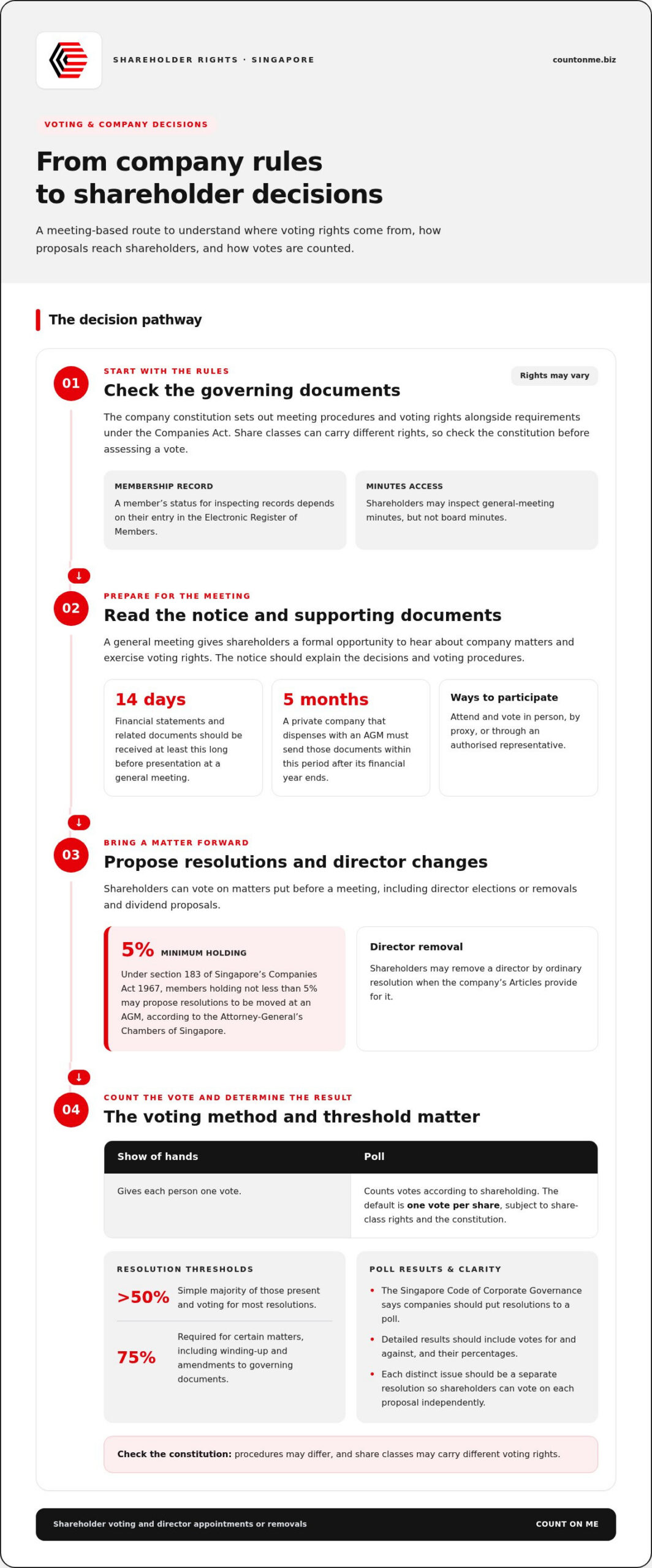
Shareholders influence company decisions by attending meetings, voting and making proposals. The company constitution sets out the procedures, alongside requirements under the Companies Act.
Participation at General Meetings
A general meeting gives shareholders a formal opportunity to hear about company matters and exercise their voting rights. You may attend and vote in person, by proxy or through an authorised representative. The notice should explain the matters for decision and voting procedures, giving shareholders time to prepare questions and consider how each resolution could affect the company’s assets or direction.
To inspect records, a member’s status depends on their entry in the Electronic Register of Members. Shareholders may inspect general-meeting minutes, but not board minutes. They should also receive financial statements and related documents at least 14 days before presentation at a general meeting; a private company that dispenses with an annual general meeting must send these documents within 5 months after its financial year ends.
Voting on Resolutions and Director Changes
Voting on resolutions lets shareholders decide matters put before a meeting, including director elections or removals and dividend proposals. Most resolutions require a simple majority of more than 50% of those present and voting. Certain matters, including winding-up and amendments to governing documents, require a 75% majority. Check the constitution because it can set procedures and share classes may carry different rights.
Shareholders may remove a director by ordinary resolution when the company’s Articles provide for it. Under section 183 of Singapore’s Companies Act 1967, members holding not less than 5% may propose resolutions to be moved at an annual general meeting, according to Attorney-General’s Chambers of Singapore. This gives qualifying members a route to put a matter before shareholders rather than relying only on board-led agenda items.
Poll Voting and Results
A poll counts votes according to shareholding, rather than giving each person one vote as a show of hands does. Shareholders may have rights to propose resolutions at an annual general meeting, subject to applicable requirements. This can clarify an inconclusive show of hands and show how much voting power supports a resolution.
For a poll, the default is one vote per share, subject to the rights attached to each share class and the company constitution. The Singapore Code of Corporate Governance says companies should put resolutions to a poll and announce detailed results, including votes for and against and their percentages. Each distinct issue should be dealt with in a separate resolution, so shareholders can vote on each proposal independently.
Dividends and declaration of final dividends
A dividend is a distribution of company profits, not an automatic return on every share. Whether shareholders receive one depends on the company’s decision to distribute profits and the rights attached to their shares.
Dividend Entitlements
A shareholder’s dividend entitlement depends on the distribution declared and the rights attached to the relevant share class. Shareholders may pass an ordinary resolution to declare a dividend, but a company may distribute dividends only if it has profits and decides to do so. A profitable year alone doesn’t guarantee a payment or establish an individual shareholder’s entitlement.
Preference shares can have different dividend terms from ordinary shares, and the Companies Act requires those terms to appear in the company constitution. Review the constitution alongside the resolution. Together, they show which holders qualify, how the amount is allocated and whether preference shares have priority under the stated terms.
A final dividend is a proposed distribution for shareholders to approve by ordinary resolution. The resolution and supporting company documents should clearly describe the proposed payment. Keep the approved decision with the company’s records to distinguish the authorised amount from profits retained as working capital or reserved for business needs.
Dividends are different from returns affected by changes in share ownership. Issuing additional shares can dilute an existing holder’s ownership percentage, while a dividend distributes profits without changing the number of shares held. Pre-emption rights may protect against dilution from new share issues if the company constitution or shareholders’ agreement provides for them.
Dividend Policy and Disclosures
A dividend policy explains how the company approaches distributions and communicates its decisions to shareholders. Guideline 15.5 of the Singapore Code of Corporate Governance encourages companies to adopt a policy, share it with shareholders and explain when dividends aren’t paid. This helps holders compare the company’s stated approach with its annual decisions.
Review the dividend policy alongside the financial statements, meeting documents and resolution. For example, a company may explain that it is retaining profits for business needs rather than declaring a dividend. That explanation helps shareholders understand the decision, but the policy itself doesn’t guarantee a payment.
Tax treatment is separate from corporate approval. Don’t infer an individual shareholder’s tax position from the dividend resolution alone. Consider the recipient’s circumstances and retain the distribution documents for accurate records. Recording the declaration, share class and payment supports later accounting and tax review.
Careful administration matters when a company approves a distribution or explains why it will retain profits. Corporate Secretary Services can support the company’s governance administration and its records of shareholder decisions.
What Are Pre-Emptive Rights?
Pre-emptive rights give existing shareholders an opportunity to buy new shares before the company offers them elsewhere. In Singapore, these rights aren’t automatic under the Companies Act 1967. The company constitution or a shareholders’ agreement must establish them, so the wording determines how members can preserve their ownership percentage. A useful guide to shareholder rights in a Singapore private limited company explains how these documents interact before a new share issue.
The distinction matters when directors propose issuing shares to raise capital. Under Section 161 of the Companies Act 1967, directors need prior shareholder approval at a general meeting to allot new shares. That approval requirement doesn’t, by itself, require an offer to existing shareholders. A pre-emption clause supplies that separate protection and sets out how eligible members can respond.
Company Constitution and the Companies Act
The Companies Act provides the common statutory framework, while the constitution sets the company’s individual rules. Under section 39(1), the constitution operates as a statutory deemed contract between the company and its members. Check it for who receives an offer, how acceptance works, and what happens to shares not taken up. These details affect how the right works in practice.
A typical new-issue clause gives shareholders 14-30 days to exercise their rights. Its process may set out the offer notice, allocation between members, response deadline and treatment of any remaining shares. If a holder doesn’t accept within the stated window, the clause may allow the company to offer those shares elsewhere, subject to its terms.
Aligning the Constitution and Shareholders’ Agreement
A shareholders’ agreement can set detailed commitments between its parties, but it can’t override company law. The Singapore High Court decision in BTY v BUA confirmed this principle. Compare the agreement with the constitution before an issue arises, especially if they set different notice periods, allocation methods or approval procedures.
For example, the constitution might require shares to be offered to all existing members, while an agreement gives participation rights only to certain signatories. This difference can create uncertainty about who may exercise a right. A guide to shareholder rights in a Singapore private limited company should account for such differences: a right set out in one document may not resolve conflicting terms in another.
Changing Pre-Emption Terms
Changing the constitution requires a special resolution, which typically needs 75% approval. Once passed, the company must file the constitutional amendment with ACRA within 14 days. Members should review the proposed wording and its effect on future issues before voting, since removing or narrowing a clause can alter how new shares affect ownership.
Don’t confuse pre-emption rights on new share issues with a right of first refusal on a share transfer. A right of first refusal typically lets existing shareholders buy a departing member’s shares at the same price as a third-party offer. Both rights can appear in company documents, but they apply to different transactions and need clear, separate terms.
Private limited company shareholder limit
A Singapore private company limited by shares can have 1-50 members. The 50-member ceiling shapes how the company brings in investors, transfers shares and records ownership as it grows.
Shares may be transferred subject to the company constitution and any applicable shareholders’ agreement. A right of first refusal commonly gives existing shareholders the chance to buy at the same price as a third-party offer. The transfer becomes official only after ACRA updates the company’s Electronic Register of Members.
The limit concerns members, not simply the number of people with an economic interest. Individuals and corporate entities may hold shares. A person becomes a member when their name appears in the Electronic Register of Members, while a beneficial owner may hold the economic interest through a nominee registered as the member.
This distinction matters when a new investor joins. For example, a beneficial owner behind an existing nominee arrangement may not appear as a separate registered member. Before completing a transfer or share issue, the company should assess the proposed ownership arrangement and identify who will be entered as the member.
Consider the member count before approving a transaction. A transfer to a new registered holder may change the count, while a transfer between existing members generally changes the ownership allocation without adding a member. Company records should reflect the registered holders and the shares attributed to each.
Restrictions can affect a transfer even when the buyer and seller agree. The constitution may require the seller to offer shares to existing members first or set out how the offer is allocated. A shareholders’ agreement may add contractual steps for its parties. Read both documents together, because different notice or acceptance terms can complicate the transaction.
A transaction also brings filing obligations. A Singapore company must file a share transfer with ACRA, and the change takes effect only when ACRA updates the Electronic Register of Members. Until then, the buyer should not assume they are the registered member for company purposes, including participation at general meetings.
Before accepting an investor or approving a transfer, consider who will be registered, how many members the company will have afterward, and whether the constitution or shareholders’ agreement restricts the transaction. These checks help founders understand the effect on ownership and voting before taking action.
The practical takeaway is clear: track registered membership as carefully as share ownership. A company approaching the 50-member limit should assess proposed transfers and new issues before completion, because the member count affects whether the private-company structure remains within its limit.
Get support with corporate secretary services
Count On Me: Cloud Accounting & Bookkeeping
Count On Me supports Singapore businesses with the financial and governance work surrounding shareholder decisions. Its Cloud Accounting & Bookkeeping service helps keep company records organised, while Tax Compliance & Advice supports tax matters as the business distributes profits or plans its finances.
For shareholder resolutions, share transfers or updates to company records, Corporate Secretary Services can support corporate administration. Payroll Management Solutions can also help businesses manage employee payroll alongside their other finance responsibilities.
If your company is preparing for a dividend decision, issuing shares or updating ownership records, Count On Me’s services can help keep related finance and administrative work in view. Contact Count On Me to discuss support for your business.
Make Shareholder Governance Part of Your Growth Plan
Ownership arrangements work best when they keep pace with the business. As plans change, revisit how decisions are recorded, how financial information reaches shareholders and whether the company’s governing documents still reflect how its owners work together. These habits can help founders and investors address differences early and make future decisions with clearer expectations.
Use this guide to shareholder rights in a Singapore private limited company as a starting point for those conversations, then consider which records and processes need attention. Count On Me offers Cloud Accounting & Bookkeeping, Payroll Management Solutions and Tax Compliance & Advice to support the financial work that accompanies business decisions.
Clear records and open communication give your company a stronger foundation for its next stage.
Frequently Asked Questions
What is a Private Limited Company?
A private limited company is a share-capital company whose members’ liability is limited to the amount unpaid on their shares. In Singapore, it can have between 1 and 50 members, including individuals or corporate entities. Ownership is divided into shares, while membership is recorded separately in the Electronic Register of Members. A company limited by guarantee is different: it has members but no shareholders or share capital.
What rights do shareholders have in a Singapore private limited company under the Companies Act?
Shareholders’ rights come from the Companies Act and the company constitution. Depending on their share class and the constitution, members may vote at general meetings, receive declared dividends and access records such as general-meeting minutes. A guide to shareholder rights in a Singapore private limited company should distinguish registered membership from beneficial ownership: a nominee may appear in the register while another person holds the economic interest.
What voting rights and voting thresholds apply to ordinary and special resolutions in Singapore?
An ordinary resolution generally needs more than 50% of votes cast by members present and voting, while a special resolution generally requires 75% approval. For example, if 10 votes are cast, an ordinary resolution needs more than five votes in favour. The constitution and share class can affect how votes are counted. Read the meeting notice carefully to identify the exact proposal and whether votes attach differently to particular shares.
What rights do shareholders have to dividends, and how are dividends declared in Singapore?
Shareholders may receive dividends when the company has profits and decides to distribute them. An ordinary resolution can declare a dividend, but share ownership alone doesn’t guarantee payment. Check the resolution and constitution for the relevant share-class terms and distribution details. Treasury shares don’t receive dividends. Keep the declaration and payment records with the company’s financial documents to distinguish an approved distribution from profits retained in the business.
How can minority shareholders challenge oppression or unfairly prejudicial conduct in Singapore?
Section 216 of Singapore’s Companies Act provides a route for members to seek relief for oppressive conduct affecting their interests. The High Court may order a buy-out of an aggrieved minority shareholder’s stake or order the company to be wound up. The statutory derivative procedure under section 216A is a separate route that may address wrongs done to the company. The appropriate remedy depends on the nature of the conduct and the relief sought.
What rights do shareholders have when new shares are issued, including pre-emption rights?
Existing shareholders don’t automatically have a statutory right to buy new shares before outsiders. Under Section 161 of the Companies Act 1967, directors need prior shareholder approval at a general meeting to allot shares. Pre-emption protection must be set out in the constitution or a shareholders’ agreement. For a guide to shareholder rights in a Singapore private limited company, check those documents for who receives an offer, how long they have to respond and how untaken shares may be allocated.