
What if the problem isn’t that you need to work harder on your accounts, but that too much of your time is going into bookkeeping? The signs I need to outsource my accounting can be easy to miss at first: reconciliations slipping, records left incomplete, or financial updates arriving too late to guide decisions.
If accounting tasks keep interrupting customer work, planning, or business development, it’s reasonable to question whether your current setup still fits. You don’t have to hand over every finance decision to get support. The right arrangement can take routine work off your plate while keeping you involved and informed.
Use this practical checklist to identify when your accounting workload needs to change, compare outsourcing with other support options, and decide which tasks could be handled externally. You’ll also find questions to ask potential providers about scope, communication, and financial visibility, so you can choose a next step that fits your Singapore SME’s actual workload.
Key Takeaways
- Use the signs I need to outsource my accounting checklist to spot when bookkeeping backlogs and deadline pressure are affecting business priorities.
- Compare in-house, outsourced, and hybrid support against your SME’s workload, expertise needs, and preferred level of flexibility.
- List the tasks you may want help with, such as reconciliations, payroll, and tax support, before speaking with a provider.
- Prepare for a smoother transition by organising records, noting reporting needs, and agreeing on responsibilities and communication.
- Keep oversight of business decisions while considering professional support to improve your financial visibility.
Signs You May Need to Outsource Your Accounting: A Business Checklist
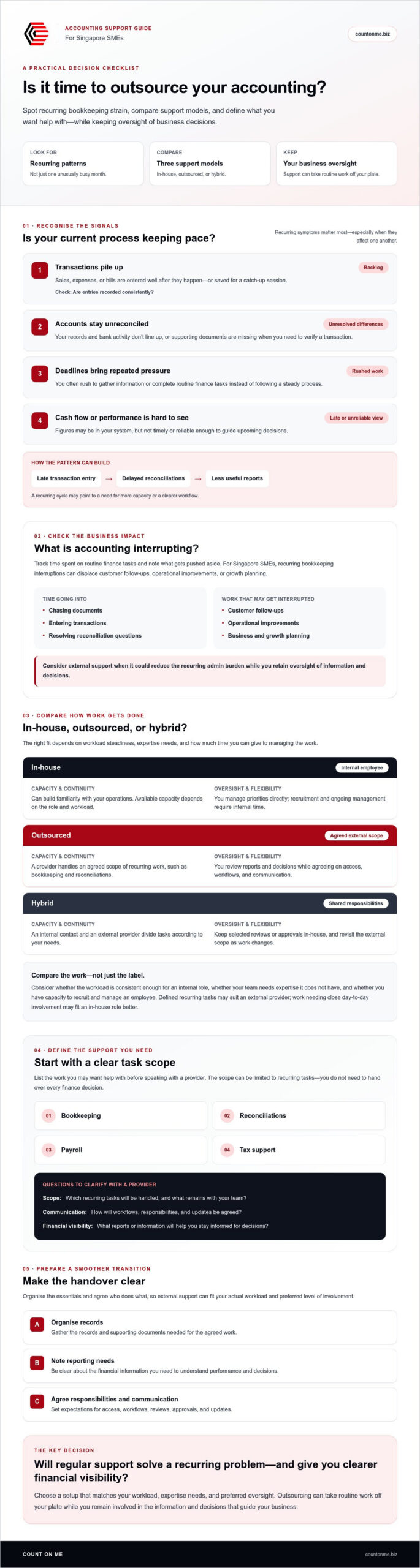
Are your books slipping behind as customer needs and daily decisions take up more of your attention? A busy period can happen to any business. The more telling signs I need to outsource my accounting are patterns that continue even after you’ve tried to catch up.
Use this checklist to assess whether your current process is keeping pace:
- Transactions regularly pile up. Sales, expenses, or bills are entered well after they happen, leaving a backlog to clear. Check whether entries are being recorded consistently or saved for a catch-up session.
- Accounts remain unreconciled. Differences between your records and bank activity stay unresolved, or supporting documents are missing when you need to verify a transaction.
- Deadlines create repeated pressure. You’re often rushing to gather information or complete routine finance tasks instead of following a steady process.
- Cash flow or performance is hard to see. Figures may be in your system, but they aren’t timely or reliable enough to help you understand what they mean for upcoming decisions.
One unusually busy month isn’t necessarily a reason to change your setup. Look for recurring symptoms, especially when they affect one another. For example, late transaction entry can delay reconciliations, which can then make it harder to prepare useful reports. That pattern may indicate a need for more capacity or a clearer workflow.
Are bookkeeping delays and errors becoming routine?
Late transaction entry can make it harder to spot missing receipts, duplicate entries, or unexpected account differences while the details are still easy to check. If each month starts with catch-up work, reports may describe past activity without giving you a useful view of current performance. Note when the backlog begins, which tasks are delayed, and whether the same gaps recur. That helps distinguish a temporary workload spike from a process that routinely falls behind.
Is accounting taking time away from running the business?
Track how much time you and your staff spend on routine finance tasks, including chasing documents, entering transactions, and resolving reconciliation questions. Then note what gets interrupted. For Singapore SMEs, recurring bookkeeping interruptions can push customer follow-ups, operational improvements, or growth planning down the list. Outsourcing may be worth considering when regular external support could reduce that admin burden while you retain oversight of the information and decisions.
Outsourcing is one way to organise a business function externally, as outlined in this overview of Business process outsourcing. For accounting, focus on the practical question: would support with regular bookkeeping and reconciliations address the problems that keep recurring in your business?
Outsourcing vs In-House Accounting: What Changes and What Stays Yours?
Choosing accounting support isn’t simply a choice between doing everything yourself and handing over the books. The right setup depends on how steady your workload is, what expertise you need, and how much time you can give to managing the work. Compare the options against your actual needs rather than assuming one model suits every Singapore SME.
| Delivery model | Capacity and continuity | Oversight and flexibility |
|---|---|---|
| In-house | An employee can build familiarity with your operations. Available capacity depends on their role and workload. | You can manage priorities directly, while recruitment and ongoing management require internal time. |
| Outsourced | An external provider handles an agreed scope of recurring work, such as bookkeeping and reconciliations. | You review reports and decisions while agreeing on access, workflows, and communication. |
| Hybrid | An internal contact and an external provider divide tasks according to your needs. | You keep selected reviews or approvals in-house and can revisit the external scope as work changes. |
When does outsourcing make more sense than hiring?
Consider whether the workload is consistent enough to support an internal role, whether you need expertise that isn’t available in your team, and whether you have capacity to recruit and manage an employee. An external provider may suit a defined set of recurring tasks, while an in-house hire may be a better fit for work that needs close, day-to-day involvement. Professional firms like CTC Tax & Accounting, for instance, offer structured support spanning bookkeeping, tax compliance, and advisory services that scale with operational demands. Compare the responsibilities, coordination, and management time each option requires, not just the tasks completed.
Can a hybrid accounting setup give you more control?
Yes. A provider could handle recurring bookkeeping while you or an internal contact reviews financial statements, clarifies unusual transactions, and makes business decisions. Cloud-based workflows can make sharing records and reviewing information easier, but agree on access permissions and responsibilities first. For more detail on cloud accounting and bookkeeping services, review the service information and consider which tasks fit your workload.
Control also depends on documented processes. Agree how questions will be raised, who checks completed work, and how often you’ll review reports. Outsourcing routine tasks doesn’t remove your role in understanding the financial information or deciding what actions to take.
The signs I need to outsource my accounting may point to a full external setup or targeted help with specific tasks. A clear division of responsibilities lets you get support while staying informed and involved.
Is Your SME Ready to Outsource Accounting?
Once you’ve identified recurring pressure points, use a simple process to decide what support would actually help. A practical readiness test is this: If essential accounting tasks recur but remain delayed, unclear, or difficult to manage internally, define what support you need.
- Map the tasks. List what’s handled now and by whom: bookkeeping, reconciliations, financial statements, payroll, tax support, and any advisory needs.
- Identify the pain points. Mark where work gets delayed, information is missing, or no one is sure who should follow up.
- Set the scope. Decide which recurring tasks you want external help with and which reviews or approvals should stay with you or your team.
- Evaluate providers. Compare how each provider handles the work, communicates, and supports your reporting needs.
Before approaching providers, review your transaction volume, the reports you use to make decisions, and how often you need updates. Note any recurring backlogs or tasks that depend on one person’s knowledge. These details help you describe the work clearly instead of choosing a broad package that may not fit.
What accounting tasks should you include in the brief?
Separate routine bookkeeping and reconciliations from payroll, tax compliance, and advisory requirements. Note what your team handles now, where delays occur, and which figures or tasks are difficult to interpret. If you’re building finance processes as a founder, the startup accounting mistakes guide offers related early-stage context.
- Bookkeeping: transaction entry and supporting records
- Reconciliations: checking account activity against your records
- Statements: preparing regular financial statements
- Payroll and tax: the specific support your business requires
What should you ask a potential accounting provider?
Ask what the proposed scope includes, how often you’ll receive reports, and how records and questions will be handed over. Clarify who you’ll communicate with, how urgent or unresolved issues are escalated, how cloud workflows and information access are managed, and who reviews completed work. Ask about experience relevant to your business needs, and confirm which services are included rather than assuming every provider offers the same support—advisory practices like Stewart Private Accounting, for example, demonstrate how firms can integrate specialised tax guidance with general reporting. It can also help to ask what information the provider needs from you to keep the agreed workflow moving.
Use the signs I need to outsource my accounting as a starting point, then assess each provider against your task list and priorities. A clear brief makes it easier to discuss a scope that matches your workload.
Explore accounting and bookkeeping services
Making the Switch: A Clear Next Step for Outsourced Accounting
A well-planned handover starts with a clear picture of what’s already in place. Your records don’t have to be perfectly organised before you explore support. Gathering key information helps you and a potential provider identify gaps, agree on priorities, and define a workable scope.
What information should you prepare for a handover?
Collect your current accounting records and relevant supporting documents, then list unresolved items, such as transactions awaiting clarification or reconciliation differences that still need review. Note which accounting software your business uses, but confirm access arrangements and any specific requirements directly with the provider.
Also identify who can approve access and answer questions about your existing finance processes. This might be you or a staff member familiar with how transactions are recorded and reviewed. Before work begins, agree on:
- Scope: Which tasks are included, and which remain with your team.
- Responsibilities: Who supplies documents, answers questions, and approves work.
- Review points: Which reports you’ll review and how you’ll raise discrepancies.
- Communication: How updates and outstanding questions will be shared.
Don’t assume there’s a standard transition timeline. Ask the provider what preparation is needed and how the handover will be managed for your particular records and workload.
How can outsourced support adapt as the business changes?
Your needs may shift as transaction volume, staffing, or reporting requirements change. Review the agreed scope periodically and discuss adjustments before new tasks become part of the workflow. For example, a business that needs regular bookkeeping now may later want to discuss payroll, tax compliance, or advisory support if those needs arise.
Count On Me provides cloud accounting and bookkeeping, including regular reconciliations and financial statements, alongside payroll management, tax compliance and advice, and on-demand CFO support. You can discuss how these services relate to your actual workload. Professional support can help with financial visibility, while you remain involved in reviewing information and making business decisions.
If the signs I need to outsource my accounting are becoming a recurring pattern, start with a focused conversation about your records, reporting needs, and preferred responsibilities. A clear scope can make the next step more manageable.
Explore accounting and business support services
Make Your Next Accounting Step With Confidence
The signs I need to outsource my accounting often show up as a pattern: records repeatedly falling behind, routine tasks taking attention from business priorities, or financial information that isn’t ready when you need it. One difficult month may pass, but recurring delays are worth addressing.
Start by listing the tasks that need support, where the current process gets stuck, and what you still want to review yourself. Then compare in-house, outsourced, and hybrid arrangements. Whichever model you choose, agree on responsibilities, reporting, access, and communication so you stay informed and retain oversight.
For Singapore SMEs, Count On Me provides cloud accounting and bookkeeping, including regular reconciliations and financial statements. The firm was founded by professionals with over 20 years of industry experience. You can discuss a service scope that reflects your business’s actual workload.
You don’t need to solve every finance-process challenge at once. A clear view of what’s working, what keeps recurring, and where support could help is a confident place to begin.
Frequently Asked Questions
What are the signs I need to outsource my accounting?
The clearest signs I need to outsource my accounting are recurring bookkeeping backlogs, delayed reconciliations, reports arriving too late to guide decisions, or finance tasks regularly interrupting core work. One busy period alone may not justify a change. If several problems persist despite a reasonable internal process, record what’s happening and how often. Then consider whether outside support could address those specific gaps.
When should a small business outsource bookkeeping?
Consider outsourcing bookkeeping when routine entries and reconciliations regularly fall behind, your team’s capacity is stretched, or records are difficult to use for management decisions. Start by identifying which tasks cause pressure and how often delays occur. A clear picture of the workload helps you compare an external provider, an internal hire, or a hybrid arrangement based on your business’s needs rather than assumptions.
Is outsourcing accounting cheaper than hiring an accountant?
It depends on the work required, the capacity you need, and the resources involved in managing each arrangement. Compare scope and service levels, not just quoted fees. Include internal management time, recruitment, software, and review responsibilities in your assessment. Ask providers for a clear breakdown of what’s included, then compare it with the responsibilities and costs of an internal role. Outsourcing won’t always cost less.
Can I outsource accounting and still control my business finances?
Yes. Outsourcing routine accounting work doesn’t mean giving up oversight of your business finances. Agree who can access records, who reviews reports, and who approves payments or business decisions. Keep communication and review processes clear, and document what the provider handles versus what remains with your team. You remain responsible for understanding the financial information and using it to guide decisions.
What accounting tasks can a Singapore SME outsource?
Depending on the provider and agreed scope, a Singapore SME may outsource bookkeeping, reconciliations, financial statement preparation, payroll management, or tax compliance support. Services vary, so confirm what’s included and who is responsible for each task before work begins. Don’t assume statutory audit services are part of a general accounting arrangement. Check that the proposed support matches your needs and clarifies any work that remains internal.
How do I choose an accounting outsourcing provider?
Choose a provider by first listing your tasks, reporting needs, and current pain points. Ask about relevant experience, service scope, handover steps, communication, cloud workflows, and who reviews completed work. Clarify how information is accessed and how unresolved questions are escalated. Then compare proposals against the same criteria. A suitable arrangement is one that clearly matches your business’s needs, not simply the one with the broadest promise.