

What if your quarterly tax deadline wasn’t a source of dread, but a clear window into your company’s financial health? We know that for many business owners, gst filing singapore feels like a high-stakes hurdle. Between the fear of a S$200 late filing penalty and the headache of separating input from output tax, it’s easy to feel overwhelmed by the complexity of IRAS e-services. You’ve likely spent too many late nights double-checking spreadsheets just to avoid a potential 200% penalty for a simple oversight.
We believe compliance should bring peace of mind, not a headache. In this guide, we’ll show you how to master the 2026 GST essentials and turn a mandatory chore into a strategic advantage. You’ll learn how to navigate the current 9% rate, understand the new InvoiceNow requirements for voluntary registrants, and maximize your input tax claims for faster refunds. We’re moving beyond manual data entry to explore how cloud automation ensures error-free returns and optimized cash flow, giving you the stability to focus on growth. Together, we can transform your tax obligations into a streamlined process that supports your long-term success.
Key Takeaways
- Identify if your business meets the S$1 million compulsory registration threshold to stay ahead of your mandatory tax obligations.
- Learn how to navigate the IRAS myTax Portal efficiently by setting up the correct Corppass authorizations for a seamless submission process.
- Discover how to avoid costly penalties and common errors during gst filing singapore, such as claiming input tax on non-deductible expenses.
- Explore how cloud-based accounting tools automate GST calculations on every invoice, saving you time and reducing manual entry errors.
- Shift your perspective from viewing compliance as a hurdle to using real-time tax data as a strategic tool for optimizing your cash flow.
Understanding GST Filing Requirements in Singapore
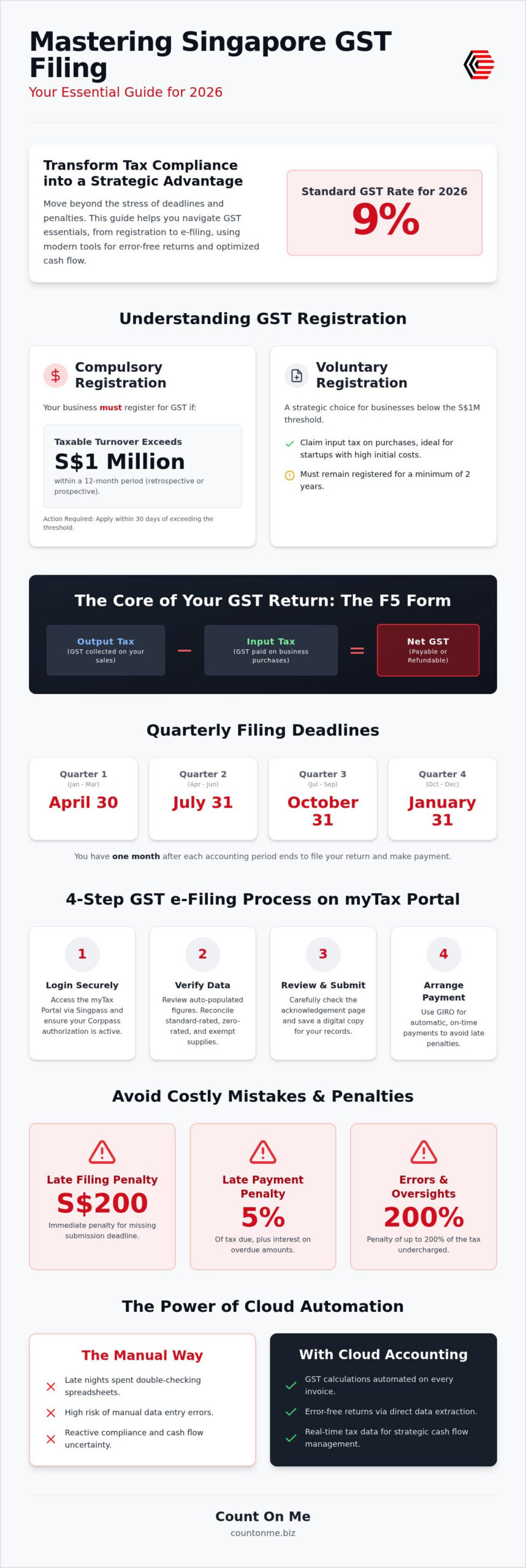
GST is a broad-based consumption tax applied to the import of goods and the supply of most goods and services. Since its inception, detailed in the History of GST in Singapore, the system has evolved to support the country’s economic growth. For 2026, the standard rate remains at 9%. The system makes gst filing singapore a regular part of your business rhythm, typically operating on a quarterly cycle. This means your accounting periods are broken down into three-month blocks; you’ll have one month following the end of each quarter to complete your submission.
Standard vs. Voluntary GST Registration
Compulsory registration is mandatory if your taxable turnover exceeds S$1 million at the end of any calendar year. You have 30 days to apply once you hit that limit. You’ll need to look at this from both a retrospective view, looking back at the past 12 months, and a prospective view, looking at the next 12 months. If your turnover is growing fast, it’s better to be proactive than to face penalties for late registration.
Deciding to register voluntarily is a strategic choice for businesses that haven’t hit the threshold yet. It allows you to claim input tax on your purchases, which is particularly useful for startups with high initial setup costs. Just keep in mind that once you register voluntarily, you’re committed for at least two years. Our tax compliance services Singapore can help you analyze your turnover and determine the most tax-efficient moment to register.
The GST F5 Return: Your Primary Filing Document
The GST F5 return is the central document for gst filing singapore. It’s a summary of your business’s tax activity over the accounting period. You’ll report your total sales, the output tax collected, and the input tax paid on business-related purchases. The math is simple: Output Tax minus Input Tax equals your Net GST. The difference between these two determines your “Net GST Payable” or “Refundable” status. If the result is positive, you pay IRAS; if it’s negative, you get a refund. This process is much smoother when you have a digital trail. Accurate bookkeeping isn’t just about following rules; it’s the foundation of a clean F5 that keeps your business running without interruptions.
Step-by-Step Guide to the GST e-Filing Process
The golden rule for gst filing singapore is simple: you have exactly one month after your accounting period ends to submit your return and pay any tax due. For the 2026 calendar year, this means your deadlines are April 30, July 31, October 31, and January 31, 2027. Missing these dates triggers an immediate S$200 penalty, so keeping a sharp eye on the calendar is your first step toward stress-free compliance. It’s also vital to ensure your Corppass authorization is active. This allows your team or tax agent to act on your behalf, turning a solo task into a collaborative effort.
Preparing Your Data for Submission
Before you even log into the portal, your data needs to be airtight. You’ll need to reconcile your standard-rated supplies (currently at 9%) against zero-rated and exempted supplies. Every transaction must be backed by a tax invoice that meets IRAS standards. If you’re still using manual spreadsheets, this is where errors often creep in. By leveraging cloud accounting services Singapore, you can automate data extraction and categorization. This ensures that the figures you’re reporting are pulled directly from your daily business activities, leaving no room for manual entry mistakes.
Executing the Filing on myTax Portal
The shift toward “Seamless Filing” means that if you use integrated software, much of the heavy lifting is done for you. However, you should still understand the manual flow to maintain full oversight of your gst filing singapore. The process follows a logical progression:
- Step 1: Log in to the myTax Portal via Singpass and navigate to the “GST e-Filing” section.
- Step 2: Verify the auto-populated figures. If you’ve used InvoiceNow-compatible software, these boxes should already reflect your actual invoice data.
- Step 3: Review the acknowledgement page carefully. This is your proof of submission; save a digital copy for your records immediately.
- Step 4: Arrange your payment. We always recommend GIRO for its convenience, as it helps you avoid the 5% late payment penalty by automating the transfer.
If you’d like a partner to help streamline these steps and ensure every box is checked correctly, our tax compliance and advice team is ready to support your journey toward digital efficiency.
Avoiding Common GST Mistakes and Penalties
Running a business is complex enough. You don’t need the weight of IRAS penalties on your shoulders. Non-compliance is expensive. If you miss a payment deadline, you’ll face an immediate 5% penalty. For late gst filing singapore, the S$200 monthly fine can quickly climb to a maximum of S$10,000 per return. We’ve seen many entrepreneurs accidentally charge GST before their official registration date. Others forget they can’t claim tax on certain expenses. These aren’t just small slips. They’re audit red flags that can lead to penalties of up to 200% of the tax undercharged if IRAS finds negligence.
Input Tax Pitfalls to Watch For
One of the most frequent errors involves “Blocked Input Tax.” IRAS is very specific about what you can’t claim. This includes medical expenses for employees, motor vehicle costs for passenger cars, and family benefits. If you include these in your F5 return, it signals a lack of oversight. Timing is also critical. You generally have a 6-month window from the tax invoice date to make a claim. Many startup accounting mistakes Singapore founders make involve poor categorization during these early stages, leading to missed opportunities or incorrect filings.
Proactive Error Correction with F7
If you realize you’ve made a mistake, don’t panic. The GST F7 form is your best friend for proactive correction during the process of gst filing singapore. It’s always better to disclose an error voluntarily than to wait for an IRAS query. Voluntary disclosure often leads to significantly reduced or even waived penalties. We believe in maintaining an open, consultative dialogue with your tax advisor. Instead of hiding a discrepancy, address it head-on. This collaborative approach shows IRAS that you’re committed to compliance. It helps build a transparent relationship with the authorities.
Book a consultation for expert Tax Compliance & Advice
How Cloud Automation Simplifies GST for SMEs
We’ve all been there. The end of the quarter looms, and you’re buried under a mountain of receipts and confusing spreadsheets. It’s a cycle of stress that drains your energy. But what if gst filing singapore was simply a byproduct of your daily operations? By transitioning to real-time tracking, you move away from reactive firefighting and into a state of quiet confidence. Cloud-based software now handles the heavy lifting, auto-calculating the 9% GST on every invoice as you create it. This means your books are always current, and the quarterly stress becomes a thing of the past.
From an on-demand CFO perspective, this digital shift offers much more than just compliance. Your GST data is actually a powerful tool for projecting cash flow. When you can see your net GST position in real-time, you’re better equipped to manage your bank balance. You’ll know exactly how much to set aside for IRAS and how much is truly available for reinvestment. It’s about turning a regulatory requirement into a strategic advantage that fuels your business growth. We help you simplify gst filing singapore so you can focus on these high-level decisions rather than manual data entry.
The Count On Me Digital Advantage
We don’t just give you software; we help you digitise your entire finance function. Our seasoned professionals, with over 20 years of experience, review your digital ledgers to ensure 100% compliance. We act as your supportive ally, making sure every input tax claim is valid and every output tax is recorded correctly. You can explore our tailored accounting and bookkeeping fees to find a plan that scales alongside your company’s ambitions.
From Compliance to Strategic Growth
Once your tax workflows are automated, you’re free to focus on the bigger picture. Detailed GST reports can reveal spending patterns you might have missed, highlighting cost-saving opportunities across your supply chain. To get a truly holistic view of your finances, we recommend integrating your tax data with payroll management Singapore. This creates a unified financial ecosystem where every dollar is accounted for. When compliance is automated, your time is finally your own again, allowing you to focus on scaling and innovation.
Turning Tax Compliance into a Catalyst for Growth
You’ve now seen how the right approach to gst filing singapore can shift from a quarterly burden to a clear financial advantage. By understanding the 2026 requirements and embracing digital automation, you’re not just avoiding penalties; you’re gaining real-time visibility into your business’s health. We’ve explored the importance of accurate data entry and the power of cloud-based systems to eliminate manual errors before they ever reach the IRAS portal.
At Count On Me, we believe in being more than just your accountants. We’re your supportive allies, bringing over 20 years of seasoned expertise to help you master these traditional foundations with modern tools. Our cloud-based automation ensures your filings are error-free, while our transparent, scalable pricing means our support grows exactly as you do. You don’t have to navigate these complexities alone when you have a partner invested in your success.
Let Count On Me handle your GST filing and tax compliance
Take the first step toward a more stable and relief-filled management experience today. We’re here to ensure your compliance is handled with precision, giving you the peace of mind to focus on what you do best: building your business.
Frequently Asked Questions
What is the current GST rate in Singapore for 2026?
The current GST rate in Singapore for 2026 is 9%, a rate that has remained stable since January 1, 2024. This consistent rate allows you to plan your business finances with greater certainty. It applies to most goods and services supplied in the country and those imported from abroad. Keeping your accounting software updated to this 9% ensures your gst filing singapore remains accurate and compliant without any manual recalculation errors.
Can I claim GST on expenses incurred before my business was registered?
Yes, you can generally claim GST on business-related expenses incurred before your registration date, provided they meet specific IRAS criteria. These typically include goods held by your business at the point of registration or services consumed within the last six months for business purposes. It’s a great way to recover setup costs. You’ll need to maintain clear records and tax invoices to support these claims during your initial gst filing singapore.
How often do I need to file my GST returns?
Most businesses in Singapore are required to file their GST returns on a quarterly basis. Your accounting period typically aligns with your financial year, meaning you’ll submit four returns annually. Each return is due within one month after the end of the quarter. For instance, if your quarter ends on March 31, your filing and payment must be completed by April 30. This regular rhythm helps you maintain a steady pulse on your tax obligations.
What happens if I make a mistake in my submitted GST F5 return?
If you discover an error in a submitted return, you should use the GST F7 form to make a voluntary disclosure. Correcting mistakes proactively is always better than waiting for an IRAS query, as it can lead to reduced or even waived penalties. Whether it’s an under-declaration or over-declaration, the F7 allows you to rectify the record. We recommend consulting with a tax advisor to ensure your correction is handled smoothly and transparently.
Do I need to file a GST return if I had no business activity this quarter?
Yes, you must still file a “Nil” GST return even if your business had no taxable transactions during the accounting period. Failing to submit a return, regardless of activity, triggers an automatic S$200 late filing penalty. It’s a quick process that ensures your status remains compliant in the eyes of IRAS. Think of it as a simple check-in that keeps your records up to date and protects you from unnecessary fines.
How long should I keep my GST-related business records?
You are required by law to maintain all GST-related business records for at least five years. This includes tax invoices, receipts, credit notes, and any documents related to imports or exports. Keeping these records organized is vital in case of an IRAS audit or review. Digital storage through cloud accounting makes this requirement much easier to manage, ensuring your historical data is always accessible and safe from physical damage.