
Have you ever looked at a “profitable” year-end report only to realize your bank account is nearly empty? It’s a common frustration for many directors, and in 2026, the stakes are even higher with shifting ACRA and IRAS requirements. Conducting a regular SME financial health check Singapore is no longer just a “good to have” task; it’s your business’s heartbeat monitor. We understand how overwhelming it feels to juggle manual bookkeeping while worrying about the 50% CIT rebate cap or the new EDGE grant transitions. You want to focus on growth, not penalties.
We’re here to help you bridge that gap between high-level strategy and daily numbers. This guide will help you master the critical metrics that actually move the needle for your business. You’ll gain a clear understanding of solvency ratios and the confidence to handle 2026 tax and CPF compliance without the usual stress. We’re laying out a practical roadmap for real-time financial monitoring so you can stop guessing and start scaling with certainty. Let’s look at how you can transform your financial data into a tool for long-term stability and success.
Key Takeaways
- Learn why your bank balance doesn’t tell the whole story and how to identify the “paper profit trap” before it impacts your cash flow.
- Discover how a regular SME financial health check Singapore ensures you stay ahead of 2026 ACRA and IRAS compliance requirements.
- Master the essential ratios, like the current ratio and net profit margin, to keep your pricing strategy resilient against inflation.
- Understand how transitioning from manual spreadsheets to cloud accounting provides the real-time visibility needed for strategic growth.
Beyond the Bank Balance: Why Singapore SMEs Need a Financial Health Check in 2026
Your bank balance is a snapshot, not a strategy. While it’s tempting to judge your success by the cash currently on hand, that number rarely tells the full story of your company’s long-term viability. An SME financial health check Singapore is a holistic diagnostic that looks at your liquidity, solvency, and compliance all at once. In 2026, where operating costs are rising and interest rates remain high, simply staying afloat isn’t enough. You need “financial fitness” to qualify for the new EDGE grant scheme or secure competitive bank financing.
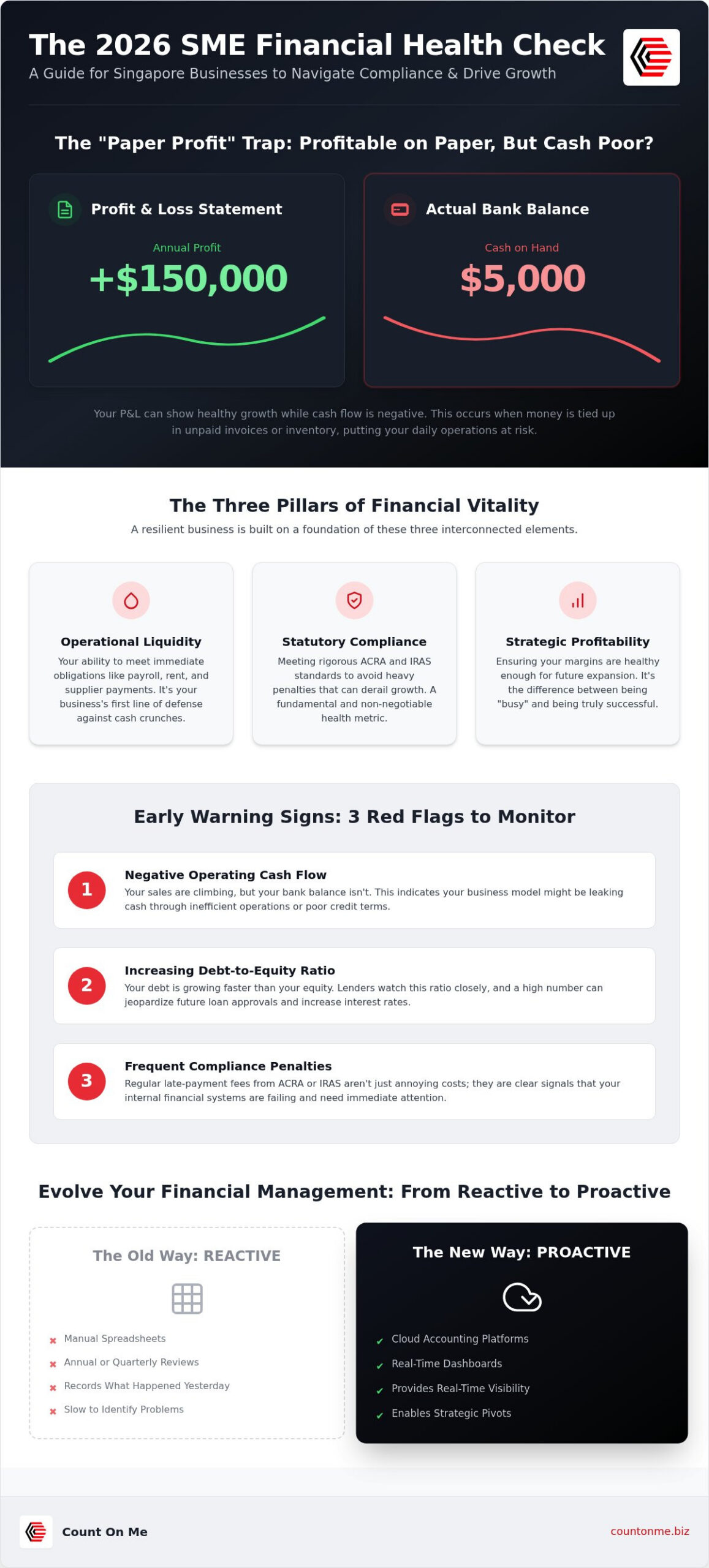
We often see business owners fall into the “Paper Profit Trap.” This happens when your Profit and Loss statement shows healthy growth, but your actual cash flow is negative. You’re technically making money, but it’s tied up in unpaid invoices or inventory while your bills are due now. Without a regular health check, this gap can quietly widen until it threatens your entire operation.
The Difference Between Bookkeeping and a Health Check
Bookkeeping records what happened yesterday. It’s essential for staying organized, but it’s fundamentally reactive. A health check is proactive; it evaluates if your business can survive and thrive over the next twelve months. With the fast pace of the 2026 market, traditional annual reviews are just too slow to be useful. We advocate for real-time visibility through Cloud Accounting platforms. This shift from manual spreadsheets to digital dashboards lets you see potential problems before they turn into crises, giving you the room to pivot your strategy when needed.
Red Flags That Demand Immediate Attention
Don’t ignore the warning signs that suggest your business is struggling under the surface. If your sales are climbing but your operating cash flow stays stubbornly negative, your business model might be leaking cash. Another major red flag is an increasing Debt-to-Equity ratio. Local lenders look at this closely when deciding on loan approvals or interest rates. You should also watch for frequent late-payment penalties from ACRA or IRAS. These aren’t just annoying costs; they’re signals that your internal systems are failing. Using a comprehensive financial health checklist helps you track these critical ratios and maintain a stable foundation for your next stage of growth.
The Three Pillars of SME Financial Vitality in Singapore
Building a resilient business requires more than just a great product or service. It demands a sturdy foundation built on three specific pillars that determine your long-term survival. When we conduct an SME financial health check Singapore, we look closely at operational liquidity, statutory compliance, and strategic profitability. These elements don’t exist in a vacuum; they interact constantly to form your business’s baseline. For example, poor liquidity often leads to missed tax deadlines, while weak profitability eventually starves your liquidity. Mastering all three is the only way to stay ready for the opportunities 2026 will bring.
Operational liquidity is your first line of defense, ensuring you can meet immediate obligations like payroll, rent, and supplier payments. Statutory compliance involves meeting rigorous ACRA and IRAS standards to avoid the heavy penalties that can derail a growing company. Finally, strategic profitability looks Beyond the Bank Balance to analyze if your margins are healthy enough to support future expansion. If you’re increasing your revenue but your net margins are thinning, you aren’t actually growing; you’re just getting “busier.”
Mastering Your Cash Flow Cycle
In the Singapore business landscape, there’s often a frustrating gap between issuing an invoice and seeing the cash hit your account. This delay can create a dangerous “cash crunch” even when your sales team is hitting record numbers. Optimizing your working capital involves managing this cycle carefully so you don’t stifle your own growth. It might mean renegotiating supplier terms or using digital tools to automate payment reminders. For a more detailed look at navigating these challenges, our guide on Cash Flow Management for Scaling Singapore Startups offers practical strategies for founders.
The Compliance Safety Net
Beyond cash flow, protecting your business from operational risks is a crucial part of long-term vitality. To explore how tailored coverage can support your resilience, you can discover MyGen Insurance Brokers and their specialized risk management solutions.
We believe compliance shouldn’t be a seasonal chore that you dread; it’s a fundamental health metric. A professional Corporate Secretary is your partner in this, ensuring your statutory registers and filings are always up to date. This pillar also covers payroll and CPF contributions. Keeping these accurate is vital for maintaining “Employer Health” and keeping your team’s trust. When your compliance is handled by experts, it acts as a safety net, allowing you to focus on innovation. If you need help stabilizing these pillars, our Cloud Accounting solutions provide the real-time visibility you need to lead with confidence.
The 2026 SME Financial Health Checklist and Critical Ratios
Numbers don’t lie, but they can be misinterpreted if you aren’t looking at the right ones. To perform an effective SME financial health check Singapore, you need to move past your bank balance and look at specific ratios that indicate your company’s true strength. We recommend focusing on three critical metrics to keep your business on track for 2026. These numbers give you the clarity needed to make bold decisions without the fear of hidden risks.
- Current Ratio: This measures your ability to pay off short-term liabilities with your current assets. Aiming for a ratio above 1.0 ensures you aren’t constantly scrambling to cover next month’s rent or payroll.
- Net Profit Margin: With the 9% GST rate and rising inflation, your margins might be thinner than they look. We help you determine if your pricing strategy is actually sustainable for the long haul.
- Accounts Receivable Turnover: Cash in your client’s pocket isn’t cash you can use. This ratio shows how quickly you’re collecting payments from your Singaporean clients.
2026 Singapore Regulatory Updates to Monitor
Compliance is a moving target that requires constant attention. For YA 2026, you can take advantage of a Corporate Income Tax (CIT) rebate of 50%, capped at S$40,000. It’s a significant boost for your cash flow, but only if your filings are accurate and on time. You also need to account for the updated CPF Ordinary Wage ceilings in your payroll health. We’ve seen many businesses struggle with the 9% GST transition; ensuring your margin calculations reflect this accurately is vital for your 2026 health.
Get a professional review of your 2026 compliance status
The Solvency Test for Directors
As a director in Singapore, you have a legal obligation to ensure your company doesn’t trade while insolvent. This isn’t just a best practice; it’s a statutory requirement that carries significant responsibility. A regular health check gives you the data needed to sign off on the “Statement of Solvency” for your annual returns with total confidence. If you’re unsure about the deadlines or requirements, our Annual Return Filing Checklist provides a clear path forward. Staying ahead of these filings prevents the debilitating penalties that often catch SMEs off guard, keeping your record with ACRA spotless.
From Diagnosis to Strategy: Leveraging Cloud Accounting and CFO Support
Relying on manual spreadsheets is perhaps the single biggest threat to your business’s stability in 2026. While they might have served you well in the past, they simply can’t keep up with the speed of modern commerce. A spreadsheet is a static document that’s often outdated the moment you hit save. To truly master an SME financial health check Singapore, you need a system that moves at the pace of your transactions. Transitioning to a digital-first finance model isn’t just about efficiency; it’s about gaining the clarity you need to lead with confidence.
The Power of Cloud-Based Monitoring
Cloud-based tools like Xero act as the heartbeat monitor for your business. By automating bank reconciliations and reducing human error, these platforms provide real-time dashboards that offer an instant snapshot of your financial vitality. You can set up automated alerts for low cash reserves or high-aging receivables, allowing you to address issues before they become crises. We’ve seen how this visibility transforms decision-making for directors. If you’re ready to make the switch, our Complete Guide to Cloud Accounting Services in Singapore walks you through every step of the process.
When to Engage an On-Demand CFO
Once you have the data, the next step is knowing what to do with it. This is where On-demand CFO services become your most valuable asset. While a bookkeeper tracks the past, a fractional CFO looks toward your future. They move you beyond simple compliance and into high-level performance by interpreting your SME financial health check Singapore results through a strategic lens. This level of professional advisory is crucial if you’re preparing for investor rounds or planning a major expansion. We help you turn raw numbers into a scaling roadmap that highlights opportunities for growth and identifies potential roadblocks. If you’re ready to see the bigger picture, you can book a consultation for a comprehensive financial health review today. We’ll work together to ensure your business remains resilient and ready for whatever 2026 throws your way.
Securing Your Business Legacy for 2026 and Beyond
Beyond corporate strategy, ensuring your personal financial future is a key part of any long-term plan; click here to discover how Zenith Wealth supports business owners with comprehensive wealth management.
You’ve seen how a deep dive into your numbers transforms your perspective from reactive stress to proactive growth. By mastering your solvency ratios and moving away from the “paper profit trap,” you’re building a foundation that can withstand the unique economic pressures of 2026. A regular SME financial health check Singapore isn’t just a compliance exercise; it’s the strategic clarity you need to scale with confidence.
We’re here to be your partner in this journey. Our team brings over 20 years of industry experience and a passion for digital innovation as Xero-certified experts. We believe that when you have real-time visibility and professional CFO advisory at your side, no regulatory change is too daunting. You don’t have to navigate these complexities alone.
Get a Professional SME Financial Health Check with Count On Me
Let’s work together to turn your financial data into your most powerful competitive advantage. You’ve got the vision, and we’ve got the tools to help you protect it.
Frequently Asked Questions
How often should a Singapore SME perform a financial health check?
You should aim to conduct an SME financial health check Singapore at least once a quarter, though monthly reviews are ideal for fast-growing businesses. Waiting until your annual tax filing means you’re looking at data that is nearly a year old. Regular check-ins allow you to spot cash flow gaps or compliance issues early. This rhythm ensures you stay agile enough to pivot your strategy before a small leak becomes a major crisis.
What is the most important financial ratio for a small business in Singapore?
The current ratio is often considered the most vital metric because it measures your immediate survival. It compares your current assets against your short-term liabilities. If this number falls below 1.0, you might struggle to pay your staff or suppliers on time. While profit margins matter for long-term growth, this specific ratio tells you if you can keep the lights on tomorrow. We focus on this to ensure your daily operations remain stable.
Can a business be profitable but still fail a financial health check?
Yes, a business can show a profit on paper while having zero cash in the bank. This usually happens when your money is tied up in accounts receivable or unsold inventory. A comprehensive health check looks beyond your P&L statement to evaluate your actual cash flow and solvency. If you can’t access your profits to pay for 2026 GST or CPF contributions, your business’s health is at risk despite your high sales figures.
What are the specific IRAS penalties for poor financial record-keeping in 2026?
IRAS takes record-keeping seriously and can impose fines of up to S$5,000 for failures in maintaining proper accounts. In more severe cases, directors may face prosecution or be required to pay a penalty equal to double the tax undercharged. Keeping your digital records organized isn’t just about efficiency; it’s a legal safeguard. We help you digitize your workflows to ensure every transaction is traceable and compliant with the latest 2026 standards.
How does cloud accounting improve my business’s financial health?
Cloud accounting transforms your financial health by replacing manual entry with real-time automation. Tools like Xero sync directly with your bank accounts, giving you an instant view of your cash position. This eliminates the “blind spots” that lead to late payments or missed tax rebates. By digitizing your finance function, you reduce human error and gain the visibility needed to make data-driven decisions. It’s like having a 24/7 monitor for your business’s vital signs.
Do I need an external auditor for a financial health check?
No, you don’t need a statutory auditor to perform an SME financial health check Singapore. While a statutory audit is a formal requirement for certain companies, a health check is a strategic management tool. It’s best conducted by a cloud accounting partner or an on-demand CFO who understands your daily operations. We focus on providing actionable insights and growth strategies rather than just checking boxes for a regulatory report.