
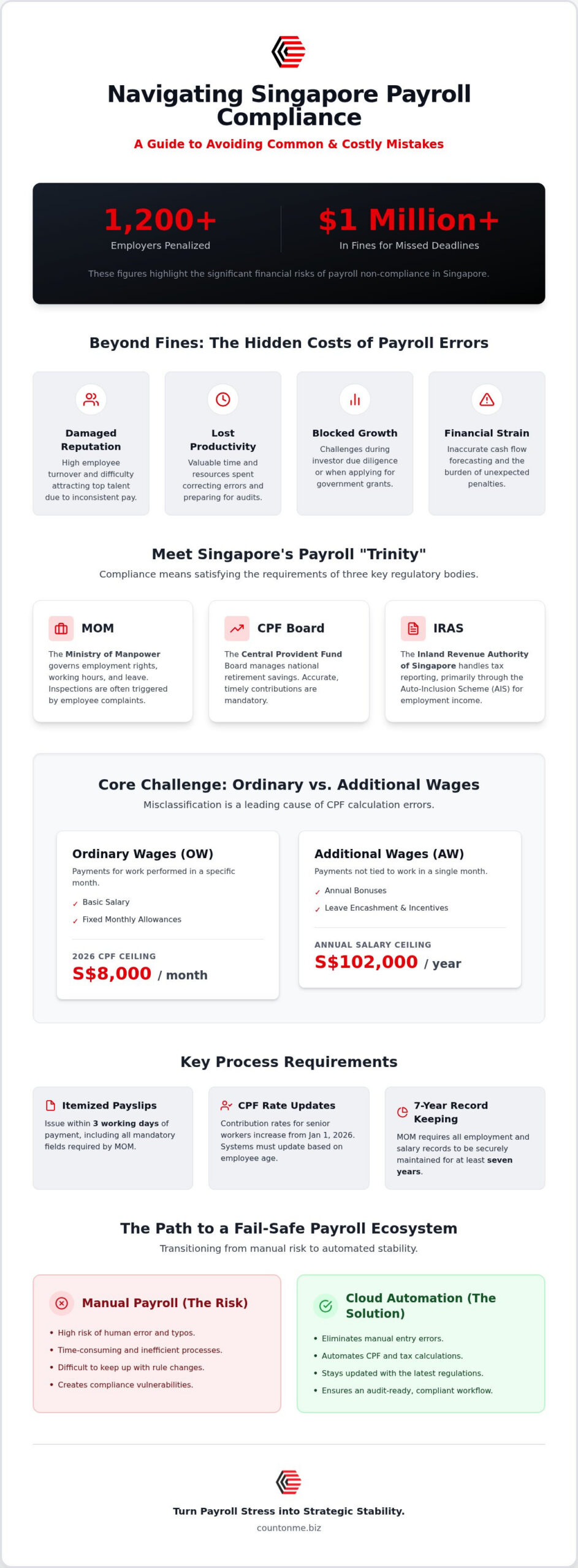
Did you know that over 1,200 Singapore employers faced more than $1 million in penalties last year simply for missing tax submission deadlines? It’s a staggering figure that highlights how easily common payroll mistakes Singapore SMEs make can lead to major financial headaches. We know that managing a growing team is exciting, but the administrative weight of staying compliant with the Ministry of Manpower (MOM) and the CPF Board can feel like a heavy burden. You’re likely juggling everything from itemized payslips to the complexities of the Auto-Inclusion Scheme, all while trying to keep your team happy and paid on time.
We’re here to help you turn that stress into stability. This guide is designed to identify the hidden pitfalls that trigger audits and clarify the confusion surrounding wage classifications. We’ll walk through the 2026 CPF contribution rates, explain the S$8,000 Ordinary Wage ceiling, and show you how to move away from time-consuming manual entry. By the end of this read, you’ll have a clear roadmap to a clean compliance record and an automated, scalable workflow that gives you back your time.
Key Takeaways
- Master the nuances of the Singapore Employment Act to protect your business from the “invisible” costs of non-compliance, such as lost productivity and damaged employee morale.
- Learn how to accurately classify Ordinary versus Additional Wages to avoid the common payroll mistakes Singapore businesses face when calculating monthly CPF contributions.
- Identify the specific mandatory fields required by MOM for itemized payslips to ensure every salary payment you issue is fully compliant and audit-ready.
- Discover how transitioning to a cloud-based payroll ecosystem can eliminate manual entry errors and provide a scalable, automated foundation for your company’s growth.
The High Stakes of Payroll Compliance in Singapore
In the eyes of the law, payroll compliance isn’t just about making sure your team gets paid; it’s about adhering to the strict guidelines set by the Employment Act in Singapore. This legal framework dictates everything from how you calculate overtime to the exact timing of salary disbursements. When these rules are overlooked, we see common payroll mistakes Singapore startups struggle with, such as miscalculating CPF contributions or failing to issue itemized payslips within the required three-day window. These aren’t just administrative hiccups. They’re compliance breaches that can lead to MOM fines or interest penalties on late CPF payments.
For a growing business, relying on manual spreadsheets is often the biggest risk factor. A single typo in a formula can ripple through your entire month’s filings, creating a mess that takes weeks to untangle. Beyond the legal risks, inaccurate payroll has a direct impact on your cash flow strategy. If you don’t have a clear view of your total labor costs, including levies and contributions, your financial forecasting remains a guessing game rather than a strategic tool for growth.
Why Accuracy Matters for Your Brand Reputation
Your employees are your greatest asset, and nothing erodes their trust faster than a late or incorrect paycheck. In Singapore’s competitive talent market, payroll delays can lead to high turnover and a damaged reputation on platforms like Glassdoor. Clean payroll records are also vital for your long-term business health; they are a primary focus during investor due diligence or when applying for government grants. Open and honest payroll transparency builds a culture of trust by showing your team that you value their contributions and respect the legal standards that protect them.
The Regulatory Landscape: MOM, CPF, and IRAS
Managing payroll means answering to the “Trinity” of Singapore regulators: the Ministry of Manpower (MOM) for employment rights, the CPF Board for retirement savings, and IRAS for tax reporting. MOM inspections are often triggered by employee complaints or inconsistent filings, which is why maintaining seven years of employment records is a critical statutory requirement. To stay ahead of these complexities, many SMEs find that professional payroll management solutions provide the stability needed to ensure every submission to the Auto-Inclusion Scheme (AIS) is accurate and on time, avoiding the penalties that hit 1,207 non-compliant employers in 2025.
Common Pitfalls: Ordinary vs. Additional Wages and CPF Errors
One of the most frequent hurdles we see business owners face is the classification of wages for CPF. It sounds simple on paper, but when you’re looking at a mix of basic salary, performance bonuses, and transport allowances, things get murky. Misclassifying these is among the most common payroll mistakes Singapore companies encounter, often leading to either underpaid contributions that trigger penalties or overpayments that hurt your bottom line. We’re here to help you navigate these nuances with confidence.
Another area where errors frequently creep in is the transition between age brackets. As of January 1, 2026, CPF contribution rates for senior workers have continued to increase to enhance retirement adequacy. If your payroll system isn’t set to update automatically on an employee’s birthday month, you might find yourself non-compliant overnight. Staying on top of these CPF contribution requirements is essential for maintaining a clean record with the authorities.
Ordinary Wages vs. Additional Wages: The Definitive Guide
Understanding the difference between Ordinary Wages (OW) and Additional Wages (AW) is critical for accurate CPF calculations. OW refers to payments made specifically for an employee’s work in a given month, such as basic salary and fixed monthly allowances. In 2026, the OW ceiling is S$8,000 per month. Any amount earned above this cap does not attract CPF contributions.
AW, on the other hand, includes payments that aren’t made solely for that month, such as year-end bonuses, leave encashment, or ad-hoc incentives. These are subject to an annual salary ceiling of S$102,000. We often see startups miss the AW ceiling calculation at the end of the year, leading to over-contributions. It’s a complex balancing act, but getting it right ensures your cash flow remains predictable and your filings stay accurate. If you’re looking for a partner to help manage these complexities, our payroll management solutions are designed to scale with your needs.
Overtime and Allowance Miscalculations
If you employ non-executive staff earning up to S$2,600 or workmen earning up to S$4,500, they’re covered under Part IV of the Employment Act. This means you’re legally required to pay them 1.5 times their basic hourly rate for any overtime work. We find that many businesses use a flat rate or forget to include certain allowances in the “basic rate” calculation, which can lead to MOM disputes. You also need to be careful with IRAS reporting; while most allowances are taxable, certain reimbursements are not. Distinguishing between these correctly is vital for your annual AIS submissions. If these calculations feel like a heavy lift, exploring automated tools can provide the relief and stability your finance team needs.
Process Errors: From Manual Entry to Non-Compliant Payslips
Relying on manual data entry is like building a house on sand. One accidental zero or a misplaced decimal point can derail your entire month’s filings, leading to significant compliance risks. This is one of the most common payroll mistakes Singapore startups fall into as they scale from five employees to fifty. Beyond simple typos, we often see a disconnect between payroll records and the general ledger. If your payroll doesn’t sync directly with your cloud accounting software, such as Xero, you’re looking at hours of manual reconciliation that could be spent on strategic growth instead. You also have the strict CPF deadline to consider; all contributions must be submitted by the 14th of the following month to avoid late payment interest and potential fines.
What Must Be Included in a Legal Singapore Payslip?
The Ministry of Manpower (MOM) is very specific about what constitutes a legal payslip. You’re required to issue itemized payslips within three working days of payment. These must include mandatory fields such as basic salary, itemized deductions, net pay, and the date of payment. If you have employees covered under Part IV of the Employment Act, you must also clearly itemize their overtime hours and the total OT pay. Failing to do this is a frequent trigger for employee disputes and subsequent MOM inspections. We recommend moving toward electronic payslips with secure digital access, which ensures your team can view their records anytime while keeping your business fully compliant.
The ‘Once-a-Month’ Task Fallacy
Many business owners treat payroll as a frantic, once-a-month scramble. This approach is a recipe for error. Instead, think of payroll as a continuous data-collection process. When you manage leave applications and expense claims in real-time, month-end disbursements become a simple verification rather than a complex puzzle. This proactive habit ensures that your records are always audit-ready and reflects the reality of your business operations. For a deeper dive into streamlining these workflows, check out our guide on Mastering Payroll Management in Singapore.
Automate your payroll with our expert management solutions
Building a Fail-Safe Payroll Ecosystem with Cloud Technology
Moving away from manual systems isn’t just about saving time; it’s about building a defensive wall against the common payroll mistakes Singapore SMEs often face. When you adopt cloud-based payroll software, the system handles the complex math of CPF age brackets and OW/AW ceilings automatically. This digital-first approach ensures your calculations are always right, but the real magic happens when you integrate payroll with cloud accounting platforms like Xero. Instead of manual data transfers that invite typos, your labor costs flow directly into your books, giving you a real-time view of your company’s financial health and cash flow.
Automation also takes the sting out of statutory reporting. By linking your payroll directly to the CPF Board and IRAS through the Auto-Inclusion Scheme (AIS), you eliminate the risk of late submissions or data mismatches. However, we’ve seen that even the best software needs professional oversight. A tool is only as good as its configuration, and having an expert eye to monitor legislative changes ensures your “fail-safe” system stays that way as your business evolves.
Transitioning from Spreadsheets to Automation
Before you flip the switch on a new system, it’s vital to clean your existing data. Migration is the perfect time to fix old errors in employee details or contribution histories. Once your data is pristine, we’ll help you set up automated reminders for statutory filing deadlines, ensuring you never miss the 14th of the month for CPF or the March 1st deadline for AIS. If you’re currently managing your books manually as well, you might find our guide on Transitioning to Cloud Bookkeeping a helpful next step in your digital journey.
Partnering for Scalable Compliance
While software is powerful, it’s not a “set and forget” solution. We believe the best results come from a partnership between smart tech and seasoned expertise. At Count On Me, we provide that essential human layer, acting as your collaborative mentor to ensure your automation is configured correctly from day one. Our Payroll Management Solutions are built to be scalable, with fees that adjust based on your headcount so you only pay for what you need as you grow. We handle the heavy lifting of compliance, giving you the relief and stability to focus on what you do best: growing your business.
Securing Your Business Growth with Confident Payroll
Staying compliant isn’t just about ticking boxes for the authorities; it’s about building a foundation of trust with your team and ensuring your business is ready for scale. We’ve explored how common payroll mistakes Singapore SMEs face, such as misclassifying Additional Wages or missing the monthly CPF deadline, can lead to avoidable penalties. By shifting from manual spreadsheets to an integrated cloud ecosystem, you don’t just eliminate errors. You gain the clarity needed to make strategic financial decisions with confidence.
At Count On Me, we’re more than just service providers; we’re your collaborative partners in growth. Our seasoned experts bring over 20 years of experience in Singapore finance to the table, combining high-level expertise with modern cloud-accounting tools like Xero. Whether you’re a lean startup or a growing SME, we offer tailored packages designed to handle the heavy lifting of compliance so you can focus on your vision.
Let Count On Me automate your payroll compliance today
You’ve worked hard to build your company. Let’s work together to make sure your payroll is as innovative and reliable as the services you provide.
Frequently Asked Questions
What are the penalties for late CPF contributions in Singapore?
If you miss the deadline on the 14th of the following month, you’ll face a late payment interest charge of 1.5% per month. The minimum interest is set at $5. Beyond these costs, the CPF Board can impose composition fines or take legal action, which may lead to court fines up to $10,000. Staying punctual is the easiest way to avoid these common payroll mistakes Singapore businesses often encounter.
Is it mandatory to issue itemised payslips to all employees?
Yes, all employers must issue itemised payslips to employees covered by the Employment Act within three working days of the salary payment. These slips can be in soft or hard copy, but they must contain specific details like basic salary, deductions, and overtime pay. Failing to provide these is a breach of MOM regulations and can lead to administrative penalties that hurt your company’s compliance record.
What is the difference between an employee and an independent contractor for payroll?
The distinction lies in the contract type; employees have a “contract of service” while contractors have a “contract for service.” Employees are entitled to statutory benefits like CPF contributions, annual leave, and sick leave. Contractors manage their own taxes and don’t receive these benefits. Misclassifying an employee as a contractor is a serious mistake that often triggers MOM audits and requires back-payment of all missed CPF contributions.
How do I calculate overtime pay for my staff correctly?
Overtime pay must be at least 1.5 times the employee’s basic hourly rate of pay. This legal requirement applies to non-executive staff earning up to $2,600 and workmen earning up to $4,500 monthly. To calculate the hourly rate, you generally divide the monthly basic salary by the average working hours. Getting this formula wrong is a frequent source of employee disputes, so we recommend using automated tools for precision.
What is the Auto-Inclusion Scheme (AIS) for IRAS, and is it compulsory?
The Auto-Inclusion Scheme (AIS) is mandatory for all employers with five or more employees as of 2026. Under this scheme, you must electronically submit your employees’ income information to IRAS by March 1st each year. This allows the tax office to pre-fill tax returns for your staff. In 2025, over 1,200 non-compliant employers faced penalties exceeding $1,000,000 for missing these critical deadlines or submitting inaccurate data.
Can I manage payroll for foreign employees the same way as locals?
While the process is similar, you don’t pay CPF for foreign employees. However, you must still pay the Skills Development Levy (SDL) for them, which is 0.25% of their monthly remuneration. You’ll also need to handle tax clearance by filing Form IR21 when a foreign employee leaves your company or Singapore. Foreigners typically don’t contribute to ethnic self-help groups like CDAC unless they choose to opt-in, unlike your local staff.