
Filing your financial statements shouldn’t feel like a high-stakes game of data entry roulette. For many SME owners, the annual xbrl requirement singapore mandates represent a looming deadline filled with technical jargon and the very real threat of a S$600 late filing penalty. We understand that staring at the BizFinx portal or trying to decide if you qualify for “Full” or “Simplified” XBRL feels more like a burden than a strategic business process.
It’s completely normal to feel overwhelmed by the complexities of ACRA’s latest Taxonomy 2026 v1.0. You’ve built your business to innovate, not to spend hours manually tagging spreadsheets or fixing validation errors. That’s why we’ve put together this guide to help you master these mandates and transition to a seamless digital workflow. We’ll break down exactly which filing category your company falls into, provide a clear roadmap for automating your conversion, and show you how professional support can turn compliance from a stressful headache into a hands-off success.
Key Takeaways
- Identify whether your company falls under the mandatory xbrl requirement singapore or if you qualify for filing exemptions as a solvent EPC or dormant entity.
- Distinguish between Full, Simplified, and FSH filing formats to ensure your financial data is mapped correctly to the latest ACRA standards.
- Discover the specific “small company” criteria that allow you to use the Simplified XBRL format, significantly reducing the number of required data elements.
- Learn how transitioning to cloud-based bookkeeping can automate your data preparation and eliminate the risks associated with manual spreadsheet entries.
- Understand how a collaborative partnership with cloud accounting experts provides a reliable roadmap for maintaining perfect compliance without the stress.
Understanding the XBRL Requirement in Singapore: Who Must File?
If you’re running a company in Singapore, you’ve likely heard the term XBRL tossed around during tax season. It stands for Extensible Business Reporting Language (XBRL), and you can think of it as a digital barcode for your financial data. Instead of treating your balance sheet as a static document, this format turns every line item into a machine-readable piece of data. ACRA mandates this because it allows for a high level of digital transparency across the entire business ecosystem.
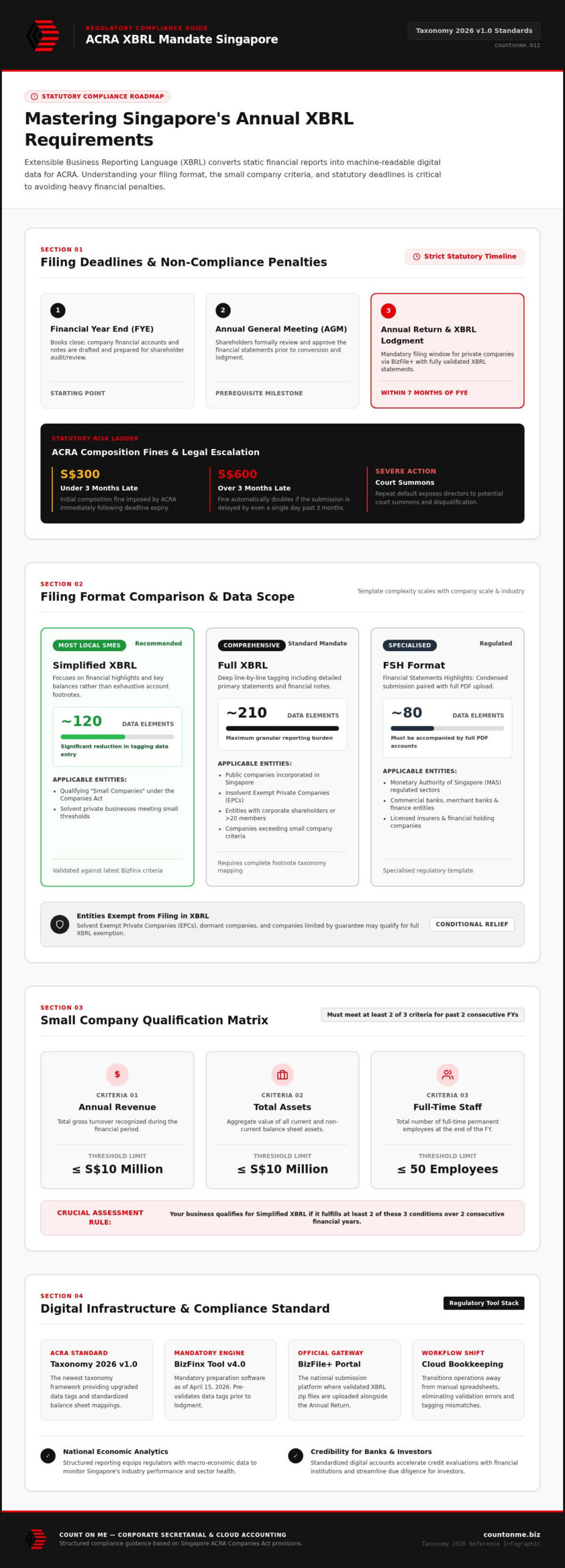
While the requirement has been in place for years, the 2026 regulatory landscape is stricter than ever. The transition from old-school PDF filings to full digital integration is now the standard for almost all Singapore-incorporated companies limited or unlimited by shares. If you don’t comply, the consequences are more than just a slap on the wrist. ACRA applies composition fines starting at S$300 for delays under three months, which doubles to S$600 if you’re even a day over that mark. For repeat offenders, you could even face a court summons or director disqualification. It’s a risk that’s easily avoided with the right digital setup.
The Purpose of Digital Financial Reporting
You might wonder why ACRA requires such a granular level of detail. By collecting data in a structured format, the government can perform massive national economic analytics to track industry health and trends. But it isn’t just for the regulators. For your business, filing in XBRL provides a layer of credibility. When your data is standardized, it’s significantly easier for banks to process credit applications and for potential investors to verify your financial standing. XBRL is the digital standard for business reporting in Singapore.
Deadlines and the Annual General Meeting (AGM) Cycle
Timing is everything when it comes to the xbrl requirement singapore. For most private companies, you have a strict 7-month window to file your Annual Return after your Financial Year End (FYE). This process is tethered to your AGM, where shareholders approve the financial statements that eventually get converted into XBRL. We’ve found that the most successful SMEs treat their Corporate Secretary Services as the primary guardian of this timeline. They ensure the gap between your meeting and your filing stays well within the legal limit, so you never have to worry about those escalating late fees.
XBRL Filing Formats: Full vs. Simplified vs. FSH
Determining which template to use for your xbrl requirement singapore filing doesn’t have to be a guessing game. ACRA currently recognizes four main templates, but for most business owners, the choice boils down to two: Full XBRL or Simplified XBRL. You’ll find that ACRA’s official XBRL filing requirements are designed to scale with your business complexity. Full XBRL is the most comprehensive format, requiring you to tag approximately 210 data elements. This is mandatory for public companies, insolvent Exempt Private Companies (EPCs), and any entity that doesn’t meet the specific “small company” criteria. If your business has corporate shareholders or more than 20 members, you’ll likely be navigating this more detailed path.
Full XBRL vs. Simplified XBRL: A Decision Matrix
Most local SMEs can breathe a sigh of relief because they often qualify for Simplified XBRL. This format covers about 120 data elements, focusing on financial highlights rather than every single note in your accounts. To qualify as a “small company” under the Companies Act, your business must meet at least two of the following three criteria for the past two consecutive financial years:
- Annual revenue not exceeding S$10 million
- Total assets not exceeding S$10 million
- Number of employees not exceeding 50
It’s a significant reduction in data entry, allowing you to focus on strategic growth rather than administrative minutiae. However, even with fewer elements, the data must be precise to avoid rejection by the BizFile+ portal.
Filing for Specialised Industries
For those in MAS-regulated sectors like banking or insurance, ACRA provides the Financial Statements Highlights (FSH) format. This is a condensed version with roughly 80 data elements, usually paired with a full PDF submission. If you’re running a company limited by guarantee or a dormant entity, you might be exempt from XBRL entirely. The latest BizFinx preparation tool, version 4.0, which became mandatory on April 15, 2026, is your best ally in selecting the correct template based on your company profile. It includes updated validation rules for the latest ACRA Taxonomy 2026 v1.0, ensuring your submission meets the current digital standard.
If you’re feeling unsure about where your company lands on this matrix, our Corporate Secretary Services can help you audit your status and ensure you’re using the right framework. Taking the time to align your accounting data with these formats early in the year makes the final submission feel like a non-event.
Exemptions: Does Your Company Need to File in XBRL?
While the xbrl requirement singapore is broad, it isn’t universal. Many business owners confuse audit exemptions with filing exemptions. Just because you don’t need an auditor doesn’t mean you can skip the digital tagging process. XBRL is the global standard for digital reporting, but ACRA provides specific pathways for smaller or inactive entities to simplify their administrative load. Understanding where you stand can save you hours of unnecessary work.
Qualifying as a Solvent EPC
An Exempt Private Company (EPC) is the gold standard for simplified compliance. To qualify, your company must have no corporate shareholders and fewer than 20 individual members. If you’re a solvent EPC, you don’t need to file financial statements at all; you simply file a declaration of solvency. This is a massive relief for many entrepreneurs. However, if your EPC is insolvent, you’re back in the pool and must file a Full XBRL return. Staying on top of these nuances is part of what we cover in The SME Guide to ACRA Compliance.
Dormant Company Filing Rules
What about companies that aren’t actively trading? ACRA defines a dormant company as one with no accounting transactions during a financial year. If you meet this criteria, you’re exempt from preparing financial statements and, consequently, from the xbrl requirement singapore. You’ll file a “Statement of Dormancy” instead. It’s vital to remember that “dormant” for ACRA might differ from “dormant” for IRAS. Even if you’re dormant, you still have to file an Annual Return and pay the S$60 filing fee.
Companies limited by guarantee also follow a different path. These entities, often non-profits, file their financial statements in PDF format rather than XBRL. It’s these specific exceptions that make the filing season feel like a maze. We believe in providing a clear roadmap so you can focus on your mission, not the paperwork.
Explore our Corporate Secretary Services to simplify your compliance
The Cloud Advantage: Streamlining XBRL Compliance
Traditional consulting firms often treat the xbrl requirement singapore as a tedious, manual data-conversion task tacked onto the end of the year. We look at it differently. When you transition from manual, disconnected spreadsheets to digital-first ledgers, regulatory compliance becomes the natural output of a healthy financial ecosystem. Cloud accounting software like Xero structures your daily transactions so they seamlessly feed into regulatory workflows, saving you from last-minute scrambles.
Mapping Your Chart of Accounts to BizFinx
Keeping a clean digital ledger is the secret to stress-free filing. Because the BizFinx tool requires precise data tagging, a messy chart of accounts leads directly to validation errors. A common slip-up we see busy founders make is misclassifying current versus non-current assets, which immediately rejects the submission. Utilizing automated bank reconciliation eliminates these data entry gaps early. For complex setups where standard mapping falls short, our On-demand CFO Services ensure that your notes to accounts are tagged accurately without breaking ACRA’s validation rules.
Partnering for Compliance Success
Attempting a DIY approach with the BizFinx portal during a busy growth phase usually leads to frustration. It turns an essential compliance task into a late-night tech support nightmare. We believe you shouldn’t have to choose between strategic growth and regulatory accuracy. That’s why Count On Me integrates your monthly Cloud Accounting & Bookkeeping directly with your annual filing requirements. We act as your collaborative allies, managing the technical heavy lifting so you can keep your eyes on the big picture.
Ready to leave the spreadsheets behind? Discover our integrated Cloud Accounting and Compliance packages to see how we can protect your deadlines and streamline your workflows.
Ready for a Seamless Digital Future?
Mastering the xbrl requirement singapore isn’t about memorizing every technical tag in the 2026 taxonomy; it’s about building a digital foundation that works for you. By choosing the right filing format and identifying your exemption status early, you move from reactive stress to proactive control. We’ve seen how a digitized finance function doesn’t just satisfy ACRA; it provides the clarity you need to lead your business with confidence and total peace of mind.
We’re here to be your collaborative allies in this transition. With over 20 years of professional expertise and our status as ACRA Registered Filing Agents and a Xero Platinum Partner, we know how to turn complex mandates into a seamless part of your monthly workflow. You don’t have to navigate the BizFinx portal alone or worry about late filing penalties ever again. Our team is invested in your success, offering a sense of relief by handling the technical heavy lifting while you focus on what you do best.
Simplify your ACRA compliance with our expert Cloud Accounting services
We’re excited to help you trade manual data entry for strategic growth. Let’s work together to ensure your compliance is handled with quiet confidence and absolute precision.
Frequently Asked Questions
What is the difference between Full XBRL and Simplified XBRL?
Full XBRL is a comprehensive format requiring approximately 210 data elements, including detailed notes to the accounts. It’s mandatory for public companies, large entities, and insolvent Exempt Private Companies. Simplified XBRL is a streamlined version with about 120 elements, focusing primarily on financial highlights. Most local SMEs qualify for this shorter format, which significantly reduces the technical burden while still satisfying the xbrl requirement singapore for digital transparency.
Can I file my financial statements in PDF format instead of XBRL?
Most Singapore-incorporated companies cannot use PDF as their primary filing format. ACRA has mandated digital reporting since 2007 to improve national data analysis and economic transparency. While specific entities like companies limited by guarantee or foreign branches still utilize PDF, most private limited firms must file in XBRL. If you’re a solvent Exempt Private Company, you don’t file financial statements at all, but you must still submit a declaration of solvency.
What are the penalties for late XBRL filing in Singapore?
Missing your deadline triggers an immediate S$300 composition fine for delays under three months. If the delay exceeds three months, this penalty doubles to S$600. These fines apply to the late filing of the Annual Return, which includes your XBRL statements. It’s important to stay vigilant; repeat offenders can face court summons or even director disqualification. Having a seasoned professional manage your timeline provides a sense of relief and keeps you compliant.
Does a dormant company need to file financial statements in XBRL?
Dormant companies are generally exempt from preparing financial statements and filing in XBRL format. ACRA considers a company dormant if no accounting transactions have occurred during the financial year. In these cases, you’ll file a “Statement of Dormancy” instead of a full digital report. However, you must still complete your Annual Return and pay the S$60 filing fee. We always recommend checking your specific status to ensure you don’t accidentally miss a filing obligation.
Is a “Small Company” exempt from XBRL filing?
A “Small Company” status doesn’t grant an exemption from the xbrl requirement singapore; it only determines which format you use. Many founders confuse the audit exemption with a total filing exemption. Even if your revenue and assets fall below the S$10 million threshold, you’re still required to file your financial data digitally. You’ll simply benefit from the Simplified XBRL format, which requires fewer data elements and less complex mapping than the Full XBRL version.
How much does it cost to engage a professional for XBRL filing?
Professional fees typically vary based on your company’s transaction volume and whether you require a Full or Simplified filing template. Many business owners find it more cost-effective to integrate this service into their monthly bookkeeping or annual corporate secretarial retainers. This collaborative approach ensures your digital ledger is always ready for conversion. By bundling these services, you avoid the high costs of last-minute manual data entry and ensure your compliance is handled by tech-forward experts.