

What if your company secretary is more than the person you contact when an annual filing is due? For a company secretary Singapore businesses can rely on, ongoing support with records and compliance can help keep important responsibilities on track. Every Singapore company must appoint a secretary within six months of incorporation, but knowing the rule is only the first step. You’ll also want to understand who can be appointed, what the role covers and how to file the appointment.
It’s reasonable to wonder whether a secretary handles accounting, legal matters or both. The role has clear boundaries: secretarial support focuses on company records and statutory requirements, while accounting and legal work remain distinct responsibilities. This guide explains what a company secretary does, what your company needs to manage and which appointment details to verify. It also covers how to assess ongoing support, including outsourced services, so recurring records and filings have a clear owner. With the right arrangement, you can stay on top of your obligations without managing every administrative detail alone.
Key Takeaways
- Understand how a company secretary supports governance and administration while directors retain responsibility for company decisions and oversight.
- Use a practical checklist to organise statutory registers, company updates, resolutions, meetings and annual return coordination.
- When choosing a company secretary singapore provider, check eligibility, appointment steps, record handover and how compliance reminders will be managed.
- Compare in-house coordination with outsourced support based on workload, expertise, continuity and control of company records.
- Clarify which filings and register-maintenance tasks are included, so responsibilities stay clear and records remain accessible.
Singapore Company Secretary Roles Beyond Paperwork
A company secretary helps organise statutory records, formal decisions and compliance-related administration. For a company secretary Singapore businesses work with over time, the value goes beyond preparing documents for a filing. Reliable records help directors see what has been decided and what needs attention next.
The role supports good governance by keeping company information orderly and helping formal processes run smoothly. For a broad overview of the role and its Singapore context, see Company Secretary in Singapore. Responsibilities vary by provider, so confirm which registers, filings and meeting documents are included. Count On Me provides corporate secretary services, including statutory register maintenance and annual return filing.
How the secretary supports directors and company governance
Accurate, accessible records give directors a clearer basis for overseeing company administration. A secretary may help prepare or maintain resolutions and meeting documents, but agree the scope with the provider. These records capture formal decisions and help keep company information consistent as the business operates and changes.
Secretarial support does not transfer authority. Directors remain responsible for company decisions and oversight. A secretary can organise the process and records, but directors must consider the issues, make decisions and fulfil their own responsibilities.
How secretarial work differs from accounting and legal services
A company secretary’s core function is to support a company’s statutory records, formal administration and governance processes. Secretarial records document matters such as company appointments, changes and resolutions. Accounting records track financial transactions and inform financial statements. These functions work alongside each other, but they answer different questions and need clear ownership.
For example, bookkeeping may record a transaction, while company secretarial work maintains relevant company records or documents a formal decision. Statutory audit is a separate service, not the same as company secretarial support. Legal advice and representation are also distinct. A secretary’s administrative support should not be mistaken for legal counsel. For more on the scope, see corporate secretary responsibilities in Singapore, and confirm the specific work your provider will handle.
Which company secretary duties and records should Singapore companies manage?
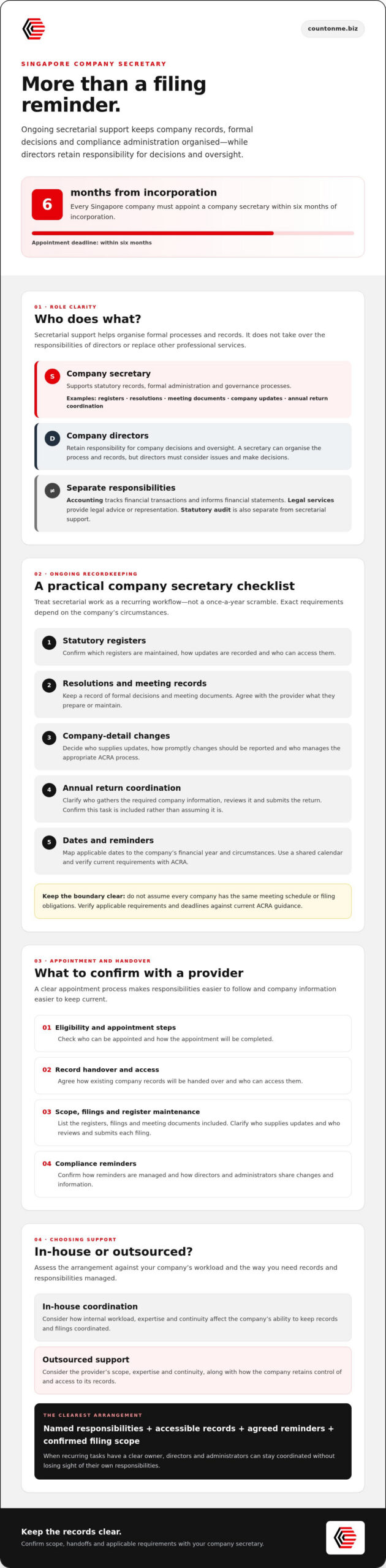
Secretarial work is easier to manage as a recurring workflow than as a once-a-year scramble. The records and filings your company needs depend on its circumstances. Use this checklist to plan, then verify each obligation and deadline against current ACRA guidance.
Company registers, resolutions and changes to company details
Keep statutory registers current and make sure the right people can access them. Documented resolutions provide a record of formal decisions, while changes to company details need to be reflected through the appropriate ACRA process. Ask your secretary which registers they maintain, who supplies updates and how promptly changes should be reported.
Core recordkeeping covers statutory registers, documented resolutions, company-detail updates, meeting records and annual-return coordination. The precise requirements depend on the company’s circumstances. For further context on the statutory requirements for a company secretary, consult a legal guide alongside current ACRA information.
Annual returns, meetings and compliance dates
Annual return coordination involves preparing the required company information and managing the filing process. Confirm who gathers the details, reviews them and submits the return. Don’t assume the task is covered simply because a secretary has been appointed. Count On Me’s corporate secretary services include statutory register maintenance and annual return filing. Check the current scope and responsibilities with your provider.
Meeting requirements and related documents can vary with a company’s situation. Don’t assume every company follows the same meeting schedule or has identical filing obligations. Ask your secretary to map applicable dates against your company’s financial year and circumstances, then verify legal requirements with ACRA. A shared calendar and a clear handoff for company changes can help directors and administrators stay coordinated.
- Registers: Confirm what is maintained and how updates are recorded.
- Changes and decisions: Agree who informs the secretary and how resolutions are documented.
- Meetings and returns: Clarify which records, preparation and filing tasks are included.
When reviewing ongoing corporate secretary services, use these questions to clarify the scope before work begins.
How should you appoint and work with a company secretary in Singapore?
A clear appointment process helps prevent gaps in records and uncertainty about who handles the next filing. For a company secretary singapore arrangement, work through the requirement, eligibility, appointment, handover and reminders in order. Check current rules with ACRA’s requirements for company secretaries before acting, as obligations and deadlines can change.
What to check before appointing a company secretary
Verify the current appointment deadline and eligibility rules against ACRA guidance. As of September 2026, a company must appoint a secretary within six months of incorporation. The secretary must be a natural person ordinarily resident in Singapore, and a sole director cannot also serve as secretary. The appointment must be filed with ACRA within 14 days. Confirm these details before proceeding, especially if your company’s circumstances are unusual.
If you’re engaging a firm, ask whether it is registered with ACRA as a Corporate Service Provider. Then clarify the service scope: which statutory registers are maintained, which filings are coordinated, and whether meeting or resolution documents are included. Ask how records will be transferred, who your contact will be, how you can access documents and how upcoming dates or company changes will be flagged. These checks help you assess a corporate secretary provider on more than price alone.
How directors can make the working relationship effective
A smooth handover starts with organised information. Prepare existing company records, ownership details, director information and any known upcoming changes. Agree who supplies documents and approvals, how the secretary should be notified about changes and who reviews information before a filing is made.
Set up a shared calendar or another agreed reminder process, then assign each task to a named person. For example, clarify who gathers the details for an annual return, who checks them and who coordinates submission. Outsourcing can support the process, but directors still need to oversee the company and provide timely, accurate information.
- Scope: What is included, and what remains with the company?
- Communication: How will reminders, document requests and changes be handled?
- Records: Where will documents be stored, and how can directors access them?
Review the scope of corporate secretary services as part of your appointment planning.
When does outsourced company secretary support make sense for an SME?
Outsourcing may suit an SME when recurring company records and filing coordination take time away from running the business, or when no one internally owns those tasks consistently. An in-house approach can work if you have the capacity, relevant expertise and a dependable process. Compare your actual workload, continuity needs and access to company records rather than assuming one arrangement suits every business.
Signs your business may benefit from outsourced support
Consider whether directors can readily find current registers and resolutions, track company changes and coordinate upcoming filings. If these tasks depend on one busy person or have become harder to manage as the company grows, external support may provide a clearer process and ongoing assistance. It can help organise recurring work, but it cannot guarantee that every deadline or compliance issue will be avoided.
For a company secretary singapore arrangement, directors should still retain oversight. Outsourcing delegates agreed service tasks; it does not transfer responsibility for company decisions or remove the need to provide complete information and approvals on time.
What to clarify before engaging a service provider
Before you commit, confirm what is covered and what is not. Ask which statutory registers are maintained, whether annual return filing is included, how company changes are handled, and who prepares or coordinates meeting and resolution documents. Check how directors can access records, what the handover requires, who will communicate with your team and how reminders are managed.
Also ask how secretarial work fits alongside your finance workflows. Bookkeeping records transactions and supports financial reporting; it does not replace statutory registers or company filing coordination. Coordinating these workflows with one provider may make information handoffs more straightforward while keeping responsibilities distinct. Count On Me provides corporate secretary services alongside cloud accounting, tax and payroll support for Singapore businesses. Confirm the current scope of any service before engaging a provider.
To assess your needs, list the records and recurring tasks your team manages now, then compare that list with the support you need. The corporate secretary services page outlines the service offering.
Choose Support That Keeps Your Company Organised
The right company secretary singapore arrangement provides more than help with an occasional filing. Look for clear ownership of recurring records and compliance tasks, accessible company information, and a reliable way to coordinate updates. Directors still retain oversight, so agree who provides documents, approvals and timely instructions.
Outsourced support can be practical when your team needs help managing recurring responsibilities. Count On Me supports Singapore startups and SMEs with corporate secretarial services alongside accounting, tax and payroll capabilities. Annual retainers include statutory register maintenance and annual return filing. Confirm the current scope and handover arrangements before engaging a provider.
Before choosing an arrangement, list the records and filing tasks your company needs help coordinating. Then clarify responsibilities, record access and how updates will be handled.
With the right working arrangement in place, company administration can be more manageable, leaving you to focus on moving your business forward.
Frequently Asked Questions
Is a company secretary mandatory for a Singapore company?
Yes, every Singapore company must appoint a company secretary. The role supports company administration, statutory records and compliance processes, but it does not replace directors’ responsibility for decisions and oversight. If you’re choosing a company secretary in Singapore, confirm which registers, filings and other tasks are included in the arrangement. Requirements can depend on the company’s circumstances, so check current guidance from the Accounting and Corporate Regulatory Authority (ACRA).
Who can be appointed as a company secretary in Singapore?
The secretary must be a natural person who is ordinarily resident in Singapore. A company’s sole director cannot also act as its secretary. These eligibility requirements apply whether you appoint an individual directly or arrange support through a corporate service provider. Before confirming an appointment, verify the current ACRA requirements and make sure the arrangement identifies the person appointed to the company secretary role.
When does a Singapore company need to appoint a company secretary?
A company must appoint a secretary within six months of incorporation, and the position cannot remain vacant for more than six months. The appointment must also be filed with ACRA within 14 days of the appointment. Add the appointment and filing steps to your company’s compliance calendar, and verify current requirements directly with ACRA, especially if your company changes secretary or other circumstances may affect its obligations.
What does a company secretary do for a private limited company?
A company secretary helps manage statutory company records and coordinate administrative compliance, which may include maintaining registers and coordinating annual return filing. They may also support documentation for formal decisions and meetings, depending on the agreed scope. These responsibilities are separate from bookkeeping, statutory audit and legal representation. Directors remain accountable for company decisions and oversight, and should confirm which tasks the secretary handles and which require their input or approval.
Can a Singapore company outsource its corporate secretarial services?
Yes, a company can arrange secretarial support through an external provider. Before appointing one, check that the firm is registered with ACRA as a Corporate Service Provider, and clarify the scope, communication process, record access and handover arrangements. Ask who coordinates filings and how company changes should be reported. Outsourcing can help organise recurring administrative work, but directors still need to provide accurate information and maintain oversight of the company.
What happens if a company does not meet its secretary or filing obligations?
A company secretary vacancy lasting over six months may expose directors to a fine of up to S$1,000. Late annual returns can also attract penalties: S$300 if filed within three months after the due date, or S$600 if filed more than three months after it. The applicable requirements depend on the company’s circumstances. Check current ACRA guidance promptly if a position is vacant or a filing is overdue.