

A practical financial reporting checklist for Singapore startups connects accurate records to the decisions you need to make about cash, spending and growth. When invoices, payroll details and transaction records are scattered across different tools, even a basic question about cash flow can be difficult to answer.
Keeping records for tax and company filings matters, but management reports serve a different purpose: they help you understand how the business is performing and spot issues early. Clear, consistent figures make it easier to review costs, plan a hire or prepare for an investor discussion.
This guide sets out a repeatable month-end process, from gathering source documents and reconciling accounts to reviewing financial statements and following up on unusual figures. It also explains how management reporting relates to Singapore compliance, and how cloud bookkeeping or on-demand CFO support can help turn reliable reports into practical next steps.
Key Takeaways
- Use a financial reporting checklist for Singapore startups to bring essential reports, reconciliations, payroll records and supporting documents into one repeatable review.
- Keep management reports distinct from statutory financial statements, tax filings and audited accounts so you understand what each is designed to show.
- Follow a four-step month-end close: gather records, reconcile accounts, review results and document follow-up actions.
- Turn report findings into a clear question, decision, owner and next review date to make the numbers more useful for business planning.
- Consider cloud bookkeeping or finance support when reporting workload, review needs or business complexity make the process harder to manage consistently.
What financial reporting means for Singapore startups, and what it does not
Financial reporting is the process of organising and interpreting a business’s financial activity over a defined period, such as a month, quarter or financial year. For a startup, it should help answer two practical questions: what happened to the money, and what does that mean for the next decision?
A financial reporting checklist for Singapore startups helps you build a consistent view of performance. However, internal reporting is not the same as preparing statutory financial statements, filing tax returns or producing audited accounts. Records may overlap, but each serves a different purpose. Requirements can also change as your company’s activities, funding stage and team develop, so review the obligations that apply to your business rather than assuming one reporting pack covers everything.
Which reports help a startup understand its financial position?
Start with three reports. The profit and loss statement summarises income and expenses over a period, helping you assess whether the business made a profit or loss. The balance sheet shows assets, liabilities and equity at a particular date. The cash flow statement tracks cash moving in and out. Together, they give you a more complete view than any one report alone. For a foundational overview of financial statements, see Wikipedia.
Management accounts are reports prepared for internal use. They can include these statements and other performance details, but they are not automatically statutory or audited financial statements. Treat them as a regular decision-making tool, not as proof that every compliance filing is complete.
How Singapore compliance connects to financial reporting
ACRA, IRAS and CPF are relevant to different parts of company reporting and administration. Accurate, organised accounting records provide a foundation for meeting applicable obligations, but the specific requirements depend on the company and its circumstances. Link supporting documents to transactions so figures can be understood and reviewed later.
Internal management reports help you steer the business; compliance filings meet separate obligations and should not be treated as interchangeable. Your monthly reporting routine can support both, but it does not replace the relevant filings or any applicable financial statement requirements. For details on tax obligations, refer to the Singapore tax compliance guide and review the current requirements for your company.
The Singapore startup financial reporting checklist: records and reports to review
Use this financial reporting checklist for Singapore startups at each reporting period. Separate recurring management checks, which help you understand performance, from tax, payroll and company compliance checks, which depend on your company’s circumstances.
Core financial reports and account reconciliations
- Compare the reports: Check that your profit and loss statement, balance sheet and cash flow statement cover the same period and use consistent figures.
- Reconcile cash accounts: Match bank and payment-platform balances to statements. Investigate unexplained differences instead of carrying them forward.
- Review amounts due: Check unpaid customer invoices, supplier bills and material accruals against the records that support them.
Reconciled balances make startup reports more reliable because they connect recorded figures to account statements and help uncover errors before you make decisions based on them.
Singapore startup records to include
- Payroll: If your company has employees, review payroll summaries and related CPF records. Check that payroll figures agree with the amounts recorded in the accounts.
- Tax and GST: Review relevant tax and GST records against your company’s circumstances. Requirements vary, so establish which obligations apply rather than assuming every startup has the same ones.
- Company records: Keep filing records and governance documents organised alongside your accounts. For official guidance on Singapore’s financial reporting requirements, refer to ACRA.
Evidence that supports the figures
For each material transaction, retain a link to the invoice, receipt, contract or other source document. Add a short explanation and supporting evidence for unusual or one-off items. That way, someone reviewing the report can understand why a figure differs from the usual pattern.
Record who prepared and reviewed key schedules according to your actual workflow. A small team might assign these tasks to different people. If one person handles both, document the process clearly. Organised digital bookkeeping makes transaction records and evidence easier to access. Count On Me provides cloud accounting and bookkeeping support to help organise this workflow.
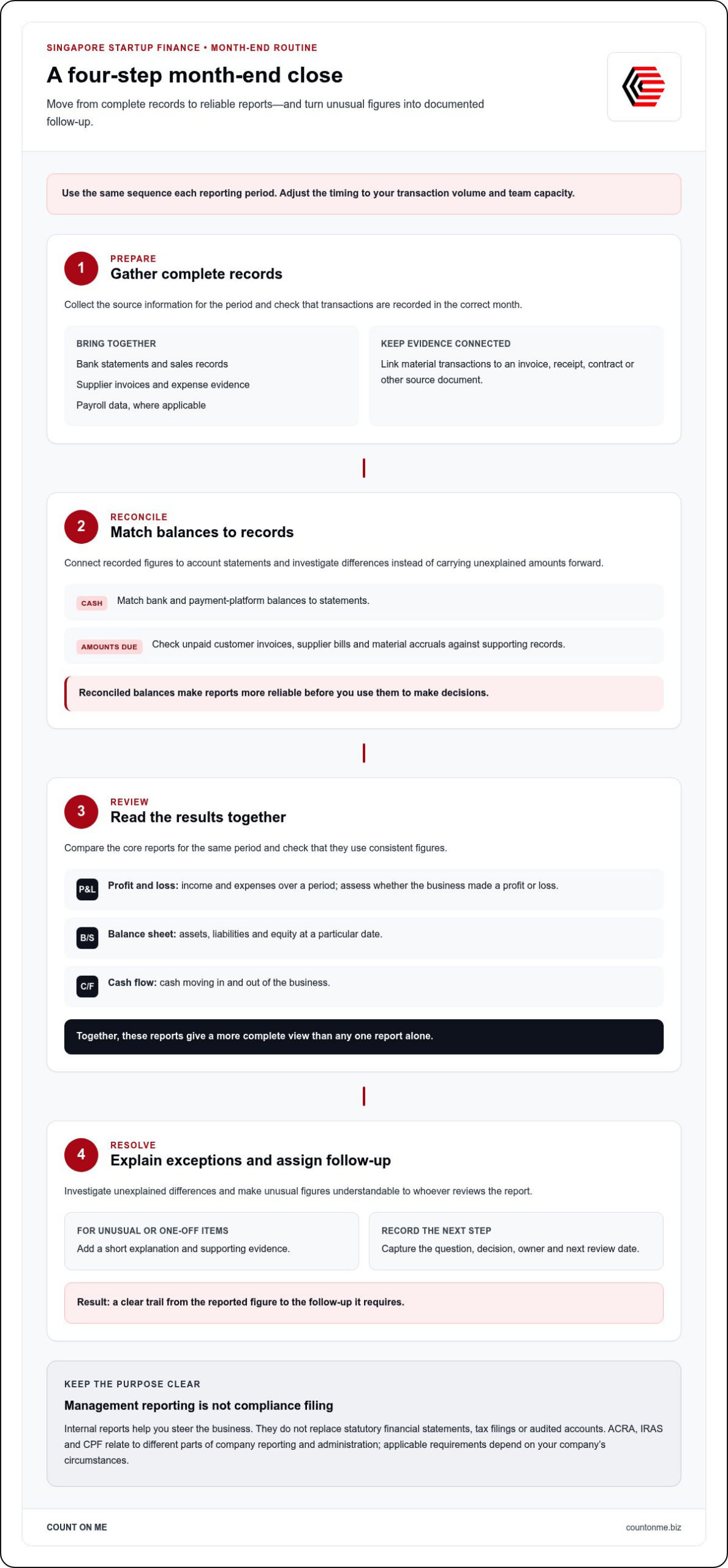
A repeatable month-end close: prepare, reconcile, review, and resolve
A reliable close can be straightforward. Build the same four steps into your financial reporting checklist for Singapore startups, then adjust the timing to suit your transaction volume and team capacity. A lean startup may need a lighter process than a business managing frequent sales, payroll and supplier payments.
1. Prepare complete records
Gather bank statements, sales records, supplier invoices, payroll data and relevant expense evidence for the period. Check that transactions are recorded in the correct month, and flag missing documents rather than leaving gaps unexplained. Use a consistent file-naming and storage approach so the team can find records without relying on one person’s inbox.
2. Reconcile and investigate
Compare ledger balances with bank statements, payment-platform records, receivables and payables. Follow up on duplicate entries, uncategorised transactions and unexplained balance movements before reviewing the reports.
Reconciliation checks whether recorded balances agree with available evidence, giving you a firmer basis for trusting the reports.
Repeated reconciliation gaps can point to process issues. If they keep appearing, review the practical fixes in the startup accounting mistakes guide and address the underlying workflow, not just the latest discrepancy.
3. Review the results
Scan the reports for unexpected changes, then compare results with the prior period or your internal plans. A rise in expenses, for example, might reflect a planned hire or a miscoded transaction. Check the supporting details before drawing conclusions.
4. Resolve and record open items
Give each unresolved issue an owner, a next action and a target review date. Record adjustments and key review decisions so the reasoning is available next month. Cloud bookkeeping keeps transaction records and supporting documents accessible in an organised workflow, making it easier to trace figures and continue the close as your team grows.
Keep the process proportionate. If transaction volume or team capacity changes, revisit the close schedule and responsibilities instead of letting unfinished tasks accumulate.
Explore cloud accounting and bookkeeping support
Turn reporting into startup decisions, and know when to get support
A report becomes useful when it leads to a clear next step. Use your financial reporting checklist for Singapore startups to identify a finding, ask what it means, decide what to do, assign an owner and set a date to review the result. This keeps the discussion grounded in evidence rather than guesswork.
Read the reports for cash, performance, and follow-up
Review cash movement alongside expected receipts and upcoming payments. Then compare revenue, expenses and margins with prior periods or your own plan. If a cost has risen, do not assume you know why. Check whether it reflects a planned change, a timing difference or something that needs investigation.
Turn each significant variance into a practical prompt: What changed? What evidence would explain it? Does it call for a decision now, or should we monitor it? Record the answer, the decision and when you will check its impact. This connects monthly reporting to everyday choices without relying on a generic runway benchmark.
Choose a reporting approach that fits your startup
Founders may be able to manage a straightforward reporting routine themselves when transactions are manageable, records are organised and someone has time to reconcile and review them. As transaction volume, payroll, funding activity or reporting complexity grows, maintaining that routine can take time away from running the business.
Cloud bookkeeping support helps organise transaction records, carry out regular reconciliations and prepare financial statements for review. If you also need help interpreting results, assessing cash flow or thinking through growth decisions, on-demand CFO support can add financial perspective. Accurate records remain the foundation; advice helps you consider what they mean.
Explore accounting and bookkeeping support to see how Count On Me’s reporting services can fit your workflow.
Set the next reporting action
Keep the monthly action list short. For each item, note the action, owner, due date and intended business outcome, such as resolving an unexplained expense or reviewing a planned cost change. At the next reporting review, check whether the action was completed and whether the result changed your view.
Reliable reports do not guarantee investor approval or a particular business outcome. They do give you a clearer basis for decisions. Count On Me provides bookkeeping, reconciliations and financial interpretation through its services.
Make your next reporting cycle more useful
A consistent financial reporting checklist for Singapore startups gives you more than a tidy set of monthly figures. It helps connect reliable records to practical decisions while keeping internal management reports distinct from compliance filings.
Start with the essentials: gather supporting documents, reconcile accounts, review your statements together and record follow-up actions. Turn notable changes into questions, assign an owner and revisit the decision at your next review. A simple process that fits your team is more useful than an elaborate one that is difficult to maintain.
If the workload is growing, cloud-based bookkeeping can support regular reconciliations and financial statement preparation. When you need help interpreting results, on-demand CFO support can bring a sharper focus to cash flow optimisation and growth insights. Reliable records come first; clear financial guidance helps you decide what to do with them.
Start with a repeatable routine, improve it as your startup changes, and use each reporting cycle to build a clearer view of the business. Explore Count On Me’s accounting and finance support.
Frequently Asked Questions
What should a startup include in a monthly financial report?
A monthly financial report should usually include a profit and loss statement, balance sheet and cash flow statement, supported by reconciled account balances. Add useful schedules such as unpaid customer invoices, supplier bills, payroll figures and notable expenses. Explain significant changes and list unresolved issues with an owner and next step. The right level of detail depends on what helps your team understand performance and make decisions.
How often should a Singapore startup prepare financial reports?
Monthly reporting gives founders a regular way to review performance, cash movement and outstanding items. It can also reveal recordkeeping gaps before they carry into later periods. The best cadence depends on transaction volume, team capacity and how quickly you need information to make decisions. Some figures may need closer monitoring, but keep the core close process manageable and consistent. Monthly management reporting is a useful practice, not a universal statutory filing deadline.
Do Singapore startups need audited financial statements?
Not every Singapore private company needs a statutory audit. Under the small-company audit exemption criteria, a private company may qualify if it meets at least two of these three thresholds for the past two consecutive financial years: annual revenue of S$10 million or less, total assets of S$10 million or less, and no more than 50 employees. Audit exemption does not remove other financial statement or filing obligations. Review current ACRA requirements for your company.
Are management accounts the same as statutory financial statements?
No. Management accounts are prepared for internal use, often monthly, to help founders monitor results and plan actions. Statutory financial statements are prepared to meet applicable company reporting requirements and are not interchangeable with internal reports. Management accounts are not automatically audited. Keep the purpose of each report clear and identify which formal reporting and filing obligations apply to your company. Monthly management accounts do not, by themselves, satisfy those obligations.
Can cloud accounting make startup financial reporting easier?
Yes. Cloud accounting and bookkeeping can organise transaction records, keep supporting documents accessible and support regular account reconciliations and financial statement preparation. That makes it easier to trace a reported figure back to its source. The process still depends on complete records and careful review: software does not automatically resolve missing documents, incorrect entries or unexplained differences. A consistent workflow and clear responsibility for review help make reports more useful.
What records should a startup keep for financial reporting in Singapore?
Keep source documents that support transactions, including sales invoices, supplier bills, receipts, contracts, bank and payment-platform statements, and relevant expense evidence. If you have employees, organise payroll summaries and related CPF records. Keep tax and GST records that apply to your company, along with company filing and governance documents. Link documents to entries where possible, and record explanations for unusual transactions so figures remain understandable during later reviews.