
A Singapore business required to maintain a register of registrable controllers (RORC) must keep a private register and file its information with ACRA’s Central RORC. When a controller reports a change, update the private register within seven days, then file the change with ACRA within two business days after that update. Some entities are exempt.
If one controller holds several positions, you may wonder whether that calls for separate updates. The key is to keep the RORC information accurate and follow the filing process when details change.
This guide explains which Singapore businesses must maintain and file a RORC, what controller details to record, and how to correct a filing mistake. It also covers when to set up the register, how exemptions work, and what to do when a controller’s information changes.
Key Takeaways
- Determine whether your Singapore entity must maintain a private register and file controller information with ACRA, including if its status or operations have changed.
- Record the required details for each registrable controller, and use the appropriate identifying information when a foreign corporate controller has no registration number.
- Assess exemptions under the schedules that apply to companies or LLPs, and understand what an exempt entity still needs to declare.
- If a filing is wrong, correct the private register first, then submit the updated information to ACRA’s Central RORC within the required timeframe.
- Keep controller details current through the required notices and updates, and get support with related corporate secretary processes when the record needs attention.
Businesses required to maintain and file a RORC
First establish whether your Singapore entity must maintain a register of registrable controllers (RORC). Then follow the applicable setup, notification and filing deadlines.
Identify Entities Required to Maintain a RORC
Identify your entity type: company, foreign company or limited liability partnership (LLP). Check whether an exemption applies before concluding that the entity is outside the RORC requirements. Dormant operations or winding-up proceedings do not, by themselves, remove the requirement.
Notify Controllers and Verify Their Information
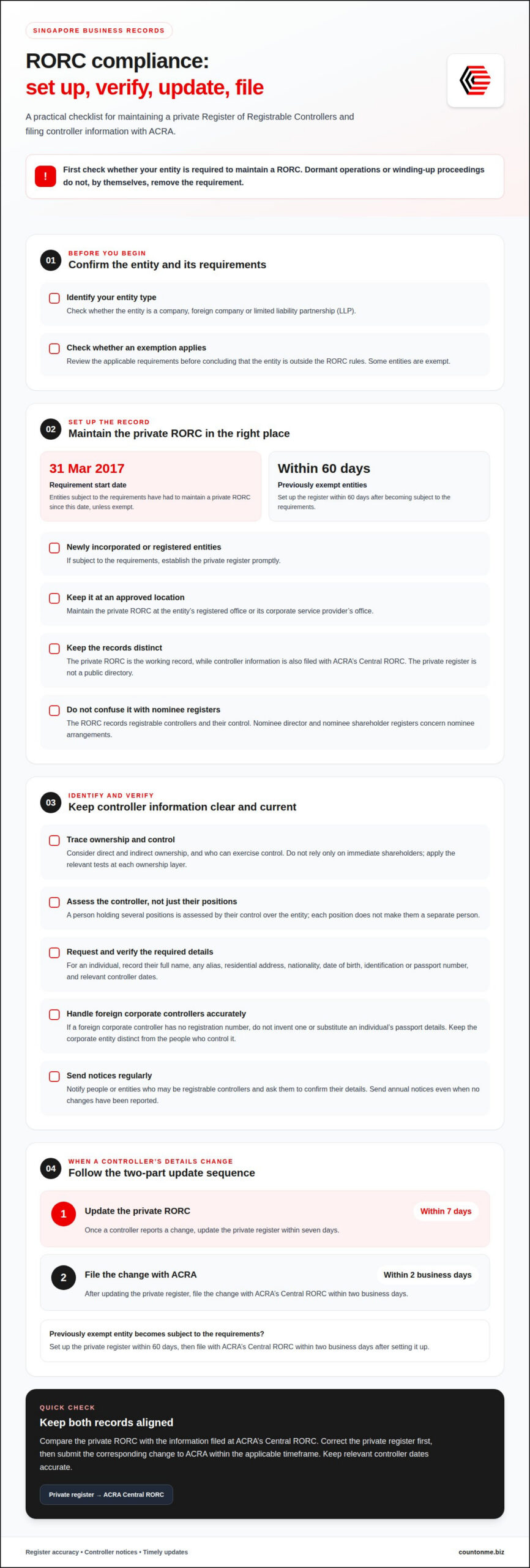
Send notices to people or entities who may be registrable controllers and ask them to confirm their details. Send annual notices even if no changes have been reported. When a controller reports a change, update the private register within seven days, then file the change with ACRA’s Central RORC within two business days.
- Set up the private register on time. Singapore entities subject to the requirements have had to maintain a private RORC since 31 March 2017, unless exempt. Newly incorporated or registered entities should establish their register promptly. A previously exempt entity must set it up within 60 days after becoming subject to the requirements.
- Keep the register at the required location. Maintain the private RORC at the entity’s registered office address or its corporate service provider’s office. This is the working record for the entity’s controller information. Do not confuse it with the filing made to ACRA’s Central RORC.
- Distinguish the RORC from nominee registers. The RORC records registrable controllers and their control over an entity. Nominee director and nominee shareholder registers concern nominee arrangements, rather than serving as another name for the RORC. A person’s position as a director or shareholder alone does not explain the purpose of these separate records.
- Understand where the records are kept. The private RORC is maintained at the registered office or corporate service provider’s office, while controller information is also filed with ACRA’s Central RORC. The private register is not a public directory. Do not treat it as a public lookup tool.
- File after setting up the private register. Businesses required to maintain a RORC must also file information with ACRA’s Central RORC. If a previously exempt business becomes subject to the requirements, it must file with the Central RORC within two business days after setting up its private register.
- Keep both records aligned. When a controller informs the entity of changed details, update the private RORC within seven days. File the change with ACRA within two business days after updating the private register. Annual notices still apply when no changes are reported.
Foreign controller without a registration number?
Identify each person or entity that meets the applicable ownership or control test. Record the details required for that controller, and keep the private register consistent with the information filed with ACRA’s Central RORC.
-
Determine Who Qualifies as a Registrable Controller
Trace direct and indirect ownership, then consider who can exercise control over the entity. A person or entity may qualify through ownership or control, so don’t rely only on the names of immediate shareholders. Apply the relevant test at each ownership layer and record the basis for identifying each controller.
If a person holds several positions, assess their control over the entity rather than treating each position as a separate person. The applicable ownership and control thresholds determine who is registrable. Apply those tests consistently to individuals and corporate entities.
-
Gather Controller Details
Request the required information from each identified controller and compare it with the entity’s existing records. For an individual, the private register must include their full name, any alias, residential address, nationality, date of birth, identification or passport number, and relevant controller dates.
If a foreign corporate controller has no registration number, don’t invent one or use an individual’s passport details as a substitute. Keep the controller’s identity separate from the people who ultimately control it, and gather the information needed to identify the corporate entity and assess its control relationship.
-
Record Individual and Corporate Information
Use a clear, separate entry for each registrable controller. For an individual, include every required detail, including relevant controller dates. For a corporate controller, distinguish the entity from its owners or other controllers, and record its relationship to the Singapore entity without treating it as an individual.
If a foreign entity has no registration number, don’t guess or enter a fabricated identifier. Keep supporting identity information consistent between the private register and Central RORC filing. This makes it easier to identify which record needs correction if details change.
- Correct errors and keep past controller dates accurate. Compare the private RORC with the information filed at ACRA’s Central RORC. Correct any error in the private register, then file the corresponding change with ACRA within two business days after the update. If a controller reports changed details, update the private register within seven days.
Keep relevant controller dates accurate when a person or corporate entity’s status changes. Annual notices still help confirm details, even when controllers report no changes. For support maintaining these records and related corporate secretary processes, explore corporate secretary services.
Exemptions for local companies, foreign companies and LLPs
Check the exemption schedule for your entity type before deciding whether it must maintain a RORC. Exemption does not remove every filing obligation.
- Identify your entity’s legal form. Distinguish a Singapore-incorporated company, a foreign company registered in Singapore, and a limited liability partnership (LLP). Exemption provisions differ by entity type. Don’t apply an LLP rule to a company, or a company rule to an LLP, simply because both operate in Singapore.
For a company, consult the Fourteenth and Fifteenth Schedules of the Companies Act. For an LLP, consult the Sixth Schedule of the Limited Liability Partnerships Act. These schedules set out the respective RORC exemptions.
- Match the entity against the relevant schedule. Read the applicable schedule in light of the entity’s legal category and circumstances. A company should assess the Fourteenth and Fifteenth Schedules, while an LLP should assess the Sixth Schedule. Don’t assume exemption based only on an entity’s name, ownership structure or business activity.
For example, an LLP should be assessed under the Sixth Schedule, not the Companies Act schedules. A company should start with the Companies Act provisions. The legal form determines which schedule to assess, and the schedule determines whether an exemption applies.
- Record the basis for the exemption decision. Keep a clear internal note identifying the entity type and schedule assessed. Record the specific category relied on and the facts supporting that classification. This creates a practical record for future filings or changes in the entity’s circumstances.
Don’t treat a past exemption decision as permanent without reassessing the relevant facts. If the entity’s status or circumstances change, revisit the applicable schedule. If it no longer meets an exemption, it may become subject to RORC requirements.
- Notify ACRA of exempt status. An entity exempt from Singapore RORC requirements must inform ACRA of its exemption status. It must also declare the exemption when filing annual returns or annual declarations. Manage both obligations: keep ACRA informed of the status and include the declaration in the relevant annual filing.
For a company, the relevant filing is the annual return. For an LLP, it is the annual declaration. Use the filing that applies to the entity and ensure the exemption declaration matches its status.
- Reassess before each relevant filing. Before submitting an annual return or annual declaration, confirm that the entity still meets the exemption category relied on. An entity that no longer qualifies should not continue declaring an exemption. Review the legal form, applicable schedule and supporting facts together.
If the entity becomes subject to RORC requirements, follow the setup and filing steps for newly required entities. Keep the exemption assessment and annual declaration consistent to avoid a mismatch between the entity’s recorded status and its obligations.
How do I fix a mistake in my RORC filing?
Correct the private register first, then file the updated information with ACRA’s Central RORC. The deadlines differ depending on whether you’re setting up the register or reporting a change.
- Set the applicable deadline. Newly incorporated or registered entities should establish their RORC promptly. An entity that becomes subject to the requirements after an exemption should set up its private register. If a controller informs the entity of changed details, update the private register within seven days.
After updating the private register, file the change with ACRA’s Central RORC within two business days. A previously exempt entity must also file with the Central RORC within two business days after setting up its private register. These deadlines cover different steps, so don’t treat them as interchangeable.
- Locate the exact error. Compare the private register with the information filed at ACRA’s Central RORC. Identify whether the mistake concerns a controller’s identity, recorded details or relevant dates. Note the incorrect entry and the information that should replace it. This helps prevent a partial correction that leaves the records inconsistent.
For example, if a controller’s address is incorrect, identify the affected controller and correct that record. If the controller has since reported another change, distinguish the earlier error from the new information. Make sure the correction relates to the right person or corporate entity.
- Correct the private register. Enter the accurate information in the entity’s private RORC before submitting the corresponding change to ACRA. Check that the corrected details match what the controller reported. Preserve relevant controller dates and avoid changing unrelated entries.
If a controller reported the change, the seven-day update period starts from that notification. The private register should contain the accurate information needed for the subsequent Central RORC filing.
- Submit the corrected information to ACRA. Once the private register is updated, file the corresponding change with ACRA’s Central RORC within two business days. The entity must maintain both records, so correcting only the private register does not complete the update. Keep the filing consistent with the corrected entry.
- Separate filing fees from service costs. A specific current ACRA filing fee isn’t available in the facts provided here, so don’t rely on an invented amount. For professional service costs, the price depends on the case and is given after a quote request. The correction required, affected entries, and records needing reconciliation shape the work.
After filing, keep the updated private register and related filing information together. This makes it easier to trace what changed and keep future controller updates consistent.
Get support with corporate secretary services
Count On Me
Count On Me’s Corporate Secretary services support the corporate administration involved in maintaining controller records and managing related filing steps. If a controller’s details have changed, an entry needs correction, or you’re unsure how an exemption affects your records, Count On Me can help you organize the next steps. Its Cloud Accounting & Bookkeeping, Payroll Management Solutions, and Tax Compliance & Advice also support related business administration. Contact Count On Me to discuss your company’s corporate record-keeping needs.
Make RORC care part of your governance routine
Controller records are easier to maintain when updates are part of ordinary business administration. Treat changes in ownership, control or contact details as prompts to review the Singapore register of registrable controllers. This turns corrections into a defined process rather than an unexpected scramble.
Count On Me’s Cloud Accounting & Bookkeeping, Payroll Management Solutions, and Tax Compliance & Advice support other core business administration. For corporate record-keeping, its Corporate Secretary services can help you manage processes related to your company’s compliance responsibilities.
You don’t need to wait for a filing mistake to make your record-keeping process clearer. Discuss the controller records or filing issue you’re handling with Count On Me and decide what support would be useful.
With a clear process in place, you can handle the next update with greater confidence.
Frequently Asked Questions
Do I need to file separate updates if my controller holds multiple positions?
No. Don’t create duplicate controller entries solely because one person holds multiple positions. Keep the person’s identity clear and ensure the register reflects their relevant control relationship with the entity. For example, if the same person is both a director and shareholder, assess their control rather than treating each role as a separate person. File changes to controller information when required.
Do I need to update information for controllers who have left?
Yes. If someone stops being a controller, update the record to reflect the change and retain the relevant controller dates. This distinguishes a former controller from someone who still has control. If the controller reports the change, update the private register within seven days, then file it with ACRA’s Central RORC within two business days after the update.
What is Singapore’s Register of Registrable Controllers (RORC)?
Singapore’s RORC records information about individuals and entities with significant ownership or control over a business. It comprises the entity’s private register and information filed with ACRA’s Central RORC. For example, a company with a corporate controller should record that entity separately from any individuals who may control it. The RORC is separate from registers concerning nominee directors or nominee shareholders.
Which Singapore companies and other entities must maintain a register of registrable controllers?
Singapore companies, foreign companies registered in Singapore, and LLPs must assess whether they are required to maintain a RORC. Exemptions depend on entity type: company exemptions are set out in the Fourteenth and Fifteenth Schedules of the Companies Act, while LLP exemptions are in the Sixth Schedule of the Limited Liability Partnerships Act. An exempt entity must inform ACRA and declare its exemption in the relevant annual filing.
What information must be recorded for each registrable controller in Singapore?
For an individual controller, record their full name, any alias, residential address, nationality, date of birth, identification or passport number, and relevant controller dates. For a corporate controller, keep its identity distinct from the individuals behind it and record information that identifies the entity and its control relationship accurately. Don’t invent a registration number if a foreign corporate controller has none.
How and where must Singapore entities keep their RORC, and can it be maintained electronically?
Keep the private RORC at the entity’s registered office or its corporate service provider’s office. The register must remain distinct from the information filed with ACRA’s Central RORC. The location requirement also applies when using electronic records: keep the register accessible at the required location rather than assuming that an electronic copy stored elsewhere meets the requirement.