
Keeping accounting in-house may not be the most practical choice for a growing SME. Whether outsourced accounting is worth it for SMEs in Singapore depends on your workload, the financial control you need day to day, and the expertise required for compliance and tax. Outsourcing can make sense when you need dependable support without building a full internal finance function. An in-house team may suit a business with enough ongoing work to keep dedicated staff occupied.
It is sensible to weigh the cost carefully: accounting affects cash flow, business decisions and deadlines, so the right setup should do more than keep records current. This article compares outsourced and in-house accounting, explains what outsourced services can cover, and shows how compliance and tax expertise factor into the decision.
We’ll look at the practical trade-offs, from bookkeeping and payroll to reporting and tax support, so you can assess which approach fits your SME’s needs now and as they change.
Key Takeaways
- Compare the full cost and scope of outsourced support with the resources needed to maintain an in-house team.
- As your business grows, a hybrid approach can pair internal financial oversight with external accounting support.
- Outsourced accounting may cover bookkeeping, reporting, payroll and tax tasks, depending on your business needs.
- Accurate records and familiarity with Singapore’s reporting requirements help support timely, compliant financial submissions.
- Access to accounting and tax expertise can help you make informed decisions while keeping your finance operations adaptable.
Outsourced vs In-House Accounting for Singapore SMEs
For Singapore SMEs, the choice depends on transaction volume, the level of internal control you need, and the work your finance operations require. A hybrid setup can combine internal oversight with flexible external support.
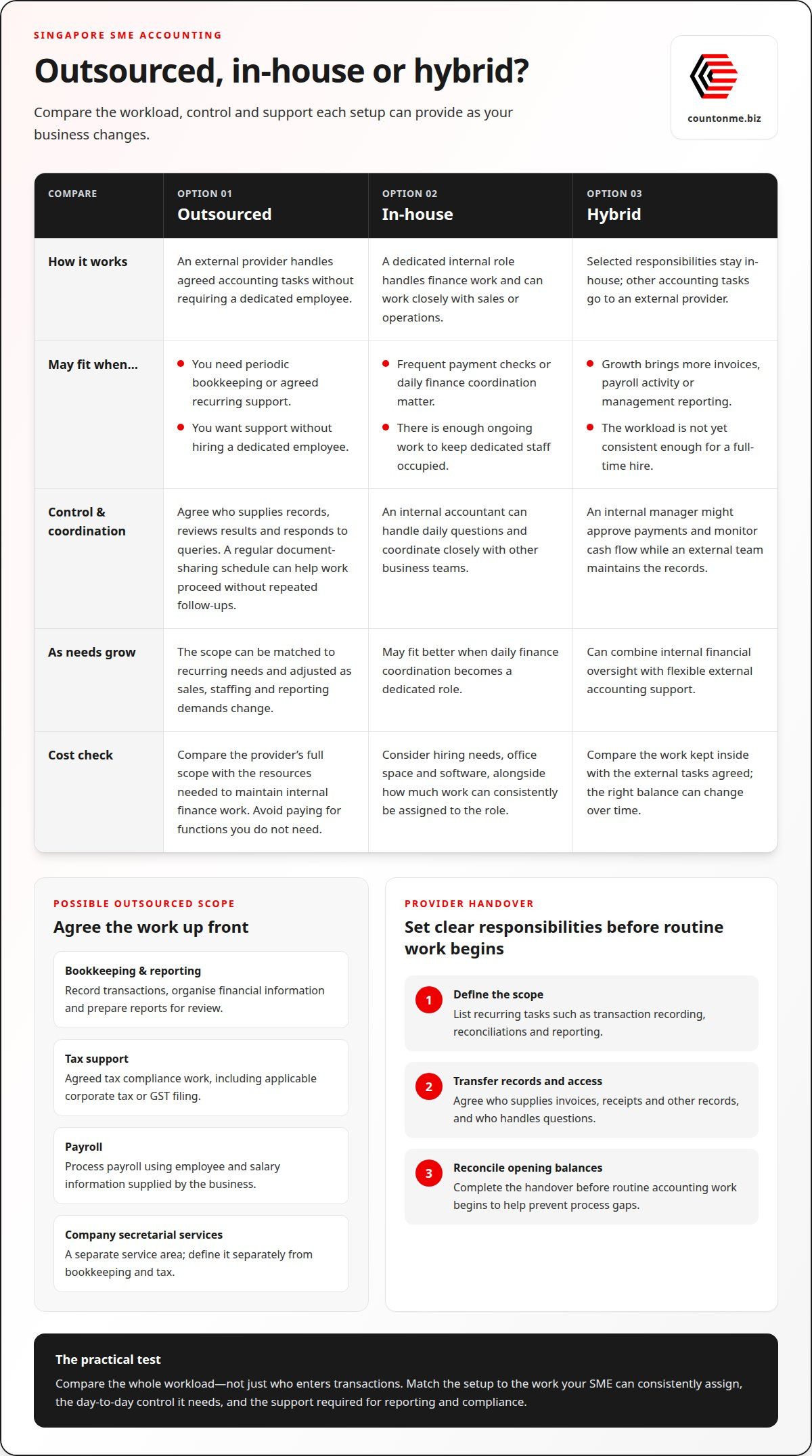
Compare the whole workload, not just who enters transactions. An in-house accountant can handle daily questions and work closely with sales or operations. An outsourced provider can take on agreed accounting tasks without requiring you to hire a dedicated employee. A business that checks payments frequently may value having someone internally, while one needing periodic bookkeeping may prefer external support. The right balance can change as sales, staffing and reporting demands grow.
Hybrid and In-House Accounting as Businesses Grow
A hybrid model keeps selected finance responsibilities in-house and assigns other accounting tasks to an external provider. It can work well when growth brings more invoices, payroll activity or management reporting, but not enough consistent work for a full-time hire. An internal operations manager might approve payments and monitor cash flow while an external team maintains the records. In-house accounting may fit better when daily finance coordination becomes a dedicated role.
Choosing an Outsourced Accounting Provider
Choose a provider whose scope matches your actual workload, rather than paying for functions you don’t need. List recurring tasks, such as transaction recording, reconciliations and reporting, then agree who supplies records, reviews results and handles queries. A switch typically involves defining the scope, transferring accounting records and access, and reconciling opening balances before routine work begins. Clear handover responsibilities help prevent gaps between the old and new processes.
Owner Focus and Time Efficiency
Outsourcing can free up time spent on bookkeeping and routine reconciliations for other business priorities. An owner who sorts sales receipts each week, for example, could focus instead on customer experience, product development or market expansion. The efficiency gain comes from removing recurring work, not merely shifting it between people. Set a regular schedule for sharing documents and resolving questions so records can be processed without repeated follow-ups.
In-House Accountant Costs
These figures help answer the cost question, but a fair comparison should also account for office space, software and hiring needs. Consider how much work your SME can consistently assign to the role.
Outsourced accounting services and responsibilities
Outsourced accounting can cover recurring finance work, giving Singapore SMEs support without assigning every task to an employee. The scope depends on the business’s records, transaction patterns and reporting needs. Agreeing responsibilities at the outset helps prevent duplicated work or gaps, especially when accounting, tax and payroll involve different information and deadlines.
A typical arrangement may include bookkeeping, financial reporting, tax compliance and payroll processing. A business might send sales and expense records for bookkeeping and receive reports to help track income and costs. Payroll support can process employee pay and related records. GST and corporate tax filing may also be included, depending on the agreed scope and the company’s requirements.
These services work best with a clear handover. The business supplies complete records, such as invoices, receipts and payroll changes, while the provider processes the agreed tasks and raises queries about missing information. A monthly close process, for example, brings transaction entries and reconciliations together before reports are prepared. This makes it easier to see who handles each part of the workflow.
- Bookkeeping and reporting: Record transactions, organise financial information and prepare reports for review.
- Tax support: Prepare and handle agreed tax compliance work, including applicable corporate tax or GST filing.
- Payroll: Process payroll using the employee and salary information supplied by the business.
- Company secretarial services: Support company secretarial requirements as a separate service area from bookkeeping and tax.
Accounting services can be combined to suit the business rather than bought as one broad package. A company with an internal finance employee may outsource specialist tax work, while a smaller team may need regular bookkeeping and payroll support. This flexibility matters because hiring for every capability can be costly when the workload is uneven. Choose a scope that covers recurring needs without adding unrelated work.
Company secretarial services should be considered separately from accounting because their tasks and scope differ. They may be arranged alongside accounting services, but responsibilities should remain clear. Specify whether the provider is handling bookkeeping, payroll, tax compliance, company secretarial support, or a defined combination. This makes the arrangement easier to understand and manage.
For businesses that want consistent bookkeeping and digital records, cloud accounting and bookkeeping can form part of an outsourced setup. The agreed scope should state which records the business supplies, what work is processed and which reports it receives.
Regulatory compliance and accounting standards
For Singapore SMEs, outsourced support can help organise reporting and tax work, but responsibilities still need to be clear. Accurate records give owners a stronger basis for business decisions and compliance submissions.
Financial Reporting and Tax Compliance
Financial reporting summarises a company’s transactions and position, while tax compliance involves preparing and submitting relevant tax information. Both depend on complete records, including sales, expenses and supporting documents. A missing supplier invoice, for example, can affect recorded expenses and the figures used in tax preparation. A defined review process helps catch gaps before accounts and returns are finalised.
GST returns may be part of outsourced accounting. The provider needs timely sales and purchase records to prepare a return, while the business remains responsible for supplying accurate information about its transactions. A practical monthly routine is to reconcile invoices and payments, identify missing documents, and resolve discrepancies before filing work proceeds. This keeps reporting connected to the underlying records.
Singapore Regulatory Requirements
Singapore company financial statements must follow Financial Reporting Standards established and implemented by the Accounting Standards Council. Applying the relevant standards consistently helps make reporting more reliable across accounting periods. An outsourced accountant can organise records and prepare statements using the required framework. Clear review responsibilities help the business understand the figures before submission.
Tax compliance also depends on the business sharing accurate information about revenue, expenses and relevant transactions. A provider can help prepare submissions and flag inconsistencies in the records, but the working arrangement should specify who reviews figures and approves information. This is especially useful when a company changes its accounting process or adds revenue streams, as both can affect how transactions are recorded.
Outsourcing does not remove operational risks. Incomplete handovers can interrupt service, incorrect source records can lead to inaccurate reports, and weak access controls can expose sensitive financial data. A sound arrangement defines who can access records, how changes are communicated, who reviews completed work, and how files are transferred if responsibilities change. These steps support security, accuracy and continuity without assuming that outsourcing alone prevents errors.
If a sales receipt is missing, for example, the provider may not be able to reconcile the related transaction promptly. If one employee holds all accounting credentials, their departure can disrupt access. Assigning appropriate access, keeping records organised, and documenting review and handover steps can reduce these avoidable risks. Businesses should also retain visibility of their financial records and understand who handles each compliance task.
For GST and tax work, responsibilities should be clear from preparing records through to review and submission. A written scope can identify the records the business supplies, the work the provider completes, and the person who approves the final figures. This helps keep financial reporting and tax compliance connected to accurate, traceable source records.
Access to accounting and tax expertise
Outsourcing can give Singapore SMEs access to accounting expertise without hiring every specialist internally. That matters when a startup needs dependable bookkeeping but does not yet have enough work for a dedicated finance team. As the business grows, its needs may shift towards tax planning, management reporting or closer financial oversight. External support can adapt to those changing needs while owners retain responsibility for business decisions. For SMEs considering whether outsourced accounting is worth it in Singapore, the expertise needed today is a useful starting point.
Expertise is valuable when everyday records raise questions beyond data entry. A business expanding its services, for example, may need to distinguish new revenue streams and organise supporting records consistently. An accounting professional can help apply sound accounting practices, identify missing documentation and prepare clearer reports. This gives owners better information for decisions than an unreconciled spreadsheet.
Tax knowledge can help a business understand what information matters for preparation and filing. Support may include tax planning, preparation and filing, as well as advice on applicable tax incentives and ways to reduce tax liabilities. The practical value is in understanding how records and business activity relate to tax work. The business still needs to provide complete information and make decisions based on its circumstances.
Some outsourced accounting arrangements have a team of 2 to 3 people overseeing a client’s portfolio. This can provide access to different perspectives across recurring work, rather than relying on one employee for every finance task. For a growing SME, that can be useful when bookkeeping, reporting and tax questions arise together. Agreeing who handles each task and who answers queries keeps the support coordinated.
The right level of expertise depends on the work, not just the company’s size. A startup may need bookkeeping and help organising financial records, while a growing enterprise may need more frequent reporting or strategic financial input. Define a core scope first, then add support as transaction volume and decision-making needs change. This connects spending to actual requirements and makes potential savings easier to assess, helping clarify whether outsourced accounting is worth it for SMEs in Singapore.
Expert advice is most useful when it leads to clear action. Regular reports can help an owner compare revenue and expenses, spot changes in cash flow, and decide whether to delay or prioritise planned spending. On-demand CFO support can add a strategic perspective without replacing the owner’s control. The benefit comes from applying financial insight to a specific business question.
To make the relationship productive, establish a regular process: share records on schedule, raise questions early, review reports, and clarify who handles each follow-up. These habits help an external team understand the business’s practices and keep its advice relevant to current operations. For SMEs weighing hiring costs against the expertise they need, this makes the decision more concrete.
Count On Me: Cloud Accounting & Bookkeeping
Count On Me supports Singapore SMEs with cloud accounting and bookkeeping to organise financial records and keep routine accounting work moving. Its services also include payroll management, tax compliance and advice, and corporate secretary services.
This support may suit you if bookkeeping is taking time away from operations, your finance workload is changing, or you want accounting and related responsibilities handled within a coordinated scope. You stay involved in business decisions while the agreed services address the finance tasks you need help with.
Contact Count On Me to discuss your accounting needs.
Make your next finance decision with clarity
Deciding whether outsourced accounting is worth it for SMEs in Singapore comes down to the role you need finance to play next. Before changing your setup, identify the decisions you want better financial information to support, such as planning a new hire, managing cash flow or assessing expansion. This gives you a practical way to judge whether your current arrangement is helping the business move forward.
Then decide what to keep in-house and which recurring tasks could sit with an external team. A clear division of responsibilities can preserve your oversight while making finance tasks easier to manage as priorities shift. The right arrangement should fit how your business operates, not force you into a fixed model.
A considered next step can make your financial processes more useful as your business grows. Choose a setup that supports your goals and leaves room to adapt.
Frequently Asked Questions
What are the typical accounting fees for small businesses in Singapore?
Accounting fees depend on the work included, transaction volume, reporting frequency and any payroll or tax support required. Company secretarial work has a separate scope, so it may affect the overall engagement differently from bookkeeping. For a useful comparison, define the tasks and expected outputs first, then request a quote based on those needs. Avoid comparing a basic bookkeeping scope with a package covering several finance functions.
How does outsourced accounting help SMEs manage compliance risks?
Outsourced accounting can support compliance by bringing structure to recordkeeping, reconciliations and submission preparation. A business can set a monthly document handover and assign someone to review reports before they are used for tax work. Clear access permissions and an approval trail also help show who changed or reviewed financial records. Outsourcing does not remove the need for accurate source documents or clear accountability within the business.
What are the main advantages of outsourcing accounting functions for SMEs?
The main advantages are flexible access to accounting support, less need to recruit for every finance task, and more owner time to run the business. Outsourcing can also bring consistency to recurring work, such as reconciling transactions or preparing management information. An SME can keep payment approvals in-house while assigning record processing externally, for example. The benefit depends on matching the scope to actual workload, not outsourcing tasks without a clear need.
What does outsourced accounting typically cost for SMEs in Singapore?
There is no standard fee for outsourced accounting. The cost depends on transaction volume, company requirements, payroll needs and the services included. A quote should clearly set out the scope, including recurring tasks, reporting outputs and any separately charged work. Compare the total cost of the service arrangement you need, rather than relying on an entry price that may cover only part of your accounting workload.
What accounting services do Singapore outsourcing firms typically include in their fees?
Fees may cover bookkeeping, account reconciliations and financial statements, with payroll processing or tax compliance included in some scopes. One business might need bookkeeping but manage payroll internally, while another may want both functions coordinated. GST or corporate tax filing may also be included in an engagement. Confirm which tasks, reports and review responsibilities the fee covers, as inclusions differ between service arrangements.
How does outsourced accounting compare with in-house accounting for Singapore SMEs?
In-house accounting gives you closer day-to-day access to a staff member, while outsourcing provides support within an agreed scope without hiring a dedicated employee. A hybrid arrangement may suit an SME that wants internal control over approvals but external help with reconciliations or reporting. Compare how quickly each setup can answer operational questions, cover routine work, and adapt as transaction volume or reporting needs change.