

Imagine sitting in a meeting with a Tier-1 VC at a cafe in Telok Ayer. When they ask how your 2026 burn rate accounts for the latest CPF statutory rates or the upcoming EDGE scheme consolidation, you don’t feel that familiar knot of anxiety in your stomach. Instead, you answer with quiet confidence because you’ve mastered your numbers. We understand that building a business in Singapore is exhilarating, but the financial side often feels like a heavy weight. You’re likely worried about running out of runway or feeling lost when trying to explain complex tax exemptions like SUTE to potential investors. It’s completely normal to feel overwhelmed by the technicalities of financial modeling for startups Singapore while you’re busy trying to innovate.
This guide is here to be your supportive roadmap. We’ll help you master the art of startup financial modeling so you can secure funding and manage your cash flow with total clarity. We’ll walk through how to build a robust 18-24 month forecast, integrate local costs like the 9% GST and corporate tax rebates, and use your model as a strategic tool for growth. By the time you’re finished reading, you’ll have the tools to navigate Singapore’s unique business ecosystem with confidence and precision.
Key Takeaways
- Understand why a robust financial model is your most persuasive tool when pitching to local VC networks for Seed and Series A rounds.
- Learn to build a logic-based revenue forecast that links your customer acquisition costs directly to your future growth projections.
- Discover the difference between top-down and bottom-up modeling to ensure your 18-24 month roadmap is grounded in operational reality.
- Master the nuances of financial modeling for startups Singapore to accurately account for local specifics like the 9% GST and current statutory CPF rates.
- Identify the right moment to scale your financial strategy by moving from DIY spreadsheets to professional on-demand CFO advisory.
Why Every Singapore Startup Needs a Robust Financial Model
A robust financial model is essentially a mathematical translation of your startup’s vision. It captures your past performance, your current standing, and your future aspirations in a single, dynamic document. Think of it as a living map for your business. Without it, you’re essentially flying blind through the complex humidity of the Singaporean market. We’ve seen many founders treat their model as a one-time chore for a pitch deck, but it’s actually the heartbeat of your strategic planning. It helps you understand the “why” behind your numbers, turning abstract goals into a concrete, actionable roadmap for hiring, marketing spend, and product development.
The Investor Narrative: Winning Over Singapore VCs
When you’re pitching to local VC networks or angel groups, they’re looking for more than just a great idea. They want proof that your unit economics actually scale within the Southeast Asian market. Your model tells this story. It shows you’ve engaged in rigorous scenario analysis, proving you have a plan for when market volatility hits. In the current 2026 funding climate, investors are laser-focused on your burn rate and runway. They want to see exactly how many months of life your business has before the next capital injection is required. By prioritizing financial modeling for startups Singapore, you demonstrate that you aren’t just a founder with a dream, but a leader with a calculated plan.
Operational Clarity and Cash Flow Management
Beyond the glitz of fundraising, a model brings sanity to your day-to-day operations. It helps you move away from “gut feeling” decisions that often lead to expensive mistakes. Instead, you’ll identify the key drivers that actually move the needle for your specific industry. This level of data-driven clarity ensures your cash flow remains healthy enough to never miss a payroll disbursement or a critical tax deadline. It’s about building a foundation of stability so you can focus on innovation.
Maintaining this clear view also helps you stay on the right side of ACRA requirements. By having a constant pulse on your solvency and capital structure, you’re protecting your company’s legal standing while building a foundation for sustainable growth. It’s about turning financial modeling for startups Singapore from a stressful obligation into your most powerful strategic asset for the years ahead.
Core Components of a Startup Financial Model
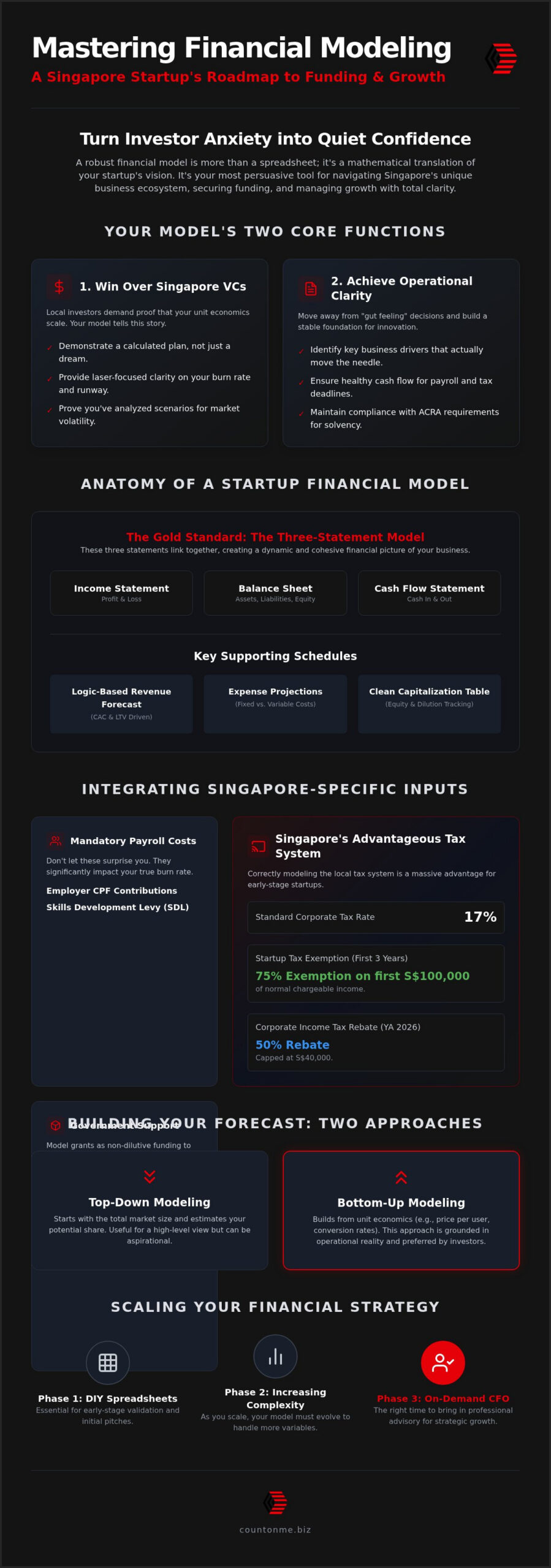
Building a robust financial model isn’t just about plugging numbers into a spreadsheet. It’s about creating a cohesive system where every part of your business speaks to the other. The gold standard for this is the Three-Statement Model. By linking your Income Statement, Balance Sheet, and Cash Flow Statement, you ensure that a surge in sales automatically reflects in your cash position and tax liabilities. This interconnectedness is what transforms a simple list of guesses into a professional tool for financial modeling for startups Singapore.
Your revenue forecast needs to be logic-based rather than aspirational. We recommend building your projections around your Customer Acquisition Cost (CAC) and Lifetime Value (LTV). This allows you to see exactly how much capital you need to “buy” your next hundred customers. On the flip side, your expense projections must distinguish between fixed costs, like your WeWork desk, and variable costs that scale with your user base. Don’t forget to maintain a clean Cap Table within your model to track equity, options, and potential dilution through your next funding rounds.
Singapore-Specific Inputs: CPF, Grants, and Tax
When you’re refining your financial modeling for startups Singapore, you can’t ignore the local nuances. You must factor in employer CPF contributions at the current statutory rates and the Skills Development Levy (SDL) for your local team. These small line items can significantly impact your true burn rate if left out. We also suggest accounting for government support. For instance, treating the Enterprise Development Grant as non-dilutive funding can provide a much clearer picture of your actual runway.
Singapore’s tax system is a massive advantage for young companies, but only if you model it correctly. While the corporate tax rate is a flat 17%, qualifying startups receive a 75% tax exemption on the first S$100,000 of normal chargeable income for their first three years. For the Year of Assessment 2026, you should also include the 50% corporate income tax rebate, capped at S$40,000. If these calculations feel like a distraction from your core mission, our Startups Package can help you integrate these local specifics seamlessly into your strategy.
Unit Economics and SaaS Metrics
Investors in 2026 are looking for efficiency. You need to break down your Cost of Goods Sold (COGS) with precision, especially if you’re balancing digital hosting fees with physical logistics. Calculating your “Magic Number” helps you determine if your sales and marketing spend is actually generating enough new revenue to justify the investment. By focusing on your Gross Margin early, you prove to late-stage investors that your business model is inherently profitable and ready for global expansion. If your strategy involves scaling into foreign jurisdictions, Pactum Global provides the specialized legal structuring needed for international success.
Building Your Model: Top-Down vs. Bottom-Up Approaches
Choosing how to structure your projections is a major fork in the road for most founders. Top-down modeling starts with the “big picture,” looking at the total addressable market (TAM) and estimating what tiny slice you might capture. While it’s helpful for long-term vision, it often feels a bit too abstract for a Series A pitch. On the other hand, bottom-up modeling starts with your actual operational reality. You look at your website traffic, your conversion rates, and how many leads your sales team can realistically handle in a month. This is the level of detail that proves you understand your business’s engine. This alignment is a key reason Why Every Singapore Startup Needs a Robust Financial Model, as it mirrors the strategic precision encouraged by Singapore’s broader economic growth plans.
In our experience, Singaporean investors almost always prefer the bottom-up approach. It shows them that you aren’t just dreaming; you’re planning. Once you’ve built your model, we always recommend a “Sanity Check.” Compare your projections against industry benchmarks for Singapore SMEs to ensure your growth rates and margins aren’t detached from reality. This stage of financial modeling for startups Singapore is where you turn a spreadsheet into a credible story that VCs can get behind.
Step-by-Step: Creating Your First Model
- Step 1: Gather historical data from your cloud accounting software to ensure your starting point is accurate.
- Step 2: Define your core revenue assumptions, such as your Average Revenue Per User (ARPU) and monthly churn.
- Step 3: Build a personnel plan that includes Singapore-specific hiring costs and current employer CPF contributions.
- Step 4: Create “Base,” “Best,” and “Worst” case scenarios to prepare for market shifts.
Excel vs. Dedicated Modeling Software
We often get asked if Excel is still the way to go. For many, the flexibility of a bespoke spreadsheet is hard to beat, especially when you’re dealing with unique Singaporean business models. However, as you scale, you might want to transition to automated forecasting tools that sync directly with Xero. These tools save time, but technical proficiency in Excel remains a “must-have” skill for anyone leading financial modeling for startups Singapore. It’s about having the right tool for your current stage of growth.
Just as mastering digital tools is essential for founders, ensuring a strong grasp of mathematical logic—often through specialized support like Learning Voyage Education Centre—is what builds the analytical confidence required for high-level financial strategy.
Explore our on-demand CFO services for expert modeling support
Scaling with On-Demand CFO Support
Knowing when to step away from the spreadsheet and into a partnership is a pivotal moment for any founder. While DIY efforts are great for getting off the ground, professional on-demand CFO support bridges the vital gap between basic bookkeeping and high-level strategy. This transition ensures your financial modeling for startups Singapore isn’t just an exercise in data entry, but a strategic asset that evolves with your business. By integrating your model with monthly bookkeeping, you create “Living Forecasts” that reflect real-time performance rather than outdated guesses.
Working with an expert also helps you sidestep common startup accounting mistakes that often trip up early-stage companies. Whether it’s misclassifying expenses or failing to account for deferred revenue, these errors can distort your model and spook potential investors. Having a seasoned professional oversee your numbers provides a sense of stability and quiet confidence, allowing you to focus on what you do best: building your product and leading your team.
The Count On Me Approach: Collaborative Innovation
We believe that financial expertise should be accessible and supportive, not cold or detached. Our specialized “Startups Package” is designed to provide the foundational modeling needed for sustainable growth. We leverage cloud-based accounting and advisory services to automate your data flow, ensuring your model is always fed with accurate, up-to-date information. This collaborative approach moves you beyond mere compliance, opening doors to strategic business valuation and long-term exit planning.
Preparing for Your Next Funding Round
When you enter a room for a Series A pitch, the due diligence process can be intense. Investors will poke holes in your assumptions and test the limits of your projections. A professional CFO acts as your ally, helping you defend your logic and explain the nuances of your unit economics with ease. They ensure you’re prepared for the technical scrutiny of Singaporean VCs, turning a stressful Q&A into a demonstration of your operational mastery. Before you book that next investor meeting, use this final checklist to see if your model is truly ready:
- Reality Check: Do your growth rates align with current Singapore SME benchmarks?
- Statutory Accuracy: Are employer CPF contributions and the 9% GST correctly integrated?
- Scenario Depth: Have you modeled a “Worst Case” scenario that maintains at least 6 months of runway?
- Integrity: Does your Balance Sheet link perfectly with your Cash Flow Statement?
Mastering financial modeling for startups Singapore is a journey, but you don’t have to walk it alone. With the right tools and a supportive partner, your numbers can become the most powerful part of your success story.
Securing Your Startup’s Financial Future in 2026
You now have the roadmap to turn financial uncertainty into a strategic advantage. By moving from a “gut feeling” approach to a robust bottom-up model, you’re giving your business the clarity it needs to thrive. Mastering financial modeling for startups Singapore is a continuous conversation between your current data and your future goals; it’s the bridge that connects your vision to investor confidence. When you accurately account for local nuances like current statutory CPF rates and the latest tax rebates, you’re building a foundation that can withstand market shifts.
Whether you’re navigating your first seed round or preparing for a Series A, you don’t have to handle the complexity alone. Our team brings over 20 years of professional expertise and a specialized focus on Xero and cloud-based automation to help you streamline your growth. We’re here to act as your supportive ally, ensuring every assumption in your model is backed by quiet confidence and technical precision.
Explore our Startups Package and On-Demand CFO Services
Your business is more than just numbers on a screen; it’s a vision that deserves a solid, predictable roadmap. We’re ready to help you build it with the care and expertise your hard work deserves. Let’s take that next step together.
Frequently Asked Questions
What is the difference between budgeting and financial modeling for startups?
Budgeting tracks your historical spending against a fixed plan, while financial modeling for startups Singapore is a forward-looking tool used to simulate different business scenarios. Think of a budget as your guardrails for the present and a model as your GPS for the future. A model allows you to ask “what if” questions about hiring or pricing changes, helping you understand the long-term impact of today’s decisions on your cash runway.
How much does it cost to hire a financial modeling consultant in Singapore?
The cost of hiring a financial modeling consultant in Singapore varies significantly based on the complexity of your business and the consultant’s experience level. Some professionals charge hourly rates, while others offer project-based fees for building a custom model from scratch. Instead of looking for the lowest price, focus on finding a partner who understands the local startup ecosystem and can provide strategic advisory alongside the technical spreadsheet work.
Do I need a financial model if I am bootstrapping my startup?
You absolutely need a financial model even if you aren’t seeking external funding. Bootstrapping requires even tighter control over your cash flow because you don’t have a venture capital safety net to fall back on. A model helps you identify exactly when you’ll reach profitability and ensures you don’t accidentally overextend your resources during a growth spurt. It’s your primary tool for maintaining operational stability while you scale on your own terms.
How often should a Singapore startup update its financial model?
We recommend updating your financial model at least once a month to reflect your actual performance against your projections. This “rolling forecast” approach allows you to spot trends early and adjust your strategy before a small variance becomes a major problem. You should also perform a deeper review whenever you hit a significant milestone, such as a major hiring round, a pivot in your product-market fit, or a shift in local regulations.
Can cloud accounting software like Xero build a financial model for me?
While cloud accounting software like Xero is excellent for tracking historical data and managing daily transactions, it doesn’t build a dynamic financial model on its own. Xero provides the “source of truth” for your past performance, which you can then export or sync with dedicated forecasting tools and spreadsheets. To get the most out of your software, you’ll need to layer strategic assumptions on top of your historical data to create a true forward-looking model.
What are the most common financial modeling mistakes made by Singaporean founders?
One of the most common mistakes is failing to account for local labor costs like current statutory CPF rates and the Skills Development Levy. Many founders also fall into the trap of being too optimistic about their sales cycles or forgetting to factor in the 9% GST on qualifying expenses. These oversights can lead to a “hidden” burn rate that exhausts your cash runway much faster than your financial modeling for startups Singapore originally predicted.