Did you know that the Corporate Income Tax rebate for Year of Assessment 2026 was recently boosted to 50 percent, offering your business a potential saving of up to $40,000? Most founders we speak with find IRAS filing a bit of a headache, especially when trying to decipher which new enhancements apply to their specific situation. It’s completely natural to feel a sense of unease about missing out on vital tax incentives for SMEs Singapore provides to help you scale. You want to focus on your vision, not get lost in a sea of regulatory updates and complex forms.
We’re here to act as your supportive ally in this process. This guide will help you discover the most lucrative tax rebates, exemptions, and grants available for 2026, while providing a clear roadmap on how to claim them. We’ll walk you through the specifics of the Startup Tax Exemption, the minimum $2,000 cash grant for local employers, and the high-impact Enterprise Innovation Scheme. By the end of this article, you’ll have the compliance peace of mind you need to file with confidence and keep your hard-earned capital where it belongs: in your business.
Key Takeaways
- Understand how the flat 17 percent corporate tax rate and enhanced 2026 rebates work together to protect your margins against rising operational costs.
- Identify if your company meets the specific shareholder requirements for the Start-Up Tax Exemption scheme to maximize your early-stage savings.
- Explore the specific tax incentives for SMEs Singapore provides for international expansion, including how to claim double deductions for your overseas activities.
- Learn how to utilize workforce-focused credits to balance fair employee compensation with your company’s long-term financial stability.
- Discover why modern cloud accounting is your best tool for maintaining the precise records needed to claim complex incentives without the stress of manual tracking.
The Singapore Tax Landscape in 2026: Why Incentives Matter Now
Singapore’s flat 17 percent Corporate Income Tax (CIT) rate has long been a beacon of stability for both local and foreign firms. However, even the most stable environments face tests. The 2026 energy crisis has significantly pushed up operational costs, leaving many founders looking for ways to protect their bottom line. Leveraging the right tax incentives for SMEs Singapore offers can turn a challenging year into one of strategic growth. These incentives act as a vital cash flow buffer, helping you absorb rising costs without sacrificing your expansion plans.
As we approach the Year of Assessment (YA) 2026 filing cycle, understanding your options is more critical than ever. The government, supported by agencies like Enterprise Singapore, has introduced specific enhancements to ensure the business ecosystem remains resilient. By staying informed about these changes, you can transform your tax filing from a mandatory chore into a strategic financial advantage for your company.
The Enhanced CIT Rebate for YA 2026
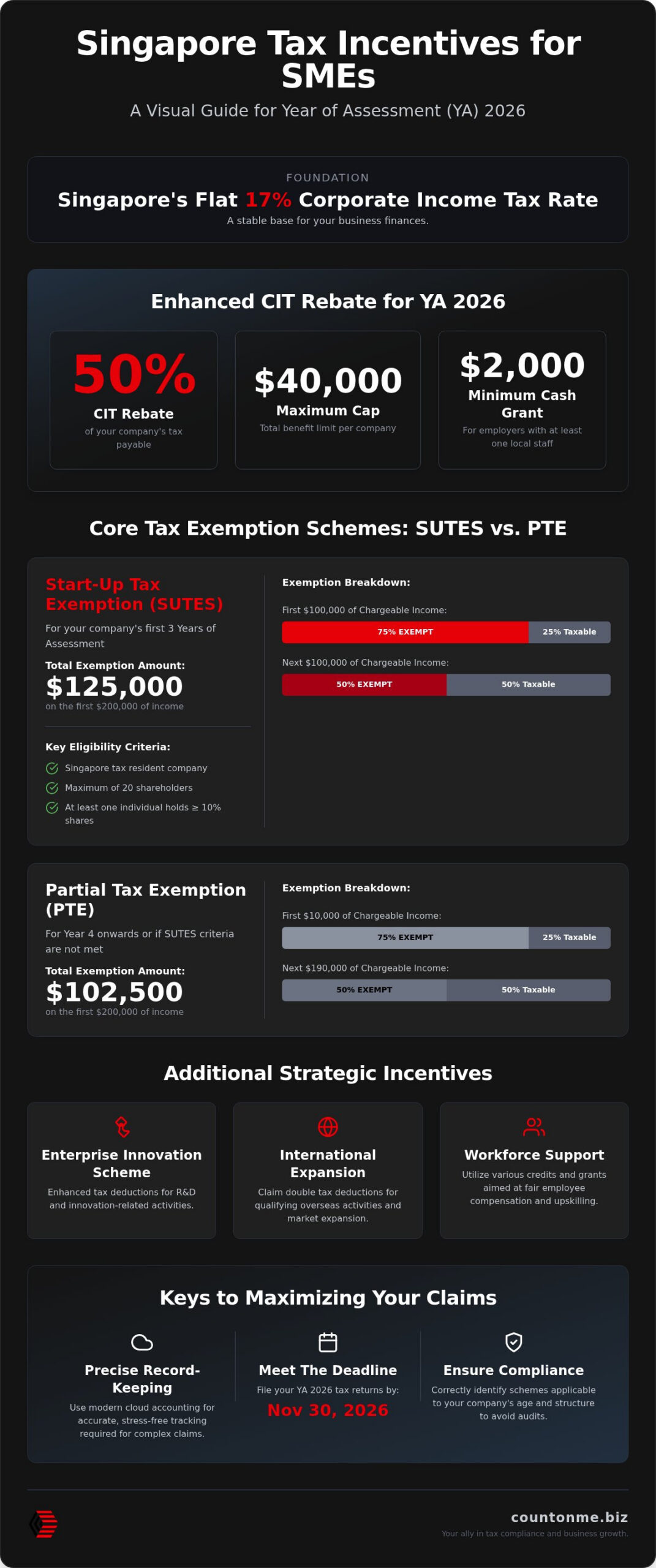
The headline support for this cycle is the enhanced CIT Rebate. For YA 2026, the rebate has been increased to 50 percent of your tax payable, up from the previously announced 40 percent. This 50 percent rebate is subject to a maximum benefit cap of $40,000. It’s a broad-based incentive, meaning most companies that are tax resident in Singapore will qualify. This direct reduction in your tax bill is one of the most effective tax incentives for SMEs Singapore provides to provide immediate financial relief and reward business efficiency.
The 2026 CIT Rebate Cash Grant
If your company focuses on local talent, you’re eligible for additional support through the CIT Rebate Cash Grant. Companies that employed at least one local employee (a Singapore Citizen or Permanent Resident) in the 2025 calendar year are entitled to a minimum cash grant of $2,000. This grant is part of the overall $40,000 rebate cap. It’s particularly helpful for smaller firms that may have lower tax liabilities but still face high overheads. In most cases, the disbursement is automatic, but ensuring your tax compliance and advice is handled correctly will help you avoid any delays in receiving these funds. The deadline for filing your YA 2026 returns is November 30, 2026, so it’s best to start organizing your records now.
Core Tax Exemption Schemes for Startups and Growing SMEs
Launching a venture is a bold move. Singapore rewards this ambition through structured exemptions that significantly lower your effective tax rate. The most powerful of these tax incentives for SMEs Singapore offers is the Tax Exemption Scheme for New Start-Up Companies (SUTES). For your first three Years of Assessment, you can enjoy a 75 percent exemption on your first $100,000 of chargeable income, followed by a 50 percent exemption on the next $100,000. It’s a massive boost for early-stage cash flow during those critical first years.
To qualify for SUTES in 2026, your startup must be a Singapore tax resident, have no more than 20 shareholders, and at least one individual shareholder must hold at least 10 percent of the ordinary shares. If your business doesn’t meet these criteria or has passed its third year, you’ll automatically move to the Partial Tax Exemption (PTE) scheme. PTE provides a 75 percent exemption on the first $10,000 and a 50 percent exemption on the next $190,000. While the SUTES benefits are more aggressive, PTE ensures that even mature SMEs maintain a competitive edge as they scale.
SUTES vs. PTE: Which Applies to Your Business?
Choosing the right path depends entirely on your company’s age and ownership structure. To qualify for SUTES in 2026, your startup must be a Singapore tax resident, have no more than 20 shareholders, and at least one individual shareholder must hold at least 10 percent of the ordinary shares. Here is how the exemptions break down for the first $200,000 of income:
- SUTES (Years 1-3): Exemption on $125,000 of the first $200,000 earned.
- PTE (Year 4 onwards): Exemption on $102,500 of the first $200,000 earned.
One common pitfall we see is founders accidentally claiming SUTES when their shareholding has shifted to corporate entities; this can trigger an IRAS audit. If you’re looking for tax compliance and advice to navigate these nuances, we’re here to help you get it right from day one.
The Enterprise Innovation Scheme (EIS)
Innovation is the currency of 2026. The Enterprise Innovation Scheme (EIS) is one of the most versatile tax incentives for SMEs Singapore provides, allowing you to claim a 400 percent tax deduction on qualifying expenditure like R&D, IP registration, and staff training. If your startup isn’t yet profitable, you can even opt to convert a portion of these deductions into a cash payout of up to $20,000. This works beautifully alongside the Double Tax Deduction for Internationalisation (DTDi) if you’re also eyeing overseas markets. It’s about building a foundation for growth while keeping your tax bill lean. If you’re unsure how to structure these claims, you might want to chat with a professional ally who understands the tech-forward landscape.
Strategic Incentives for Expansion and Workforce Support
If you’re planning to test the waters in new markets, the Double Tax Deduction for Internationalization (DTDI) is a game changer. It allows you to claim a 200 percent tax deduction on the first $150,000 of qualifying expenses each year. The beauty of this scheme is that most of these claims are automatic, meaning you don’t need prior approval for activities like participating in overseas trade fairs, conducting market surveys, or going on business missions. It’s a straightforward way to halve the effective cost of your international marketing efforts. To make the most of these opportunities, you can explore our Count On Me advisory services to build a tax efficient expansion strategy.
Managing Labor Costs with PWCS
We know that rising wages can be a source of stress for founders. The Progressive Wage Credit Scheme (PWCS) is another of the tax incentives for SMEs Singapore uses to help businesses manage labor costs by offering government co-funding for salary increases given to lower-wage workers. While this is technically a credit, it directly impacts your financial health by offsetting your labor overheads. When you receive these payouts, they’re generally considered taxable income, so it’s vital to record them correctly during your corporate tax filing. Balancing these credits with your internal budgets requires a clear view of your numbers. You might find our guide on Mastering Payroll Management in Singapore (2026) helpful for keeping your records audit ready.
Integrating these incentives with grants like the Market Readiness Assistance (MRA) allows you to stack your benefits. While the MRA provides upfront cash for expansion activities, the DTDI ensures you get a secondary benefit at the end of the tax year. This layered approach is how savvy SMEs fund their most ambitious projects.
Let’s discuss your 2026 expansion and tax planning strategy
Maximizing Your Claims: The Role of Cloud Accounting
Claiming the right tax incentives for SMEs Singapore provides is only half the battle. The other half is proving your eligibility with precision. In 2026, manual record keeping isn’t just outdated; it’s a liability. IRAS expects digital transparency, and a single missed receipt or miscategorized expense can disqualify a high value Enterprise Innovation Scheme claim. We believe that your accounting system should be the wind in your sails, not an anchor holding you back. By moving away from spreadsheets, you eliminate the risk of manual errors that often trigger unwanted audits.
Digital records are now non negotiable for 2026 tax compliance. With the e-filing deadline of November 30, 2026, fast approaching, having your data organized in a cloud environment ensures you aren’t scrambling at the last minute. This organized approach doesn’t just keep you compliant; it gives you a clear view of your financial health, allowing you to make bold moves with quiet confidence.
Automating Tax Readiness
Cloud software simplifies the tracking of complex claims like the EIS and DTDI by tagging expenses as they happen. Instead of digging through emails for R&D costs or international travel invoices, you can see these figures in real time. Our Complete Guide to Cloud Accounting Services in Singapore (2026) explains how these tools use automated bank reconciliations to capture every possible deduction. This automation ensures that no eligible expense slips through the cracks, maximizing your eventual rebate without adding to your daily workload.
The Value of On-Demand CFO Advisory
While software handles the data, a strategic ally helps you interpret it. There is a significant difference between simple compliance and strategic tax planning. Our on-demand CFO services focus on identifying underutilized tax incentives for SMEs Singapore founders often overlook. Whether it’s optimizing your SUTES eligibility or layering the Progressive Wage Credit Scheme with your growth plans, expert guidance turns raw data into a roadmap. You can learn more about this collaborative approach in The SME Guide to Tax Compliance Services in Singapore (2026). We aren’t just filing forms; we’re partnering with you to build a more resilient, tax efficient business for the long haul.
Take Command of Your 2026 Tax Strategy
The roadmap for YA 2026 is clear; the government is providing substantial support to help you navigate rising costs. From the enhanced 50 percent CIT rebate to the powerful 400 percent EIS deductions, the tax incentives for SMEs Singapore offers are designed to fuel your ambition. The right combination of startup exemptions and internationalization credits can transform your financial outlook when paired with precise record keeping.
Our team brings over 20 years of professional finance experience to your side. As Xero-certified cloud accounting experts, we specialize in building the digital foundations that make these claims seamless. Whether you’re just starting with one of our specialized startup packages or you’re ready for on-demand CFO advisory, we’re here to ensure you never leave money on the table.
You don’t have to face the complexities of IRAS filing alone. We’re ready to act as your supportive ally, turning your compliance requirements into a strategic advantage for your business growth.
Frequently Asked Questions
What is the corporate tax rate in Singapore for 2026?
The headline corporate tax rate in Singapore remains a flat 17 percent for both local and foreign companies. This stable rate is one of the primary reasons the city state is such a popular hub for entrepreneurs. While the rate is fixed, your effective tax rate is often much lower once you apply various tax incentives for SMEs Singapore provides. These include exemptions for new startups and partial exemptions for more established businesses.
How do I claim the 50% CIT Rebate for Year of Assessment 2026?
You don’t need to make a separate application for the 50 percent Corporate Income Tax (CIT) rebate. IRAS calculates this automatically based on the information you provide in your Form C-S, Form C-S (Lite), or Form C filing. For Year of Assessment 2026, ensure you e-file by the November 30, 2026, deadline. The rebate is capped at $40,000, and having accurate, cloud based records ensures your tax payable is calculated correctly from the start.
Can my startup get a cash grant instead of a tax rebate?
Yes, if your company employed at least one local employee in the 2025 calendar year, you’re eligible for a minimum cash grant of $2,000. This is part of the CIT Rebate for YA 2026 and provides immediate support regardless of whether your company has a tax liability. It’s a great way for early stage ventures to receive tangible financial relief even before they become profitable, provided they meet the local employee condition.
What is the Enterprise Innovation Scheme (EIS) and who qualifies?
The Enterprise Innovation Scheme (EIS) offers a 400 percent tax deduction on qualifying expenditure in areas like R&D, IP registration, and staff training. It’s open to all businesses performing these activities in Singapore from YA 2024 to YA 2028. For businesses that aren’t yet profitable, there’s a unique option to convert some of the tax benefit into a cash payout. This makes it one of the most flexible tax incentives for SMEs Singapore currently offers.
How long should I keep my financial records for IRAS compliance?
You are legally required to keep your financial records and supporting documents for a period of five years. This includes invoices, receipts, and bank statements that verify your income and expenses. Using modern cloud accounting software simplifies this process significantly because you can store digital copies of your documents directly in the system. This ensures you’re always audit ready and can easily retrieve records if IRAS requests clarification on your 2026 claims.
Is the Startup Tax Exemption Scheme available for every new company?
No, the Startup Tax Exemption Scheme (SUTES) has specific eligibility criteria that you must meet. Your company must be incorporated in Singapore, be a tax resident for that Year of Assessment, and have no more than 20 shareholders. Additionally, at least one individual shareholder must hold at least 10 percent of the ordinary shares. It’s also important to note that companies primarily involved in investment holding or property development for sale don’t qualify for SUTES.