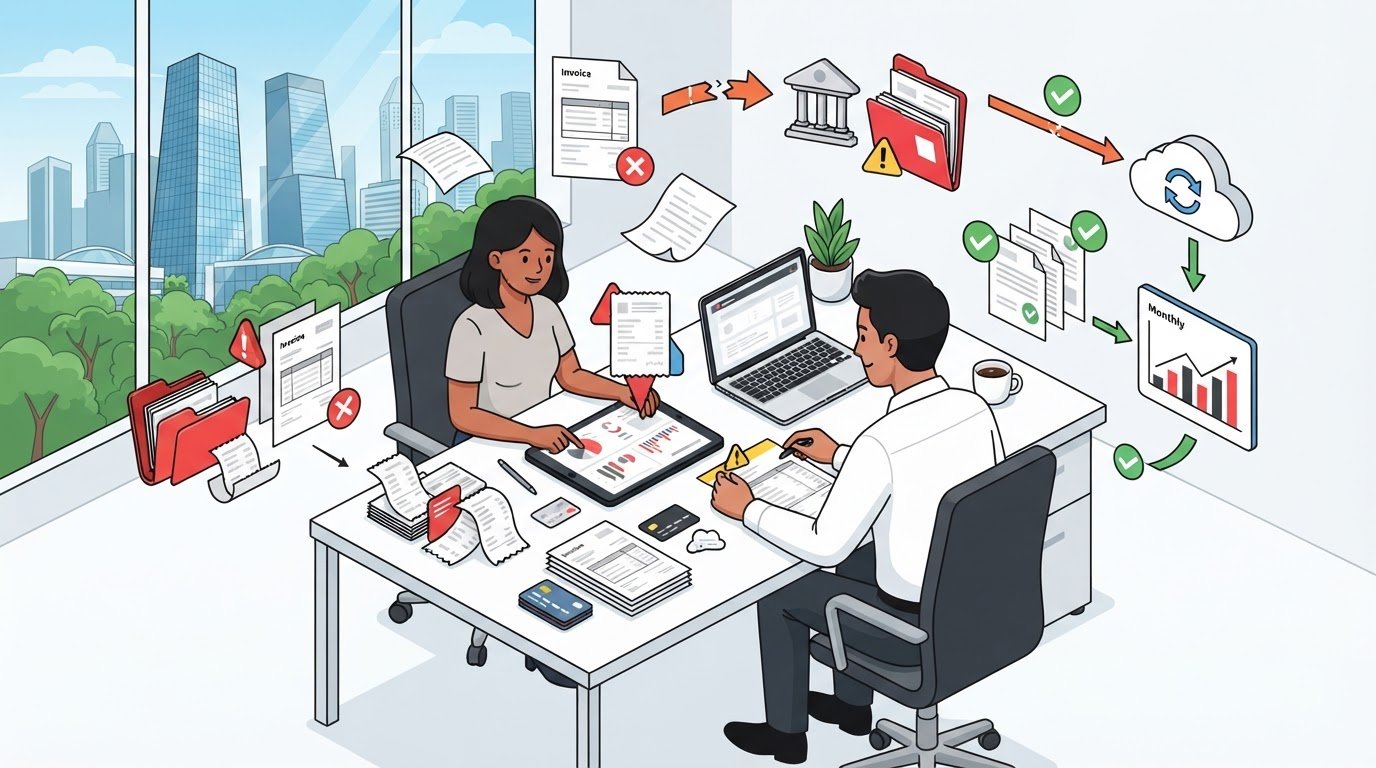
What if the bookkeeping mistake causing the most trouble isn’t a dramatic error, but a small transaction you meant to match later? Mixing personal and business spending, misplacing receipts, or leaving bank transactions unreconciled can make your reports harder to trust. This guide to common bookkeeping mistakes to avoid focuses on everyday habits that can quietly distort your records, and the checks that help catch them.
It’s understandable if bookkeeping slips behind while you’re running a business. But unclear records make cash flow harder to assess and can add pressure when tax, payroll, or other Singapore compliance tasks come around. A consistent routine helps you find and correct errors before they build into a backlog.
Use this practical 2026 checklist to match receipts and invoices to transactions, set a manageable reconciliation rhythm, and decide what needs follow-up. We’ll also look at how cloud-based bookkeeping keeps records current and reviewable, and how ongoing professional support can reduce avoidable rework.
Key Takeaways
- Spot common bookkeeping mistakes to avoid, including unclear categories, omitted entries, and transfers recorded as income.
- Reconcile records regularly to uncover missing or duplicate transactions, timing differences, and incorrect amounts.
- Keep source documents complete and consistent to make tax preparation and payroll reviews more straightforward.
- Build a monthly routine that assigns responsibility for capturing transactions, matching documents, resolving exceptions, and reviewing statements.
Common bookkeeping mistakes to avoid when recording everyday transactions
You pay for supplies between meetings, transfer money to another account, and plan to update the books later. By the time you sit down to record everything, the reason for a payment may no longer be clear. That’s when small errors creep in. Common bookkeeping mistakes to avoid include mixing personal and business spending, guessing categories, leaving out transactions, and treating transfers as income. Each can make profit and available cash harder to assess.
Mixing business and personal spending or misclassifying transactions
Use separate business and personal accounts wherever possible. If you pay a business expense personally or take money from the business, record it consistently as an owner-related item and keep a note or supporting document. A transfer between two accounts belonging to the business isn’t automatically revenue or an expense. Recording it as one can inflate income or costs. Clear chart-of-accounts categories also make reports easier to interpret.
For example, placing software, meals, and equipment under one broad “miscellaneous” category may hide useful spending patterns. Choose a category that describes the transaction, then use it consistently. The basic purpose of Bookkeeping principles is to capture and organise financial activity so it can be reviewed, not simply to enter numbers into a system.
Leaving transactions, receipts, or payment evidence incomplete
Match each income or expense entry to an invoice, receipt, or other supporting record. A bank entry may show that money moved, but not what it was for. Memory-based descriptions and vague categories make transactions harder to trace later. Save the document with a clear date and description, then attach or file it alongside the entry.
Cloud records can keep transaction details and documents current and reviewable, rather than letting them gather in a backlog. For a closer look at how digital tools support recordkeeping, see this cloud accounting and bookkeeping service.
- Guessing a category: Check the invoice or payment purpose, then use the closest consistent account category.
- Omitting a transaction: Compare recorded activity with statements and source documents, then enter any missing item.
- Recording a transfer as income: Identify the sending and receiving accounts, then record the movement as a transfer rather than a sale.
These checks make everyday entries easier to explain during a financial review and give you a clearer view of what the business earned, spent, and has available.
How missed reconciliations and weak month-end reviews undermine bookkeeping
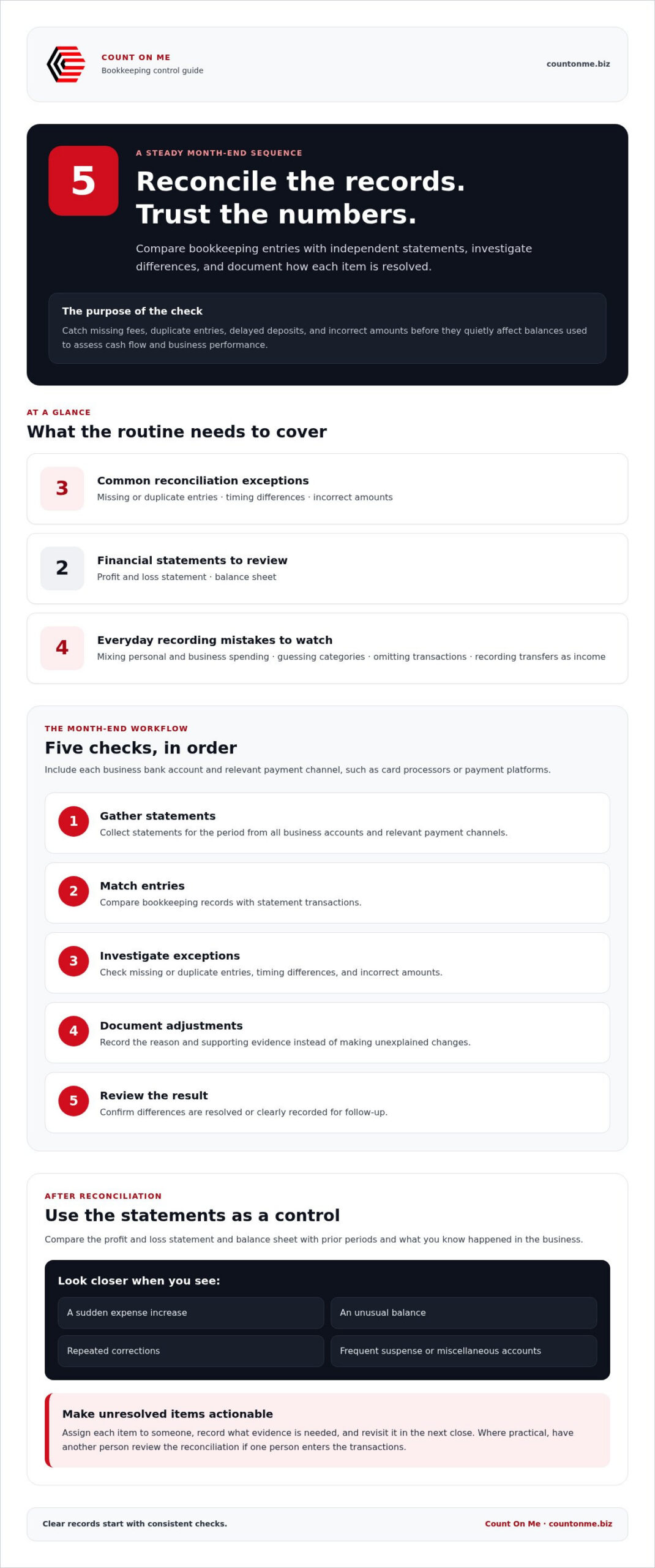
A bookkeeping system can contain every transaction you’ve entered and still be wrong. Reconciliation compares your records with independent statements, such as bank or payment-provider statements, and investigates differences. Without it, a missing fee, duplicate entry, delayed deposit, or incorrect amount can quietly affect the balances you rely on to assess cash flow and business performance.
Reconciliation isn’t just matching lines on a screen. Review unmatched items, trace them to supporting records, and document how each difference was resolved. This helps catch coding and matching errors that automation alone may not explain. Investigate an unexplained balance instead of adjusting it simply to make the figures agree.
Reconcile bank and payment records consistently
Include each business bank account and relevant payment channel in your routine, such as card processors or payment platforms. Statements may show fees, refunds, or settlement timing that isn’t obvious from a sales entry. Trace unmatched items to invoices, receipts, settlement reports, or other source documents, then note the explanation and any correction. If one person enters transactions, assign another person to review the reconciliation where practical.
A steady month-end sequence makes this work easier to repeat:
- Gather statements for the period from all business accounts and relevant payment channels.
- Match entries in the bookkeeping records against statement transactions.
- Investigate exceptions, including missing or duplicate entries, timing differences, and incorrect amounts.
- Document adjustments with the reason and supporting evidence, rather than making unexplained changes.
- Review the result to confirm differences are resolved or clearly recorded for follow-up.
Use financial statements as a control, not a filing formality
Once accounts are reconciled, review the profit and loss statement and balance sheet. Compare them with prior periods and what you know happened in the business. A sudden expense increase, an unusual balance, repeated corrections, or frequent use of suspense and miscellaneous accounts deserves a closer look. These may point to a coding issue or an item still waiting for clarification.
Make the review actionable: assign each unresolved item to someone, record what evidence is needed, and revisit it in the next close. Regular cloud bookkeeping and accounting support can help keep reconciliations and financial statement preparation on a consistent schedule. Among the common bookkeeping mistakes to avoid, treating month-end reports as paperwork instead of a control can leave errors undiscovered and make the numbers less useful for decisions.
Singapore bookkeeping mistakes that can complicate tax and payroll records
Tax and payroll records are only as useful as the transaction details behind them. Missing documents, inconsistent descriptions, or figures that don’t agree across records can make preparation and compliance reviews more difficult. In Singapore, orderly books can support work involving IRAS, GST, ACRA reporting, and CPF payroll records. Bookkeeping preserves the underlying information, while tax treatment and legal requirements involve separate considerations.
Use this simple check to catch recordkeeping gaps early:
- Incomplete invoice or receipt: The transaction may be difficult to explain later. Keep the dated source document with a clear description.
- Unclear or inconsistent category: Reports may be harder to interpret. Use consistent account categories and flag uncertain classifications for qualified review.
- Payroll figures that don’t align: Salary expenses may not match payroll summaries or payments. Compare the records and investigate differences before closing the period.
Keep tax-related records complete and reviewable
Keep dated invoices, receipts, and transaction descriptions together so each entry has a clear trail. If you’re unsure how an item should be treated, flag it for qualified review instead of guessing or copying last year’s treatment. Bookkeeping preserves and organises the underlying facts; tax advice determines how relevant rules apply. For broader context on Singapore obligations, refer to this Singapore tax compliance guide.
Align payroll records with accounting entries
Compare payroll summaries with salary payments and the related expenses recorded in your accounts. If the figures differ, check for missing entries, duplicate postings, or timing differences, and document the explanation. Keep CPF-related payroll records aligned with the payroll information in the books. An accounting entry by itself doesn’t establish that a contribution has been correctly handled. The payroll management guide covers payroll processes in more detail.
For Singapore SMEs, a common bookkeeping mistake is treating incomplete records as a minor admin issue. Consistent documentation gives tax and payroll reviewers clearer information to work with, while flagged questions are less likely to disappear into vague categories or old assumptions.
Explore cloud bookkeeping and accounting support
Monthly checklist to prevent bookkeeping mistakes
A checklist turns bookkeeping into a repeatable control routine, with clear responsibility and evidence to show what was checked. Keep the process practical: one person can prepare the records, while another reviews key checks if your team allows. Adapt the steps to your transaction volume, team size, and business complexity. Record who completed each task and what still needs follow-up.
A repeatable month-end checklist for a small business
Work through these checks in order. For each one, note the owner, completion date, evidence reviewed, and any unresolved item with a named person responsible for the next step.
- Collect records: The owner or administrator gathers bank and payment statements, invoices, receipts, and payroll summaries. Save them in a shared, organised location.
- Post transactions: The bookkeeper records the period’s income and expenses, using source documents to support descriptions and categories.
- Reconcile accounts: The person responsible for the books matches recorded activity against bank and relevant payment statements. Keep the completed reconciliation as evidence.
- Investigate exceptions: The bookkeeper traces unmatched items to source records, documents any correction, and assigns unresolved questions for follow-up.
- Review reports: The owner or reviewer checks the profit and loss statement and balance sheet for unusual figures or changes that don’t fit known business activity.
Carry forward open items with a short explanation, supporting evidence, an owner, and a target review date. Don’t mark a check complete just because software has processed transactions. A person still needs to assess whether the entries make sense. Growing backlogs, repeated unexplained balances, or reports you can’t interpret are signs to revisit the process and bring in support.
When consistent bookkeeping support can make the process easier
If month-end tasks keep slipping or follow-ups have no clear owner, cloud bookkeeping support can help maintain current, reviewable records. Count On Me’s bookkeeping support includes regular reconciliation and financial statement preparation, giving owners clearer information to consider alongside day-to-day operations and cash flow decisions. The aim is a steadier process, not simply a software setup.
Use the common bookkeeping mistakes to avoid as prompts for a monthly review, then refine the checklist as your business changes. A routine that people can follow and evidence is more useful than a long list that gets ignored.
Explore cloud accounting and bookkeeping support
Make reliable books part of your next business decision
Your bookkeeping routine should do more than keep entries tidy. It should give you information you can use when planning spending, managing cash flow, or deciding what needs attention next. When accurate records are paired with strategic guidance from business advisory firms like Venta Belgarum, owners are better equipped to turn financial clarity into greater profitability and personal freedom. Treat the common bookkeeping mistakes to avoid as signals to strengthen your process, not as reasons to feel behind. Clear responsibility for each check and a record of unresolved questions can help you build consistency over time.
If keeping records current competes with the demands of running your business, structured cloud-based bookkeeping support can help maintain a dependable review routine. Count On Me supports Singapore SMEs with accounting professionals, and the firm was founded by professionals with more than 20 years of industry experience. Ongoing support can help you spend less time untangling old entries and more time using financial information to guide the business.
Start with one manageable monthly routine, improve it as your business changes, and give yourself a clearer foundation for what comes next.
Frequently Asked Questions
Can bookkeeping mistakes be corrected after a financial period has closed?
Yes, a closed period can often be corrected, but keep a clear record of what changed and why. Confirm the source document and identify which account and reporting period the error affects. Don’t silently overwrite or delete an entry, especially if financial statements or a tax filing already used it. For material corrections, document the impact and follow the applicable reporting process.
Does accounting software prevent common bookkeeping mistakes?
What is the difference between cash flow and profit?
Profit measures income earned minus expenses recorded over a period, while cash flow tracks money entering and leaving your accounts. They can differ because a sale may be recorded before the customer pays, or a loan repayment may use cash without being an expense in the same way. A profitable month can still feel cash-tight if customers haven’t paid invoices. Check both measures before committing to new spending.
How long should a Singapore business keep bookkeeping records?
Singapore companies must keep accounting records for at least five years, according to the current record-keeping requirement. Keep records organised so a transaction can be traced to its supporting documents, rather than relying on a folder of unlabelled files. Retention periods can differ for other types of records, including payroll documents, so confirm the applicable requirement for each record category using current official guidance or professional advice.
What should I do first if I find a duplicate transaction?
Check whether both entries represent the same payment by comparing the date, amount, payee, and reference against the original statement or receipt. If one is a duplicate, correct it using your system’s established process and retain a note explaining the change. Don’t delete an entry just because it looks similar; two genuine transactions can share an amount or date. Recheck the affected account balance and any reports that included the duplicate.
When should a small business move from spreadsheets to cloud bookkeeping?
Consider moving when spreadsheets become difficult to maintain, more than one person needs to update records, or you’re spending more time checking versions and formulas. A cloud system can centralise records and make collaboration and review easier, but it still needs sensible processes and human checks. Compare your current workflow with what you need for document storage, reconciliation, reporting, and access, then plan a careful transition that preserves your past records.