What if the difference between a thriving startup and one facing a S$600 penalty is just a few clicks on a digital ledger? We know how it feels. You’re trying to scale your business, but the looming deadline for your annual return filing Singapore often feels like a dark cloud. It’s easy to get tangled in the confusion between ACRA requirements and IRAS tax deadlines, or to feel a bit of dread when someone mentions XBRL. We’ve seen many founders lose sleep over these administrative hurdles, wondering if they’ve missed a critical step that could jeopardize their company’s status.
We’re here to tell you that compliance doesn’t have to be a source of anxiety. This guide provides a clear, jargon-free roadmap to help you master your ACRA obligations and ensure your business remains in “Good Standing” throughout 2026. We’ve put together a step-by-step checklist that turns a complex process into a manageable routine, covering everything from filing fees to the latest digital-first requirements on BizFile+. You’ll learn exactly what’s required for your company type and when it might be time to lean on professional support to keep your growth on track.
Key Takeaways
- Learn the critical difference between your annual return filing Singapore and your IRAS tax obligations so you don’t miss any mandatory deadlines.
- Identify the specific steps needed to finalize your accounts and determine if your startup qualifies for a statutory audit exemption.
- Master the “7-month rule” for filing deadlines and clarify whether your business must submit financial statements in XBRL format.
- Understand how a corporate secretary helps you avoid heavy penalties by managing your BizFile+ submissions with precision.
What is Annual Return Filing in Singapore and Why Does It Matter?
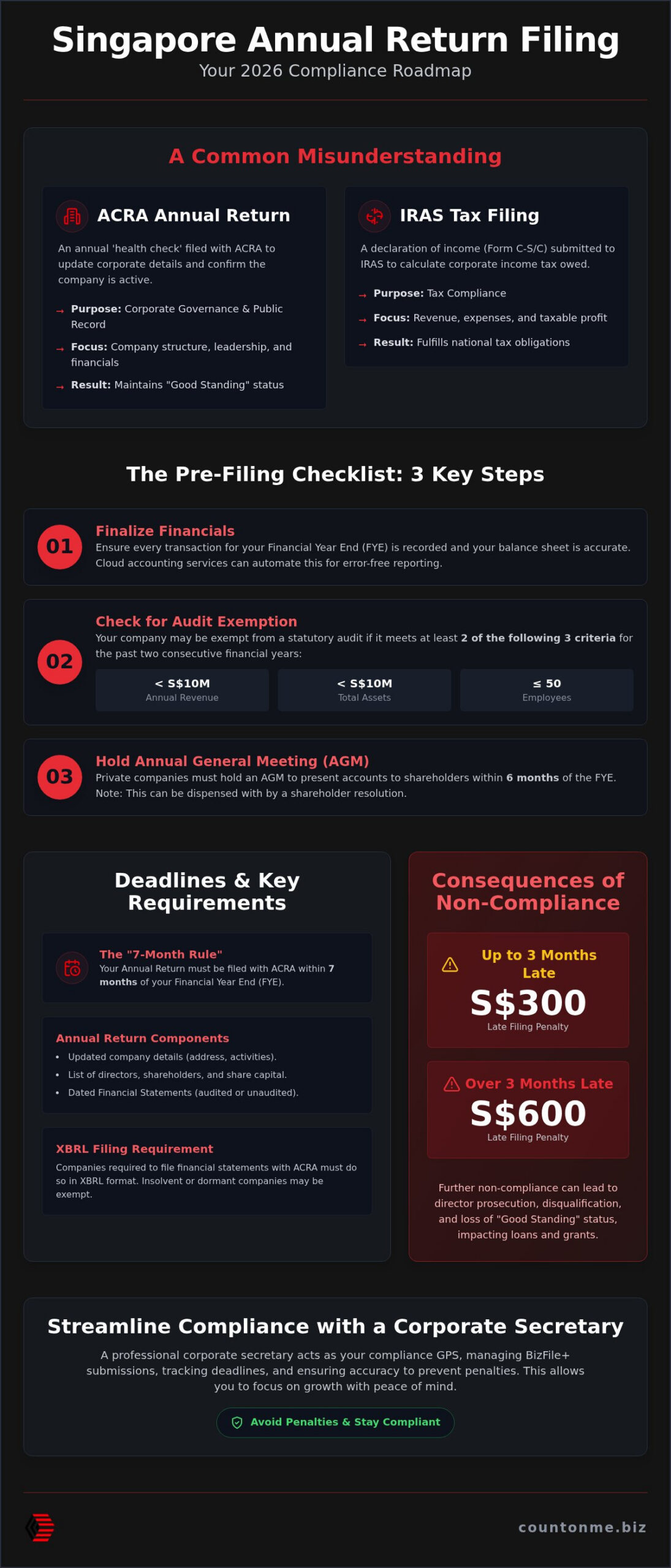
Think of your annual return (AR) as your company’s yearly health checkup. It is an electronic report submitted to the Accounting and Corporate Regulatory Authority (ACRA) that confirms your business is still active and provides updated details about its structure. Many founders we work with initially confuse this with their tax filing. It’s a common mix-up. Your annual return filing Singapore is about corporate governance and public records, while your IRAS filing (Form C-S or C) is strictly about how much tax you owe. You need to do both to stay compliant and keep your business running smoothly.
Maintaining “Good Standing” status is more than just a badge of honor. It is a critical signal to banks and government agencies that your business is reliable and low-risk. If you’re looking to secure bank loans or apply for government grants in 2026, a clean filing record is often the first thing they’ll check. This is where your company secretary becomes your most valuable ally. They don’t just push paper; they facilitate this mandatory submission to ensure your public profile remains spotless while you focus on scaling your operations.
Key Components of an Annual Return
An annual return isn’t just a single form. It’s a package that provides a snapshot of your company’s vital signs. The filing includes:
- Company details: Confirmation of your registered office address and primary business activities.
- Share capital and leadership: An updated list of your directors, shareholders, and current share capital.
- Financial transparency: Your financial statements, whether audited or unaudited, along with the date of your Annual General Meeting (AGM).
The Consequences of Non-Compliance
The stakes for missing a deadline are higher than many realize. For 2026, ACRA has set late filing penalties at S$300 if you’re up to three months late, and that amount jumps to S$600 if you exceed the three-month mark. Beyond the financial cost, the risk of prosecution or even disqualification for directors is a real possibility if compliance is ignored. We believe in proactive management to avoid these stresses. By partnering with a professional corporate secretary, you gain a compliance GPS that prevents these risks before they start. Our team ensures every detail is captured accurately in the BizFile+ system, giving you the peace of mind to lead with confidence.
Your Pre-Filing Checklist: Preparing Financials and Holding the AGM
Before you even think about the actual annual return filing Singapore, you need to lay the groundwork. We like to think of this phase as clearing the runway before takeoff. If your financials aren’t ready, your filing will stay grounded. The process starts with finalizing your accounts for your Financial Year End (FYE). This means ensuring every transaction is recorded and your balance sheet reflects the true state of your business. Most startups and SMEs in Singapore fall under the “small company” exemption, meaning you likely won’t need a statutory audit if you meet at least two of the following: annual revenue under S$10 million, total assets under S$10 million, or fewer than 50 employees.
Once your accounts are settled, you’ll need to prepare the Directors’ Statement and the full set of financial statements. These documents tell the story of your year. Finally, for private companies, you must hold an Annual General Meeting (AGM) to present these accounts to your shareholders. It’s a formal step, but it doesn’t have to be a logistical headache. If your shareholders agree, you can actually pass a resolution to dispense with the AGM entirely, making the whole process much faster. If you want to streamline these administrative steps, exploring our compliance support can help you stay ahead of the curve.
The Power of Digital Ledgers
Using cloud accounting services in Singapore transforms this pre-filing stage from a weeks-long sprint into a simple confirmation. When you reconcile your accounts monthly rather than waiting for December, you avoid the dreaded “year-end crunch” that leaves many founders feeling overwhelmed. Automated bookkeeping reduces human error in financial reporting by syncing your bank feeds directly with your ledger, which means your numbers are always accurate and ready for review. This digital-first approach ensures that when it’s time to file, your data is already clean and compliant.
AGM Requirements for Private Companies
Timing is everything when it comes to your AGM. For private companies, you must hold this meeting within six months of your FYE. During this time, you’ll share your financial statements with your shareholders, ensuring everyone is on the same page regarding the company’s performance. If you choose to dispense with the AGM, you still need to send the financial statements to all shareholders within five months of your FYE. Keeping these timelines in mind ensures you never run afoul of ACRA’s strict windows for annual return filing Singapore.
Filing Deadlines and XBRL Requirements for 2026
The “7-Month Rule” is your golden window for annual return filing Singapore. If your company is a private entity, you have exactly seven months from your Financial Year End (FYE) to submit your return to ACRA. It’s a strict timeline, but it’s manageable when you work backward from your FYE. For public companies, this window is even tighter, requiring submission within five months. We’ve found that many founders get caught out because they focus only on the AGM date and forget the filing clock is already ticking. If you hit an unexpected snag, you can apply for an Extension of Time (EOT) through BizFile+. This costs S$200 and grants you a 60-day extension, but you must apply before your original deadline passes.
2026 Deadline Summary Table
| Financial Year End (FYE) | AGM Deadline (Private) | AR Filing Deadline (Private) |
|---|---|---|
| 31 Dec 2025 | 30 June 2026 | 31 July 2026 |
| 31 March 2026 | 30 Sept 2026 | 31 Oct 2026 |
| 30 June 2026 | 31 Dec 2026 | 31 Jan 2027 |
Tracking these dates is one of the primary reasons for appointing a company secretary in Singapore. They act as your compliance concierge, ensuring you never miss a milestone that could lead to penalties.
Demystifying XBRL Filing
XBRL stands for eXtensible Business Reporting Language. Think of it as a digital barcode for your financial data that allows ACRA to analyze company performance across the island. While it sounds technical, it is mandatory for most Singapore-incorporated companies. However, you might be exempt if your business is a solvent Exempt Private Company (EPC) or a dormant company. EPCs are companies with no corporate shareholders and fewer than 20 individual shareholders. If you don’t qualify for an exemption, you’ll need to prepare either Full XBRL or Simplified XBRL statements. This process requires specialized mapping software to ensure your data aligns with ACRA’s taxonomy, which is why most founders prefer to let their annual return filing Singapore experts handle the technical heavy lifting.
Let our experts handle your ACRA deadlines and XBRL mapping
Streamlining the Process with a Compliance Partner
Attempting a “DIY” approach to BizFile+ submissions might seem like a cost-saving move, but it often leads to unnecessary stress. We’ve seen many founders get caught in technical loops, from misclassifying share capital to struggling with the nuances of XBRL mapping. A small error during your annual return filing Singapore can trigger queries from ACRA or result in a “not in good standing” status that affects your banking relationships. Instead of treating compliance as a lonely uphill battle, think of a Corporate Secretary as your compliance GPS. We don’t just tell you where to go; we handle the navigation so you can focus on the road ahead.
The secret to a seamless filing lies in integration. When you link your annual requirements with your monthly accounting and bookkeeping, the year-end process becomes a non-event. Our approach at Count On Me is built on this foundation of stability. By using digital ledgers like Xero, we ensure your data is accurate every single month. This means when the filing deadline approaches, there’s no frantic searching for receipts or reconciling old bank statements. You move from a state of deadline anxiety to a position of quiet confidence, knowing your corporate records are as sharp as your business strategy.
What to Look for in a Corporate Secretary Provider
Choosing the right partner is about more than just checking a box. You need a team that values transparency as much as you do. Look for providers who offer clear, upfront corporate secretarial services fees without hidden administrative charges. Technical proficiency is also a must. Your provider should be a digital innovator, comfortable with cloud tools that make collaboration easy. Most importantly, they should have a proactive communication style. A great partner reaches out to you long before a deadline hits, acting as a shield against ACRA filing penalties and ensuring your company remains a “Good Standing” entity.
Next Steps: Your Compliance Roadmap
Ready to put the stress of annual return filing Singapore behind you? Start by reviewing your current Financial Year End and your last filing date to see where you stand. If the dates feel uncomfortably close, it’s time to reach out for a compliance health check. We’re here to audit your current status and build a roadmap that keeps you ahead of every ACRA requirement. Let’s turn your corporate governance from a chore into a strategic advantage.
Ready to Lead Your Business with Confidence?
Mastering your corporate governance is about building a solid foundation for long-term growth rather than just dodging late fees. By staying ahead of the “7-month rule” and using digital ledgers to keep your financials ready for review, you transform a potentially stressful deadline into a routine win. Your annual return filing Singapore is much more than a box to check; it’s a clear signal to banks, investors, and government agencies that your company is stable and ready for the next big opportunity.
We understand that your time is best spent on innovation and strategy. That’s why we offer tailored startup and SME packages that combine over 20 years of seasoned expertise with the modern efficiency of cloud-first accounting. We’re here to serve as your proactive ally, ensuring every detail is captured accurately so you don’t have to worry about compliance again.
You’ve worked hard to build your business from the ground up. Don’t let administrative hurdles slow your momentum. With a clear roadmap and a partner who’s truly invested in your journey, you can lead your company into 2026 with total peace of mind and quiet confidence.
Frequently Asked Questions
Can I file my own annual return in Singapore without a professional?
Yes, you can file it yourself through BizFile+, provided you have a CorpPass and a solid understanding of your financial statements. Many founders find that the time spent navigating technical mapping and XBRL requirements is better spent on growth, which is why they partner with professionals. We’re here to help if you decide that DIY compliance isn’t the best use of your energy.
What happens if I miss the annual return filing deadline?
Missing the deadline triggers immediate late filing penalties and puts your company’s “Good Standing” status at risk. ACRA may also issue a summons to the company directors if the filing remains outstanding. In extreme cases, this can lead to prosecution or disqualification. We’ve seen how these stresses can weigh on a business, so we always suggest setting reminders well in advance of your specific deadline.
Is an Annual General Meeting (AGM) mandatory for all startups in 2026?
While the AGM is a standard requirement, many private companies can dispense with it if all shareholders agree to pass a resolution. You must still send your financial statements to shareholders within five months of your FYE. This flexibility helps startups stay lean while remaining compliant with ACRA’s governance standards. It’s a great way to simplify your administrative workload without sacrificing your legal obligations.
How much are the ACRA late filing penalties for SMEs?
For 2026, the penalty is S$300 for filings up to three months late and S$600 for anything beyond that. These fees apply per missed requirement, meaning you could be fined for both a late AGM and a late annual return filing Singapore. It’s an expensive mistake that’s easily avoided with proactive planning and a clear understanding of the current regulatory landscape.
What is the difference between a financial year end and a filing deadline?
Your Financial Year End (FYE) is the date your accounting period closes, while your filing deadline is the legal date by which you must submit your report. For private companies, your annual return filing Singapore must be completed within seven months of your FYE. Understanding this gap is essential for mapping out your compliance calendar and ensuring you have enough time to finalize your accounts.
Do I need to file an annual return if my company is dormant?
Yes, every incorporated company in Singapore must file an annual return, even if it has no business activity. While dormant companies may benefit from simplified filing processes and exemptions from preparing full financial statements, the obligation to report to ACRA remains mandatory. Failing to file for a dormant company carries the same penalty risks as an active one, so don’t let it slip through the cracks.