Did you know that 85% of small businesses are expected to adopt AI by the end of 2026 to manage their finances? If you’re still spending your precious weekends wrestling with manual bank reconciliations or worrying about potential IRAS filing errors, you aren’t just losing time; you’re missing out on a massive digital shift. It’s the perfect moment to automate accounting in Singapore and finally reclaim your peace of mind.
We know how draining it is to lose track of paper invoices or feel the financial weight of hiring a full-time in-house accountant. It’s genuinely stressful trying to manage cash flow when your data is always a few weeks behind. We’re here to show you how to transform those manual tasks into a high-efficiency digital engine that handles the heavy lifting for you. This article provides a comprehensive 2026 SME checklist to help you achieve real-time visibility and seamless compliance with ACRA and IRAS regulations. Let’s walk through the steps to build a finance function that supports your growth instead of slowing you down.
Key Takeaways
- Move from historical data to real-time financial visibility to drive smarter, faster business decisions for your SME.
- Discover how to automate accounting Singapore using cloud software and OCR tools that turn paper receipts into digital assets.
- Pinpoint the daily and weekly tasks, from bank reconciliation to expense management, that you can hand off to technology today.
- Follow our five-step implementation roadmap to audit your manual bottlenecks and set up a robust digital chart of accounts.
- Balance your new digital engine with human expertise to catch anomalies and handle complex tax nuances that software might miss.
What is Automated Accounting and Why Does Your Singapore SME Need It?
Think of automated accounting as your business’s digital nervous system. It isn’t just about moving numbers from one spreadsheet to another; it’s about using smart algorithms and AI to handle those repetitive, soul-crushing tasks like manual data entry, bank reconciliation, and basic reporting. When you choose to automate accounting Singapore processes, you’re moving away from ‘historical’ records that tell you what happened last month. Instead, you gain ‘real-time’ insights that show you exactly where your cash flow stands right now. This shift is vital for making quick, confident decisions in a fast-paced market.
The Singapore government has set a clear ‘Digital First’ mandate. By 2026, the expectation is that nearly every SME will have transitioned to digital workflows to stay competitive. This isn’t just about following a trend. It’s about survival and scalability. By leveraging modern accounting software to handle the grunt work, you ensure your business remains agile. You’ll be able to pivot when the market changes without being weighed down by outdated, slow processes that consume your team’s energy.
The End of the Shoebox: Manual vs. Automated Bookkeeping
We’ve all been there: the ‘shoebox’ of receipts that grows more intimidating every week. Manual bookkeeping is a magnet for human error, and in the eyes of IRAS, even an honest mistake can lead to penalties. The true cost isn’t just the potential fines, though. It’s the hours you spend typing in invoice numbers instead of thinking about your next big growth move. When you automate accounting Singapore operations, you move to a secure digital ledger. This creates a permanent, searchable audit trail that protects your team and turns your financial data into a valuable asset rather than a weekend chore.
Singapore Regulatory Advantages of Going Digital
In Singapore, the regulatory environment is designed to reward those who digitize. With the GST rate at 9% as of 2024, staying compliant requires absolute precision. Modern systems offer direct links to IRAS for GST filing, which removes the friction from your quarterly submissions. You’ll also find that complying with the Singapore Companies Act becomes much simpler when your records are organized and accessible. Whether it’s an annual return for ACRA or a corporate secretarial filing, having your data in a digital format ensures you’re always ready for a smooth, stress-free audit process.
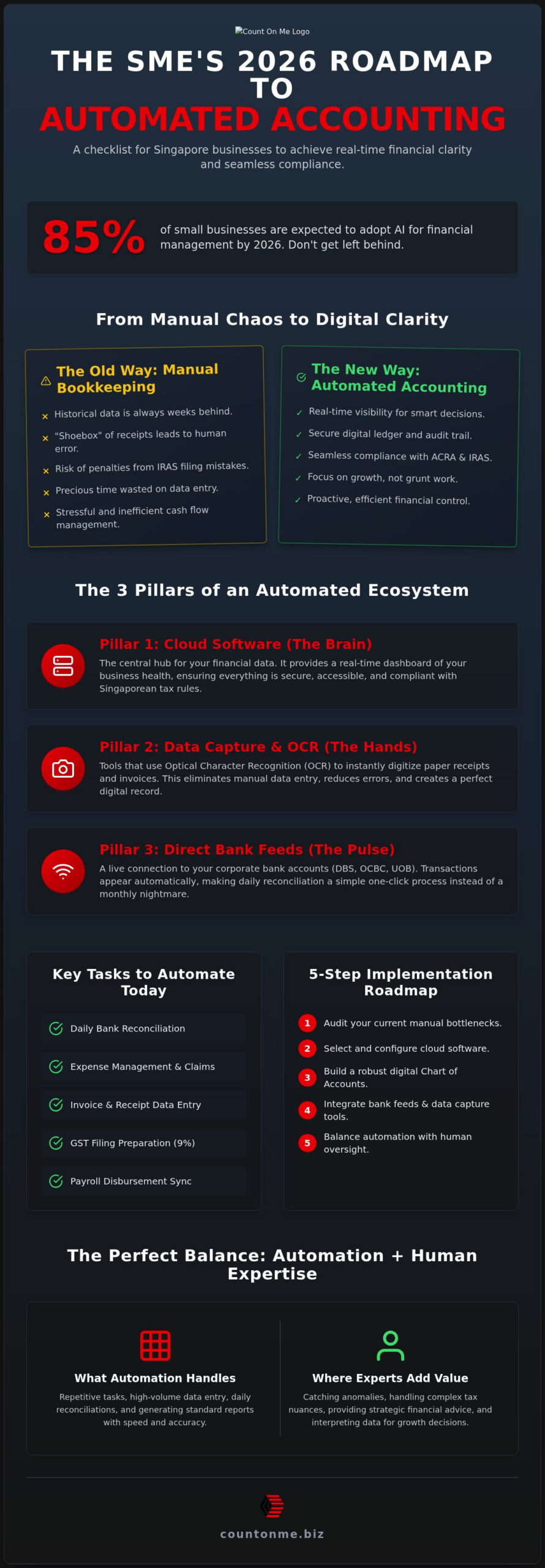
The 3 Pillars of an Automated Accounting Ecosystem
Building a digital engine for your finances is about more than just buying a software subscription. It’s about creating a connected ecosystem where data flows seamlessly without you ever needing to touch a keyboard. To effectively automate accounting Singapore businesses need to focus on three core pillars: the brain, the capture, and the pulse. When these three elements work in harmony, you stop being a data entry clerk and start being a strategic owner who understands their numbers in real time.
Cloud Accounting Software as Your Foundation
We often recommend Xero as the “brain” of your operation because of its open API and deep local integrations. It’s vital to understand the cloud accounting service vs software Singapore distinction. While the software is the tool that holds your data, the service is the expert setup and management that ensures your chart of accounts is configured correctly for Singapore’s specific tax rules. Security is a top priority in this pillar. Modern platforms utilize multi-factor authentication and encrypted data storage, keeping your sensitive financial information far safer than a physical ledger or a stray spreadsheet on a laptop.
Data Capture and Bank Feed Integration
The second pillar involves OCR (Optical Character Recognition) and data extraction tools. Think of these as the “hands” of your ecosystem. Tools like Dext or Hubdoc allow you to snap a photo of a receipt or forward an email invoice, and the AI automatically extracts the date, supplier, and GST amount. This eliminates the manual entry that often leads to the “human error” penalties we discussed earlier. It turns a stack of paper into a neat, digital line item in seconds.
The third pillar is the “pulse” provided by direct bank feeds. By connecting your local corporate accounts from DBS, OCBC, or UOB directly to your ledger, every transaction appears automatically the next morning. You don’t need to download CSV files or manually upload statements. The software’s AI even learns to suggest account codes for recurring transactions, which makes your daily reconciliation a matter of a few quick clicks. To truly automate accounting Singapore workflows, you should also sync your payroll disbursements. This ensures your employee costs are reflected in your financial reporting immediately. If you’re ready to move away from manual spreadsheets, our team can help you implement a tailored Cloud Accounting & Bookkeeping system that brings all these pillars together.
The Essential Checklist: Tasks to Automate Today
Once your digital ecosystem is ready, the next step is to delegate the recurring tasks that usually clutter your calendar. We’ve found that the best way to automate accounting Singapore workflows is to break them down by frequency. This approach ensures nothing slips through the cracks while giving you back hours of your week. By moving these responsibilities to your software, you transition from being a reactive bookkeeper to a proactive business leader.
- Daily: Set up automated bank reconciliation. Your software matches incoming transactions with your invoices, so you only need to click “OK” to stay current.
- Weekly: Scan and upload all receipts. This keeps your digital ledger updated and ensures you never lose a tax deduction because of a faded piece of thermal paper.
- Monthly: Automate your payroll and CPF calculations. With the CPF Ordinary Wage ceiling at S$8,000 as of January 2026, let the system handle the math to ensure total accuracy for every employee.
- Quarterly: Generate your GST reports. Since the GST rate remains at 9% in 2026, having your software track your liability in real time makes the filing process a non-event.
- Annual: Prepare your financial statements for ACRA. A year of automated data entry means your year-end reporting is essentially a final review rather than a month-long scramble.
Invoicing and Accounts Receivable
Cash flow is the lifeblood of your SME, and waiting for clients to pay can be incredibly stressful. You can significantly reduce your ‘Days Sales Outstanding’ (DSO) by setting up automatic payment reminders. Instead of you sending awkward follow-up emails, the system does it politely on your behalf. We also suggest integrating ‘PayNow’ and credit card options directly into your digital invoices. When it’s easier for your customers to pay you, they usually do it much faster.
Expense Management and Accounts Payable
Managing what goes out is just as vital as what comes in. You can now approve bills on-the-go using mobile apps, which means your vendors stay happy and your services stay uninterrupted. By automating recurring payments for fixed costs like rent or utilities, you eliminate the risk of late fees. Linking your entire business spend to your cloud accounting services Singapore provides total visibility into your overhead. This level of clarity helps you spot where you can save money without digging through piles of paperwork. It’s about creating a system that works for you, so you can focus on the big picture.
5 Steps to Implement Accounting Automation in Singapore
Transitioning from manual spreadsheets to a digital engine can feel like a massive undertaking. We’ve guided many SMEs through this journey, and we’ve found that a structured approach is the best way to automate accounting Singapore operations without disrupting your daily business. It isn’t just about flipping a switch; it’s about building a sustainable workflow that grows with you, which often includes upskilling your team through professional training resources like traineticsacademy.com.sg. By following these five steps, you’ll move from administrative overwhelm to strategic clarity.
- Step 1: Audit your current bottlenecks. Every business has that one drawer or folder where “to-be-filed” documents go to die; identifying these friction points is the first step toward freedom.
- Step 2: Partner with a Xero-certified expert. Don’t try to DIY your setup. A certified partner ensures your software is configured correctly for Singapore’s specific regulatory landscape.
- Step 3: Connect your local bank accounts. Establish direct data feeds from DBS, OCBC, or UOB to ensure your ledger reflects your actual cash position every single morning.
- Step 4: Train your team on mobile capture. Show your staff how to use expense apps to snap photos of receipts instantly. This removes the burden of manual entry from their plates.
- Step 5: Establish a monthly review cycle. Use your newly automated data to have meaningful conversations with your outsourced CFO about your business’s health and future growth.
Setting Up Your Chart of Accounts for Success
A professional setup is the difference between a system that works and one that creates more mess. Your chart of accounts is the foundation of your financial reporting, and it needs to be tailored to your specific industry. For example, if you are running a restaurant, you’ll need a different structure than a consultancy. Our guide on bookkeeping for F&B Singapore highlights how industry-specific categories help you track margins and inventory more effectively. Getting your GST codes correctly mapped from the start is also vital for ensuring your IRAS reporting remains error-free and compliant.
Data Migration: Moving from Excel or Desktop Software
Moving your data doesn’t have to be a headache if you prepare properly. We always suggest cleaning up your existing records before the big move; don’t import old errors into your new, clean system. You’ll need to set a “Conversion Date,” typically the start of a new month or quarter, to create a clean break from your old habits. Once you’ve imported your opening balances and outstanding invoices, you’ll find that the real-time nature of your new system makes the old way of working feel like a distant memory. If you’re feeling overwhelmed by the technical setup, our team offers a specialized Startups Package to get your foundation right from day one.
The Human Element: Why Automation Needs an Expert Ally
Technology is a powerful engine, but every engine needs a skilled driver at the wheel. While your software handles the “doing” by processing thousands of data points, it’s the “thinking” that truly protects and grows your business. Even the most advanced AI can’t replace the intuition of a seasoned professional who understands the nuances of the Singaporean market. To successfully automate accounting Singapore operations, you must pair your digital tools with human expertise to ensure your data isn’t just accurate, but also strategic.
AI is excellent at matching patterns, but it can miss subtle anomalies that a human eye catches instantly. For instance, a software tool might not flag a duplicate payment to a vendor if the invoice number has a slight typo, or it might incorrectly categorize an expense that qualifies for a specific tax incentive. When we look at the 50% corporate income tax rebate for YA 2026, an expert ally ensures you’re maximizing every available dollar while staying within the S$40,000 cap. This level of oversight turns your automated system from a basic ledger into a robust shield for your company’s finances.
Strategic Growth through Real-Time Insights
Automation moves you away from “compliance-only” accounting, where you only look at your numbers to satisfy IRAS or ACRA. Instead, you enter a “growth-oriented” phase. With your data updated daily, you have the proof points needed to secure business loans or attract investor funding. By analyzing real-time automated data, a CFO identifies seasonal trends and payment delays to ensure your business always has the liquidity needed for rapid expansion. Understanding the broader landscape of digital finance transformation Singapore SMEs are undergoing can help you benchmark your own progress and identify the next strategic moves for your business. This high-level on demand CFO Singapore support allows you to make big moves with confidence, knowing your decisions are backed by solid, current facts.
Many entrepreneurs worry that adding human expertise will break their budget. However, a hybrid model is actually the most affordable accounting services Singapore model for growing SMEs. By using technology to handle the low-value, repetitive tasks, you only pay for the high-value advisory time you actually need. You get the best of both worlds: tech-driven efficiency and professional peace of mind.
Partnering with Count On Me
At Count On Me, we don’t just sell you a software subscription; we become your supportive ally in the digital landscape. Our collaborative approach focuses on setting up your digital finance engine correctly from day one and then staying by your side as you scale. We bridge the gap between high-level professional expertise and the friendly, personalized support you need to feel stable. If you’re ready to stop wrestling with paperwork and start focusing on your vision, book a consultation with Count On Me to start your automation journey. Let’s build a finance function that works as hard as you do.
Take Control of Your Financial Future
Navigating the shift to a digital-first economy doesn’t have to be overwhelming. We’ve seen how building a connected ecosystem of cloud software, OCR tools, and direct bank feeds can finally put an end to the “shoebox” era of manual records. When you automate accounting Singapore processes, you’re not just saving time; you’re gaining the real-time visibility required to make bold, strategic moves. Remember that while technology handles the repetitive data entry, the true value lies in the “thinking” provided by an expert ally who can interpret those numbers and protect your margins.
As a Xero Certified Partner with over 20 years of professional experience, Count On Me is uniquely positioned to help you bridge the gap between traditional foundations and modern innovation. We specialize in providing scalable payroll and CFO solutions that ensure your business remains compliant and agile as you grow. You deserve a finance function that offers relief and stability rather than administrative stress. Ready to automate? Let Count On Me build your digital finance engine today. We’re excited to partner with you and turn your financial data into your greatest competitive advantage.
Frequently Asked Questions
Is automated accounting software compliant with IRAS and ACRA?
Yes, most leading cloud platforms are fully compliant with IRAS and ACRA requirements for Singapore businesses. When you automate accounting Singapore operations, it’s vital to choose software from the IRAS Accounting Software Register. This ensures your system can generate the required IRAS Audit File (IAF) and GST F5 returns with total precision.
How much does it cost to automate accounting for a Singapore SME?
Software subscriptions generally range from S$15 to S$50 per month, depending on the features your team needs. To help with the transition, SMEs can apply for the Productivity Solutions Grant (PSG), which provides up to 50% funding for pre-approved digital tools. Some specialized schemes available in 2026 may offer even higher support levels for qualifying companies.
Which local Singapore banks support direct feeds to Xero?
Most major local banks, including DBS, OCBC, and UOB, support direct, secure feeds to Xero. This connection allows your daily transactions to flow into your ledger automatically every morning without manual intervention. It’s a read-only link, meaning the software can see your data for reconciliation but cannot move your money.
Can I still use my old Excel spreadsheets alongside automation?
You can certainly use Excel for custom forecasting or deep-dive analysis, but it shouldn’t be your primary ledger. Using spreadsheets for daily bookkeeping often leads to version control issues and manual entry errors that automation is designed to fix. It’s best to let your cloud software be the single “source of truth” for your business.
Do I need to be a tech expert to use automated accounting tools?
What happens to my data if I decide to switch accounting firms?
You remain the legal owner of your data at all times, regardless of which firm you partner with. If you ever decide to switch, we simply transfer the subscriber rights of your cloud account back to you or your new provider. You can also export your entire financial history into portable formats like CSV or PDF whenever you need.
Does automation eliminate the need for a corporate secretary?
Automation handles your financial data entry, but it doesn’t replace the legal role of a corporate secretary. While your software tracks expenses and income, a corporate secretary ensures you meet statutory requirements like filing annual returns with ACRA and maintaining your minute books. Both are essential for a healthy, compliant Singapore company.
Is my financial data safe in the cloud from cyber threats?
Your data is typically much safer in a secure cloud environment than on a physical office hard drive. Leading providers use bank-grade encryption and multi-factor authentication to prevent unauthorized access. They also run continuous backups across multiple geographic locations, ensuring your records are protected even if your local hardware fails or is stolen.