
Have you ever found yourself staring at a spreadsheet on the 13th of the month, wondering if you’ve correctly calculated the contribution rates for your senior employees versus your new hires? It’s a common stressor for SME owners who want to do right by their team but feel buried under the weight of shifting regulations. Managing CPF payroll services Singapore can be a daunting task, but you don’t have to tackle it alone.
We understand that distinguishing between Ordinary and Additional Wages or keeping track of variable rates for different age groups feels like a full-time job. You deserve the peace of mind that comes with knowing your employee benefits are handled correctly and your filings are always on time. This 2026 guide is designed to help you master your CPF obligations and discover how digital payroll services ensure 100% compliance for your business. We’ll walk you through the latest regulatory updates, show you how to automate your workflows to sync with your accounting, and help you eliminate the risk of late-filing penalties for good.
Key Takeaways
- Understand the dual responsibility of employer and employee contributions to build a solid foundation for your team’s financial security.
- Navigate the specific 2026 rate adjustments for different age groups to keep your budget and payroll calculations precise.
- Learn how professional CPF payroll services Singapore can automate your monthly workflow and help you consistently hit the critical 14th-of-the-month deadline.
- Identify the key differences between Ordinary and Additional Wages to prevent costly overpayments or compliance gaps.
- Shift from manual spreadsheets to digital systems that sync with your accounting for total visibility and zero filing stress.
Understanding CPF Obligations for Singapore Employers
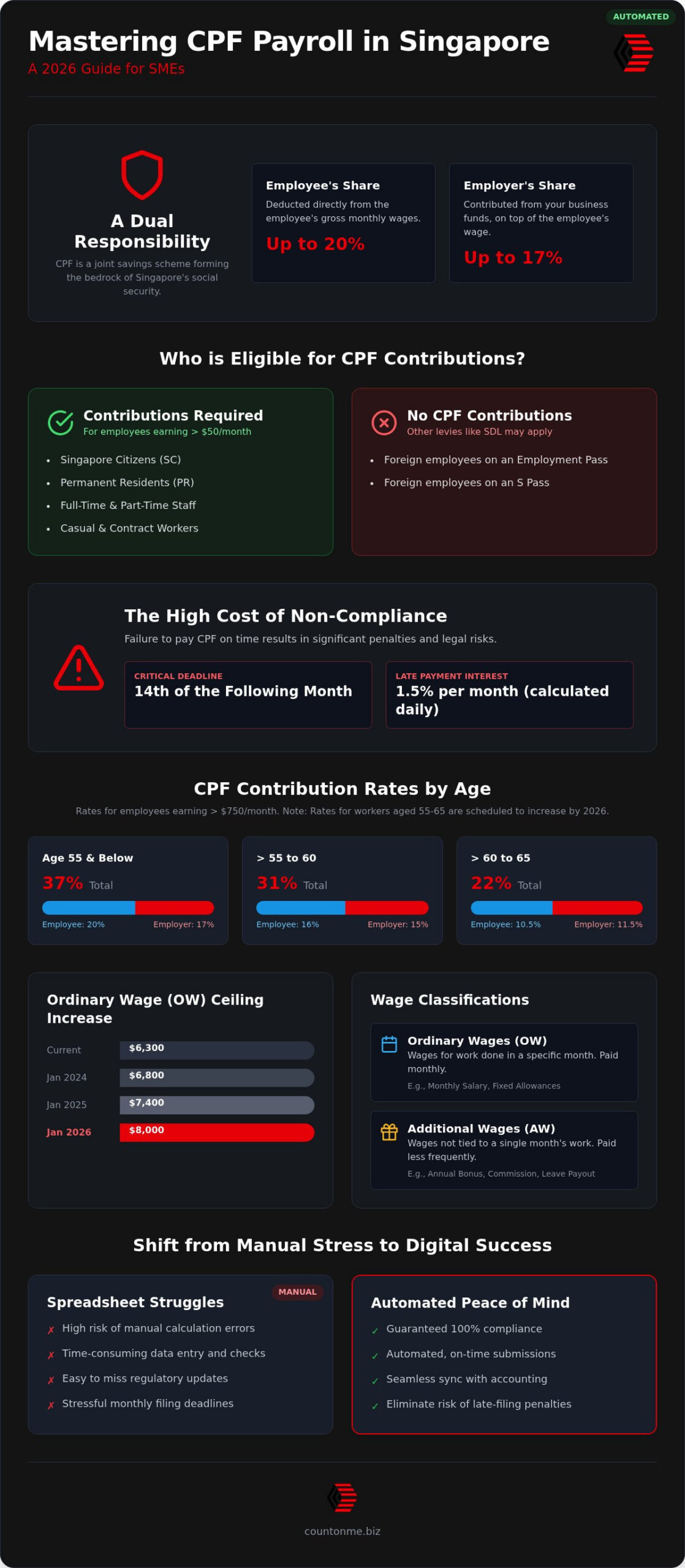
Think of the Central Provident Fund (CPF) as the bedrock of Singapore’s social security system. It isn’t just a tax or a mandatory deduction; it’s a dedicated savings scheme designed to ensure Singaporeans and Permanent Residents (PRs) can afford retirement, healthcare, and housing. As a business owner, you’re a vital partner in this system. Your responsibility is dual in nature. You must accurately deduct the employee’s share from their gross wages while also contributing an additional employer’s share from your own business funds.
Legally, you’re required to make these contributions for any employee who earns more than $50 in a calendar month. While it might seem like a simple calculation at first, the complexity grows as your team expands. The CPF Board maintains a rigorous enforcement framework to ensure that every eligible worker in Singapore receives their rightful contributions on time, every time. Many SMEs find that partnering with CPF payroll services Singapore provides the necessary oversight to keep these moving parts in perfect sync.
Who Qualifies for CPF Contributions?
The rules mainly apply to Singapore Citizens (SC) and Permanent Residents (PR). It’s a common mistake to think only full-time staff qualify. In reality, you must also contribute for part-time, casual, and even contract employees who meet the monthly earnings threshold. However, foreign employees holding an Employment Pass or S-Pass do not receive CPF contributions. Instead, you’ll likely deal with other requirements like the Skills Development Levy (SDL) for these team members. Keeping these categories straight is essential for staying on the right side of the law.
The Consequences of Non-Compliance
Missing a deadline or miscalculating a contribution isn’t just a minor administrative hiccup. If you fail to pay by the 14th of the following month, you’ll face a late payment interest rate of 1.5% per month. This interest is calculated on a daily basis, so costs can spiral quickly. Beyond the financial impact, persistent defaults can lead to composition fines or even court action. There’s also the human element to consider. Late or incorrect filings can damage your reputation and erode the trust your employees place in you. Our Payroll Management Solutions offer a way to automate these tasks, giving you the peace of mind that your team’s benefits are always handled with care and precision.
Navigating CPF Contribution Rates and Wage Classifications
Calculating CPF isn’t just about applying a flat percentage to a paycheck. It’s a moving target that depends heavily on how old your team members are. For most employees under 55, you’re likely familiar with the standard 37% total contribution. However, once an employee crosses that 55-year milestone, the rates begin to taper off. This is designed to stay competitive in the hiring market while still building retirement adequacy. By 2026, you’ll need to be particularly sharp. The government has scheduled further increases for senior workers aged 55 to 65 to help them catch up on their retirement savings.
There’s also the matter of the Ordinary Wage ceiling. By January 2026, this ceiling is set to reach $8,000. This means you’ll be calculating contributions on a larger portion of your high-earners’ salaries than in previous years. It’s a lot to keep track of, especially when you’re busy growing your business. Many founders find that CPF payroll services Singapore provide a much-needed safety net. These professional payroll management solutions handle these shifting variables automatically, so you don’t have to worry about manual entry errors or missed updates.
Ordinary Wages (OW) vs. Additional Wages (AW)
To get your filings right, you have to split “Total Wages” into two specific buckets. Ordinary Wages are your bread and butter. They include the monthly salary, fixed allowances, and payments that are strictly tied to that month’s work. Additional Wages are the outliers. Think of yearly bonuses, commissions that aren’t paid monthly, or leave pay-outs. The reason this split matters is the AW ceiling. This formula limits the total CPF payable on bonuses in a calendar year, preventing you from over-contributing when a team member has a particularly successful year.
Statutory Donations and Levies
Beyond CPF, your payroll run must include several other mandatory contributions. First is the Skills Development Levy (SDL). As an employer, you pay 0.25% of each employee’s total monthly wages, with a minimum of $2 and a maximum of $11.25. Then, there are the Self-Help Group (SHG) funds like CDAC, ECF, MBMF, and SINDA. These are deducted from the employee’s wages based on their race or religion. While these are mandatory by default, some employees may choose to opt out. If they provide you with an official opt-out form from the respective group, you must stop the deduction immediately. Managing these small but vital details is much easier when you have a supportive partner by your side. You can explore how we handle these nuances in our comprehensive service packages to see if they fit your needs.
How to Streamline Your CPF Submissions and Compliance
Transitioning from understanding the rules to implementing them doesn’t have to be a headache. We’ve found that a structured monthly workflow is the best way to keep your sanity. By breaking the process down into manageable steps, you can transform a complex compliance task into a routine part of your business operations. When you use modern CPF payroll services Singapore, much of this manual heavy lifting is replaced by automated logic that flags errors before they become penalties.
- Step 1: Accurate data collection. It starts with clean data. Ensure every employee profile is updated with their current residency status and NRIC number. If someone transitions from a work pass to Permanent Residency, your system needs to reflect this change immediately.
- Step 2: Monthly calculation. Run your payroll and reconcile the gross pay with the necessary deductions. You’ll need to calculate both the employer’s share and the employee’s share based on the age-specific rates we covered earlier.
- Step 3: Submission via CPF EZPay or FTP. Upload your details to the CPF Board. Most modern systems generate an FTP file that you can simply upload, saving you from typing in names and amounts one by one.
- Step 4: Payment reconciliation. Once the submission is done, verify that the actual bank deduction via GIRO matches your records. This final check ensures there are no surprises when you review your monthly statements.
The Importance of the 14th-of-the-Month Deadline
The 14th isn’t a suggestion; it’s a hard wall. If you miss this date for the previous month’s contributions, the interest and potential fines start accruing immediately. We always recommend setting an internal “soft” deadline on the 7th of every month. This buffer gives you time to handle bank holidays, technical glitches, or last-minute salary adjustments without the stress of a looming midnight cutoff. For more tips on building a resilient workflow, check out our guide on Automated Payroll Setup in Singapore: 2026 SME Guide.
Leveraging Cloud Technology for Payroll
Cloud platforms like Xero have revolutionized how SMEs handle compliance. These tools auto-generate CPF files in the required FTP format, which dramatically reduces the risk of manual data entry errors. Beyond the monthly submission, digital record-keeping makes it easy to comply with the mandatory 7-year retention period for payroll documents. It’s much easier to search a digital archive than to dig through boxes of paper from three years ago. By integrating CPF payroll services Singapore with cloud accounting, you create a seamless data bridge. You can see how payroll processing for SME Singapore can be simplified through these digital tools, allowing you to focus on growth rather than paperwork.
Explore our Payroll Management Solutions
Why Outsourced CPF Payroll Services are the Smart Choice for SMEs
Managing payroll in-house often looks cheaper on paper, but the hidden costs tell a different story. You aren’t just paying for software subscriptions. You’re spending hours of valuable time on manual data entry and risk mitigation. One small error in a CPF contribution rate can lead to interest penalties that eat into your margins. By choosing professional CPF payroll services Singapore, you’re investing in a partnership that goes beyond simple data processing. We act as your digital innovator, staying on top of the 2026 regulatory shifts so you don’t have to.
At Count On Me, we see ourselves as a supportive ally for your business. We believe that your payroll shouldn’t exist in a vacuum. It’s a critical piece of your holistic finance function, sitting right alongside your tax compliance and bookkeeping. When these elements work together, you gain a level of strategic insight that a standalone spreadsheet simply can’t provide. This integrated approach ensures that every dollar spent on employee benefits is tracked and optimized for your business growth. If you’re looking to build a fully automated, zero-error workflow, our in-depth resource on mastering payroll management in Singapore walks you through the exact framework SMEs are using to scale compliantly in 2026.
Beyond Just Numbers: Scalable Support
As your business grows, your needs change. Hiring your 10th employee is a milestone. Hiring your 50th is a completely different operational challenge. Outsourcing allows your compliance to scale effortlessly without you needing to hire a dedicated administrator just to handle the paperwork. We also provide expert support for more complex scenarios, such as IR21 tax clearance for departing foreign staff. For deeper insights into how to grow your team while staying compliant, take a look at our Payroll Outsourcing in Singapore: 2026 SME Guide. Having this level of expertise on demand means you can make bold hiring decisions with confidence.
Getting Started with Count On Me
We’ve designed our onboarding process to be collaborative and transparent. We don’t just take over your files. We work with you to understand your specific business rhythm and ensure your transition to CPF payroll services Singapore is seamless. If you’re an early-stage founder, our Startups Package offers an all-in-one compliance solution that covers everything from corporate secretarial duties to payroll. Our goal is to make your business management feel stable and stress-free, giving you the freedom to focus on what you do best. Let us handle the complexities of the 14th-of-the-month deadline so you can get back to building your legacy.
Building a Compliant Future for Your SME
Mastering your CPF obligations is about more than just avoiding late-filing penalties. It’s about building a foundation of trust with your employees and ensuring your business is resilient enough to handle the digital demands of the future. By automating your workflows and staying ahead of the 2026 rate adjustments, you turn a complex administrative burden into a streamlined part of your success story. Professional CPF payroll services Singapore provide the peace of mind you need to lead with confidence.
Our team of Xero-certified experts brings over 20 years of seasoned experience to your corner. Whether you’re a new founder looking for our specialized Startups Package or an established SME ready to scale, we’re here to act as your supportive ally. We handle the technical nuances and strict deadlines so you can keep your focus on growth and innovation. For a comprehensive look at how to build a stress-free, growth-ready payroll framework, explore our guide on payroll management Singapore strategies for SME growth in 2026.
Let’s streamline your payroll—Explore Count On Me’s Services
You’ve built something incredible. Let’s work together to make sure your payroll is just as robust as your vision for the future.
Frequently Asked Questions
What is the deadline for CPF contributions in Singapore?
The deadline for CPF contributions is the 14th day of the month following the month for which contributions are due. If the 14th falls on a Saturday, Sunday, or public holiday, you have until the next working day to complete the payment. We always suggest setting an earlier internal reminder to avoid the 1.5% late interest fee that starts accruing immediately after the cutoff.
Do I need to pay CPF for part-time employees?
You must pay CPF for part-time employees if they are Singapore Citizens or Permanent Residents earning more than $50 a month. The same contribution rates apply to them as to your full-time staff, based on their age and total wages. This is a common area where CPF payroll services Singapore help business owners stay compliant without second-guessing their math or missing small deductions.
How is the Additional Wage (AW) ceiling calculated in 2026?
In 2026, the Additional Wage (AW) ceiling is calculated by subtracting your total Ordinary Wages (OW) from the annual wage limit of $102,000. Since the OW ceiling rises to $8,000 per month in January 2026, the maximum OW used in this calculation is $96,000 for the year. Any bonus or commission amount that exceeds this resulting gap does not attract further CPF contributions for that calendar year.
Can I submit CPF contributions manually without using CPF EZPay?
You cannot submit CPF contributions manually via paper forms because the Board has transitioned fully to electronic submissions. Most SMEs use CPF EZPay for direct entry or upload an FTP file generated by their payroll software. Utilizing CPF payroll services Singapore ensures these digital files are formatted correctly; this saves you the stress of manual data entry and prevents potential upload errors on the portal.
What happens if I accidentally overpay an employee’s CPF?
If you accidentally overpay, you can apply for a refund of the excess amount through the CPF Board’s online portal. You’ll need to submit the request within one year from the date the overpayment was made. It’s helpful to keep your payroll records and bank statements ready to prove the discrepancy during the application process to ensure a smooth reconciliation with the authorities.
Are directors’ fees subject to CPF contributions?
Directors’ fees are typically not subject to CPF contributions because they are considered a return on office rather than a salary from an employment contract. However, if a director also holds an executive role with a formal contract of service, their monthly salary is subject to the usual CPF rules. It’s important to clearly distinguish these payments in your accounting records to avoid confusion during an audit.