It’s late on the 14th of the month, and instead of planning your next big expansion, you’re hunched over a spreadsheet double-checking CPF contributions and SDL rates. We’ve seen so many SME owners lose sleep over the fear of an IRAS penalty or a simple calculation error. Mastering payroll management Singapore shouldn’t feel like a high-stakes math test where one small slip leads to a frustrating compliance headache. It’s exhausting to manually juggle leave requests and expense claims while trying to keep up with the latest MOM regulations.
We understand the weight of these responsibilities, and we’re here to help you move past the manual grind. This guide is designed to unlock a stress-free payroll framework that ensures total compliance while powering your business growth. You’ll learn how to build a fully automated workflow that guarantees zero-error submissions to the AIS and CPF Board. By the end of this article, you’ll have a clear roadmap to transition from a reactive administrator to a proactive strategist, giving you the freedom to focus on what you do best.
Key Takeaways
- Understand how MOM, CPF, and IRAS regulations intersect so you don’t fall into common filing traps or penalty zones.
- Streamline your monthly cycle with a modern payroll management Singapore framework that uses employee self-service to reduce manual data entry.
- Calculate the “Total Cost of Ownership” for your payroll setup to help you choose between in-house software and expert outsourcing.
- Turn your payroll into a strategic asset by integrating it with cloud accounting platforms like Xero for real-time cash flow visibility.
- Build a future-proof, digital-first foundation that scales seamlessly as your team grows.
Understanding the Singapore Payroll Ecosystem in 2026
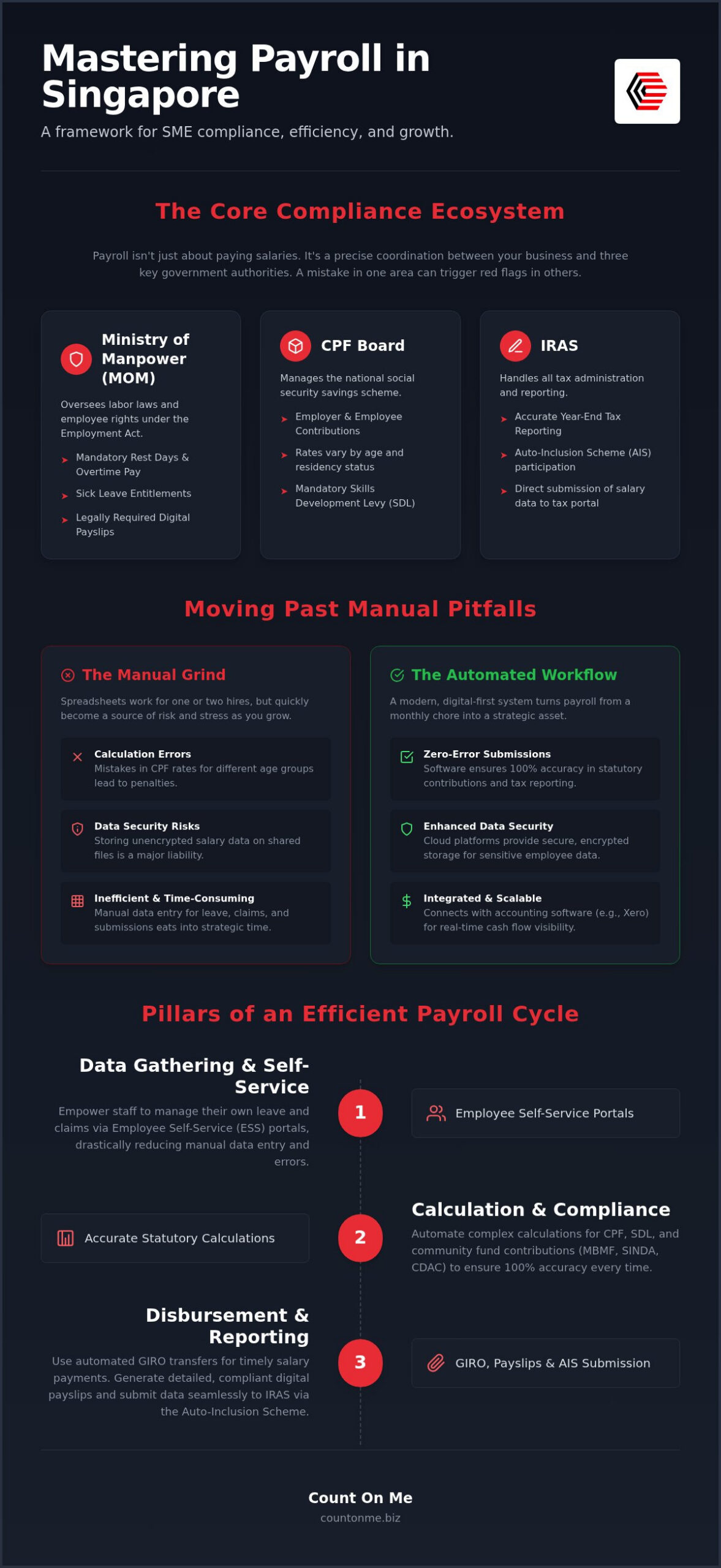
Think of payroll management Singapore as a three way conversation between your business and the government. It’s not just about transferring money to your team’s bank accounts on time. It’s a precise coordination of labor laws, social security contributions, and tax reporting. In 2026, the regulatory environment is more integrated than ever. This means that a mistake in one area often triggers a red flag in another. Moving from manual spreadsheets to a structured, digital-first system isn’t just about efficiency; it’s about the massive relief of knowing your business is fully protected.
The Three Pillars: MOM, CPF, and IRAS
To keep your business running smoothly, you need to satisfy three specific authorities. The Ministry of Manpower (MOM) oversees the Employment Act, which dictates mandatory rest days, sick leave entitlements, and overtime pay. You can’t afford to guess these figures. Next, the Central Provident Fund (CPF) Board requires precise employer and employee contributions based on age and residency status. You’ll also need to calculate the Skills Development Levy (SDL) for every staff member. Finally, the Inland Revenue Authority of Singapore (IRAS) expects accurate year-end tax reporting. Most SMEs are now required to participate in the Auto-Inclusion Scheme (AIS), where salary data is sent directly to the tax portal.
Common Pitfalls in Manual Payroll Management
Many founders start with a “home-grown” spreadsheet because it feels simple. It might work for your first few hires, but it usually breaks down once you grow beyond five employees. Manual entry is a magnet for calculation errors, especially when CPF contribution rates change for different age groups. There’s also the hidden risk of data security. Storing unencrypted salary details in a shared file or an unsecured desktop folder is a major liability. If you’re feeling the strain of these manual tasks, exploring professional payroll management solutions can turn that monthly anxiety into quiet confidence. We’ve seen how a structured system allows founders to stop being administrators and start being leaders again.
Key Pillars of Compliant and Efficient Payroll Processing
Running a successful business means finding a rhythm that works for you and your team. A professional payroll cycle usually begins with gathering data on hours worked, leave taken, and any claimable expenses. By using Employee Self-Service (ESS) portals, you empower your staff to manage their own leave and claims. This simple shift significantly reduces your monthly admin load and minimizes data entry errors. It’s a win-win that lets you focus on high-level growth rather than chasing paper trails.
Compliance is the backbone of this process. The Auto-Inclusion Scheme (AIS) is the mandatory standard for 2026 tax reporting, ensuring that all employee income data is transmitted directly to IRAS without manual intervention. Beyond basic salary, you must ensure 100% accuracy in statutory contributions like MBMF, SINDA, and CDAC. These small but vital deductions reflect your commitment to the local community and must be handled with care. If you’re looking for a partner to simplify these steps, our payroll management solutions are designed to take that weight off your shoulders.
Automating Salary Disbursements and Payslips
Reliability builds trust with your employees. Setting up automated GIRO transfers ensures that salaries land in bank accounts on the same day every month, providing financial stability for your team. Under the Employment Act, providing digital payslips is now a legal requirement. These documents must be detailed and easily accessible, outlining everything from basic pay to specific deductions. For a deeper dive into the technical side, check out our guide on Automated Payroll Setup in Singapore.
Managing CPF and Statutory Contributions
Calculating CPF isn’t a one-size-fits-all task. You’ll need to navigate different contribution rates for Singaporeans and Permanent Residents, which often vary based on their year of residency and age. There’s also the Skills Development Levy (SDL), a mandatory employer contribution used to fund the SkillsFuture movement. Every employer must pay this for all employees, including part-timers and foreign workers. To ensure you’re getting every decimal point right, see our CPF Payroll Services Singapore Guide. Effective payroll management Singapore requires this level of detail to prevent costly back-payments or penalties.
Strategic Evaluation: In-House Software vs. Outsourced Payroll Management
Deciding how to handle your monthly salary cycle is a major milestone in your business journey. It’s often a choice between maintaining control through in-house software or gaining peace of mind through professional support. To make the right call, you need to look beyond the price tag of a software subscription. Effective payroll management Singapore involves a “Total Cost of Ownership” that includes the significant time your team spends on manual data entry and compliance research. While software is a powerful tool, it lacks the nuanced judgment that comes with years of professional experience. For a deeper look at how this works, you might find our guide on Payroll Outsourcing in Singapore: 2026 SME Guide particularly helpful.
When to Keep Payroll In-House
Keeping things internal might make sense for micro-SMEs with a very small, stable team where salary structures rarely change. However, this model requires a dedicated, trained HR administrator who truly understands the landscape. The biggest risk here is “key person dependency.” If your sole payroll person is unavailable during the critical payment window, your entire operation faces a bottleneck. You have to ask yourself if your business is resilient enough to handle that single point of failure without disrupting your team’s livelihood.
The Benefits of Professional Outsourcing
Transitioning to an outsourced model offers immediate scalability. Your costs move in tandem with your headcount, ensuring you never overpay for capacity you don’t use. Most importantly, you gain a compliance guarantee. Professionals monitor every MOM and CPF update, so you don’t have to spend your weekends reading regulatory circulars. There is also the vital element of confidentiality. Using an external partner keeps sensitive salary data away from internal staff eyes, which helps maintain a healthy boundary within your office culture. This level of expert oversight turns your payroll from a chore into a strategic advantage.
Explore our Payroll Management Solutions
Future-Proofing Your Payroll: A Digital-First Approach for SMEs
Payroll is often seen as a back-office chore, but it’s actually one of the most powerful data sources in your business. When you treat payroll management Singapore as a strategic asset, you unlock insights that can transform your cash flow management. We believe that every dollar spent on your team should be trackable and purposeful. As your tech-forward mentor, we help you move beyond just “getting people paid” to using that data for smarter business scaling. It’s about building a digital foundation that supports your vision rather than holding it back.
Effective payroll management Singapore is about more than compliance; it’s about clarity. Modernizing your system starts with seeing the bigger picture. For a detailed breakdown of the technical requirements, our Payroll Processing for SME Singapore Reference Guide offers a deep dive into the 2026 standards.
Integrating Payroll with Cloud Accounting
The days of manually keying in salary figures into your ledger are over. Integrating your payroll with cloud accounting platforms like Xero allows for automated journal entries that sync instantly. This doesn’t just save you hours of tedious data entry; it gives you real-time visibility into your true staff costs. You’ll see exactly how salaries, CPF, and levies impact your bottom line as they happen. If you’re ready to see how this fits into your wider financial strategy, explore our Complete Guide to Cloud Accounting Services in Singapore.
Leveraging On-Demand CFO Insights
When your payroll and accounting are in sync, you can start asking higher-level questions. A fractional or on-demand CFO uses this integrated data to analyze departmental costs and productivity metrics. This strategic oversight helps you identify trends before they become problems. Here is how that data drives growth:
- Budgeting Accuracy: Forecast future hiring costs based on historical CPF and levy trends.
- Departmental Analysis: Identify which areas of your business have the highest labor-to-revenue ratios.
- Scaling Readiness: Know exactly when your cash flow can support a headcount expansion.
Instead of guessing if you can afford a new hire, you’ll have the hard data to back up your growth plans. We’re invested in your success, and we’re here to provide the pioneer tools you need to stay ahead.
Discover our integrated payroll and accounting solutions
Empowering Your Business Through Strategic Payroll
Building a resilient business starts with a foundation you can trust. We’ve explored how navigating the complex web of MOM, CPF, and IRAS regulations is no longer a solo mountain to climb. By embracing a digital-first framework and integrating your systems with cloud accounting, you turn a monthly administrative task into a powerful engine for growth. Effective payroll management Singapore is about more than just compliance; it’s about reclaiming your time to focus on the big picture. Moving away from manual spreadsheets provides a sense of relief that every entrepreneur deserves.
As Xero-certified digital innovators with over 20 years of Singapore industry experience, we understand the specific hurdles local startups and SMEs face. We’re here to be your tech-forward mentors, offering the stability and tailored support you need to scale with confidence. You don’t have to manage these complexities alone. Our team is invested in your success, ensuring your back-office operations are as modern and adaptable as your business vision.
Let us take the weight of payroll off your shoulders; explore our scalable solutions today.
We’re ready to help you build a future where your finance functions work for you, not against you. Let’s start this partnership today.
Frequently Asked Questions
Is it mandatory to use the Auto-Inclusion Scheme (AIS) for payroll in Singapore?
Participation in the Auto-Inclusion Scheme (AIS) is mandatory for employers with five or more employees or those who have received an official notice from IRAS. By 2026, this has become the standard for almost all SMEs. It ensures that your employees’ income data is sent directly to the tax authority, making their year-end filing much simpler and significantly reducing the chance of reporting discrepancies.
What are the penalties for late CPF contributions in 2026?
Late CPF payments attract a mandatory interest charge of 1.5% per month for every month the payment is overdue. The minimum interest penalty is $20. Beyond these financial costs, persistent late payment can lead to heavy composition fines or even prosecution in court. We recommend using GIRO payments to automate this process so you never have to worry about missing a deadline.
Can I manage Singapore payroll using just an Excel spreadsheet?
You can technically use Excel for a very small team, but it’s a risky method for payroll management Singapore as you grow. Spreadsheets don’t automatically update when CPF rates change or when MOM introduces new leave requirements. This manual approach often leads to calculation errors and data security risks that could be easily avoided with a more modern, structured digital solution.
How much do payroll management services typically cost for a Singapore SME?
Professional payroll fees are generally structured as a scalable model based on your total employee headcount. This flexible approach ensures that you only pay for the specific support you need each month. It’s a cost-effective way for startups and growing businesses to access expert oversight without the overhead of hiring a full-time, in-house payroll specialist to manage the monthly cycle.
What is the Skills Development Levy (SDL) and is it compulsory for all employees?
The Skills Development Levy (SDL) is a mandatory monthly contribution that employers must pay for all employees, including part-time and foreign workers. These funds are collected by the CPF Board on behalf of the SkillsFuture Singapore Agency to support workforce training initiatives. You’ll need to calculate this carefully for every staff member as part of your monthly statutory contribution process.
How does cloud-based payroll software improve security for my business?
Cloud systems offer superior protection through end-to-end encryption and multi-factor authentication, which local spreadsheets simply can’t match. These platforms provide a clear audit trail of every change made and allow you to restrict sensitive salary data to only authorized users. It’s a much safer way to handle confidential information while ensuring you meet local data protection standards and employee privacy expectations.